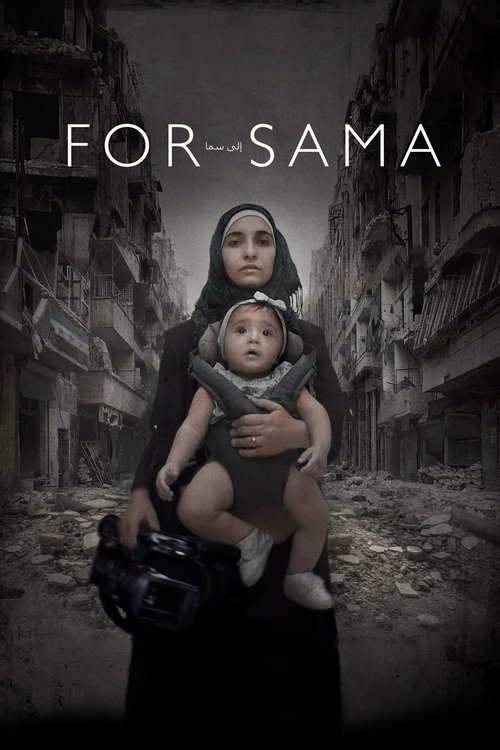
For Sama
2019 · Edward Watts
For when you're ready to be wrecked by something real and important — this is demanding, essential viewing, not a casual pick. Watch it when you want a film that turns headlines back into human beings.
What it's about
A young Syrian woman films five years of her life in East Aleppo — falling in love, marrying a doctor, giving birth to her daughter Sama — while the city around her descends from hopeful uprising into siege and bombardment. Framed as a letter to that infant daughter, the film asks the question its maker actually lived: whether to flee with your child or stay in the city you fought for. It is assembled almost entirely from footage Waad al-Kateab shot herself.
The experience
Overwhelming and intimate at once — moments of ordinary joy, jokes, and newborn wonder cut against scenes from a hospital under bombing that are among the hardest documentary footage you will ever watch. It doesn't let you look away, and it doesn't want to.
The craft
The first-person camera is the whole method: because al-Kateab filmed her own courtship, marriage, and motherhood alongside the war, the film has an intimacy no embedded journalist could achieve, and co-director Edward Watts helps shape the years of footage into a taut, non-chronological letter to a child. The home-movie warmth makes the horror register as loss rather than spectacle.
Why it matters
One of the most awarded documentaries of its era and the defining first-person account of the siege of Aleppo, it stands as a landmark of citizen journalism becoming cinema.
Snapshot
For Sama is a first-person war documentary assembled from five years of footage that Waad al-Kateab shot inside opposition-held East Aleppo between the first stirrings of the 2011 Syrian uprising and the city's fall in December 2016. Framed as an epistolary address to al-Kateab's infant daughter — the "Sama" of the title, an Arabic name meaning "sky" — the film braids the intimate register of a home movie (courtship, marriage, childbirth) with the catastrophe of a besieged city under Russian and Syrian bombardment. It is important to correct the grounding metadata at the outset: the film is co-directed by al-Kateab, who filmed nearly all of it, and the British documentarian Edward Watts, who joined in the editing and structuring stage. That authorship split — a Syrian citizen-journalist supplying the lived, handheld footage and a professional director shaping it into feature form — is the central fact of the film's production and its aesthetic. Emerging from the Channel 4 News reporting apparatus, the film became one of the most decorated documentaries of its era and a landmark of the "citizen cinema" that the Syrian war produced.
Industry & production
For Sama is a product of broadcast journalism as much as of independent documentary. Al-Kateab's footage first reached Western audiences through Channel 4 News in the UK, where her "Inside Aleppo" dispatches — filed under a pseudonym adopted to protect relatives still in regime territory — became among the most-viewed news reports the broadcaster had produced, and won her international news awards. The feature was produced by Channel 4 News / ITN Productions in the UK in partnership with the American public-television strand PBS Frontline, with Channel 4's Siobhan Sinnerton and Nevine Mabro among the executive producers. This institutional lineage matters: unlike a self-financed indie, For Sama had a newsroom's infrastructure behind its archiving, verification, and post-production, and it carried the evidentiary weight of accredited journalism into the art-documentary festival circuit.
The film premiered at SXSW in March 2019, where it took the top documentary honors, and then screened at the Cannes Film Festival, where it won the L'Œil d'or (Golden Eye), the festival's cross-section documentary prize. Theatrical distribution followed in the UK (with a notable Channel 4 broadcast) and internationally; it was widely reported as one of the most award-laden documentaries of its year, and won the BAFTA for Best Documentary and an Academy Award nomination for Best Documentary Feature in 2020 (the Oscar went to American Factory). Beyond the industry, the filmmakers built an advocacy campaign, "Action For Sama," using the film as an organizing tool around attacks on hospitals — an instance of a documentary functioning simultaneously as artwork, journalism, and activism.
Technology
The film is inseparable from the technological moment that made it possible. Al-Kateab was not a trained cinematographer but a marketing/economics student turned activist who documented the uprising with lightweight consumer and prosumer digital cameras and, at times, a phone — the same democratized image-capture that defined the Arab Spring's video culture. The footage's grain, its abrupt exposure shifts, its handheld instability, and its willingness to keep rolling through moments a crew would never have been permitted to film are all functions of a single embedded civilian with a small camera and a hard drive rather than a broadcast unit with access constraints. Reports place the accumulated material at several hundred hours gathered across five years; the technological story of For Sama is therefore as much about digital storage, portability, and the survivability of footage smuggled out of a siege as it is about the camera itself. In post, the newsroom pipeline supplied the counterweight: professional editing systems, grading, and a composed score converted raw survival footage into a structured feature. The film thus sits at the hinge between two technological orders — the ubiquitous cheap camera that captures history from the inside, and the industrial post-production that renders it legible to a cinema audience.
Technique
Cinematography
The camerawork is the film's signature and its ethical problem in equal measure. Because al-Kateab shot from within her own life, the cinematography has no external vantage: the lens is at the height of a person crouching in a hospital corridor, riding in a car through shelled streets, or turned around to capture her own reaction. The instability, whip-pans toward explosions, and moments where the frame drops to the ground as the operator takes cover are not stylistic affectations but indices of danger and presence. Against this, al-Kateab repeatedly composes small islands of stillness — her daughter's face, a persimmon tree in a bombed courtyard, a fish tank she and her husband improbably maintain — that function as visual respite and as assertions of ordinary life persisting. The result is a body of imagery whose authority comes precisely from its refusal of the polished, tripod-mounted objectivity of conventional war reportage.
Editing
Editing is where For Sama becomes a film rather than an archive, and the credited editors Chloe Lambourne and Simon McMahon — working with Watts and al-Kateab — perform the decisive authorship. The film abandons chronology for an associative, memory-like structure that loops backward and forward across the five years, anchored by the address to Sama. It opens in the terror of the siege, then folds back to the hopeful early days of the revolution and al-Kateab's romance with the doctor Hamza al-Kateab, so that the viewer holds the coming catastrophe in mind throughout the tender passages. This braided construction converts documentary footage into dramatic irony. The editors also modulate the film's proximity to violence with care, alternating between unflinching hospital scenes and domestic interludes so that horror never becomes numbing spectacle.
Mise-en-scène / staging
Because nothing is staged, "mise-en-scène" here means the found arrangement of a world under siege and the filmmakers' selection within it: the improvised hospital run by Hamza that becomes the film's principal space; the apartment where a family life is maintained under bombardment; the courtyard garden. The recurring settings acquire almost architectural meaning through repetition — the hospital as the site where the war's cost is tallied in bodies, the home as the fragile counter-space. One of the film's most discussed sequences, the resuscitation of a baby delivered by emergency caesarean from a wounded mother, derives its power from the unstaged real: an outcome no screenwriter would dare, captured because the camera happened to be present.
Sound
The sound design carries much of the film's terror. The soundscape of Aleppo — the whine and concussion of incoming ordnance, the distinctive drone of aircraft that residents learned to read as a death sentence, the acoustics of a hospital in crisis — is foregrounded so that the audience acquires the same anxious listening the residents lived by. Against this, Nainita Desai's score is used sparingly and lyrically, threading emotional continuity beneath the epistolary voice-over without over-scoring the atrocity. Al-Kateab's own narration, spoken to Sama, is the film's connective tissue, its calm, direct address holding the fragmented images inside a single intimate consciousness.
Performance
There is no acting in For Sama; its "performances" are the selves that real people present to a trusted camera held by someone inside their world. What the film captures — and this is a function of al-Kateab's embeddedness — is behavior that would be unavailable to any outside crew: unguarded grief, gallows humor among the hospital staff, Hamza's exhausted tenderness, the candor of neighbors and children. Al-Kateab herself is the closest thing to a protagonist, present as a voice and occasionally as an on-camera figure, and the film's emotional force depends on the viewer's sense that its maker is also its subject, filming her own impossible choices in real time.
Narrative & dramatic mode
The film's mode is the epistolary first-person documentary: a diary-testament addressed to a specific listener who cannot yet understand it. This framing solves the structural problem of shapeless real time by giving the material a destination — the mother explaining to the daughter why she chose to stay, and why she filmed. The dominant dramatic engine is a single ethical dilemma articulated in the synopsis: whether to flee Aleppo to protect Sama or to remain in the struggle for which so much has already been sacrificed. That question converts documentary contingency into something with the momentum of tragedy. The register oscillates deliberately between the domestic (love, marriage, birth) and the apocalyptic (siege, mass casualty, exodus), and the friction between those registers — a baby's laughter over the sound of shelling — is the film's essential dramatic device.
Genre & cycle
For Sama belongs to the war documentary, and more specifically to the cycle of Syrian civil-war films made by insiders that emerged in the 2010s. It stands alongside Talal Derki's Return to Homs (2013), Feras Fayyad's Last Men in Aleppo (2017) and The Cave (2019), and the shorts around the White Helmets — a body of work distinguished from earlier conflict documentary by being shot from within the besieged population rather than by embedded or visiting foreign crews. Within that cycle, For Sama occupies the intimate, maternal, first-person pole, in contrast to the more collective or observational approach of Fayyad's hospital films. It also participates in the longer tradition of the personal-essay and diary documentary, where the filmmaker's own life is the primary text.
Authorship & method
The authorship of For Sama is genuinely dual and worth stating precisely. Waad al-Kateab is the film's originating author, cinematographer, narrator, and subject; the footage, the vantage, and the moral stakes are hers, accumulated through years of activist journalism at enormous personal risk. Edward Watts, an experienced British documentary director, is the co-author of the film as a film — brought in to help transform the archive into feature structure, a role realized jointly with editors Chloe Lambourne and Simon McMahon. Composer Nainita Desai supplied the score. Al-Kateab's husband, Dr. Hamza al-Kateab, is both a central subject and, effectively, a collaborator whose hospital work generated much of the film's setting and access. The method is thus a two-stage authorship characteristic of the citizen-footage documentary: capture by an embedded participant, shaping by professional filmmakers — a division that raises, and the film largely earns its way through, questions about who authors a life filmed from the inside.
Movement / national cinema
The film is a keystone of an emergent Syrian documentary cinema forged in exile and under siege, one of the most significant national-cinema developments of the 2010s. This is a cinema without a domestic industry, made by dispersed filmmakers and often completed with European or American co-production and broadcast support; its defining works are the Syrian conflict documentaries noted above, several of which reached the Oscar shortlist within a few years of one another. For Sama is simultaneously a British production (Channel 4 / ITN) and an unmistakably Syrian film in voice, subject, and authorship — an instance of how national cinema now travels through diasporic and broadcast channels rather than a national studio system.
Era / period
For Sama is a document of the Syrian civil war and the arc from the 2011 Arab Spring uprising to the fall of East Aleppo in December 2016, and it is equally a document of the 2010s media condition that made such filmmaking possible: ubiquitous personal cameras, social-video circulation, and the collapse of the boundary between activist, journalist, and filmmaker. Its 2019 release places it at the tail of a decade in which the world had absorbed vast quantities of citizen-shot war imagery; the film's achievement was to gather that fragmentary form into a single sustained, authored account.
Themes
Motherhood and witness are the film's twin subjects, and it insists that they are the same act: to bear a child in a dying city and to film it are both refusals of erasure. The film interrogates the ethics of choosing revolution over safety, and the guilt and justification bound up in exposing one's child to mortal danger for a cause. It is about the persistence of ordinary life — love, gardens, humor, birth — as a form of resistance against annihilation. It meditates on the responsibility of the image: why film atrocity, for whom, and at what cost to the filmer. And underlying everything is the theme of legacy and address — the making of a record so that a daughter, and a world, cannot say the siege of Aleppo went unseen.
Reception, canon & influence
Critically, For Sama was among the most acclaimed documentaries of its year, praised for the almost unbearable intimacy of its access and for the sophistication with which raw footage was structured into tragedy; reviewers frequently singled out the emergency-caesarean sequence as one of the most extraordinary passages in recent nonfiction cinema. Its awards run was exceptional — SXSW's top documentary prizes, the Cannes L'Œil d'or, the BAFTA for Best Documentary, and an Academy Award nomination — and it was frequently described in coverage as one of the most-awarded documentaries on record, though precise tallies vary by source and should be treated with caution.
Looking backward, the film draws on the diary/essay-documentary tradition of the filmmaker-as-subject and on the immediate precedent of the insider Syrian war films — Derki's Return to Homs and Fayyad's Last Men in Aleppo most directly — as well as the broader Arab Spring culture of activist video. Looking forward, its influence operates on two levels. Aesthetically and industrially, it validated the feature-length citizen-footage documentary as a form capable of festival and awards success, encouraging broadcasters and funders to convert embedded activist archives into cinema. As advocacy, the "Action For Sama" campaign made the film a template for documentary-as-organizing around the targeting of hospitals in wartime, and al-Kateab became a prominent public voice on Syria. Its exact reach on subsequent filmmakers is still consolidating, and the honest scholarly position is that its full canonical placement — within documentary history and within the still-forming corpus of Syrian exile cinema — remains to be settled, even as its status as a defining record of the Aleppo siege is already secure.
Reception
Acclaimed instantly — SXSW Grand Jury and Audience awards, then the Prix L'Œil d'or at Cannes — and unlike most awards-season documentaries it never faded: it's still routinely brought up as one of the most devastating docs of its decade.
How For Sama was received, from release to now →
Influences: the films it descends from and the films it influenced
- 5 Broken Cameras (2011) — Establishes For Sama's exact two-stage authorship — years of consumer-camera footage shot by an embedded participant, addressed to his infant son, then given feature shape by a professional co-director — the capture-by-witness / structure-by-craftsman division al-Kateab and Watts inherit wholesale.
- Return to Homs (2013) — Immediate Syrian precedent for filming the siege from inside the encircled community rather than from a press vantage, staying with subjects as shelling reshapes the frame — the embedded insider access For Sama extends into the hospital.
- Last Men in Aleppo (2017) — Model for observational verité shot during active bombardment with first-responder access, letting sound of incoming ordnance and long unbroken presence carry dread without commentary — the diegetic-warfare soundscape For Sama reproduces.
- The Square (2013) — Proves activist Arab Spring footage shot by embedded participants can be braided into festival-grade feature structure, legitimizing the citizen-journalism archive as cinema — the industrial pathway For Sama traveled to the Oscars.
- Tarnation (2003) — Pioneers the feature built entirely from an accumulated personal video archive, editing years of intimate home footage into associative, emotionally-sequenced autobiography rather than chronology — the archival-braiding method Lambourne and McMahon apply to al-Kateab's tapes.
- Silverlake Life: The View from Here (1993) — Foundational first-person camcorder diary that keeps filming a loved one through catastrophe at unbearably close range, a filmmaker who is also subject — the ethics-of-the-image dilemma (when to keep rolling) For Sama inherits.
- Dear Zachary: A Letter to a Son About His Father (2008) — Structures the entire documentary as an epistolary address to a child who will one day watch it, weaponizing that second-person 'to you' voice — the direct formal template for al-Kateab's narration to Sama.
- Sherman's March (1986) — Canonizes the first-person diary-essay in which the filmmaker's own handheld camera and confessional voiceover become the organizing consciousness, folding private life into a larger historical journey — the diaristic authorship For Sama adopts.
- Restrepo (2010) — Benchmark for narration-free embedded frontline cinematography where the handheld camera shares the physical danger of its subjects in real time, refusing analytical distance — the embedded-first-person camerawork For Sama practices under fire.
- No Other Land (2024) — Extends the multi-year, participant-shot first-person video diary from inside a besieged community, structured as a direct address to a loved one — the closest contemporary sibling in self-authored conflict documentary.
- 20 Days in Mariupol (2023) — Extends For Sama's template directly: a journalist-participant narrates his own embedded siege footage — including maternity-ward and hospital death — in first person, foregrounding the ethics of whether and why to keep filming.
- Flee (2021) — Carries the intimate first-person exile testimony forward into a new register, structuring an entire film around one refugee's confessional narration of displacement — the Syrian-exile-cinema, witness-in-the-first-person mode For Sama helped make bankable.
- The Cave (2019) — Released the same year from the same Aleppo-siege conflict cycle, it centers an embedded underground hospital and its staff under bombardment, the twin of For Sama's medical-witness setting captured by co-present cameras.
- The White Helmets (2016) — Builds from Syrian rescue-workers' own phone and helmet-cam footage of pulling victims from rubble, the same consumer-device citizen-capture pipeline and hospital/rescue vantage For Sama assembles into feature form.
- Winter on Fire: Ukraine's Fight for Freedom (2015) — Compiles dozens of activists' handheld and phone streams of the Maidan uprising into a single embedded ground-level chronicle, the crowd-sourced citizen-footage-into-cinema method that runs parallel to For Sama's single-author archive.
- Midnight Traveler (2019) — A refugee family films its own flight entirely on three smartphones, the parents narrating to and for their children — the same first-person exile diary shot on consumer devices and addressed across generations.
- Beyond Utopia (2023) — Fuses participant-captured survival footage with a first-person testimonial-essay address, the same composite of self-shot in-extremis material and reflective narration.
- Black Box Diaries (2024) — Al-Kateab shoots years of intimate first-person prosumer video-diary footage inside a danger zone, then assembles the accumulation into chronicle — Ito's record-across-time-then-edit diary method.
Similar films
- Flee (2021) — influence & lineage
- Farha (2021) — shared sensibility
- The Voice of Hind Rajab (2025) — shared sensibility
- All That's Left of You (2025) — shared sensibility
- No Other Land (2024) — shared sensibility
- Capernaum (2018) — shared sensibility
- Leila and the Wolves (1986) — shared sensibility
- Love Letters (2025) — shared sensibility