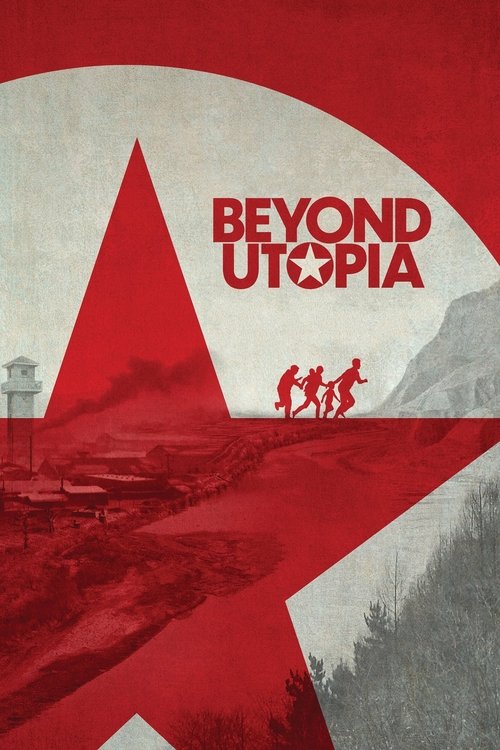
Beyond Utopia
2023 · Madeleine Gavin
For when you want a documentary that grips like a thriller and actually matters — this is a challenge, not comfort, but it earns every minute. Reach for it when you're ready to have your sense of the world enlarged and your nerves tested.
What it's about
A Seoul pastor runs an underground network that smuggles North Korean defectors out through China and Southeast Asia, coordinating brokers, safe houses, and bribes across multiple borders. The film follows a family of five — including two small children and an elderly grandmother — as they attempt the escape route, with much of their flight captured on camera by the very people guiding them, so you watch it unfold as it happens rather than in reenactment.
The experience
Almost unbearably tense — this is real footage of real people whose lives are on the line, and the film never lets you forget it. Between the white-knuckle stretches there is warmth, dark humor, and grief, and it leaves you shaken in a way fiction rarely manages.
The craft
The astonishing thing is the footage itself: cameras carried by brokers and defectors capture river crossings, jungle treks, and safe-house waits in progress, and Madeleine Gavin cuts this raw material into a propulsive, coherent escape narrative. Context arrives through defector testimony and archival material that never slows the momentum. Watch it somewhere you won't be interrupted — the tension depends on staying inside it.
Why it matters
It became one of the most acclaimed documentaries of its year and reframed the North Korea story from distant geopolitics to the ground-level experience of the people trying to get out.
Snapshot
Beyond Utopia is a feature documentary that follows the work of an underground network moving North Korean defectors along a clandestine route out of the country — through China and across Southeast Asia — toward asylum in South Korea. Its organizing figure is Pastor Kim Sung-eun of Seoul's Caleb Mission, a Christian minister who coordinates brokers, safe houses, and bribes across multiple borders. What distinguishes the film from the broad genre of North Korea exposés is that a substantial portion of it consists of footage captured during an escape in progress: a family of five — including two young children and an elderly grandmother, referred to as the Roh family — is filmed by the brokers guiding them, so the audience experiences the flight in something close to real time rather than in retrospective reconstruction. Running in parallel is the story of Soyeon Lee, a defector already resettled in the South who is attempting to extract her teenage son, left behind years earlier. The result is a work that fuses the immediacy of vérité with the moral architecture of a rescue narrative, and it arrived in 2023 as one of the more discussed nonfiction films of its year, winning the U.S. Documentary Audience Award at Sundance.
Industry & production
The film sits in the well-established international ecosystem of independent, issue-driven documentary: financed and produced outside the studio system, premiered on the festival circuit, and released theatrically by a specialty distributor before a streaming afterlife. It premiered at the Sundance Film Festival in January 2023, where it took the Audience Award in the U.S. Documentary Competition — a category signal that the film played strongly with general audiences, not only with juries. Theatrical distribution in the United States was handled by Roadside Attractions, a specialty label with a long history of positioning documentaries and prestige indies for awards consideration. The film subsequently entered the awards conversation and was included on the Academy's documentary feature shortlist, though it did not advance to the final slate of nominees; I flag that as a point where the specific competitive record matters and should be stated precisely rather than inflated.
The production's most consequential logistical fact is also an ethical and legal one: much of the material was gathered covertly, along a route where discovery could mean imprisonment, repatriation, or death for the participants. That reality shaped everything from how footage was obtained to how faces and identities were handled in the finished film. Among the producers and on-camera experts is Sue Mi Terry, a former intelligence analyst specializing in Korea, whose presence lends the film both institutional credibility and geopolitical framing. Beyond that, precise line-item production details — budget, exact financing partners, the full producing roster — are not something I can enumerate reliably here, and I won't invent them.
Technology
The film is a document of what consumer and concealable recording technology has made possible in closed societies. The escape footage appears to have been captured on small, portable devices — phones and compact cameras carried by brokers and guides — the kind of equipment that can be hidden, smuggled, and operated without a crew. This is the same technological substrate that has transformed documentation of authoritarian states over the past fifteen years: the camera small enough to be deniable. The film then intercuts this covert material with conventionally shot interviews and with archival and propaganda imagery from and about North Korea. The technological through-line is the collision of two image regimes — the state's own polished, ideological self-presentation versus the furtive, low-resolution, handheld record of people fleeing it — and the film's grammar depends on the viewer registering the difference in texture between them.
Technique
Cinematography
There are effectively two cinematographic modes in the film, and the tension between them is deliberate. The first is the covert, participant-captured footage of the escape route: unstable, improvised, often shot in darkness or cramped interiors, framed by necessity rather than composition. Its power is indexical — the sense that the camera is genuinely present at risk. The second is the controlled interview and observational photography of the resettlement and coordination scenes, lit and composed conventionally. The film's cinematographer credit and the division of labor between original photography and acquired footage are details I would want to verify before asserting; the honest description is that the finished image stream is a composite of professionally shot and clandestinely gathered material, and the direction's achievement is making that composite legible as a single narrative rather than a patchwork.
Editing
Editing is the film's central craft, and it is worth noting that Madeleine Gavin came to directing from a career as a film editor — a background that is visible in the construction here. The core editorial problem is one of suspense built from real events whose outcomes the filmmakers could not control: the cross-cutting between the Roh family's border-by-border progress and Soyeon Lee's attempt to reach her son generates a dual-track tension in which the audience is made to fear for both without knowing how either resolves. The editing also has to manage exposition — the geography of the route, the mechanics of brokerage and bribery, the political stakes — without stalling the forward momentum of the escape. That the film keeps a general audience oriented across multiple countries, languages, and time frames while sustaining dread is an editorial accomplishment as much as a directorial one.
Mise-en-scène / staging
Because so much of the film is captured under conditions no filmmaker could stage, "mise-en-scène" here refers less to arranged composition than to the found staging of real spaces: the back rooms, vehicles, riverbanks, and jungle crossings of the route. The film derives meaning from these spaces precisely as sites of concealment and exposure — the safe house as a held breath, the border as a threshold. In the interview and expert segments, staging is conventional and functional, subordinated to testimony. The contrast between the two — the improvised geography of flight and the composed geography of witness — is itself a structuring device.
Sound
Sound design carries a heavy load in a film where much of the imagery is degraded or obscured. Ambient sound in the escape sequences — hushed voices, engines, the noise of border crossings — does a great deal to establish presence and threat. The film also relies on a musical score to shape emotional register across the cross-cutting; the specific composer credit is something I would verify rather than assert. Voiceover and translated testimony (subtitled Korean predominating) form the film's connective tissue, and the calibration between spoken testimony, ambient tension, and score is where the film's emotional control largely lives.
Performance
As a documentary, the film has no performances in the fictional sense; its "performers" are its real participants, and the ethical weight of the film rests on them. Pastor Kim functions as the film's protagonist by virtue of his coordinating role and his on-camera candor about the moral and practical calculus of the work. Soyeon Lee's presence — a mother's grief and determination rendered without melodrama — supplies the film's most direct emotional line. The Roh family, filmed in extremity, are less interview subjects than people caught in an unfolding event; the film's restraint in how it presents them, given the stakes, is part of its integrity.
Narrative & dramatic mode
The film operates in the mode of the rescue thriller grafted onto observational documentary — a nonfiction suspense structure. Its dramatic engine is the classic one of escape narrative: a journey across hostile territory with escalating obstacles and uncertain outcome, in which each border crossing raises the stakes. What makes it more than a procedural is the moral framing supplied by Pastor Kim and the experts, and the counter-narrative of Soyeon Lee, whose thread introduces the possibility of failure and loss against the (differently weighted) Roh family thread. The film thus braids a forward-driving suspense plot with a testimonial, essayistic register that supplies context about the North Korean state, the ideology of the "utopia" the title invokes, and the machinery of defection.
Genre & cycle
Beyond Utopia belongs to the substantial cycle of documentaries about North Korea and about escape from authoritarian states more broadly. Within nonfiction film there is by now a recognizable sub-genre of North Korea documentaries — works built variously on defector testimony, smuggled footage, and analysis of the regime's propaganda apparatus. The film's particular innovation within that cycle is the real-time escape footage, which pushes it toward the "vérité thriller" end of the spectrum rather than the interview-and-archive essay end. It also participates in the broader humanitarian-documentary tradition of films organized around a rescuer or activist figure whose network the film follows.
Authorship & method
The controlling authorship is Madeleine Gavin's, and the method reflects her dual identity as director and editor. Her prior feature documentary, City of Joy (2016), concerned a center for survivors of sexual violence in the Democratic Republic of Congo — establishing a body of work concerned with trauma, survival, and the institutions and individuals who respond to atrocity. Her editorial background is directly relevant to Beyond Utopia's construction, since the film's identity is forged in the cutting room: the marrying of acquired covert footage to original photography, the cross-cut suspense, the balancing of exposition and momentum.
On collaborators, I want to be careful to distinguish what I can state with confidence from what I cannot. Sue Mi Terry's involvement as a producer and on-camera Korea expert is a meaningful authorial input, shaping the film's geopolitical framing. The specific credited cinematographer, composer, and additional writing or producing collaborators are details I would verify against the film's credits before naming them, and I decline to assign names speculatively. The methodological signature that is safe to state is the film's reliance on a real network — Pastor Kim's mission — as both subject and, in effect, a source of its most extraordinary footage.
Movement / national cinema
The film is difficult to slot into a single national cinema. It is an American-led production in its financing, direction, and distribution, but its subject, language, and much of its footage are Korean, and its geography is transnational — spanning North Korea, China, and Southeast Asia. It is best understood as a work of international human-rights documentary, a mode that is deliberately deterritorialized: made for a global festival and streaming audience, concerned with a border-crossing subject, and produced across jurisdictions. If it belongs to a "movement," it is the contemporary current of activist nonfiction cinema that treats the camera as an instrument of witness against closed regimes.
Era / period
Beyond Utopia is very much a film of the early 2020s. Its release in 2023 places it in a moment when the tools of covert documentation had matured, when streaming platforms and specialty distributors had built robust pipelines for issue documentaries, and when North Korea remained one of the world's most sealed societies — a condition arguably intensified by the pandemic-era border closures that made defection even harder in the years immediately preceding the film. The film's period character lies in this combination: an old, intractable geopolitical subject documented with the newest generation of concealable, participant-operated recording technology, and delivered through the contemporary festival-to-streaming apparatus.
Themes
The film's governing theme is announced by its title: the gulf between the "utopia" that the North Korean state advertises to its own citizens and the reality that drives people to risk death to leave. From that irony the film draws several linked concerns — the machinery of totalitarian control and the ideology that sustains it; the peculiar difficulty of escaping not just a country but a worldview instilled since birth (several participants describe having to unlearn belief in the regime); the moral economy of rescue, including the uncomfortable dependence on bribery and brokers; and the intimate cost of separation, embodied in Soyeon Lee's severed relationship with her son. Underlying all of these is a meditation on freedom as something both longed for and disorienting — the film is attentive to the psychological weight of leaving, not only its logistics. Faith is a further thread, given Pastor Kim's Christian mission, though the film keeps its focus on the humanitarian rather than the doctrinal.
Reception, canon & influence
Critically and with audiences, the film was well received: its Sundance Audience Award and its subsequent theatrical run through Roadside Attractions positioned it as one of 2023's notable documentaries, and it earned enough traction to reach the Academy's documentary shortlist, though not the final nominee slate — a distinction I state carefully. Critical response broadly praised the film's suspense and the extraordinary access of its escape footage while, in some quarters, raising the standing questions such films provoke about the ethics of filming people in extremis and about the framing of rescue narratives.
Looking backward, the film's influences are the North Korea documentary tradition that precedes it and the broader lineage of vérité escape and rescue films; it also draws, in its testimonial dimension, on the substantial body of defector memoir and reportage that has accumulated over the past two decades. Looking forward, its most likely legacy is as a benchmark for what participant-captured, real-time documentation can achieve within the North Korea sub-genre — a demonstration that the escape itself, not only its recollection, can be filmed. Any claim that it has directly shaped a specific later film would be premature this close to its release, and I won't manufacture a line of influence the record doesn't yet support; the more defensible statement is that it consolidated a set of techniques and raised the bar for immediacy in its field.
Reception
It stormed out of Sundance 2023 with the U.S. Documentary Audience Award and near-unanimous raves, then became one of that season's most-cited Oscar snubs when it made the documentary shortlist but missed the final nomination.
How Beyond Utopia was received, from release to now →
How to watch Beyond Utopia: what to notice on a first viewing
- Notice how unsteady and dark the escape footage looks against the interviews. The film alternates between covert, handheld footage shot during the actual crossing and composed, well lit interview scenes. The rougher footage is real time evidence of risk, not a stylistic choice, and the film lets you feel that difference.
- Watch the film cross-cut between two separate families' escapes. The editing cross-cuts the Roh family's journey with Soyeon Lee's search for her son, two real, unresolved storylines rather than one family straight through. Splitting attention between them builds suspense over two separate outcomes the filmmakers could not control.
- Listen for hushed voices and ambient noise during the border crossings. Engine sounds, footsteps, and whispered speech carry the tension in scenes where the image itself is often dark or obscured. When the picture cannot show you the danger clearly, the sound is doing that work instead.
- Watch the ordinary spaces the escape moves through: vehicles, riverbanks, back rooms. The film treats these found, unstaged locations as places of concealment and exposure rather than as scenery. The plainness of the spaces is what makes the danger inside them feel real rather than dramatized.
- Watch Pastor Kim's manner when he discusses his own operation's risks. He speaks with matter-of-fact candor about brokers, bribery, and danger rather than performing heroism for the camera. His plainness is what gives the film's account of the rescue network its credibility.
The whole guide to watching Beyond Utopia, with the keys for a rewatch →
Influences: the films it descends from and the films it influenced
- The Defector: Escape from North Korea (2012) — Directly models the participant-captured escape: covert handheld footage shot alongside a paid broker while defectors cross China's underground railroad, the same acquired-in-transit material Gavin later marries to her own photography.
- Seoul Train (2004) — Establishes the North Korea sub-genre's broker-network structure and its real-time interception jeopardy, cutting between safe-house handlers and defectors in flight to generate procedural suspense.
- Under the Sun (2015) — Pioneers concealable/left-running recording inside the DPRK to capture the machinery behind the staged utopia, the concealed-camera evidentiary method Gavin's covert footage inherits.
- Kimjongilia (2009) — Builds the defector testimonial-essay form, assembling first-person survivor accounts into an indictment of the regime that supplies Beyond Utopia's recollective spine.
- Camp 14: Total Control Zone (2012) — Extends the defector-memoir tradition into cinema, translating written escape testimony into structured on-camera recollection of totalitarian confinement and its unlearning.
- Which Way Home (2009) — Sets the observational escape-journey template of tracking vulnerable subjects across hostile borders in ongoing danger, letting the journey's uncertain outcome drive the film rather than retrospection.
- Man on Wire (2008) — Demonstrates heist-grammar suspense construction in nonfiction, using cross-cutting and withheld information to make a known-outcome event play as a thriller — the editorial logic Gavin applies to the crossing.
- City of Joy (2016) — Gavin's own prior feature, forging her editor-director signature of shaping trauma-and-survival material in the cutting room and balancing testimony against forward momentum.
- A State of Mind (2004) — Films the interior performance of the DPRK's engineered devotion, giving the sub-genre its close study of manufactured ideology that Beyond Utopia's 'unlearning' arc reacts against.
- Citizenfour (2014) — Films a subject in real-time extremis inside a surveillance state, sustaining tension through ambient dread and the constant threat of exposure rather than reconstruction — the covert-present-tense thriller mode Gavin shares.
- For Sama (2019) — Fuses participant-captured survival footage with a first-person testimonial-essay address, the same composite of self-shot in-extremis material and reflective narration.
- Icarus (2017) — Mutates mid-film into a live asylum thriller, cross-cutting concealed digital communications with a fleeing informant to construct suspense out of an unfolding, unscripted danger.
- Navalny (2022) — Runs on covertly recorded phone confrontation and real-time investigative jeopardy, editing withheld reveals into thriller beats within an activist-nonfiction frame.
- Virunga (2014) — Deploys hidden-camera recording as courtroom-grade evidence within an activist documentary, embedding concealed footage inside a narrative of protectors under lethal threat.
- Last Train Home (2009) — Uses patient observational cross-cutting of a mass-migration journey, staging tension in found spaces — stations, crowds, borders — that the crossing sequences echo.
- 20 Days in Mariupol (2023) — A contemporary benchmark for participant-captured frontline footage under a hostile state, bound together by a spare testimonial voiceover essay — the same immediacy-plus-narration architecture.
Similar films
- Escape from Mogadishu (2021) — shared sensibility
- Minari (2021) — shared sensibility
- The Berlin File (2013) — shared sensibility
- The Seed of the Sacred Fig (2024) — shared sensibility
- Steel Rain (2017) — shared sensibility
- Parasite (2019) — shared sensibility
- Souleymane's Story (2024) — shared sensibility
- 12 Years a Slave (2013) — shared sensibility
All the films related to Beyond Utopia →
Watch it with: curated runs of related films
- Ordinary People, Impossible Odds — A run of true-life ordeals where staying alive comes down to sheer endurance and the people who refuse to leave anyone behind — watch them together when you want to be reminded what human beings actually do at the edge.