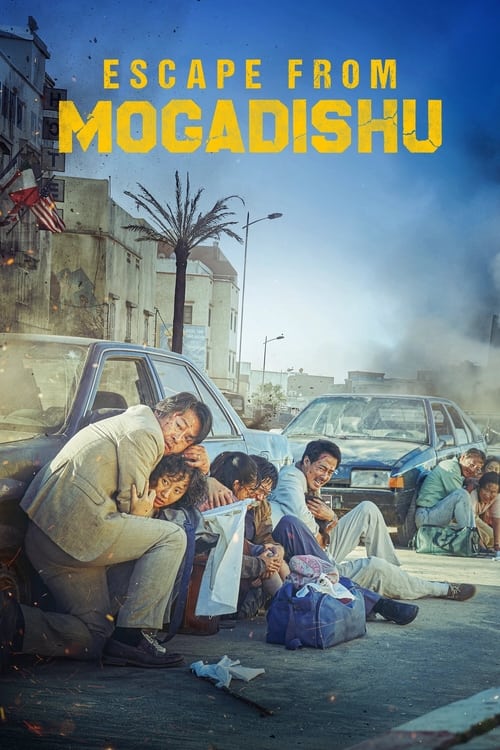
Escape from Mogadishu
2021 · Ryoo Seung-wan
For when you want a smart, propulsive thriller with actual stakes — the kind of true-story escape movie that keeps you pinned to the couch and gives you something to feel at the end. Intense but crowd-pleasing, not grim.
What it's about
Mogadishu, 1991: as Somalia's civil war erupts overnight, the South Korean embassy staff find themselves trapped in a city with no law, no phones, and no way out. Then their sworn rivals from the North Korean embassy arrive at the gate, starving and hunted, and the two delegations — men and women trained to despise each other — must attempt a joint escape through militia checkpoints and collapsing diplomatic channels. It's a true story, which makes every impossible decision land harder.
The experience
A slow-burn siege that tightens into flat-out, white-knuckle action, with an undertow of real feeling every time the two Korean teams have to trust each other another inch. You come out wrung out and a little moved.
The craft
Ryoo Seung-wan stages urban chaos with unusual clarity — you always know where everyone is and what stands between them and the airport — and the climactic escape run through the city is a marvel of sustained, practical-feeling action filmmaking. It's built for a big screen and loud speakers; the gunfire and crowd scenes have real weight.
Why it matters
A major box-office hit in South Korea that swept its domestic awards, it confirmed Ryoo Seung-wan as the country's premier action director and brought a nearly forgotten episode of inter-Korean cooperation to a global audience.
Snapshot
A diplomatic thriller grounded in a little-known historical episode, Escape from Mogadishu dramatizes the January 1991 cooperation between North and South Korean embassy staffs stranded in the Somali capital as clan-based civil war closed around them. The North Koreans, their embassy breached and supplies cut off, seek refuge with their ideological adversaries; the South Koreans reluctantly take them in; together the two delegations negotiate an exit through collapsing Italian diplomatic channels and a gauntlet of armed militia checkpoints. Ryoo Seung-wan, already established as South Korea's foremost practitioner of kinetic genre cinema, fuses the political-escape thriller with the urban war film and the buddy-action road movie, producing a work that is simultaneously spectacular popular entertainment and a meditation on the absurdity of the Korean division when stripped of all ideological scaffolding. Released in South Korea on 28 July 2021 during a cautious reopening of cinemas, it became one of the most commercially significant domestic releases of the pandemic era and was selected as South Korea's submission for the Academy Award for International Feature Film at the 94th ceremony.
Industry & production
The project was developed by Ryoo Seung-wan and producer Seong Bong-sik at Lotte Entertainment, the studio that has backed several of Ryoo's mid-to-large-scale productions. The real events of January 1991 had long existed as a footnote in diplomatic histories of the Korean peninsula, occasionally surfacing in memoirs and news retrospectives, but had never been dramatized. Ryoo reportedly spent several years in research and script development, working with a screenwriting team to reconstruct the political context — including South Korea's simultaneous lobbying campaign at the United Nations for membership, which the North was countering — and to flesh out the composite characters who represent the embassy staffs.
Because contemporary Mogadishu was inaccessible as a production location, the majority of exterior shooting took place in Morocco — primarily Rabat and surrounding areas — whose medina streets, low-rise concrete architecture, and arid light provided a credible stand-in for the Somali capital of thirty years prior. The production design team undertook extensive archival research to recreate the look of 1991 Mogadishu: signage, vehicle fleets, militia weaponry, and the specific visual texture of a city transitioning from authoritarian order to armed chaos. The production also constructed or modified interiors in Korean studio facilities. The scale of the Moroccan location work — involving hundreds of extras, period-correct vehicles, and live pyrotechnics — represented a substantial logistical undertaking by Korean industry standards.
The film's pandemic-era release context deserves note. It opened under Korean social-distancing protocols that limited cinema capacity, yet still demonstrated that domestic audiences would return for event-scale productions; its performance helped stabilize the Korean exhibition sector at a critical moment.
Technology
Escape from Mogadishu was shot digitally, consistent with mainstream Korean production practice by the early 2020s. The production made extensive use of practical vehicles for the central convoy chase sequence rather than relying primarily on digital replacement, a decision that gives the sequence its particular physical credibility. Pyrotechnic practical effects — explosions, burning vehicles, muzzle flare — were used throughout the location work in Morocco. Post-production visual effects were employed to augment crowd scale, extend destruction, and integrate aerial photography that establishes the geography of the siege, but the film's aesthetic strategy consciously privileges practical chaos over synthetic spectacle. The sound work involved layered post-production design to build the sonic environment of a city under fire: overlapping small-arms fire, crowd noise, vehicle engines, and the intermittent intrusion of heavier ordinance.
Technique
Cinematography
The film was shot by Choi Young-hwan, who has served as Ryoo Seung-wan's primary cinematographer across several features including Veteran (2015) and The Battleship Island (2017). Choi's approach to the Mogadishu material favours a grammar of controlled urgency: handheld work dominates the combat and chase sequences, introducing instability and proximity to bodies and surfaces, while the early diplomatic scenes are shot with a more composed, wide-frame grammar that establishes institutional order before its dissolution. The Moroccan locations are lit to maximize the contrast between interior shadow — the besieged embassy as a pocket of artificial calm — and the flat, harshly bright exterior world of the city in collapse. In the climactic convoy sequence, Choi's camera moves freely between vehicles, shooting through windscreens, from running boards, and in tight over-shoulder framings that maintain spatial coherence while communicating the convoy's vulnerability from all sides.
Editing
The editing constructs a consistent rhythm of tension and release across the film's two-hour-plus running time. The early political-manoeuvring sequences are cut with a deliberate pace that registers bureaucratic and diplomatic time; as the civil war closes in, the cutting accelerates without sacrificing legibility. The climactic chase is edited so that geography remains comprehensible — a relatively rare achievement in contemporary action cinema — allowing the audience to track the convoy's progress, the location of threats, and the cost of each obstacle. Cross-cutting between individual vehicles and their passengers personalizes the sequence while maintaining momentum.
Mise-en-scène / staging
Ryoo's staging throughout is characterized by an emphasis on bodies in space under physical constraint. The embassy interiors, increasingly crowded as both delegations consolidate, are staged to make visible the awkwardness of proximity between people trained to treat each other as adversaries: shared meals across tables that have become demarcation lines, sleeping arrangements in which ideology has no practical purchase. The street sequences are choreographed to make militia violence feel omnidirectional and ungovernable — the opposite of the contained, rule-governed spaces in which the characters' professional identities were formed. The convoy sequence represents Ryoo's most ambitious spatial achievement: a sustained kinetic passage that must simultaneously feel lethal and navigable, chaotic and directed.
Sound
The sound design treats Mogadishu's ambient sonic landscape as a character in itself. The gradual intrusion of distant gunfire into early scenes — first as rumor, then as weather, then as immediate fact — charts the city's deterioration. The convoy sequence deploys an overwhelming sonic density: engine noise, screaming metal, crowd sounds, and weapons fire are layered to produce a sense of environmental saturation that reinforces the characters' inability to process or respond to all stimuli simultaneously. The score, composed by Kim Tae-seong, uses orchestral tension-building idioms calibrated to Korean genre convention, supporting rather than dominating the sound design's practical work.
Performance
The cast is anchored by Kim Yoon-seok as the South Korean ambassador Kang Dae-jin and Heo Joon-ho as his North Korean counterpart Rim Yong-su — two actors with substantial stage and screen reputations whose primary dramatic task is to make the negotiation of trust across ideological enmity feel earned rather than schematic. Zo In-sung as the South Korean diplomat Han Shin-sung and Koo Kyo-hwan as North Korean officer Tae Joon-gi provide the more physically active dimension of the partnership, their characters younger and more volatile. The ensemble is asked to perform both professional rigidity — the habitual performance of ideological loyalty — and its gradual erosion under survival pressure, a shift that Ryoo manages without tipping into sentimentality. The Somali characters in the film are rendered with considerably less interiority, a limitation that several critics noted; this is addressed further under Reception.
Narrative & dramatic mode
The film's narrative architecture follows a classical three-act structure with a clear inciting crisis (the outbreak of civil war), a central act organized around the problem of North-South trust under siege conditions, and a climactic action sequence that externalizes the resolution of that problem. The dramatic mode is that of the political thriller inflected by the survival film: external threat compresses normal ideological time, forcing characters to act on impulses — mutual protection, pragmatic cooperation — that their official identities forbid. The screenplay uses the UN membership campaign as a consistent ironic counterpoint: the two delegations are engaged in a proxy diplomatic war at the global level even as, on the ground, their survival depends on setting that war aside. The film does not resolve the larger political reality — the ending returns characters to the world of division — but it locates in the shared experience of survival a residue of human recognition that the structure of the peninsula cannot fully erase.
Genre & cycle
Escape from Mogadishu operates at the intersection of several genre currents. Within Korean cinema's blockbuster tradition — the high-concept, technically ambitious domestic productions that emerged from the late 1990s wave and have since constituted a consistent industrial category — it belongs to the sub-genre of films that use the Korean division as dramatic material, including Park Chan-wook's Joint Security Area (2000), Kang Je-gyu's Brotherhood (Taegukgi, 2004), and Jang Hoon's The Front Line (2011). It is also legible within a transnational cycle of diplomatic-escape and siege thrillers anchored by Hollywood examples including Ben Affleck's Argo (2012) and Ridley Scott's Black Hawk Down (2001). Its placement of Korean protagonists in an African crisis zone is relatively unusual in Korean cinema, extending the international scope that Ryoo had begun to develop with The Berlin File (2013), set in the German capital, and anticipating a broader Korean industry interest in globally situated genre narratives.
Authorship & method
Ryoo Seung-wan began his career as an actor — he appeared in several of Hong Sang-soo's early films — before establishing himself as a director with Die Bad (2000), a low-budget action film shot in a semi-documentary style that announced his investment in physical performance and unglamourised violence. His subsequent career traces a consistent auteurist signature across budget scales: an emphasis on the body as the primary site of dramatic meaning; a preference for practical choreography over digital augmentation; a structural interest in institutions and their limits; and a tonal range that moves freely between genre pleasure and moral seriousness. Arahan (2004), The City of Violence (2006), and Veteran (2015) established the kinetic mode; The Battleship Island (2017), a more contested work dealing with Korean forced labor under Japanese occupation, demonstrated his willingness to engage directly with historical material at larger scale.
Escape from Mogadishu represents a synthesis of these tendencies: the historical subject matter of The Battleship Island handled with the genre discipline and tonal confidence of Veteran. Ryoo's collaboration with cinematographer Choi Young-hwan has been central to the visual grammar of his mature phase, and the two appear to have developed a shared language for action space that balances visceral immediacy with spatial coherence. The record of Ryoo's precise working methods on this production — rehearsal processes, stunt coordination, the division of responsibilities with his production designer — is not extensively documented in English-language sources; a fuller account of his directorial practice awaits more comprehensive critical attention.
Movement / national cinema
The film belongs to the industrial and aesthetic formation that Korean cinema scholars and critics have described variously as the New Korean Cinema, the Korean Wave (hallyu), or the post-1998 blockbuster generation — the system that emerged following the industry's near-collapse in the early 1990s and its subsequent rebuilding around domestic genre production, the screen quota system, and new investment structures. By 2021 this formation had matured into a globally recognized cinema, with Bong Joon-ho's Parasite (2019) having won the Palme d'Or and the Academy Award for Best Picture in 2019–20. Escape from Mogadishu sits within this mature phase: technically comparable to international genre production, capable of engaging global genre conventions while maintaining specifically Korean dramatic preoccupations. Its engagement with the Korean division as material is continuous with a lineage of Korean films that have used the North-South relationship as a lens for examining national identity, historical trauma, and the human cost of ideological structures.
Era / period
The film is historically set in January 1991, locating it in a specific conjuncture: the final years of the Cold War as experienced in proxy theaters. Somalia under Siad Barre had been a Cold War client state whose internal contradictions were amplified by superpower competition; as that competition dissolved, so too did the patronage systems that had held clan conflicts in partial check. The Korean peninsula's own Cold War geography — and the specific episode of South Korea's UN membership bid — places the film at a moment of reconfiguration: the Cold War is ending, but Korean division is not. The film's period production design reconstructs this conjuncture with care, and the juxtaposition of late-Cold War geopolitical logic with the ground-level human emergency of the Somali collapse gives the film much of its ironic charge.
Themes
The film's central thematic concern is the relationship between political identity and human solidarity under extreme pressure. The Korean division is treated not as a natural fact but as a constructed condition — one that structures behavior, organizes loyalty, and determines who can be trusted — but one that proves inadequate to the conditions it confronts in Mogadishu. The film asks what remains when the institutional frameworks that sustain political identity are removed: its answer is a provisional, fragile, but genuine capacity for mutual recognition that the division structure ordinarily suppresses. Secondary themes include: the arbitrariness of diplomatic protocol when stripped of the power that backs it; the particular position of Korean national identity in Third World spaces historically defined by Cold War competition; and the moral cost of the survival imperative — several decisions in the film require characters to act in ways that serve the group at the expense of the individual or the stranger. The film also engages, less successfully by most critical accounts, with questions of African agency and Somali political complexity; its Somali characters tend to function as either sympathetic helpers or threatening others rather than as fully dimensioned presences in their own political landscape.
Reception, canon & influence
Critical reception. The film was received warmly by Korean critics and audiences, with particular praise directed at the convoy sequence, the lead performances, and Ryoo's management of the tonal shift from political comedy-of-manners to survival thriller. International critical reception was positive, with English-language reviewers frequently noting the film's genre competence and the quality of its action filmmaking. The most consistent criticism, raised by both Korean and international commentators, concerned the film's treatment of Somali characters and the broader dynamics of its African setting: a predominantly Korean story told through a crisis in Somalia risks reproducing a version of the "dark continent" backdrop familiar from Western action cinema, and the film does not fully escape this problem. Whether this constitutes a significant formal or ethical failure or an understandable limitation of the film's focalization is a point on which critics disagreed.
Influences on the film. The clearest formal antecedent is Black Hawk Down (Ridley Scott, 2001), which established a grammar for the contemporary urban war film — the extended set-piece choreographed across multiple positions and perspectives, the emphasis on organisational breakdown and survival improvisation — that Escape from Mogadishu draws on and reconfigures. Argo (Ben Affleck, 2012) provides a structural template for the diplomatic-escape thriller and the use of bureaucratic and protocol detail as suspense mechanism. Within Korean cinema, the division-film tradition — particularly Joint Security Area and Brotherhood — provides the emotional grammar for North-South cooperation under pressure. Ryoo's own prior work, especially the large-scale crowd and action management of The Battleship Island, is a direct precondition for this film's technical ambitions.
Legacy. As of 2021–22, the film's forward influence is difficult to assess definitively: it is too recent for its downstream effects to have fully materialized. It can be noted that it contributed to the growing international visibility of Korean genre cinema in the post-Parasite moment and demonstrated that Korean productions set outside the peninsula — outside East Asia entirely — could sustain Korean domestic and international interest. It may also be understood as part of a broader Korean industry reckoning with historical episodes that had previously received little dramatic treatment. Whether it will prove generative for subsequent productions in the way that Joint Security Area or Memories of Murder proved generative for the 2000s generation remains an open question. Its status as a technically accomplished, politically serious popular film in a tradition that has historically struggled to hold those qualities in balance is, at minimum, secure.
A Deleuzian reading
Start with the table.
The full Deleuzian reading of Escape from Mogadishu →
Reception
A pandemic-era release that still became South Korea's highest-grossing film of 2021, then swept the Blue Dragon Awards including Best Film — it went from box-office comeback story to instant fixture in the modern Korean action canon.
How Escape from Mogadishu was received, from release to now →
Influences: the films it descends from and the films it influenced
- Black Hawk Down (2001) — Established the multi-position urban combat grammar — simultaneous cutting between units losing coordination across a fragmented city — that Ryoo directly imports for the convoy ambush, including the use of spatial disorientation as both tactical and emotional device.
- The Battle of Algiers (1966) — Originated the handheld siege-city mode in which the camera is embedded in ambient crowd deterioration — mass movement, collapsing urban sound design — rather than standing apart from it; Ryoo recalibrates this grammar for the Mogadishu street sequences.
- Joint Security Area (2000) — Establishes the Korean division film's emotional grammar: staging North and South Korean characters in enforced physical proximity to dramatize ideological division through personal affect rather than political argument, the direct template for EfM's diplomatic-compound sequences.
- Taegukgi: The Brotherhood of War (2004) — Codifies the Korean war-action film's physical grammar — large-scale practical combat staging in which bodies are the primary dramatic unit — and the emotional structure of ideological adversaries who discover fraternal obligation under shared physical danger.
- United 93 (2006) — Develops the real-time procedural crisis form — institutions attempting coordination as events outpace protocol — using the fragmented handheld frame to render institutional rigidity as kinetic collapse rather than as exposition.
- The Hurt Locker (2008) — Bigelow's tension-release editing rhythm — the extended anticipatory build followed by sudden explosive release, with ambient sound deterioration marking the psychological state of the body under threat — is directly echoed in EfM's alternation between diplomatic deadlock and convoy combat.
- Argo (2012) — Provides the structural template for the diplomatic-escape thriller in which bureaucratic protocol detail — paperwork, clearance procedures, checkpoint negotiations — functions as the primary suspense mechanism rather than as procedural background.
- The Berlin File (2013) — Ryoo's own prototype for the North-South operative uneasy alliance: the staging technique of placing ideologically opposed Korean agents in the same operational space and tracking the erosion of institutional rigidity through escalating shared physical danger — the method EfM inherits and scales.
- Sicario (2015) — Introduces the convoy-as-crucible form — the motorcade advancing through a hostile city as the primary tension unit — with omnidirectional threat staging in which every civilian figure in the frame is a potential combatant, a configuration EfM applies to the Mogadishu extraction.
- Steel Rain (2017) — Transposes Steel Rain's forced North-South alliance structure to an international crisis — the 1991 Somali coup — with diplomatic staffs from both embassies compelled to cooperate for survival; the cross-ideological trust arc becomes the film's entire dramatic engine, demonstrating the portability of the inter-Korean cooperation formula to any geography where the two states share a geopolitical predicament.
- Hunt (2022) — Directly extends EfM's ideological-proximity-under-fire staging to a domestic intelligence context — opposing KCIA factions forced into operational cooperation — inheriting the technique of placing institutional adversaries in physically intimate danger to dramatize the absurdity of Cold War division.
- Ransomed (2023) — Extends EfM's genre innovation of the Korean official operating extrajudicially in a collapsed-state setting, while inheriting Ryoo's structural ironic counterpoint between bureaucratic protocol and survival improvisation as the primary narrative motor.
- Zero Dark Thirty (2012) — Shares EfM's procedural architecture of prolonged institutional deliberation paid off by concentrated physical action, merging the grammar of the intelligence-bureaucracy film with a kinetic climax in which institutional planning dissolves into body-level improvisation.
- 13 Hours: The Secret Soldiers of Benghazi (2016) — The closest Western formal parallel for EfM's specific problem — a diplomatic compound besieged in a collapsed-state African city — including the staging of small-team convoy extraction through sonic saturation and the use of ambient urban deterioration to mark the absence of governing authority.
- A Taxi Driver (2017) — Shares EfM's tonal architecture — ironic social comedy that pivots into mortal political stakes — and its strategy of channeling historical meaning through an ordinary protagonist whose institutional position (driver, diplomat) is stripped away by the event.
- The Spy Gone North (2018) — Korean Cold War espionage procedural using institutional procedure and ideological ambiguity as the primary dramatic engine, with the same ironic-counterpoint structure in which cooperation between adversarial state agents generates moral complexity rather than resolution.
Similar films
- The Berlin File (2013) — influence & lineage
- Black Hawk Down (2001) — influence & lineage
- Joint Security Area (2000) — influence & lineage
- Tae Guk Gi: The Brotherhood of War (2004) — influence & lineage
- A Taxi Driver (2017) — influence & lineage
- Beyond Utopia (2023) — shared sensibility
- 12.12: The Day (2023) — shared sensibility
- Steel Rain (2017) — shared sensibility