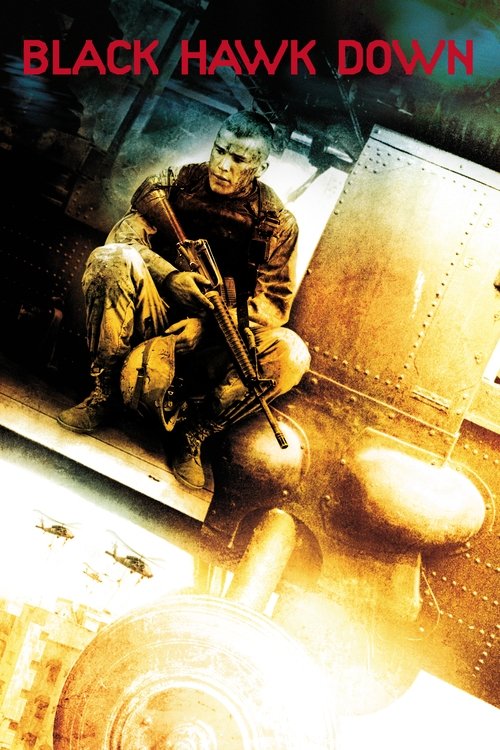
Black Hawk Down
2001 · Ridley Scott
As famous now for press-tour belligerence ("go f— yourself" to historical accuracy critics of Napoleon) as for the films; Gladiator II's "are you not entertained" marketing and shark-in-the-Colosseum discourse kept him meme-central in his late 80s. The industry's most quotable octogenarian.
For when you want total immersion and maximum intensity — a white-knuckle night, not a relaxing one. Reach for it when you're ready to be pinned to the couch for two-plus hours; skip it if you need something gentle.
What it's about
Mogadishu, 1993. A force of U.S. Army Rangers and Delta Force operators launches what should be a quick daytime raid to snatch two lieutenants of a Somali warlord. When militia fighters shoot down two Black Hawk helicopters, the mission collapses into an eighteen-hour running battle through hostile streets, as soldiers fight to reach the crash sites and get everyone out alive. Based on the true story of the Battle of Mogadishu.
The experience
Relentless. After a brief setup the film locks you into near-continuous combat — disorienting, loud, and physically draining, with the chaos of the fight rendered so immediately you lose track of time the way the soldiers do. It's gripping rather than fun, and it leaves you wrung out.
Performances
A deep ensemble of actors just before or at the edge of stardom — Josh Hartnett, Ewan McGregor, Eric Bana, Tom Hardy in an early role — playing soldiers as a collective rather than star vehicles, which suits the film's unit-over-individual ethos.
The craft
Ridley Scott stages urban combat with a clarity and sensory force few war films have matched — dust, tracer fire, rotor wash, the geography of a city turning hostile block by block. The editing won an Oscar, the sound design is punishing in the best way, and this is emphatically a big-screen, good-speakers film: much of its meaning is in its texture.
Why it matters
It set the visual and sonic grammar for two decades of modern-combat films and games — the desaturated palette, the helmet-cam immediacy — and its release just after 9/11 made it a lightning rod for arguments about how America tells its war stories.
Snapshot
A kinetic, nearly real-time reconstruction of the Battle of Mogadishu (October 3–4, 1993), in which a combined U.S. Army Ranger and Delta Force raid spiraled into an eighteen-hour street engagement that left eighteen American soldiers dead and many more wounded. Adapted from journalist Mark Bowden's book of the same name, the film strips war down to its sensory and physiological texture — sweat, blood, cordite, chaos — at the near-total expense of political context. It arrived in limited release on December 28, 2001, roughly three months after the September 11 attacks, a coincidence that saturated its reception with meanings its makers had not entirely anticipated.
Industry & production
Ridley Scott and producer Jerry Bruckheimer optioned Mark Bowden's book before it was published; Bowden had originally serialized his account in the Philadelphia Inquirer in 1997, drawing on hundreds of interviews with veterans and Somali participants, before expanding it into a book released in 1999. The combination of Scott's visual ambition and Bruckheimer's blockbuster machinery gave the project an unusual dual character — prestige war film and high-octane action release at once.
The production received significant cooperation from the U.S. Army and the Department of Defense, which supplied UH-60 Black Hawk and MH-6 Little Bird helicopters, active-duty personnel as technical advisors, and access to Special Operations veterans who worked directly with cast members. This cooperation, standard for many American military-themed productions, shaped not only the film's tactical authenticity but also its political sympathies, tilting the frame toward the American soldiers and largely leaving Somali perspectives underdeveloped. Several veterans of the actual battle served as on-set consultants; some later expressed mixed feelings about the portrayal of specific individuals and incidents.
Principal photography took place in Morocco, primarily in Rabat and Salé, which doubled convincingly for the streets of Mogadishu's Bakara Market district. The Moroccan army provided additional support. Shooting in the actual Mogadishu was not feasible given the ongoing instability of Somalia in the late 1990s. The production built elaborate sets replicating the architecture and street geography of the battle zone, and the scale of the physical production — controlled demolitions, burning vehicles, hundreds of Moroccan extras — was among the largest practical location shoots of its era.
Screenwriter Ken Nolan distilled Bowden's densely documented account into a workable screenplay, making decisions about which soldiers to foreground while compressing or omitting others. The sheer number of real participants — dozens of soldiers, each with a distinct role — created structural challenges that the film never fully resolved, producing what many critics noted as thin characterization in exchange for collective immersion.
Technology
Black Hawk Down was among the earlier major studio releases to employ a full Digital Intermediate (DI) process, in which the photochemical negative is digitized, color-graded in a digital environment, and printed back to film for exhibition. The DI workflow gave colorist and cinematographer precise control over the final image's tonal range and hue, enabling the film's characteristic look — a desaturated, almost bleached palette with greenish and amber undertones — to be applied globally and consistently across footage shot with multiple cameras under variable conditions. This was not merely aesthetic: the DI also helped unify the visual character of footage shot in different lighting conditions, at different times of day, and on different stocks.
The production also made extensive use of multiple cameras shooting simultaneously — reportedly as many as seven units operating at once during major action sequences — a logistical and editorial challenge that generated enormous quantities of material and demanded an unusual kind of post-production discipline.
Technique
Cinematography
Polish cinematographer Sławomir Idziak, best known for his richly saturated, painterly work on Krzysztof Kieślowski's Three Colors: Blue (1993) and Agnieszka Holland's Europa Europa (1990), here moved in a diametrically different direction. Black Hawk Down's visual grammar is agitated, undersaturated, and deliberately harsh. Idziak employed a combination of handheld and Steadicam work, very long telephoto lenses that compress space and flatten perspective, and a persistent haze of smoke, dust, and burning debris that diffuses light and softens spatial legibility. The result is a sustained visual correlate for confusion — viewers frequently cannot orient themselves to the geography of the battle, which is part of the point.
The color treatment — achieved through a combination of lens filtration and the DI grade — drains the image of the warm, golden hues associated with more heroic war films, pushing instead toward an ash-green and ochre palette that recalls newsreel footage without directly imitating it. Shafts of bright light cutting through smoke, a signature Ridley Scott visual motif inherited from his advertising background and refined across Alien, Blade Runner, and Gladiator, appear here too, but stripped of beauty; they illuminate threat rather than grandeur.
Editing
Pietro Scalia's editing won the Academy Award for Film Editing, a recognition of the extraordinary difficulty of imposing coherence on an enormous volume of multi-camera material depicting simultaneous, spatially overlapping action. The film's editing style operates on a tension between maximal kinetic energy and minimal legibility — cuts are fast and disorienting during the heaviest firefights, but Scalia and Scott work to maintain just enough spatial and narrative thread to keep the viewer from becoming entirely lost. The editorial rhythm also governs the film's pacing across its roughly two-and-a-half-hour runtime, calibrating the sustained action sequences to avoid numbing fatigue without letting the film breathe enough to invite reflection.
Mise-en-scène / staging
Scott's staging in the action sequences emphasizes scale, simultaneity, and fragmentation. Rather than orchestrating setpieces around a single focal point, he distributes the action across multiple planes and vectors — a technique that embodies the tactical reality of the battle (dispersed forces, multiple simultaneous crises) while foreclosing the kind of heroic clarity that older war films provided. The combat choreography was extensively researched and rehearsed with veteran advisors; the film's tactical staging has been cited by military training institutions for its accuracy, even where the dramatic frame distorts the larger context.
Sound
The sound design, which won the Academy Award for Sound Editing (Per Hallberg and Karen Baker Landers), is arguably the film's most distinctive formal achievement. The aural environment is built from layered, precisely differentiated sounds — the specific acoustic signatures of different weapons, the unmistakable rotor wash of helicopters at various distances, radio chatter, voices cutting in and out of comprehension. The effect is immersive in the most physiologically visceral sense: viewers in theatrical exhibition reported feeling physically enclosed by the battle. Sound here is not illustration but environment.
Hans Zimmer's score, which incorporates Afro-minimalist textures and drone-based orchestral writing, works beneath the sound design rather than over it, supplying emotional undertow without the triumphalism that a more conventional composer or more conventional film might have demanded. The Breton singer Denez Prigent's haunting performance of "Gortoz a Ran" ("I'm Waiting"), used in the film's quieter moments, provides a modal lament that cuts against any easy heroic reading.
Performance
The cast — Josh Hartnett, Ewan McGregor, Tom Sizemore, Eric Bana, William Fichtner, Sam Shepard, Jason Isaacs, and many others — operated largely in service of ensemble texture rather than individual arc. Eric Bana, in his American breakthrough role as Delta operator John Grimes (a composite character), brought a coiled physical intelligence that attracted considerable attention. The demands on performers were primarily physical and behavioral; Scott and his casting directors assembled a group capable of credible military bearing, and the actual character psychology was largely a secondary concern in the film's economy. The thinness of individual characterization was frequently noted in reviews, though defenders argued that this was a deliberate structural choice consonant with the film's collective, immersive design.
Narrative & dramatic mode
Black Hawk Down abandons the protagonist-centered arc that structures most Hollywood war films in favor of something closer to a sustained present-tense immersion. The film spends minimal time on exposition or backstory — roughly fifteen to twenty minutes before the raid begins — and the narrative thereafter tracks multiple threads simultaneously without clearly privileging any single perspective. This quasi-documentary mode, in which the viewer is placed inside an event rather than guided through a story, had precedents in the war film tradition but was rare at this budget level and scale.
The film's deliberate eschewal of political context — there is almost no effort to explain the Somali civil war, the U.N. intervention, or the Clinton administration's strategic decisions — was both its most praised and most criticized feature. Supporters argued that this myopia was aesthetically honest: the soldiers themselves were operating without full context, and the film respects that epistemological limit. Critics, including many Somali commentators and scholars of the conflict, argued that the evacuation of context produced a film that naturalized American military action while rendering its Somali antagonists and civilian casualties as undifferentiated background.
Genre & cycle
The film sits at the intersection of the American war film, the action thriller, and a nascent subgenre that might be called the "tier-one operator" film — works centered on elite Special Operations forces engaged in asymmetric, close-quarters combat in the Global South. This subgenre would crystallize further through Lone Survivor (2013), Zero Dark Thirty (2012), 13 Hours (2016), and Act of Valor (2012), each of which owes something to the aesthetic template Black Hawk Down established. The film also participates in a post-Vietnam rehabilitation of the American soldier that distinguished individual valor from strategic folly — a move that allowed the film to honor combatants without endorsing the political decisions that placed them in harm's way.
Authorship & method
For Ridley Scott, Black Hawk Down represented both a continuation and a departure. His background in advertising and television commercials had always given his work an unusually acute attention to visual surface, light, and texture, and those skills were here deployed in the service of gritty realism rather than fantasy spectacle — a tonal reversal from Gladiator (2000), released just eighteen months earlier. Scott has spoken in interviews about his interest in experiential authenticity over dramatic convention, and Black Hawk Down is perhaps the purest expression of that preference in his filmography.
Sławomir Idziak and Pietro Scalia were critical creative partners. Zimmer's score, developed in close consultation with Scott, established a sonic idiom that Zimmer would revisit in several subsequent projects. The screenplay's credited architect, Ken Nolan, worked from Bowden's extensively sourced book, and the film's factual grounding — whatever its interpretive distortions — was a consistent point of emphasis in the production's promotional framing.
Movement / national cinema
Black Hawk Down is unambiguously a product of the American studio system, but its creative team was markedly international: a British-born director, a Polish cinematographer, a German composer, and a cast that included Welsh, Scottish, British, and Australian performers alongside Americans. This internationalization of the American war film — financing and cultural content remain American, execution and craft are global — was characteristic of the post-1990s Hollywood blockbuster.
Era / period
The film was in production before September 11, 2001, but its release into the immediate aftermath of the attacks transformed its cultural reception. What had been conceived as a story about a forgotten 1990s conflict arrived as a document of American military vulnerability and soldier sacrifice at a moment when those themes had acute political charge. The film's refusal to explicitly endorse the mission's strategic rationale — combined with its full-throated endorsement of the soldiers themselves — allowed it to be read simultaneously as pro-military and as a cautionary tale about the human cost of intervention. This ambiguity made it useful to multiple political audiences.
Themes
The film's dominant theme is the primacy of unit cohesion and mutual obligation — the "leave no man behind" ethic as the irreducible moral core that survives when strategic rationale collapses. This is the film's most explicit ideological claim, voiced directly in dialogue and enacted in the plot's central decisions. Brotherhood under fire, the gap between institutional command and ground-level reality, the physical and psychological cost borne by individual bodies — these are the film's genuine concerns. The larger questions of what the mission was for, who paid the heaviest price, and what the engagement meant in the arc of American foreign policy are largely not its concerns, and this selective attention constitutes both its formal coherence and its ethical limitation.
Reception, canon & influence
Influences on the film: The most immediate precursor was Steven Spielberg's Saving Private Ryan (1998), which had established a new standard for visceral, de-glamorized combat cinematography; Scott and Idziak clearly engaged with Spielberg's formal innovations while pushing further toward chaos and disorientation. The film also draws on the handheld energy of William Friedkin's The French Connection (1971), the claustrophobic intensity of Wolfgang Petersen's Das Boot (1981), and the dehumanizing sensory overload of Francis Ford Coppola's Apocalypse Now (1979). More immediately, the quasi-documentary ensemble war film — multiple simultaneous protagonists, real events, minimal fictional architecture — had precedents in Lewis Milestone's A Walk in the Sun (1945) and the large-scale Allied productions of the early 1960s.
Critical reception: The film received two Academy Awards — for Film Editing (Pietro Scalia) and Sound Editing — and nominations for Best Director and Best Cinematography. Critical response was broadly positive on formal grounds, with near-unanimous recognition of its technical achievement, and considerably more divided on its politics, with a significant strand of criticism centered on its marginalization of Somali experience. The Somali community in the United States and scholars of the conflict were among the sharpest critics of its representational choices.
Legacy: The film's forward influence is difficult to overstate within its subgenre. It effectively established the aesthetic grammar for the American military action film of the 2000s and 2010s: the de-saturated palette, the multi-camera handheld chaos, the procedural ensemble structure, the foregrounding of tactical realism, the deliberate effacement of strategic context. Kathryn Bigelow's The Hurt Locker (2008) and Zero Dark Thirty (2012) engage critically with many of these conventions even as they inherit them. The film also had a documented influence on the military first-person shooter video game genre, with its aesthetic of immersive, ground-level combat experience entering the visual vocabulary of games that would define the 2000s.
A Deleuzian reading
Remember the moment the first Black Hawk goes down.
The full Deleuzian reading of Black Hawk Down →
Reception
Rushed into theaters just months after 9/11, it landed as a technical triumph (two Oscars) wrapped in a political firestorm — accused of jingoism and of erasing the Somali perspective. Today it's canonized as the template for the modern combat film, though the politics debate never went away.
How Black Hawk Down was received, from release to now →
Influences: the films it descends from and the films it influenced
- The Battle of Algiers (1966) — Marcello Gatti's handheld 16mm-inflected photography — deliberately grainy, newsreel-textured — established the quasi-documentary visual grammar for insurgent/counter-insurgent combat that Idziak's smoke-diffused telephoto work consciously extends.
- A Bridge Too Far (1977) — Multi-strand parallel cutting across simultaneous elements of a collapsing large-scale operation (Market Garden) established the structural template for BHD's simultaneous-front editorial architecture — the logic of a raid that exceeds its commanders' grasp, told through intercutting engagements.
- Apocalypse Now (1979) — Walter Murch's multi-layer diegetic soundscape — helicopter rotors, ambient environmental texture, radio chatter stacked against a subordinated score — established the template for immersive war-film audio that BHD's sound team directly applies to the Mogadishu streets.
- Platoon (1986) — Robert Richardson's handheld-within-the-platoon combat photography — shooting from inside the action at soldier's-eye level rather than from command perspective above — is the direct formal ancestor of Idziak's embedded handheld approach and the ensemble-over-arc narrative structure.
- Full Metal Jacket (1987) — The Hue City sniper sequence introduced telephoto lens compression in urban combat — distant threats rendered as flat, ambiguous shapes through long glass — a precise formal device that Idziak deploys throughout to convey the spatial illegibility of the Mogadishu firefight.
- Saving Private Ryan (1998) — Janusz Kaminski's desaturated bleached-frame combat palette (silver retention, anti-reflective coating removed from lenses) and Gary Rydstrom's diegetic-dominant sound design — weapons and ambient texture over score — are the immediate predecessors that BHD's DI grade and sound team explicitly extend.
- Three Kings (1999) — Newton Thomas Sigel exploited the then-nascent Digital Intermediate pipeline to achieve a distinctive burnt/oversaturated Gulf War image — the first major studio war film to fully weaponize DI for period-combat aesthetics — directly preceding and laterally informing BHD's more widely noted DI work.
- Aliens (1986) — Scott applies Cameron's sustained-comprehensibility editing standard — consistent spatial anchors and eyeline matching during extended multi-unit combat tracking a large ensemble — to a documentary-realist aesthetic, extending the Aliens principle that audiences can follow simultaneous deaths across a large cast if spatial geography is established and maintained before contact.
- Tora! Tora! Tora! (1970) — Ensemble-without-protagonist battle procedural rendered with documentary legibility and architectural clarity of a real operation's geography, inheriting Tora's procedural-architectural staging.
- Zulu (1964) — A small Western force pinned and besieged inside a hostile city by overwhelming local numbers, told through procedural-ensemble combat and architectural, street-by-street siege cutting descended from Zulu's spatial method.
- Decalogue V (1989) — Idziak's flashed, desaturated, hand-filtered war photography is the same optical toolkit — filters held to the lens, deliberate vignetting — that gave Episode Five its sickly light, now industrialized for a studio production.
- The Hurt Locker (2008) — Barry Ackroyd deployed multiple handheld telephoto cameras around IED disposal sites — spatial compression flattening distance into legible threat-fields — directly extending BHD's telephoto-in-combat approach; the film's score-subordinated immersive sound design cites the same formal logic.
- Zero Dark Thirty (2012) — The Abbottabad raid sequence — multi-camera handheld in near-total darkness, tier-one operators clearing rooms, no score, diegetic radio and weapon sounds dominant — is a direct craft extension of BHD's operator-film aesthetic retooled for the surveillance and drone era.
- Act of Valor (2012) — Actual active-duty Navy SEALs as principal cast, GoPro and multi-camera handheld rigs capturing real tactical drills, and complete elimination of musical score during operational sequences — a radical maximization of BHD's ensemble-over-arc and DoD-cooperation principles taken to their logical extreme.
- Lone Survivor (2013) — Masanobu Takayanagi's handheld telephoto mountain firefight photography and Berg's multi-strand cutting of simultaneous engagements directly apply BHD's telephoto-compression and parallel-editing grammar to Afghanistan; Berg has publicly cited BHD as the direct formal model for this production.
- Sicario (2015) — Roger Deakins' telephoto surveillance aesthetic — the convoy scene shot through long glass from helicopter altitude, compressing the column into flat shapes against the desert — and the context-evacuation narrative structure (the audience, like Kate, is never given full operational context) transpose BHD's craft grammar into cartel-war filmmaking.
- 13 Hours (2016) — Dion Beebe's multi-camera handheld siege photography of the near-real-time Benghazi engagement, a dispersed ensemble of tier-one contractors without individual character arcs, and the context-evacuation narrative form a near-structural echo of BHD's Mogadishu template — the same operation-in-Africa-that-goes-wrong grammar redeployed.
- American Sniper (2014) — Tom Stern's multi-camera deployment around sniper hides — telephoto glass flattening rooftop distances into compressed kill-zones — extends BHD's telephoto-combat vocabulary into the single-biography war film, retaining the same DoD cooperation framework and tactical-authenticity production methodology.
- Edge of Tomorrow (2014) — Established the contemporary grammar of embedded-handheld chaos-cinema in sustained ground combat, with diegetic audio cueing — radio chatter, directional weapon-fire, proximity-based sound texture — as the primary means of spatial orientation inside fragmented battlefield sequences; EoT's combat photography and sound design operate from this template.
- 13 Hours: The Secret Soldiers of Benghazi (2016) — Pietro Scalia edited both films; the ensemble operational structure, spatial coherence in multi-vector chaos, and docudramatic framing of American soldiers in African terrain are the direct template 13 Hours inherits.
- Anthropoid (2016) — Scott and Slawomir Idziak's technique of multiple-coverage small-unit staging with desaturated stock — giving a historical special operations engagement the texture of recovered documentary footage — informs Ellis's grammar of procedural authenticity applied to the Anthropoid mission's execution phase.
- Escape from Mogadishu (2021) — Established the multi-position urban combat grammar — simultaneous cutting between units losing coordination across a fragmented city — that Ryoo directly imports for the convoy ambush, including the use of spatial disorientation as both tactical and emotional device.
- The Forgotten Battle (2021) — Selective-handheld crosscutting across simultaneous multi-strand combat actions within a compressed geographic theater; the specific technique of using camera movement as an index of tactical confusion rather than individual subjective distress, denying the audience a stable orientation point.
- Gladiator (2000) — Ridley Scott and editor Pietro Scalia developed the multi-camera kinetic action grammar — simultaneously shot angles, rapid spatial-disorientation cuts in the arena sequences — on this film, then applied the identical editorial architecture to BHD's firefights in the production immediately following.
- Enemy at the Gates (2001) — Robert Fraisse's handheld telephoto photography of Stalingrad sniper duels — long-lens compression of space, heat shimmer through dust — and the diegetic-over-score sound mix are direct contemporaries of BHD's visual grammar, sharing Full Metal Jacket's sniper-telephoto as a common ancestor.
- We Were Soldiers (2002) — Dean Semler employed the same multi-camera DoD-cooperated helicopter battle grammar with a comparable DI grade and dispersed-ensemble staging — using the BHD production playbook (DoD cooperation, Morocco-adjacent location stand-in, real veterans as consultants) released the following year.
- American Gangster (2007) — Scott and editor Pietro Scalia developed the ensemble procedural editing architecture here — intercutting multiple simultaneous operational threads without a single protagonist anchor — and imported it directly into AG's diptych; Scalia's technique of using tonal contrast rather than temporal logic to justify cuts is identical across both films.
- The Martian (2015) — Scott's most advanced deployment of multi-strand crisis intercutting before The Martian: simultaneous geographically dispersed action threads edited under continuous time pressure, a structural method Scott transfers directly to the parallel NASA/JPL and Mars-surface narrative architecture.
- Eye in the Sky (2015) — Pioneers the two-world command structure of officers reading a remote aerial/screen feed while violence unfolds elsewhere, carried by procedural radio-traffic sound design.
Similar films
- Platoon (1986) — influence & lineage
- The Hurt Locker (2008) — influence & lineage
- Lone Survivor (2013) — influence & lineage
- Zero Dark Thirty (2012) — influence & lineage
- Apocalypse Now (1979) — influence & lineage
- Saving Private Ryan (1998) — influence & lineage
- Gladiator (2000) — influence & lineage
- Enemy at the Gates (2001) — influence & lineage
All the films related to Black Hawk Down →