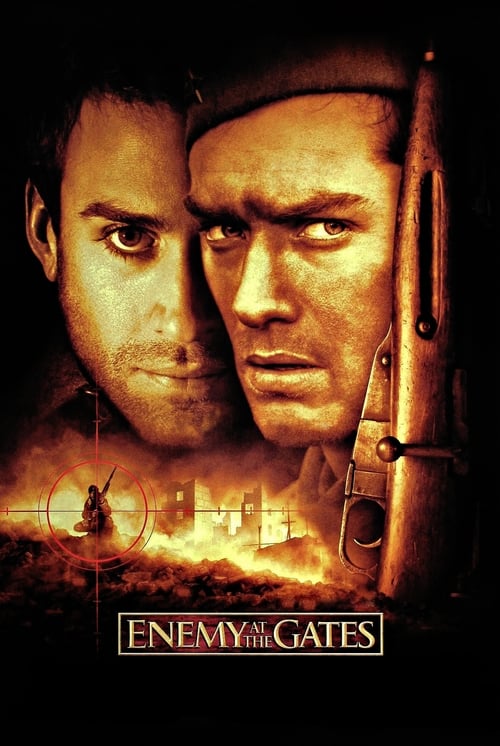
Enemy at the Gates
2001 · Jean-Jacques Annaud
For when you want a tense, sweeping wartime thriller on a Saturday night — accessible and gripping rather than punishing, despite the grim setting.
What it's about
In the frozen rubble of Stalingrad, 1942, a young shepherd from the Urals becomes the Red Army's deadliest sniper — and, thanks to a propaganda officer who makes him a national hero, a marked man. Germany dispatches its own master marksman to hunt him, and the two settle into a lethal cat-and-mouse duel through ruined factories and shell craters while the wider battle grinds on around them.
The experience
Big, brutal, old-fashioned war spectacle wrapped around an intimate two-man chess match — the sniper duels are genuinely nerve-shredding stretches of silence, stillness, and one wrong move. Grim in its battlefield scenes, pulpy in its romance and rivalry, and paced to keep you leaning forward.
Performances
Ed Harris is the standout as the German sniper — glacial, courteous, and terrifying without ever raising his voice — a study in how much menace an actor can generate from patience alone.
The craft
Annaud stages the Stalingrad crossing and the bombed-out cityscape at enormous, tactile scale — one of the most expensive European productions of its time — then narrows the film to two men, two scopes, and agonizing waiting games. The sound of a single distant shot does more work here than most films' whole battle scenes.
Why it matters
It brought the Eastern Front and the legend of Vasily Zaitsev to a mass Western audience, and its duel structure became a touchstone for how movies stage sniper warfare.
Snapshot
Enemy at the Gates dramatizes the Battle of Stalingrad through a single thread: a duel of marksmen. Jude Law plays Vasily Zaitsev, the Ural shepherd-turned-Red Army sniper whose kills are amplified into propaganda by the political officer Danilov (Joseph Fiennes); Ed Harris plays Major König, the German sniper-school head dispatched to hunt the Soviet hero. Around their cat-and-mouse, the film stages the rubble, attrition, and ideological machinery of the 1942–43 siege. It was, at the time of release, among the most expensive films ever financed largely outside the Hollywood studio system, an English-language European super-production shot in Germany. Director Jean-Jacques Annaud — coming off Seven Years in Tibet — treated the project as a return to the intimate-figure-in-vast-spectacle mode of his earlier work, but the result divided critics sharply: praised for its harrowing opening and production scale, faulted for the incongruity of its English-accented Soviets and Germans and for romanticizing a sniper legend that historians regard as substantially mythologized. The film opened the 2001 Berlin International Film Festival.
Industry & production
The picture was a transnational co-production, mounted by Annaud's Paris-based company with significant German financing and distributed in the United States through Paramount Pictures, in partnership with Mandalay Pictures (the company headed by Peter Guber). Its reported budget — in the region of $68–70 million — made it one of the costliest European-led productions of its era, a status frequently cited in coverage of the film because it underscored an ambition to compete with Hollywood war spectacle on Hollywood's own terms while keeping creative control in European hands. I flag the budget figure as the widely reported approximate; precise final cost accounting for a multi-territory co-production of this kind is not something to state with false precision.
Principal photography took place in and around Germany, with the Stalingrad cityscape — its bombed factories, the Volga crossing, the central square and fountain — constructed as large-scale exterior sets on former East German military and industrial ground near Berlin, with studio work at Babelsberg. Building a convincingly ruined Soviet industrial city required enormous set construction and dressing: collapsed masonry, gutted machine halls, snow and mud, and the choreography of mass infantry. The scale of the build was itself a selling point and a logistical centerpiece of the production.
Commercially, the film performed unevenly against its large outlay. It drew respectable international business and a softer domestic return, leaving it a film that recouped over time rather than an outright hit — I avoid attaching exact grosses, which vary by source and territory. Its release also generated political friction: in Russia, some veterans' groups and members of the Duma objected to the portrayal of Red Army conduct — particularly the depiction of NKVD blocking detachments shooting their own retreating men — as a Western distortion, a reception that became part of the film's public story.
Technology
Enemy at the Gates was produced as a conventional 35mm photochemical feature at the cusp of the digital-intermediate transition, before DI grading became standard practice; its look was achieved primarily in-camera and through physical means — set construction, atmospherics, practical lighting — rather than through pervasive digital manipulation. Visual effects were used judiciously to extend the city, populate wide shots, and augment battle, but the film's identity rests on built environments and practical destruction rather than on computer-generated spectacle. The sniper premise also made it a study in optical technology as subject: telescopic sights, the geometry of sightlines, glint and reflection become both narrative devices and visual motifs, so that the apparatus of the rifle scope is effectively a recurring lens-within-the-lens.
Technique
Cinematography
Robert Fraisse, who had shot Seven Years in Tibet for Annaud, photographed the film in a desaturated, cold register appropriate to a winter siege — steel blues, ash grays, the brown of mud and rust — punctuated by the warm flare of fire and muzzle flash. The opening river-crossing sequence is the showcase: handheld immediacy, smoke and water and chaos, the camera embedded in the press of bodies as troops are ferried across the Volga under air attack and then driven forward into machine-gun fire. Thereafter the visual strategy shifts toward the held, watchful frame demanded by the sniper duel — long lenses, careful eyelines, compositions organized around concealment and exposure, the patient stillness of two men waiting for the other to move. The film repeatedly stages the tension between vast ruined space and the single vulnerable figure within it, a compositional idea native to Annaud's cinema.
Editing
Noëlle Boisson, Annaud's longtime editor, cut the film. The editing carries two contrasting rhythms: the percussive, overwhelming montage of the assault scenes, where rapid cutting conveys disorientation and slaughter; and the drawn-out, suspense-driven construction of the duel set-pieces, which depend on withheld information and the audience's uncertainty about who can see whom. The sniper sequences are essentially exercises in spatial editing — establishing positions, sightlines, and the deadly cost of revealing oneself — and the film's suspense lives or dies on the clarity of that cutting.
Mise-en-scène / staging
The production design by Wolf Kroeger is the film's most unambiguous achievement: a fully realized ruined Stalingrad of collapsed factories, shell-pocked apartment blocks, and a war-blasted central square dominated by the wrecked fountain. Staging exploits verticality and rubble — snipers in attics and pipework, troops funneled through broken streets, the department store that serves as a German strongpoint. Annaud orchestrates large numbers of extras and military hardware in the battle scenes while reserving the duel for confined, charged spaces. The persistent atmosphere of smoke, dust, and cold lends physical credibility to the set, and the contrast between monumental destruction and the cramped hiding-holes of the snipers structures nearly every sequence.
Sound
The sound design foregrounds the sniper's world — the crack and report of rifle fire, the silence of waiting, the amplified small sounds (a shifting boot, a breath) that betray position — against the enveloping din of the larger battle. The single gunshot is the film's defining acoustic event, and the design repeatedly isolates it for maximum impact. James Horner's score (see below) overlays this with a Russian-inflected lyricism.
Performance
The casting is the film's most contested element. Jude Law plays Zaitsev with a guarded watchfulness; Ed Harris gives König a chilly, aristocratic precision that many critics singled out as the film's strongest performance, a portrait of professional lethality. Joseph Fiennes plays Danilov, whose propaganda-making and rivalry over Tania (Rachel Weisz) form the human triangle; Bob Hoskins appears as a forceful Nikita Khrushchev, and Ron Perlman as the veteran sniper Koulikov. The decision to have an Anglo-American cast play Soviet and German characters in English, without attempting Russian or German accents, was widely criticized as undercutting the realism the production design worked so hard to build — a recurring note in the film's reviews.
Narrative & dramatic mode
The film operates in the mode of personalized epic: it reduces a battle of millions to a contest between two men, using the duel as a synecdoche for the larger war. Its dramatic engine is suspense built on the sniper's logic of seeing-without-being-seen, braided with a propaganda subplot (Danilov manufacturing Zaitsev's legend to give a desperate army a hero) and a romance (Zaitsev, Tania, and Danilov's rivalry). The propaganda thread gives the film a degree of self-awareness about myth-making — Danilov literally writes the legend the film is dramatizing — though the film ultimately delivers the heroic payoff it gestures at interrogating. Tonally it moves from the nihilistic horror of the opening to a more conventional thriller-romance structure as the duel narrows to its conclusion.
Genre & cycle
Enemy at the Gates belongs to the WWII combat film and, more specifically, to the early-2000s cycle of large-scale, viscerally graphic war pictures that followed Saving Private Ryan (1998). Its harrowing opening assault invited immediate comparison to Spielberg's Omaha Beach sequence, and the film shares that cycle's commitment to bodily realism and its interest in the individual ground down by mechanized mass warfare. Within the war genre it sits in the sniper-duel sub-tradition — the patient, two-hander hunt — alongside the broader lineage of films built around marksmen and the morality of killing at a distance. It also overlaps the "Eastern Front" strand of war cinema, less common in English-language film than the Western theater.
Authorship & method
Jean-Jacques Annaud built his career on a recurring template: an individual figure tested within an overwhelming, meticulously reconstructed world — the prehistoric humans of Quest for Fire, the medieval abbey of The Name of the Rose, the wilderness of The Bear, the Himalaya of Seven Years in Tibet. Enemy at the Gates extends that method to the Eastern Front: a craftsman's commitment to physical reconstruction and a taste for the lone protagonist against vast forces. Annaud co-wrote the screenplay with Alain Godard, his frequent writing collaborator. The film draws its title and grounding from William Craig's 1973 nonfiction book Enemy at the Gates: The Battle for Stalingrad and from the published legend of Zaitsev; the central sniper duel, however, is one whose historical reality is disputed by scholars, and the German antagonist is best understood as a dramatic construction rather than a documented individual. The principal collaborators recur from Annaud's circle — cinematographer Robert Fraisse and editor Noëlle Boisson — lending the film the controlled, large-canvas craftsmanship that is the director's signature. James Horner's score supplies the emotional and national coloring, drawing on a Russian melodic idiom and the orchestral sweep characteristic of his war and historical work.
Movement / national cinema
The film resists a single national label. Mounted by a French director with substantial German financing and infrastructure, shot in Germany, performed in English by British and American stars, and distributed by a Hollywood studio, it is a paradigmatic example of the late-1990s/early-2000s "Europudding" or pan-European super-production — continental capital and talent organized to make English-language films of Hollywood scale for a global market. Annaud is among the French directors most associated with this internationalist, English-language mode rather than with any domestic French movement. The film thus belongs less to a national cinema than to the globalized co-production economy of its moment.
Era / period
Released in 2001, the film arrived in the immediate wake of the Saving Private Ryan–driven revival of the prestige combat film and amid Hollywood's appetite for WWII subjects (the same window produced Pearl Harbor and the television landmark Band of Brothers). It reflects the period's technological and stylistic conventions — practical, large-scale physical production with restrained digital augmentation, photochemical capture, and a realist-brutalist aesthetic of mud and blood. It also reflects a post–Cold War willingness to dramatize Soviet experience for Western audiences, including unflattering depictions of Stalinist coercion, which is precisely what generated objection in Russia.
Themes
The film's central preoccupations are the manufacture of heroism and the uses of propaganda: Danilov's project of turning Zaitsev into a symbol foregrounds how morale and myth are produced under totalitarian war. Related to this is the theme of the individual under twin tyrannies — the German enemy ahead and the Soviet state behind, embodied in the blocking detachments that shoot retreating men. The sniper premise dramatizes killing as patience, intimacy, and observation rather than mass frenzy, raising questions of class and fate (the shepherd's eye versus the aristocrat's training) and of being seen — visibility as mortal danger. Love and rivalry in extremity, and the cheapness of life in attritional warfare, round out the thematic field. The propaganda theme gives the film a reflexive edge, even if it finally indulges the heroic narrative it examines.
Reception, canon & influence
Critical reception was mixed. Reviewers widely admired the opening Volga-crossing and assault sequence and the conviction of the production design, and several singled out Ed Harris's controlled menace as the film's strongest element. The dominant reservations were twofold: the casting choice that had Soviets and Germans speak unaccented English undercut the realism, and the grafting of a conventional romance onto the historical material struck some critics as a softening of the subject. The film's relationship to history drew particular scrutiny — both the contested authenticity of the Zaitsev–König duel, which historians treat as substantially a product of Soviet wartime publicity, and the Russian political objection to the portrayal of the Red Army's treatment of its own soldiers.
Looking backward, the film's clearest debts are to William Craig's book and the Zaitsev legend for its raw material, to Annaud's own career-long method of figure-against-reconstructed-world, and, stylistically, to the post-Saving Private Ryan template for depicting combat with unsparing physical immediacy. Looking forward, its legacy is modest but real: it stands as one of the most prominent English-language dramatizations of Stalingrad and a notable entry in the sniper-film tradition, helping keep the marksman-duel premise alive in popular war cinema. It is more often remembered as a film of striking parts — an unforgettable opening, a memorable villain, an ambitious recreation of a ruined city — than as a unified canonical achievement, and that split assessment has remained stable in the decades since its release.
A Deleuzian reading
The camera finds him lying in a heap of broken masonry, so still he could be part of it, one eye pressed to the telescopic sight.
The full Deleuzian reading of Enemy at the Gates →
Reception
Panned by many critics on release — it opened the 2001 Berlin Film Festival to jeers, and Russian veterans objected to its portrayal of the Red Army — but it's since settled into beloved dad-movie/war-canon status, endlessly rewatched for the sniper duel.
How Enemy at the Gates was received, from release to now →
Influences: the films it descends from and the films it influenced
- Saving Private Ryan (1998) — The Volga-crossing assault directly emulates Spielberg/Kaminski's combat grammar — stripped-shutter handheld immediacy, drained cold palette, and percussive cutting that registers each impact as bodily shock.
- Quest for Fire (1981) — Establishes Annaud's career template applied here to Stalingrad: a lone protagonist tested inside a meticulously reconstructed total world built for the camera rather than for dialogue.
- The Name of the Rose (1986) — Annaud's commitment to immersive full-scale physical set-building — the medieval abbey — is the production-design method later poured into the ruined-city set and its tactile rubble.
- The Bear (1988) — Near-wordless storytelling carried by faces, animal scale, and long-lens eyeline matching trains the optical grammar the film uses to stitch sniper and target across distance.
- Come and See (1985) — Its subjective Eastern-Front immersion — assaultive sound design and a terrorized youth's POV through battlefield chaos — anticipates the disorienting first-person panic of the Volga landing.
- Cross of Iron (1977) — Pioneers Eastern-Front combat staged partly from the German vantage, with percussive montage of explosive impacts that fragments the battle into discrete shocks.
- The Day of the Jackal (1973) — The procedural, emotion-stripped portrait of a professional marksman whose lethal craft is patience and stillness supplies the cold-professional template for Ed Harris's König.
- Full Metal Jacket (1987) — The concealed single sniper pinning a squad — isolated gunshots puncturing silence, the duel reduced to nerves and a fractional reveal — is the suspense engine the Zaitsev–König standoff inherits.
- Stalingrad (1993) — The prior major dramatization of the same battle establishes the vertical rubble-fighting geography — stairwells, gutted facades, sniper sightlines through broken floors — recreated here.
- Gorky Park (1983) — Sustains the Western surrogate-geography dramatization of the Soviet world, rendering its interiors in the same flat-cold realist surface.
- Jarhead (2005) — Extends the marksman psychology — the sniper's suspended, frustrated patience and the charged ritual of breath-and-trigger — as the dramatic core rather than a set piece.
- The Hurt Locker (2008) — Its desert sniper standoff builds suspense from extended long-lens eyeline geometry, heat-shimmered waiting, and the isolated report of a single shot — the duel-as-patience grammar refined.
- American Sniper (2014) — Revives the dueling-marksmen premise outright — two opposing snipers stalking each other across a battlefield, the held-breath silence broken by one isolated gunshot.
- Stalingrad (2013) — Returns to large-scale recreation of the gutted city, foregrounding the verticality of rubble combat and sniper-haunted ruins as the defining spatial spectacle.
- Fury (2014) — Carries forward the cold desaturated palette and mud-and-rubble tactile physicality of late-war Eastern-style combat, treating the soldier's body and machine as grimy material fact.
- The Forgotten Battle (2021) — Multinational ensemble cast each speaking their own language across a single-battle theater, establishing the practical trilingual casting model—characters never translating for each other—that The Forgotten Battle replicates with Dutch, Belgian, and German performers.
- The Thin Red Line (1998) — A contemporaneous prestige WWII film that likewise refracts mass combat through individual interiority and long-lens isolation of figures against an overwhelming landscape.
- Black Hawk Down (2001) — Same-year exercise in the post-Ryan idiom: desaturated handheld urban-ruin combat with overlapping sound and percussive cutting organizing chaotic street-level firefights.
Similar films
- Cross of Iron (1977) — influence & lineage
- Black Hawk Down (2001) — influence & lineage
- Jarhead (2005) — influence & lineage
- The Thin Red Line (1998) — influence & lineage
- All Quiet on the Western Front (2022) — shared sensibility
- The Forgotten Battle (2021) — shared sensibility
- No Man's Land (2001) — shared sensibility
- All Quiet on the Western Front (1930) — shared sensibility