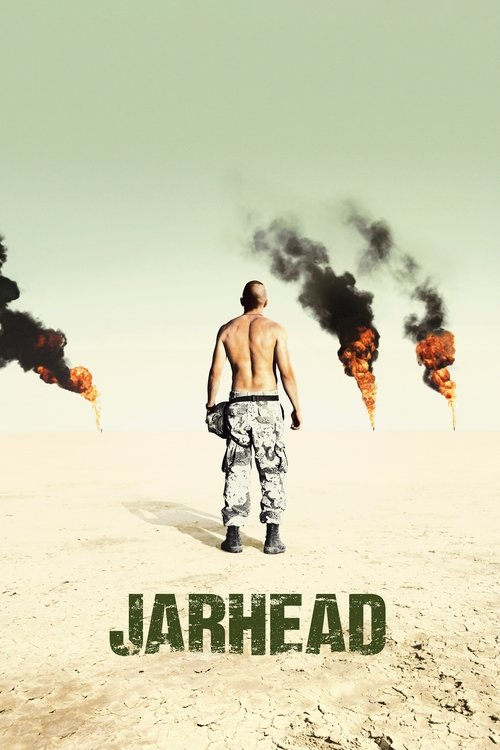
Jarhead
2005 · Sam Mendes
For when you want a war film that makes you think instead of cheering — wry, unsettling and unglamorous. Good for a night when you're up for something substantial with a bitter sense of humor.
What it's about
Anthony Swofford survives a brutal Marine boot camp, trains as a scout sniper, and ships out to the Saudi desert for the Gulf War — where nothing happens. He and his unit wait for months: digging holes, hydrating, brawling, obsessing over the girlfriends they suspect are leaving them, rehearsing a fight that keeps not arriving. Based on Swofford's memoir, it's a war story about men trained to kill who may never get the chance.
The experience
Darkly funny, restless and slowly corrosive — it puts you inside the boredom, testosterone and creeping madness of the wait without ever boring you. When the desert finally turns apocalyptic, the images land hard precisely because so little came before.
Performances
Jake Gyllenhaal charts Swofford's unraveling from gung-ho recruit to hollowed-out sniper with real volatility, Peter Sarsgaard does quietly devastating work as his spotter, and Jamie Foxx gives the staff sergeant a lifer's complicated pride.
The craft
Roger Deakins shoots the desert like another planet — bleached-white sand, night skies raining oil, burning wells turning day into apocalypse — and those images are among the most stunning in any war film. Mendes leans on the absurd as much as the epic, and the oil-fire sequences demand the biggest screen you can find.
Why it matters
It became the defining film of the Gulf War — a conflict Hollywood had barely touched — and set the template for the modern war movie about waiting, boredom and psychological attrition rather than combat.
Snapshot
Jarhead is Sam Mendes's adaptation of Anthony Swofford's 2003 memoir of the same name, a war film built almost entirely out of the absence of war. It follows Swofford — "Swoff," played by Jake Gyllenhaal — from a brutal Marine boot camp through scout-sniper school and into the deserts of Saudi Arabia and Kuwait during Operation Desert Shield and Desert Storm in 1990–91. There he and his fellow Marines wait. They dig holes, clean rifles, masturbate, brawl, sunburn, and rehearse a violence the war never quite lets them commit. The film's central irony, drawn directly from Swofford's book, is that a trained sniper can serve an entire conflict without firing a single round at the enemy — and that the deprivation of the kill is its own kind of trauma. Against the spectacle of burning oil fields and a "Highway of Death" littered with charred corpses, Mendes stages a study of masculine anticipation curdling into futility: boredom as the true condition of the modern soldier, and the war film itself as the machine that primes young men to crave a combat that may never arrive. It stands as both a late entry in the post-Vietnam war-movie tradition and one of the first major studio films to register the disorientation of America's open-ended engagements in the Middle East.
Industry & production
Jarhead was produced by Universal Pictures, with Lucy Fisher and Douglas Wick of Red Wagon Entertainment among its producers. It arrived as Sam Mendes's third feature, following the Academy Award–winning American Beauty (1999) and Road to Perdition (2002) — a director with enormous prestige capital and a reputation, earned in the theater before film, for controlled, formally exacting work. The screenplay was written by William Broyles Jr., himself a former Marine and Vietnam veteran (and a screenwriter of Apollo 13 and Cast Away), whose own service gave the adaptation an insider's authority over military idiom and the texture of deployment.
The source was a literary event: Swofford's Jarhead: A Marine's Chronicle of the Gulf War and Other Battles was a critically acclaimed bestseller, prized for its lacerating prose and its refusal of heroic cliché. Adapting it meant translating a fragmented, interior memoir into dramatic form without supplying the conventional combat payoff a war picture is built to deliver — a commercial risk the film embraces as its subject.
Principal photography took place largely in desert locations in California (the Imperial Valley region near the Mexican border) and in Mexico, standing in for the Arabian Peninsula, with the production recreating the apocalyptic burning oil fields of retreating Iraqi forces. Casting paired Gyllenhaal, then ascending, with Peter Sarsgaard as the older, disillusioned Troy and Jamie Foxx as Staff Sergeant Sykes — Foxx arriving fresh from his Oscar-winning turn in Ray (2004). The ensemble includes Lucas Black, Chris Cooper, and Dennis Haysbert. The film opened in November 2005. Its commercial performance was moderate rather than spectacular, and I won't cite specific box-office figures I can't verify; its standing rests more on its craft and its uneasy timing than on its returns.
Technology
The film was shot photochemically on 35mm in the standard high-end studio workflow of the mid-2000s, before the wholesale shift to digital capture. The relevant technical achievement is less a matter of novel equipment than of physical production: the recreation of burning oil wells, which required controlled pyrotechnics and fire effects on a large scale to produce the film's signature images of black smoke blotting out the sun and crude raining from the sky. The desert shoot demanded the management of extreme heat, dust, and natural light across wide exteriors. Where digital tools were used, they served the orchestration of fire, smoke, and atmosphere rather than any conspicuous visual-effects spectacle; the film's aesthetic is grounded in the photographable real — actual flame, actual desert, actual sweat — which is part of its claim to authenticity. I'll flag that the precise breakdown of practical versus digital effects in the oil-field sequences is something a reader should confirm against production sources rather than take from this summary.
Technique
Cinematography
The photography is by Roger Deakins, one of the most esteemed cinematographers in the medium, and the film is among his most visually striking works. Deakins renders the desert as a vast, bleached emptiness — overexposed sand and white sky that swallow the tiny figures of the Marines — and then detonates that monotony with the unforgettable palette of the burning fields: orange flame against tar-black smoke, a noon turned to false night, men silhouetted against an inferno. The most celebrated images are near-surreal: a horse coated entirely in oil emerging from the dark, crude raining down on upturned faces, the Highway of Death rendered as a charnel tableau. Deakins's framing is precise and often symmetrical, holding the soldiers as small, isolated forms within indifferent expanses, and his control of natural and firelight gives the film a beauty that is deliberately, queasily at odds with its subject. The cinematography insists that war here is something seen and waited within rather than fought.
Editing
The film was edited by Walter Murch, the legendary editor and sound designer whose credits include The Conversation, Apocalypse Now, and The English Patient — a resonant choice, given that Jarhead is in part a film about the war movies that came before it. Murch's cutting holds the film in a register of suspended time: long stretches of waiting, drift, and repetition, punctuated by sudden eruptions of incident, so that the rhythm itself dramatizes the soldier's experience of boredom interrupted by adrenaline. The structure resists the accelerating momentum of a conventional combat narrative; instead it accumulates episodes that circle back on the same frustrations. Swofford's first-person narration threads the sequences together, an editorial-literary device that preserves the memoir's interiority while the images supply the external world.
Mise-en-scène / staging
Mendes, formed in the theater, stages the film as a series of charged tableaux within institutional and elemental spaces — the boot-camp barracks, the Spartan desert encampments, the tent cities, the open sand. The Marine body is everywhere foregrounded: shaved heads, identical uniforms, bodies packed together in close quarters, the homosocial intimacy and aggression of men with nothing to do but wait and watch one another. The famous sequences are built on staging that exposes the gap between the rituals of war and its substance — the Marines screening Apocalypse Now and cheering the helicopter assault as a pep rally; the celebratory "field-fuck" horseplay; the Christmas party that turns ugly. The burning oil field, the oil-soaked horse, and the highway of the dead function as set pieces of arrival — the soldiers finally reaching "war," only to find it already over, an aftermath rather than a battle.
Sound
The score is by Thomas Newman, Mendes's regular composer from American Beauty and Road to Perdition, working in a spare, percussive, often ambient idiom that underscores the film's hollowness rather than swelling toward heroism. As important is the film's pointed use of source music: pop and rock needle-drops that comment ironically on the action and on the soldiers' borrowed images of combat — most discussed is the deliberate anachronism of using Kanye West's "Jesus Walks" over a 1991 setting, a choice that collapses the distance between the Gulf War and the post-9/11 moment of the film's making. Sound design renders the desert's oppressive quiet, the mechanical clatter of the military, and the roar of the burning fields, building an aural environment in which the expected sounds of battle are conspicuously withheld.
Performance
Gyllenhaal anchors the film with a performance of mounting psychological pressure: Swoff begins as a wry, watchful recruit and deteriorates into someone unmoored by sexual jealousy, sun, and the unrelieved craving to use his training. His near-breakdown — and the unbearable, aborted sniper shot late in the film, when he and Troy are denied their single sanctioned kill — registers the cost of violence rehearsed but never released. Sarsgaard's Troy is the film's quiet tragedy, a Marine whose entire identity is invested in the war he is not permitted to fight, and his collapse when the chance is taken away is the film's emotional core. Jamie Foxx's Sykes complicates the drill-sergeant archetype, a career Marine who genuinely loves the Corps and finds meaning in a vocation the film otherwise treats as absurd. The ensemble sustains a convincing sense of unit cohesion and its frictions.
Narrative & dramatic mode
Jarhead's dramatic mode is anti-climax raised to a structural principle. Where the war film conventionally builds toward and through combat, this one builds toward a battle that never comes — the entire architecture of training, deployment, and anticipation pays off in denial. Its narrative is episodic and memoiristic, organized by Swofford's retrospective voice-over and by the accumulation of incident rather than by a tightening plot. The governing irony is that the soldiers' deepest distress arises not from the horror of killing but from being prevented from killing — the unspent training, the wasted readiness. This is a coming-of-age story whose rite of passage is aborted, and a psychological study of how the appetite for violence, once manufactured, has nowhere to go. The mode is bleakly ironic, closer to absurdist tragicomedy than to either the heroic or the straightforwardly tragic war film.
Genre & cycle
The film is a war film that systematically frustrates the genre's expectations, and it is acutely conscious of its own lineage. It belongs unmistakably to the post-Vietnam tradition of disillusioned, ironic combat cinema — its boot-camp sequences and its detached, profane register descend directly from Stanley Kubrick's Full Metal Jacket (1987), and its reckoning with the seductions of war-as-spectacle is staged literally through Francis Ford Coppola's Apocalypse Now (1979). At the same time it stands at the head of a distinct early-21st-century cycle: Hollywood's attempt to grapple with the Gulf War and, by implication, the ongoing wars in Iraq and Afghanistan. Released in 2005, it precedes or accompanies a wave of Middle East–war films — among them In the Valley of Elah, Redacted, Rendition, Stop-Loss, and ultimately The Hurt Locker — many of which struggled commercially with audiences wary of the subject. Jarhead is also a "soldier's experience" film in which the enemy is largely absent and the real adversaries are tedium, the self, and the institution.
Authorship & method
The film bears Sam Mendes's authorial signature: the formalist control, the symmetrical compositions, the cool ironic distance, and above all the recurring subject of individuals trapped inside institutions and ideologies that hollow them out. The suburban malaise of American Beauty becomes, in Jarhead, an institutional and masculine malaise — the Marine Corps as a total environment that shapes desire and identity. Mendes's theatrical background shows in his handling of ensemble and his attention to charged staging, and his interest in masculinity under strain runs through his subsequent work, including his return to war with the very different 1917 (2019).
The key collaborators are central to the achievement. Cinematographer Roger Deakins — who would work with Mendes again and shoot 1917 — supplies the film's indelible visual language of bleached emptiness and apocalyptic fire. Editor Walter Murch, a veteran of the defining Vietnam-era films, shapes its suspended, anti-momentum rhythm. Composer Thomas Newman, Mendes's regular musical voice, provides a score that refuses heroic uplift. Screenwriter William Broyles Jr., a Marine veteran, translates Swofford's memoir with an insider's command of military life. And the source author, Anthony Swofford, supplies the film's interior voice and its governing irony. The authorship is genuinely collaborative — a director's vision realized through a roster of major craftspeople — but it is unmistakably of a piece with Mendes's wider concerns.
Movement / national cinema
Jarhead is a product of American studio prestige filmmaking rather than of any named movement — a mid-budget, star-driven drama made within the Hollywood system by a director with art-cinema credibility. Its proper context is the long American tradition of the war film and that tradition's periodic crises of conscience, from the Vietnam reckonings of the 1970s and 1980s to the post-9/11 moment of its own making. It participates in a broader American cinematic project of trying to represent the country's wars in the Middle East at a time when those wars were ongoing and politically raw — a body of work distinguished by ambivalence, skepticism toward official narratives, and an emphasis on the psychological damage of the soldier over the justice of the cause.
Era / period
Released in late 2005, the film is doubly timed: it depicts the Gulf War of 1990–91 but speaks to the United States of the Iraq War then in its third year. That overlay is the source of much of its power and its unease — the anachronistic music, the focus on a war remembered as "easy" and brief, the sense of soldiers deployed into a conflict whose purpose and endpoint are obscure to them. The mid-2000s were a period of deep public ambivalence about American military adventure, and Jarhead channels that ambivalence into a portrait of futility and waiting. It reflects its era's skepticism, its preoccupation with the gap between the mediated image of war and its lived reality, and its turn away from heroic narrative toward the interior costs of service.
Themes
The film's central theme is the manufactured appetite for violence and its frustration — the way training, ideology, and the war-movie tradition itself condition young men to crave combat, and the psychological wreckage that follows when that craving is denied an object. Bound to this is boredom as the true face of modern war: the long stretches of waiting, drilling, and idleness that the film insists are the soldier's real experience. Masculinity and homosociality run throughout — the intimacy, aggression, and ritualized performance of manhood within an all-male institution, charged with a homoeroticism the film makes explicit. The war film as propaganda for itself is a self-reflexive theme, crystallized in the Marines cheering Apocalypse Now: the movies that critique war also glamorize it and recruit its next generation. There is the theme of anti-climax and futility — the kill withheld, the war ending offstage, the trained skill rendered useless. And running beneath it all, the anxious home front: Swofford's jealousy over a possibly unfaithful girlfriend, the "Wall of Shame," the disintegration of the bonds that deployment leaves behind.
Reception, canon & influence
Critical reception was respectful but divided. The film drew wide praise for Deakins's cinematography and for the conviction of its performances, and admiration for its refusal of war-movie formula; some critics, however, found it emotionally cool, aimless, or finally as inconclusive as the deployment it depicts — a charge that mirrors, perhaps unavoidably, the film's own subject. Its reputation has held as a serious, distinctive entry in the modern war-film canon, though I'd note that the precise contours of its 2005 reviews are best verified against contemporary sources rather than taken solely from this summary.
Backward — influences on the film: The foundational source is Anthony Swofford's memoir, which supplies the premise, the voice, and the central irony of the unfired weapon. Cinematically, the film stands in conscious dialogue with the post-Vietnam tradition: Kubrick's Full Metal Jacket in its boot-camp brutality and ironic detachment, and Coppola's Apocalypse Now — invoked on screen — in its vision of war as hallucinatory spectacle. Broyles's and Mendes's debt to that lineage is explicit and self-aware. Mendes's own American Beauty supplies the template of the individual hollowed out by an institution.
Forward — its legacy: Jarhead helped define the early-21st-century cycle of skeptical Middle East–war films and demonstrated that a major studio war picture could withhold combat entirely and still hold an audience. Its imagery — the oil-soaked horse, the rain of crude, the burning fields — has become a visual touchstone for the Gulf War in popular memory. The Mendes–Deakins partnership it cemented would culminate in the technically audacious 1917 (2019), and the film stands as an important station in Deakins's path toward his eventual recognition as a master of the form. It spawned later direct-to-video sequels unconnected to Mendes's involvement, which have done nothing to diminish the original's standing. More broadly, Jarhead remains a key reference for any account of how American cinema tried to represent its wars in the era of the War on Terror — a film whose subject is, finally, the difficulty of making meaning, or war, out of waiting.
A Deleuzian reading
A man lies in the sand with his eye to a rifle scope.
The full Deleuzian reading of Jarhead →
Reception
In 2005 critics shrugged at a war movie with no combat — it felt aimless next to the prestige-drama Oscar run everyone expected from Mendes. Two decades on it's been quietly reappraised as one of the great films about military boredom and dread, with Roger Deakins's burning-oil-field imagery now treated as some of his finest work.
How Jarhead was received, from release to now →
Influences: the films it descends from and the films it influenced
- Full Metal Jacket (1987) — Supplies the bifurcated war-film architecture Jarhead reproduces as near-homage — a dehumanizing boot-camp first half built on ritualized drill-instructor cadence, followed by an ironic, anticlimactic deployment that withholds the expected combat.
- Apocalypse Now (1979) — Models war as hallucinatory sensory spectacle (the burning-field/oil imagery) and is literally screened within Jarhead; its editor Walter Murch carries the same immersive, sound-led montage method directly into Mendes's film.
- The Conversation (1974) — Establishes Walter Murch's signature editing-as-suspension — a subjective, sound-driven rhythm that refuses forward momentum, the exact anti-momentum cutting he brings to Jarhead's tale of waiting.
- American Beauty (1999) — The Mendes/Thomas Newman/first-person-voiceover template: a detached narrator framing an individual hollowed out by a total institution, rendered in cool symmetrical compositions — suburban malaise restaged as the Marine Corps.
- The Thin Red Line (1998) — Pioneers the meditative interior voiceover laid over war's dead time, privileging soldiers' subjectivity and waiting over plot — the anti-narrative model Jarhead adopts for its combat-less Gulf.
- Catch-22 (1970) — Absurdist template of war as bureaucratic futility, where soldiers never get the war they were promised — the structural anti-climax and masculine impotence Jarhead inherits.
- Three Kings (1999) — First film to render the specific surreal iconography of the 1991 Gulf War — bleached overexposed desert, oil fires, looted spectacle — establishing the visual vocabulary Deakins refines.
- Barton Fink (1991) — Early Deakins showcase of oppressive, drained, near-monochrome interiors and oppressive negative space — the desaturated emptiness he scales up to Jarhead's desert.
- Tigerland (2000) — Extends the central Tigerland gambit of a war film that earns its power by never showing the war, sustaining tension through training, waiting, and the psychic grind that combat never relieves.
- Enemy at the Gates (2001) — Extends the marksman psychology — the sniper's suspended, frustrated patience and the charged ritual of breath-and-trigger — as the dramatic core rather than a set piece.
- 1917 (2019) — The Mendes–Deakins partnership Jarhead cemented reaches its technically audacious culmination; the same charged-tableaux staging and practical-flare night imagery recur as Mendes's mature war grammar.
- The Hurt Locker (2008) — Extends the post-9/11 skeptical war cycle Jarhead opened, built on episodic tension-without-payoff and a refusal of heroic catharsis around men addicted to a war that gives no resolution.
- Generation Kill (2008) — Directly extends Jarhead's 'Marines who wait and rarely fight' verisimilitude — profane downtime, anticlimactic engagements, and embedded-memoir interiority over conventional combat drama.
- American Sniper (2014) — Continues the Iraq-cycle study of the sniper's masculine futility — the rifleman defined by the discipline of waiting and the hollowing return home, the Swofford-memoir lineage in a new key.
- Zero Dark Thirty (2012) — Carries forward Jarhead's War-on-Terror anti-climax — a procedural that withholds triumphant catharsis and ends on emotional vacancy rather than victory.
- Atropia (2025) — Pioneers the war-on-terror of waiting, drilling and performing readiness with no combat payoff, in the same desert boredom-texture Atropia inhabits.
- Skyfall (2012) — Extends the Mendes–Deakins look directly — rigorously symmetrical framing and silhouetted figures staged against fire and backlight, the charged-tableau aesthetic developed on Jarhead.
- Sicario (2015) — Deakins transplants Jarhead's landscape grammar — vast symmetrical desert wides, dread-laden empty horizons, thermal/night-vision palettes — into the cartel war.
- Revolutionary Road (2008) — Same Mendes/Deakins/Newman team applying the institution-hollows-the-individual subject and cool formalist framing to domestic life, confirming Jarhead's masculine-futility theme as authorial signature.
- Fury (2014) — Roger Deakins' bleached, overexposed photography as a visual register of the soldier's psychological dissociation — color grading deployed as moral damage rather than period nostalgia — runs formally parallel to Vasyanov's low-light digital palette, both films using photographic texture to externalize institutional deformation.
Similar films
- The Hurt Locker (2008) — influence & lineage
- Full Metal Jacket (1987) — influence & lineage
- The Thin Red Line (1998) — influence & lineage
- American Sniper (2014) — influence & lineage
- Atropia (2025) — influence & lineage
- Zero Dark Thirty (2012) — influence & lineage
- 1917 (2019) — influence & lineage
- Warfare (2025) — shared sensibility