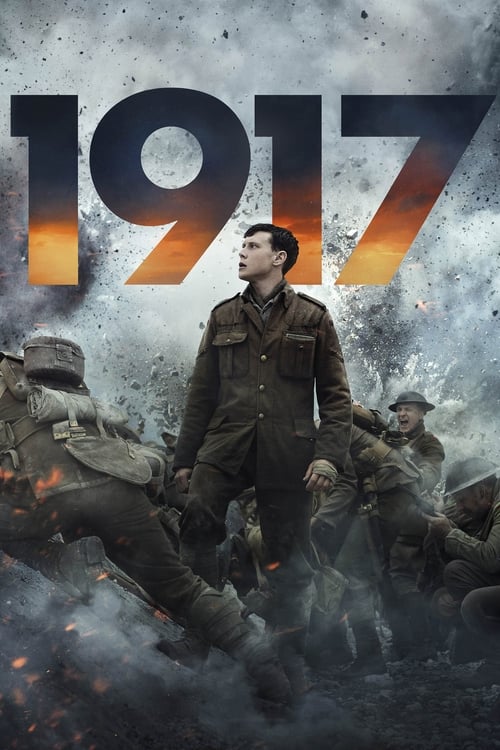
1917
2019 · Sam Mendes
When you want to be pinned to your seat — a big, visceral, edge-of-panic experience rather than a cozy one. Pick it for a night when you can give it the biggest screen and best sound you have.
What it's about
April 1917, the Western Front. Two young British soldiers are handed an impossible errand: cross abandoned enemy ground and deliver an order calling off an attack before 1,600 men — including one of their brothers — walk into a trap. The film stays with them for every step, presented as one continuous, unbroken shot.
The experience
Relentless and immersive — the camera never cuts away, so there's no relief, just forward motion through mud, wire, and silence that could break at any second. Two hours pass like a held breath.
Performances
George MacKay carries enormous stretches of the film nearly alone, his exhaustion and resolve doing the work dialogue can't; Dean-Charles Chapman gives the mission its warmth.
The craft
Roger Deakins's Oscar-winning cinematography stitches the whole film into what feels like a single take, through trenches, rivers, and a burning town lit like a nightmare. With Thomas Newman's score pushing underneath, it's one of the great see-it-loud, see-it-big technical feats of recent cinema.
Why it matters
It became the defining one-shot experiment of prestige filmmaking and the capstone of the WWI centenary wave, sweeping technical awards and reviving the war epic as pure immersion.
Snapshot
A single-mission war film built around the sustained illusion of one unbroken shot, 1917 follows two young British lance corporals — Schofield and Blake — tasked with crossing enemy-held ground to deliver a stand-down order before 1,600 men walk into a German ambush at the Hindenburg Line. Directed by Sam Mendes from a script he co-wrote with Krysty Wilson-Cairns, and shot by Roger Deakins in a series of invisibly joined long takes, the film subordinates conventional dramatic structure to duration, presence, and the phenomenology of forward movement. It arrived at the close of the WWI centenary cycle, consolidated a decade of technical experimentation with the "oner" aesthetic in prestige cinema, and earned Deakins his second Academy Award for cinematography. Structurally spare but formally extravagant, it is among the most consciously designed war films of its decade.
Industry & production
The film was produced by Neal Street Productions and Amblin Partners, with DreamWorks Pictures and Universal Pictures as co-financiers for the North American market. Sam Mendes, already established as a prestige director through American Beauty (1999) and the Bond films Skyfall (2012) and Spectre (2015), brought the project to Universal with Roger Deakins attached early, the formal conceit — the simulated single take — built into the pitch rather than arrived at in development. The project was thus sold as a technical event film in the tradition of Birdman or Children of Men, with Deakins and Mendes's existing collaboration (they had worked together on Jarhead in 2005) guaranteeing the practical credibility of the conceit.
Mendes has spoken publicly about the film's origin in stories told to him by his grandfather Alfred Mendes, a Trinidad-born writer who served as a runner during the First World War and later became associated with the literary culture of 1930s Trinidad. The single-runner premise derives from that family memory, though the specific mission, characters, and dramatic events are fictional. Co-writer Krysty Wilson-Cairns, then primarily known for television work, received an Academy Award nomination for Best Original Screenplay — a notably prominent credit for an early-career writer sharing a script with a director of Mendes's standing.
Principal photography took place in England, across locations including Wiltshire's Salisbury Plain (for the trench systems and No Man's Land), Hankley Common in Surrey, Govan in Glasgow (for the ruined town of Écoust), and various canal and river settings in the north of England. The practical sets were built at considerable scale: miles of trenches were constructed, and the ruined village through which Schofield passes in the film's nocturnal third act was erected as a physical set and then lit largely with pyrotechnics.
Technology
The film's technological achievement is inseparable from its artistic premise. Because the oner aesthetic requires the camera to occupy the same physical space as the actors in real time, the entire production pipeline — from set construction through lighting design to camera rigging — was engineered to support continuous motion. Roger Deakins shot on the Arri Alexa Mini LF (the large-format version introduced in 2019), using primarily prime lenses that gave the image a slightly wider, more immersive field than 35mm anamorphic work. The camera frequently moved on Steadicam, on custom-built tracking rigs, and by hand through tight spaces.
The lighting design required particular ingenuity. As the camera moves through environments across a single implied take, cuts that might normally permit relighting are unavailable. For the interior of the German dugout, Deakins built practical lighting into the set itself. The film's celebrated night sequence — Schofield moving through a burning, flare-lit Écoust as the town is consumed by fire — was lit almost entirely with pyrotechnics and fire sources on set, supplemented by LED panels outside camera range that could be varied in real time. This sequence is widely cited as one of the most technically demanding individual scenes Deakins has undertaken: the light sources flicker, shift, and die unpredictably, and the Steadicam operator had to navigate rubble and falling debris while maintaining frame.
The hidden cuts that stitch the film's long takes together are concealed in darkness (when the camera passes through a doorway or Schofield falls unconscious), in fast panning motions that blur the frame, or in close passage through narrow physical spaces. Lee Smith's editing, which received an Academy Award nomination, is largely invisible by design — its goal is its own erasure.
Technique
Cinematography
Deakins's approach in 1917 extends his career-long interest in natural-source and practical lighting into territory that had previously required montage to manage. The trench sequences use overcast English daylight and deep earth tones; the bombed fields of No Man's Land are rendered in a gray-green palette that recalls both archival WWI photography and the muted landscapes of British countryside in winter. The camera's relationship to the two soldiers is intimate without being subjective — it follows slightly behind, or moves alongside, or in rare moments precedes them, as though it were an observing presence rather than a point-of-view. The effect is less the first-person register of a video game (an analogy some reviewers raised) and more the quality of a witness: present, unable to intervene.
The cherry-blossom sequence near the end of the film, in which a wounded Schofield floats downstream past trees in bloom, is a deliberate lyric interruption — a sudden access of beauty inside extreme violence that has precedent in several significant war films.
Editing
Lee Smith, who had collaborated extensively with Christopher Nolan on The Dark Knight (2008), Inception (2010), Interstellar (2014), and Dunkirk (2017), brought expertise in temporally complex editing to a project that required the opposite skill: the suppression of cutting as an expressive tool. The film's apparent continuity demanded that every cut either be invisible or be turned into a narrative event (loss of consciousness, transition through darkness). The transition that sends the film from the death of Blake into the film's second half — Schofield losing consciousness and the screen going to black — is one of the rare moments where the edit is acknowledged.
Mise-en-scène / staging
Rehearsal was as central to the production as any technical preparation. Actors and camera operators drilled the long takes as one would stage choreography, with the physical sets built and lit before shooting commenced so that timing could be practiced. The staging required every element of the frame — actors, extras, stunt performers, set dressers, background action — to be precisely cued, because the camera could not leave a take and return to a corrected version; any failure required returning to the beginning of the sequence. This produced a heightened intensity on set that Mendes and the principal cast have described in publicity materials, though the specific details of that process are better known through Deakins's interviews and podcasts than through comprehensive production documentation.
The single-take aesthetic also enforces certain staging choices: scenes must begin and end in continuous space, which shapes how entrances and exits are managed. The supporting characters who enter and leave Schofield's journey — Mark Strong's Captain Smith, Andrew Scott's Lieutenant Leslie, Richard Madden's Captain Blake, Colin Firth's General Erinmore — are each staged as encounters along a road, figures who appear, deliver information or emotional weight, and then recede. This gives the film something of the structure of an allegorical journey.
Sound
The sound design, which won the Academy Award for Best Sound Mixing, reinforces the film's immersive regime. The sonic environment changes continuously as the soldiers move: the enclosed acoustics of the trenches give way to the exposed, windswept ambience of No Man's Land, which shifts again into the echo of ruined buildings and the roar of fire in Écoust. War noise — artillery, rifle fire, collapsing structures — is placed and scaled with unusual precision, designed to indicate distance and direction and to give the audience spatial information about threats not yet visible.
Thomas Newman's score (his fifth collaboration with Mendes) is markedly sparse and restrained. Sustained string textures and low tonal drones appear intermittently, often withdrawn when diegetic sound is sufficient. The score expands most explicitly in the film's final movement, providing an emotional framework that the accumulated suppression of music makes available at that point.
Performance
George MacKay carries the film in its second half with almost no dialogue, and his performance is more physical than verbal — a sustained study in exhaustion, grief, and determination expressed through gait and face rather than speech. Dean-Charles Chapman's Blake in the first half establishes the film's emotional stakes quickly and efficiently; his death, about halfway through, is the film's central structural gamble. By killing its more expressive character and leaving the quieter Schofield to carry the remainder, the film risks depleting audience identification at the moment when pace and tension increase. That this gamble largely pays off is credited to MacKay's performance, which opens after Blake's death rather than closing.
The supporting cast — strong actors in small roles — functions less as characterization than as a system for delivering the film's thematic arguments. Colin Firth's general and Benedict Cumberbatch's colonel are both authoritative and, in different ways, remote from the reality of the ground-level mission the film inhabits.
Narrative & dramatic mode
1917 belongs to the "mission film" subgenre — a form defined by a clearly stated objective, a route, and the attrition of obstacles — rather than to the broader-canvas war narrative. Its dramatic logic is procedural: the question is not whether the message will be delivered (the genre contract makes delivery likely) but at what cost, by what path, and through what transformation. The death of Blake pivots the film from a buddy narrative into a solo endurance film, which is a tonal shift as significant as any plot development.
The real-time or near-real-time conceit creates a specific kind of dramatic pressure. The film covers approximately eight to nine hours of story time, compressed into approximately one hour and forty-nine minutes — meaning it is not literally real-time, but the continuous camera makes duration feel present in a way that conventional editing would dissolve. The result is closer to the temporal experience of theater than of most film: the audience cannot cut away.
Genre & cycle
The film arrives within the "prestige WWI picture" cycle that the war's centenary (2014–2018) stimulated, alongside War Horse (Spielberg, 2011), Dunkirk (Nolan, 2017), They Shall Not Grow Old (Jackson, 2018), and the 2022 German remake of All Quiet on the Western Front. Within this cycle, 1917 occupies the position of the technical-formal event film rather than the historical reconstruction or the anti-war elegiac mode. It is less interested in the political architecture of the war than in the phenomenology of survival on the Western Front.
More broadly, the film participates in the "immersive war film" cycle catalyzed by the opening sequence of Saving Private Ryan (1998), which redefined the sensory register of Hollywood war cinema and made visceral presence — as opposed to choreographed spectacle — the dominant mode for serious war filmmaking. Dunkirk extended this into formal experimentation with temporal structure; 1917 extends it into formal experimentation with spatial continuity.
Authorship & method
Sam Mendes was trained in theater before moving to film, and his theatrical sensibility — a commitment to the integrity of performance within a defined spatial and temporal frame — shapes 1917 more legibly than perhaps any of his earlier films. The continuous-shot aesthetic is a theatrical constraint applied to cinema: it insists that the camera inhabit the same time as the actors rather than assembling time from fragments.
Roger Deakins's contribution is sufficiently central to the film's achievement that 1917 is, in meaningful terms, a co-authored work. Deakins has described the extensive pre-production process in detail across interviews and his own podcast — the building of models, the development of lighting rigs, the camera tests conducted months before shooting — and the film's visual intelligence is inseparable from his decisions about lens, framing, and practical light. He won his second Academy Award for the work, having won his first for Blade Runner 2049 (2017) after a notably long sequence of nominations without a win.
Krysty Wilson-Cairns's contribution as co-writer shaped the film's structure and dialogue. Lee Smith's invisible editing was the technical mechanism that made the conceit viable at feature length. Thomas Newman's restrained score, deployed sparingly, provided the film's emotional architecture without overtaking its sensory design.
Movement / national cinema
1917 is in several respects a quintessentially British film: its subject matter, its landscape, its class dynamics (the gulf between general and private made physical by the mise-en-scène), and its emotional register of stoic endurance under extreme pressure are all rooted in a specifically British cultural relationship to the First World War. The Western Front remains one of the defining traumas of British national memory, and the film's pastoral imagery — fields, hedgerows, a stream lined with cherry trees — set against industrial devastation participates in a long tradition of British war poetry and art that juxtaposes the English countryside with its destruction.
At the same time, the film was an American co-production, shot to compete at the Academy Awards, and belongs as much to Hollywood prestige cinema as to any British national tradition. Mendes, who was knighted in 2000 and is associated with both West End theater and Hollywood studio filmmaking, occupies precisely this transatlantic position.
Era / period
The film is set in April 1917, during the German retreat to the Hindenburg Line and the period immediately preceding the Nivelle Offensive. The specific military background — the strategic withdrawal that left elaborately booby-trapped abandoned positions, the Allied discovery of suddenly empty trenches — is historically grounded. The film does not dramatize actual named battles or documented incidents; the Devonshire Regiment's threatened attack and the German trap are fictional, though constructed within a plausible historical framework.
As a production, the film belongs to the moment of late 2010s prestige cinema characterized by large technical ambitions, significant marketing investment in formal concepts, and competition between streaming-adjacent and theatrical exhibition models. It was released on Christmas Day 2019, the traditional prestige awards slot, and was a significant commercial as well as critical success.
Themes
The film's most insistent theme is the arbitrariness of death in industrialized warfare. Blake, the more expressive of the two soldiers, dies not heroically but almost incidentally — an act of misplaced mercy (helping a downed German pilot) that kills him. The randomness of this death, and the film's refusal to give it meaning, aligns it with the anti-heroic tradition of WWI representation established by Wilfred Owen and reinforced by Kubrick's Paths of Glory (1957).
A second theme is the tension between individual action and the institutional machinery of war. The mission requires one man to carry a message that the entire communications infrastructure has failed to deliver; the film is interested in what individual human bodies can do inside systems that are largely indifferent to them. General Erinmore cannot cross No Man's Land; only someone young and physically capable enough to run the distance can do it. The generals and colonels who appear briefly are, without exception, insulated from the ground the film inhabits.
The theme of memory and transmission runs through the film's biographical origins — Mendes receiving these stories from his grandfather — and surfaces in Schofield's final gesture: sitting against a tree, looking at a photograph of his family. What he carries from the war, the film suggests, is not triumph but the weight of having survived.
Reception, canon & influence
1917 received strong critical reception on release, with particular attention to its technical achievement. It won three Academy Awards — Best Cinematography, Best Sound Mixing, and Best Visual Effects — and received nominations for Best Picture, Best Director, Best Original Screenplay, Best Film Editing, Best Production Design, and Best Original Score. At the Golden Globes it won Best Picture (Drama) and Best Director. Notably, it was widely expected to win Best Picture at the Oscars before Bong Joon-ho's Parasite prevailed — a historically significant upset that the film's competitive positioning made more visible.
Influences on the film. The most direct precursor for the oner aesthetic is Alfonso Cuarón's Children of Men (2006), which produced extended tracking shots in warlike conditions and demonstrated that sustained camera motion could generate a specific kind of existential dread. Alejandro G. Iñárritu's Birdman (2014) established the commercial viability of an apparent single-take feature. Alexander Sokurov's Russian Ark (2002) — an actual single-take film, shot without cuts on a digital camera in the Hermitage — is a more distant artistic precedent. Alfred Hitchcock's Rope (1948) is the classical Hollywood experiment in disguised cutting that all subsequent oner films consciously or unconsciously cite.
For the war content, the film's visual grammar of the Western Front owes debts to Paths of Glory (Kubrick, 1957) for its trenches and its critique of command; to All Quiet on the Western Front (Milestone, 1930) for its insistence on the soldier's-eye view; and to Saving Private Ryan (Spielberg, 1998) for the post-Vietnam aesthetics of immediate, embodied combat. Das Boot (Petersen, 1981) offers a precedent for sustained, claustrophobic immersion in a combat environment rendered through an observing rather than action-hero camera.
Legacy and influence. The film's primary legacy is technical and commercial rather than formal-theoretical: it demonstrated that the oner aesthetic could sustain a feature-length studio production with substantial awards and box-office success, which has encouraged imitators in both advertising and film. Its influence on subsequent war filmmaking is more difficult to assess cleanly, since the formal approach is sufficiently demanding that few productions can replicate it at scale. Whether it represents a new paradigm for war cinema or an exceptional one-off remains, at the distance of a few years, genuinely open. What is settled is its place in the short list of films that made Roger Deakins's cinematography a subject of public discussion well beyond specialist circles, and its standing as the film that most fully realized the prestige-oner as a genre in its own right.
A Deleuzian reading
Keep the camera a single stride behind the running man and you have the whole film.
The full Deleuzian reading of 1917 →
Reception
It swept the Golden Globes and BAFTAs and looked like the Best Picture frontrunner — until Parasite's historic win turned it into 'the film that lost.' Now it's mostly remembered as a jaw-dropping technical feat whose awards-season shine faded fast.
How 1917 was received, from release to now →
Influences: the films it descends from and the films it influenced
- Children of Men (2006) — The extended Steadicam tracking shots through active combat—the car ambush and the Bexhill battle—are the direct technical precursor to 1917's oner grammar; Deakins has cited Lubezki's work on these sequences as foundational to his own approach to sustained camera motion in warlike conditions.
- Birdman or (The Unexpected Virtue of Ignorance) (2014) — Established hidden-cut concealment via motivated camera pivots and darkness transitions as a commercially viable feature-length technique, normalizing the simulated-oner aesthetic for studio production and the awards circuit and demonstrating it could sustain narrative coherence across a full feature.
- Russian Ark (2002) — Shot in a single uninterrupted 96-minute digital take without cuts, it proved structurally that a feature could be organized around temporal continuity rather than editorial assembly—the conceptual pole 1917 approaches but deliberately stops short of, its hidden cuts marking the aesthetic's commercial compromise.
- Rope (1948) — The classical Hollywood prototype for disguised-cut continuity: cuts hidden in coat backs and dark frames to simulate unbroken time across a confined space, the fundamental technique 1917 scales from a single interior into a sprawling outdoor multi-environment production.
- Paths of Glory (1957) — Kubrick's tracking shots through the trench system before the assault—camera following characters through cramped dugouts at chest height—established the Western Front as a spatial labyrinth navigable by a moving observational camera, the grammar 1917 inherits for its opening trench sequence.
- All Quiet on the Western Front (1930) — Insisted on the infantryman's bounded perceptual horizon as the governing viewpoint, foreclosing the commanding officer's strategic overview that structured most WWI films; 1917 inherits this refusal of the elevated perspective and its corollary—the soldier does not understand what is happening to him.
- Saving Private Ryan (1998) — The post-Vietnam grammar of handheld, body-proximate combat imagery and the mission-film structure—a small squad dispatched with a named objective through enemy territory—are the direct action templates 1917 refines, substituting continuous camera motion for Janusz Kamiński's crash-zoom editorial rhythm.
- Das Boot (1981) — Sustained immersive tracking through a confined, claustrophobic environment with a camera that follows rather than cuts, establishing the long-duration observational camera-body relationship under protracted combat stress that 1917 externalizes from the submarine interior into open, hostile landscape.
- Come and See (1985) — Klimov's encoding of a soldier's sensory disorientation—hearing loss rendered as diegetic sonic texture, facial trauma as primary dramatic register rather than action—precedes and directly anticipates 1917's insistence on survival as phenomenological experience rather than heroic agency.
- Apocalypse Now (1979) — The mission-film structure in which traversal of hostile territory constitutes the entire narrative arc, and Vittorio Storaro's practical-source fire and darkness as the governing lighting palette for night sequences, both feed into Mendes and Deakins's pyrotechnic river crossing and ruined-village passages.
- Gravity (2013) — Cuarón's extension of oner logic to a near-real-time survival feature—the 17-minute opening sequence and subsequent sustained continuous-motion camera through three-dimensional hostile space—elaborates the same grammar 1917 applies to terrestrial war, with Lubezki solving the same choreographic rehearsal problem Deakins would face.
- Victoria (2015) — Shot in a single genuine two-hour take across Berlin without hidden cuts, Victoria represents the technical extreme 1917 defines itself against; its existence clarifies what the simulated-oner aesthetic chooses to accept—scale, spectacle, VFX—and what it refuses—pure temporal integrity.
- All Quiet on the Western Front (2022) — The German remake inherits the WW1 centenary prestige format and the soldier's-sensory-experience grammar that 1917 helped codify, extending it through contemporary DI color work and a more explicitly anti-nationalist perspective while preserving the refusal of the command viewpoint Milestone established and Mendes reinforced.
- Athena (2022) — Models the feature-length continuous traversal of contested terrain, using concealed stitch-cuts to map battlefield geography in unbroken real time.
- Blade Runner 2049 (2017) — Deakins's immediately prior major work, where he developed the practical-source lighting philosophy and extended camera-subject choreography—particularly the low-angle tracking in enclosed spaces—that he and Mendes then carried directly into 1917's pre-production design.
- Resurrection (2025) — Roger Deakins's elaborately choreographed 'one-shot' stitched from concealed digital seams is the same constructed-continuity technique Bi deploys.
- Boiling Point (2021) — Uses digitally concealed cuts to simulate an unbroken single take, with Roger Deakins's choreography of continuous action through space replacing conventional editing; shares Boiling Point's cinematographic problem of blocking narrative through movement rather than cutting, though unlike Barantini it uses VFX joins rather than genuine unstitched recording.
- Warfare (2025) — Mendes and cinematographer Roger Deakins's sustained procedural movement through continuous combat landscape — duration as immersive commitment rather than narrative convenience — occupies the same formal territory as Warfare's sustained-duration editing strategy, though Mendes's single-shot virtuosity foregrounds the filmmaker's presence where Warfare's transparency works to erase it.
- Top Gun: Maverick (2022) — Privileges continuous, geographically legible space so a mission's stakes read physically moment-to-moment — the same spatial-legibility editing principle governing Maverick's flight clarity.
- The King's Man (2021) — Shares the immersive, mud-and-gray desaturated WWI palette and the drive to make trench warfare a visceral, continuous spatial experience.
- The Outpost (2020) — Roger Deakins' continuous-take war film made spatial coherence and the unbroken camera the central formal device, the contemporary long-take movement The Outpost's battle staging belongs to.
- The Long Walk (2025) — Shares the device of perpetual forward motion through a lethal landscape as the narrative engine, with the camera locked to the walking body via mobile rigs.
- Flow (2024) — Constructs an apparently continuous gliding traversal of terrain as immersive spatial grammar, the same commitment to unbroken movement-through-place that governs Flow's camera.
Similar films
- All Quiet on the Western Front (2022) — influence & lineage · same viewing thread
- Paths of Glory (1957) — influence & lineage · same viewing thread
- Dunkirk (2017) — influence & lineage
- All Quiet on the Western Front (1930) — influence & lineage
- Saving Private Ryan (1998) — influence & lineage
- The Revenant (2015) — influence & lineage
- Russian Ark (2002) — influence & lineage
- Das Boot (1981) — influence & lineage · same viewing thread
All the films related to 1917 →
Watch it with: curated runs of related films
- The Futility of War — A run of films about ordinary men fed into war's machinery — from the trenches to the Casbah to the Warsaw sewers — where the futility and human cost rhyme across a century and a dozen conflicts.