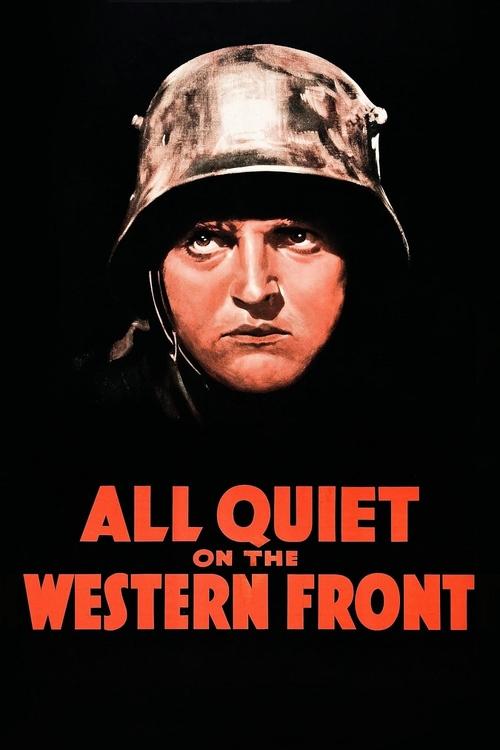
All Quiet on the Western Front
1930 · Lewis Milestone
For when you want a film that takes war seriously and you're ready to sit with something devastating. This is a challenge, not a comfort — reach for it when you want to be moved and sobered, not entertained.
What it's about
A classroom of German schoolboys, whipped into a patriotic fever by their teacher, enlists for the First World War expecting glory. What they find on the Western Front is mud, hunger, shellfire, and the slow erosion of everything they were promised. The film follows them from boot camp through the trenches as the war grinds their idealism down to bare survival, and the bond between the young soldiers and a weathered veteran becomes the only thing holding them together.
The experience
Bleak, immersive, and startlingly modern for its age — the battle scenes still land with real force, and the quieter stretches between them ache. It builds a heavy, mournful weight that stays with you well after it ends.
Performances
Lew Ayres, as the young soldier Paul, carries the film's disillusionment on his face — an open, boyish presence that the war visibly hollows out, in one of the defining performances of early sound cinema.
The craft
Made at the exact moment movies learned to talk, it keeps the sweeping, mobile camera of the silent era — long tracking shots gliding along the trenches as machine guns rake the attacking lines — and adds the roar of shells and gunfire, used with brutal restraint and no musical cushioning. The battle sequences were staged at enormous scale and still look expensive and terrifying. The black-and-white imagery rewards the biggest screen you can find.
Why it matters
It won the Academy Award for Best Picture, set the template every anti-war film since has worked from, and was so politically potent that it was banned in Germany. It remains the benchmark for depicting the First World War on screen.
Snapshot
All Quiet on the Western Front is the foundational American sound film about the First World War and, by wide consensus, the most influential anti-war film of the early talkie era. Adapted from Erich Maria Remarque's 1929 novel Im Westen nichts Neues, it follows a class of German schoolboys swept into the trenches by their teacher's nationalist rhetoric and ground down, one by one, into corpses or hollowed survivors. Universal Pictures, then a second-tier studio, staked an unusually large budget on the project under the new production chief Carl Laemmle Jr.; the gamble produced both a critical landmark and the Academy Awards for Outstanding Production and Best Director at the third ceremony. Made at the precise hinge between silent and sound technique, the film fuses the mobile, choreographed camera of late silent cinema with the new expressive possibilities of recorded sound and dialogue. Its central insight — that war is neither heroic nor redemptive but an industrial machine for destroying the young — was radical for Hollywood in 1930 and remains the template against which subsequent combat films are measured. Banned and rioted over in Weimar Germany, it is a film whose reception is inseparable from its politics.
Industry & production
The film was a signature production of Universal's brief, ambitious prestige phase. Carl Laemmle, the studio's founder, handed studio reins to his twenty-one-year-old son Carl Laemmle Jr. in 1928, and All Quiet became the younger Laemmle's defining bid for respectability. Universal had built its fortunes on horror, serials, and modest programmers; committing major resources to a sober literary adaptation about defeated German soldiers was a deliberate reach for cultural standing. The reported budget — frequently cited as well over a million dollars, an enormous sum for Universal — funded extensive trench sets and battlefield earthworks constructed on ranch land in California, with hundreds of extras, many of them said to be war veterans.
The production sits squarely in the awkward transitional moment of 1929–30, when studios shot in both sound and silent versions to serve theaters not yet wired for sound; a silent version of All Quiet was prepared alongside the sound release. The film's commercial life was complicated by its subject: domestically it was a prestige success and Oscar winner, but its international fortunes were politically fraught, most notoriously in Germany, where its 1930 Berlin screenings were disrupted by Nazi-organized riots — Joseph Goebbels among the agitators — leading to the film's withdrawal and effective banning. The episode is one of the clearest early cases of a Hollywood film becoming a flashpoint in another nation's domestic politics.
Technology
All Quiet was made on the leading edge of sound-on-film technology, only two to three years after The Jazz Singer (1927) demonstrated synchronized dialogue's commercial power. By 1930 the industry had largely standardized optical sound recorded directly onto the film strip, but the apparatus remained cumbersome: microphones were stationary and concealed, and cameras — noisy enough to spoil a sound take — were typically immured in soundproof booths or "blimps" that crippled their mobility. Many early talkies are consequently static and stage-bound.
The technological significance of All Quiet lies in how aggressively Milestone and his crew fought these constraints. The film is notable for restoring camera movement to a medium that sound had temporarily frozen, using crane and tracking apparatus to sweep over battlefields even as it carried recorded sound. The production also exploited the new sound technology not merely for dialogue but as a weapon of the film's anti-war argument — the continuous roar of shellfire, machine guns, and chaos becomes an enveloping sonic environment rather than a discrete effect. The exact details of the post-synchronization and mixing are not fully documented in popular sources, and where the technical record is thin it should not be overstated; but the film is routinely and rightly cited as a demonstration that the early sound camera could move.
Technique
Cinematography
Arthur Edeson's cinematography is the film's most celebrated craft achievement. Edeson, an experienced silent-era cameraman, mounted the camera on cranes and tracking rigs to produce the film's signature battlefield passages, in which the lens travels laterally along the trenches and over no-man's-land as soldiers advance and fall. The most famous figure is the tracking shot that glides alongside an attacking line while a fixed machine gun cuts men down in sequence, the camera's smooth motion held in cold counterpoint to the slaughter. Edeson favors deep, expansive framings of the battlefield that emphasize scale and exposure — the smallness of individual bodies in a churned, smoking landscape — alternating with tighter, more intimate compositions in the trenches and dugouts. The visual rhetoric is consistently anti-romantic: there is little of the heroic backlighting or ennobling composition that later combat cinema would lean on.
Editing
Edited by Edgar Adams (with Milestone's strong editorial sensibility shaping the film — Milestone had himself worked as an editor early in his career), the film deploys montage with real force, particularly in its battle sequences, where rapid cutting between charging figures, explosions, and falling men generates the sensory overload of combat. The editing is also structural: the narrative proceeds as a series of episodes — enlistment, training, the front, leave, return — that accumulate into an argument rather than a conventional plot, each movement stripping away another layer of the protagonists' illusions. The famous closing image, in which a hand reaches toward a butterfly, depends entirely on editorial timing for its devastating effect, the cut withholding and then delivering the death it implies.
Mise-en-scène / staging
The production design renders the Western Front as an exhausting, mud-choked, denuded world. Trenches, dugouts, shell craters, and barbed wire fill the frame; the recurring motif of a blasted, treeless landscape gives the battle scenes their bleak uniformity. Milestone stages mass action with documentary-like density — waves of men moving across open ground — but reserves his most pointed staging for confined spaces: the dugout under bombardment, the field hospital, the shell hole where Paul is trapped with a dying French soldier. The contrast between the impersonal vastness of the battlefield and the claustrophobic intimacy of these enclosures is one of the film's central spatial ideas, and it is built into the staging rather than merely the script.
Sound
Sound is not incidental to All Quiet but integral to its meaning. The film uses the relentless noise of artillery and gunfire to convey the psychological attrition of trench warfare — a soundscape of near-constant threat from which there is no relief. Dialogue is handled naturalistically rather than declaimed, and the film notably avoids a wall-to-wall musical score, allowing silence and ambient battle sound to carry long passages. This restraint was unusual and forward-looking; many contemporaries either over-scored their films or treated sound as filmed theater. All Quiet's recognition that sound could be used for immersion and dread — and that its strategic absence could be as powerful as its presence — marks it as one of the most sophisticated early uses of the medium.
Performance
Lew Ayres carries the film as Paul Bäumer, the sensitive schoolboy whose disillusionment is the audience's. Ayres plays the role with a quiet, increasingly haunted naturalism that resists the broad emoting common in early talkies; the part made him a star and, famously, shaped his life — Ayres became a conscientious objector in the Second World War, a stance widely linked to the film. Louis Wolheim, a gravel-voiced character actor, provides the film's moral ballast as the veteran Katczinsky ("Kat"), who mentors the recruits in the brutal practicalities of survival; the bond between Paul and Kat supplies the film's emotional center. The ensemble of young actors playing the doomed classmates is used precisely for its interchangeability — the point is that they are a generation, not a set of individuals — while John Wray's drill sergeant Himmelstoss embodies the petty tyranny of military authority.
Narrative & dramatic mode
The film's dramatic mode is tragic and cumulative rather than goal-driven. It opens with a rhetorical frame — the schoolmaster Kantorek's patriotic exhortation that it is sweet and fitting to die for the fatherland — and then methodically dismantles that ideology through experience. There is no mission to accomplish, no victory to win; the structure is one of erosion, in which characters are introduced largely so that they can be killed, and the protagonist's arc bends not toward triumph but toward a numbed, doomed clarity. The pivotal shell-hole sequence, in which Paul stabs a French soldier and then must watch him die slowly, crystallizes the film's argument: the enemy is a frightened man like himself, and the war is a crime committed against both. The famous return-home episode, where Paul finds civilians still mouthing the rhetoric that sent him to die and discovers he can no longer speak to them, completes the thematic circuit. The ending refuses catharsis — death arrives almost casually, in a moment of beauty — leaving the audience with grief rather than resolution.
Genre & cycle
All Quiet belongs to, and substantially defines, the anti-war combat film. It arrived amid a late-1920s and early-1930s cycle of war pictures — The Big Parade (1925), Wings (1927), Journey's End (1930) — that increasingly treated the Great War with disillusionment rather than jingoism, part of a broader interwar cultural reckoning that also produced Remarque's novel and a wave of war literature. Within that cycle All Quiet is the most uncompromising, and it established many of the war film's durable conventions: the diverse squad bonded under fire, the cynical veteran mentor, the training-to-front structure, the death of comrades as the narrative's pulse. Crucially, it does so from the perspective of the former enemy — its soldiers are German — which makes its universalist humanism all the more pointed and was itself a daring generic choice for an American studio addressing audiences barely a decade past the war.
Authorship & method
Lewis Milestone, a Russian-born émigré who had served in the U.S. Signal Corps during the war and worked as a film editor before directing, brought both firsthand familiarity with military life and a montage-trained eye to the project. His direction is marked by the integration of fluid camera movement, dynamic cutting, and large-scale staging — a synthesis of silent-era visual sophistication with sound-era resources. All Quiet is generally regarded as the peak of his career; he won the Academy Award for directing and, while his later filmography (including A Walk in the Sun, 1945) is respected, nothing else he made attained the same stature.
The key collaborators are essential to the achievement. Cinematographer Arthur Edeson designed the celebrated tracking and crane work and would go on to a distinguished career (later shooting The Maltese Falcon and Casablanca). The screenplay was adapted from Remarque by a team including Maxwell Anderson and George Abbott, who shaped the novel's episodic interior narrative into dramatic scenes while preserving its anti-war thesis. The film's restrained approach to music — eschewing the continuous scoring that would soon become standard — was itself a defining authorial choice. Producer Carl Laemmle Jr. deserves credit as the executive will behind the film's scale and seriousness. Where individual technicians' contributions are not fully documented in the popular record, claims should be made cautiously; the film was, by all accounts, a genuinely collaborative feat of early-sound filmmaking.
Movement / national cinema
The film is a product of the Hollywood studio system at the dawn of sound, not of any formal art movement, but its technique bears the imprint of two important currents. The first is the late American silent cinema's mastery of mobile camera and large-scale spectacle, visible in the lineage running from King Vidor's The Big Parade. The second is the influence of Soviet montage theory, which by the late 1920s had reached Western filmmakers; Milestone's editing-driven battle sequences show an affinity for the expressive collision of images associated with Eisenstein and Pudovkin, even if the film is built on Hollywood's continuity foundations rather than dialectical montage proper. Nationally, the film is a distinctly American treatment of a German story, and its place in German cultural history is largely one of rejection and suppression in the Weimar and Nazi periods — a national-cinema relationship defined by exclusion rather than belonging.
Era / period
All Quiet is doubly a period work: it depicts the years 1914–18 and it embodies the technological and cultural moment of 1930. Its 1914–18 setting places it within the immediate aftermath of the war it portrays — released only twelve years after the Armistice, to audiences for whom the Great War was living memory and active grief. Its 1930 production moment is equally legible in the film: it is a transitional-era sound film, made as Hollywood was still learning what the new technology could do, and its boldness in moving the camera and using sound immersively is inseparable from the experimental energy of that hinge year. It also belongs to the brief window of relative frankness before the Production Code was rigorously enforced from 1934, and to the disillusioned interwar sensibility — the same cultural mood that produced the literature of the "lost generation."
Themes
The film's governing theme is the betrayal of the young by the old — by teachers, politicians, and a culture that packaged industrial slaughter as glory. From this flow its other concerns: the gulf between patriotic rhetoric and lived combat; the dehumanization of soldiers into expendable material; the shared humanity of supposed enemies, dramatized in the shell-hole confession; and the impossibility of return, the soldier estranged forever from the civilian world that sent him to fight. The motif of the classroom frames the film — the boys leave one and Paul returns to find the same teacher recruiting a new crop, the cycle poised to repeat. Death is rendered not as sacrifice but as waste, and the film's refusal to find meaning in that death is the source of both its bleakness and its moral authority. The butterfly of the ending condenses these themes into a single image: fragile beauty and instant, meaningless extinction.
Reception, canon & influence
Critically, All Quiet was received in the United States as a major achievement and was honored with the Academy Awards for Outstanding Production and Best Director, a rare convergence of prestige and craft recognition for a film of such uncompromising subject matter. Its reputation has only grown; it is a fixture of canons of great American films and of the war-film genre specifically, and it was among the works selected for preservation in the National Film Registry. Its reception abroad was a different story, with the German riots and ban making it an early symbol of cinema's collision with political extremism — a dimension that has become part of the film's historical meaning.
Looking backward, the film's influences are clear: Remarque's novel above all, which supplied its structure, its episodes, and its anti-war conviction; the disillusioned interwar war literature and the earlier Hollywood war-film cycle (The Big Parade, Wings); and the techniques of late silent cinema and Soviet montage that Milestone synthesized.
Looking forward, its legacy is vast. All Quiet established the grammar and the moral seriousness of the modern combat film, and virtually every subsequent anti-war picture works in its shadow — the lineage runs through Paths of Glory, Platoon, Full Metal Jacket, Saving Private Ryan, and beyond, all of them inheritors of its insistence that combat be shown as horror rather than adventure. Its conventions — the doomed squad, the veteran mentor, the death-of-comrades structure — became genre furniture. The novel and this adaptation have together generated remakes (a 1979 television version and a 2022 German-language feature that itself won wide acclaim and Academy recognition), a testament to the enduring power of the source and of Milestone's original. Few films of the early sound era have proven so durable, and fewer still have so completely defined the way an entire genre would think about its subject.
A Deleuzian reading
The camera moves the way it would move along something beautiful — a riverbank, a row of dancers.
The full Deleuzian reading of All Quiet on the Western Front →
Reception
One of the very few early Best Picture winners cinephiles still rave about — it swept the 1930 Oscars, got banned in Nazi Germany, and nearly a century later it's still routinely called the greatest anti-war film ever made rather than a dusty relic.
How All Quiet on the Western Front was received, from release to now →
Influences: the films it descends from and the films it influenced
- The Big Parade (1925) — Milestone's no-man's-land advance directly extends Vidor's metronomic dolly tracking soldiers marching in lockstep into the woods, and inherits its episodic doughboy's-eye structure of training, the front, and disillusion.
- Wings (1927) — Established the Hollywood prestige WWI cycle's appetite for large-scale combat staging with real ordnance, crowds, and pyrotechnics that licensed All Quiet's epic battlefield scale.
- Battleship Potemkin (1925) — Supplied the Soviet collision-montage Milestone applied to the over-the-top assaults — rapid rhythmic intercutting of charging men, machine-gun fire, and falling bodies to make slaughter legible as rhythm.
- Mother (1926) — Modeled montage-of-linkage, building emotional accumulation through associative cutting rather than continuity — the editorial logic behind All Quiet's battle and death sequences.
- The Last Laugh (1924) — Karl Freund's 'unchained camera' — the liberated crane and dolly gliding through space — is the direct precedent for Arthur Edeson's celebrated tracking and crane work over the trenches.
- J'accuse (1919) — Pioneered the cinema of anti-war disillusionment, treating combat as moral horror and the dead as accusation, the conviction Remarque and Milestone formalized.
- Variety (1925) — Karl Freund's roving subjective camera here proved the expressive mobile shot to Hollywood, feeding the fluid-camera vocabulary Edeson deployed at the front.
- Grand Illusion (1937) — Extends the enemy-as-fellow-man humanism — most literally All Quiet's shell-hole scene with the dying French soldier — into a full study of soldiers' shared humanity across the line.
- Paths of Glory (1957) — Inherits the mobile camera as moral instrument, tracking laterally through the trenches and across no-man's-land, married to All Quiet's anti-war indictment of the command that feeds men to the machine.
- The Steel Helmet (1951) — Carries forward the doomed-squad combat naturalism and veteran-mentor furniture All Quiet codified, stripped to lean ground-level grunt observation.
- Platoon (1986) — Reuses the death-of-comrades structure and ground-level grunt POV, insisting combat be shown as horror rather than adventure — the core inheritance from Milestone's grammar.
- Full Metal Jacket (1987) — Dramatizes war-as-industrial-machine via the dehumanizing processing of recruits, the boot-camp-to-front erosion arc that All Quiet's Kantorek/training opening first templated.
- Come and See (1985) — Pushes the haunted-naturalism performance — the thousand-yard stare and the face aged by horror — to its extreme, extending Lew Ayres's hollowed-out final affect.
- Saving Private Ryan (1998) — Inherits the diegetic-battle-soundscape and montage-driven combat assembly, rendering the assault as disorienting visceral chaos stripped of heroic scoring — Milestone's restraint amplified.
- 1917 (2019) — Extends the tracking-and-crane camera through no-man's-land into a sustained continuous-movement immersion, the direct heir to Edeson's gliding battlefield mobility.
- All Quiet on the Western Front (2022) — A direct re-adaptation of Remarque that re-stages the industrial-machine thesis and the tragic-erosion arc, consciously measuring itself against Milestone's grammar of combat horror.
- From Here to Eternity (1953) — Milestone's structural use of a single recurring prop (the boots) as an ironic mortality marker that accrues meaning through repetition until its final appearance delivers the film's moral verdict established the diegetic-motif-as-structural-anchor technique Zinnemann employs with Taps.
- Das Boot (1981) — Founds the anti-war template of men-as-expendable-materiel and the anti-cathartic ending, where survival through the ordeal is annulled by an arbitrary final death — the exact structural move of Das Boot's dockside finale.
- The King's Man (2021) — The foundational source for the over-the-top charge and machine-gunned no-man's-land tableau that defines the trench sequences' iconography.
- A Walk in the Sun (1945) — Milestone returns to the same naturalistic infantry-ensemble method — a small squad observed across a single grinding operation, dialogue and ambient sound foregrounded over score.
- Hell's Angels (1930) — The other 1930 answer to the problem of sound-era spectacle: Arthur Edeson's crane-borne lateral tracking shots across the trench line restore mobility to a blimped camera on the ground, the terrestrial counterpart to Hughes's camera ships.
Similar films
- All Quiet on the Western Front (2022) — influence & lineage
- 1917 (2019) — influence & lineage
- Platoon (1986) — influence & lineage
- J'Accuse (1919) — influence & lineage
- Grand Illusion (1937) — influence & lineage
- Paths of Glory (1957) — influence & lineage
- Saving Private Ryan (1998) — influence & lineage
- Battleship Potemkin (1925) — influence & lineage
All the films related to All Quiet on the Western Front →