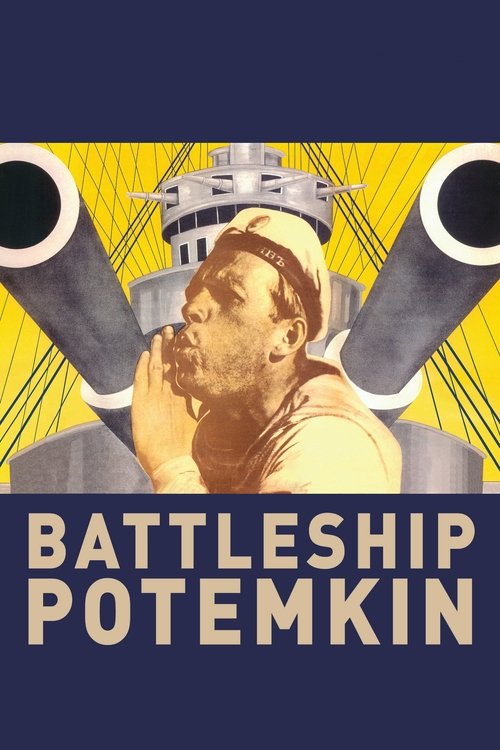
Battleship Potemkin
1925 · Sergei Eisenstein
For when you're curious where movie language actually comes from and want the lesson to be visceral, not homework. It's a challenge pick, but a short one — 75 minutes of pure momentum.
What it's about
Aboard a Tsarist warship in 1905, sailors fed maggot-ridden meat push back against their officers, and a shipboard grievance ignites into full mutiny. When the city of Odessa rallies to the sailors' side, the empire answers with soldiers on the great harbor steps. There's no single hero — the crew, the crowd, and the fleet itself are the protagonist.
The experience
A silent film that hits like a fist: short, furious, and built to make your pulse climb through pure editing rhythm. The Odessa Steps sequence is still genuinely harrowing a century on — panic engineered frame by frame.
The craft
This is the founding demonstration of montage — meaning generated by the collision of shots, tempo used as a weapon. Faces, boots, a rolling baby carriage: individually simple images cut together into overwhelming force. See it with live or well-chosen musical accompaniment if you can; the editing is the score's dance partner.
Why it matters
Within a few years it was being called the most advanced film ever made and banned in several countries — a measure of how dangerous pure editing suddenly looked. Its techniques, and the Odessa Steps sequence above all, have been studied, taught, and quoted by filmmakers ever since.
Snapshot
Commissioned to mark the twentieth anniversary of the 1905 Russian Revolution, Battleship Potemkin dramatizes a naval mutiny aboard a Tsarist warship and the massacre of civilian sympathizers on the Odessa Steps. Running approximately seventy-five minutes in its canonical form, it is divided into five titled acts that follow a classical tragic arc: Men and Maggots / Drama on the Quarterdeck / An Appeal from the Dead / The Odessa Steps / Meeting the Squadron. The film is less a conventional narrative than a kinetic argument — a proof-of-concept for Eisenstein's emerging theory of montage as dialectical collision. No single hero drives the action; the collective — crew, townspeople, fleet — is the protagonist. Within two years of its release it had been both celebrated as the most advanced film yet made and banned in half a dozen countries. It remains the foundational text of Soviet montage cinema and one of the most cited films in the history of the medium.
Industry & production
Potemkin grew out of a sprawling, ultimately unrealized commission. Eisenstein and co-writer Nina Agadzhanova-Shutko had been developing a multi-episode panorama of the entire 1905 revolution — a project of epic scope that would have required years to complete. As the December 1925 anniversary approached, the decision was made to develop only the Potemkin mutiny episode into a standalone film. Shooting proceeded at a compressed pace, primarily in Odessa and on the Black Sea, during the summer and autumn of 1925, with additional footage shot in Leningrad.
The film was produced under the auspices of Goskino, the Soviet state film enterprise, with production managed by Jacob Bliokh. Because no actual surviving ship of the Potemkin class was available, production used the decommissioned battleship Twelve Apostles, then serving as a storage hulk in Sevastopol harbor, for the shipboard sequences, supplementing it with footage shot aboard other vessels. Eisenstein was twenty-seven years old. He had made only one prior feature, Strike (1924), and had come to cinema from the theater, specifically from study under the biomechanist director Vsevolod Meyerhold. The production budget is not documented in figures that have been reliably established in the scholarly record.
Technology
Potemkin was shot on orthochromatic black-and-white film stock, which responded strongly to blue and green tones while compressing reds — a characteristic that cinematographer Eduard Tisse turned to expressive advantage in the harbor sequences, where the tonal contrast between sky, water, and hull could be precisely manipulated. The film is silent. In at least some exhibition prints prepared for early screenings, a single frame — the flag raised over the mutinous ship — was hand-tinted red, a pointed use of selective color that had been part of the film grammar since the Lumière era but here carried unmistakable political charge.
Camera technology was conventional for 1925: hand-cranked and fixed-mount cameras were the norm, though Tisse devised improvised rigs to achieve movement through the crowd on the steps. Some accounts credit the use of cameras mounted on moving platforms, on the bodies of operators, and at ground level. The film was edited on a Moviola, the dominant flatbed editing apparatus of the period.
Technique
Cinematography
Eduard Tisse, Eisenstein's permanent collaborator throughout the silent period, is the unsung co-architect of the film's visual language. His work on the Odessa Steps sequence — framing that repeatedly alternates between the vast spatial sweep of the staircase seen from above and the compressed, ground-level terror of boots descending into frame — organizes an enormous crowd into legible visual geography without losing the sense of chaos. The famous close-ups of a mother's face, a pince-nez, a perambulator are given weight precisely because Tisse has established the spatial field they inhabit. His harbor and fog sequences, shot in soft early-morning light, create a counterweight of lyrical stillness against which the film's violence registers more sharply. Low angles recur throughout, imparting a monumental, almost sculptural mass to figures — the priest's cross, the officer's saber, the doctor's pince-nez — that the montage will then subject to ironic or violent deflation.
Editing
The editing is the film's primary argument. Eisenstein theorized, in essays written during and after production, that montage operates not through smooth continuity (the model he associated with D. W. Griffith and classical Hollywood) but through collision: two shots placed in sequence generate a meaning that neither contains independently, analogous to the Hegelian dialectic of thesis and antithesis producing synthesis. He identified several registers of this collision — metric montage (cutting on rhythmic duration), rhythmic montage (cutting on movement within the frame), tonal montage (cutting on emotional or tonal register), overtonal montage (the layered combination of the above) — and Potemkin demonstrates each, often simultaneously.
The most celebrated illustration is the sequence of the stone lions. Three separate statues at the Vorontsov Palace in Alupka are cut together — one sleeping, one rising, one alert — to produce the impression of a single lion stirring to life. No camera movement, no trick photography: the effect is entirely editorial. The Odessa Steps sequence uses accelerating metric montage in its final phases, shots growing shorter as the tempo drives toward the perambulator's plunge. The editing in the fifth act, as the mutinous ship steams toward the Tsarist fleet and the fleet opens its formation in solidarity, resolves the film's dialectical tension — oppression and resistance — into a rhetorical affirmation that functions as both political argument and formal climax.
Mise-en-scène / staging
Eisenstein's staging consistently treats crowds as formal material. Masses of sailors, townspeople, and soldiers are arranged according to compositional logic derived partly from constructivist visual art and partly from biomechanical theater. The tarpaulin scene, in which the condemned sailors are covered before execution, produces a tableau of anonymous, draped shapes that Eisenstein frames and cuts as a piece of graphic abstraction before Vakulinchuk tears the canvas free. The church-going priest — a barrel-chested figure with raised cross — is staged as a near-caricature, a type rather than a person, consistent with Eisenstein's systematic avoidance of psychologically individuated character. Real locations in Odessa (the port, the harbor steps, the Richelieu staircase) are used throughout, lending physical authenticity that studio recreations could not have supplied.
It bears noting that the Odessa Steps massacre as depicted in the film has no confirmed historical parallel of that specific form. The 1905 events in Odessa were genuinely violent and chaotic, but the canonical staircase sequence — the marching soldiers, the perambulator — appears to be largely Eisenstein's dramatic invention, a composite and intensification rather than a documentary record.
Sound
Potemkin was released as a silent film; its "sound" was always supplied by live orchestral accompaniment in exhibition. The score composed by Edmund Meisel for the film's celebrated Berlin premiere in 1926 became associated with the work and was considered by contemporaries a bold, almost expressionist collaboration between music and image — Meisel reportedly composed accelerating, industrial rhythms for the Steps sequence that contributed materially to its physical impact on audiences. The pairing of Meisel's score and Eisenstein's cutting was understood at the time as an early model of what synchronized sound might eventually accomplish. In the decades since, the film has attracted numerous new scores; its relationship to any single musical accompaniment remains unstable and contested.
Performance
Eisenstein worked almost entirely with non-professional performers, a practice he theorized under the term typage: the systematic casting of individuals for their physical characteristics — facial structure, body type, bearing — rather than acting ability. A sailor should look, in Eisenstein's formulation, like what a sailor is; a priest should carry the visual grammar of priesthood. Professional actors, in his view, brought the accumulated habits of stage performance and tended to individualize characters in ways that compromised the collective argument. Aleksandr Antonov plays the sailor Vakulinchuk, the film's closest thing to an individual protagonist, but even Vakulinchuk dies early and gives way to the crowd. Grigori Alexandrov, later a significant Soviet director in his own right, appeared in the film and served as assistant director. The result is a cast whose faces read as types, masks almost, pressed into rhetorical service.
Narrative & dramatic mode
The five-act structure of Potemkin is explicitly modeled on classical tragic form — Eisenstein acknowledged the parallel — but the content subverts tragic convention. There is no hamartia in the individual, no fall of a great man; the collective rises rather than falls. The film's dramatic mode is oratory rather than drama in the Aristotelian sense: each sequence is structured as an argument, a demonstration, a call to response. The narrative ellipsis is radical: entire swaths of causal logic are omitted, and the viewer is asked to supply connection through the emotional logic of the cuts rather than through plot. The final act's resolution — fleet opens for ship, enemy becomes comrade — is wishful history, a propagandistic revision of the actual 1905 events, in which the Potemkin mutiny ended in exile rather than revolutionary solidarity.
Genre & cycle
Potemkin is foundational to the Soviet revolutionary film cycle of the 1920s, a body of work commissioned and partially state-funded to memorialize and mythologize the events of 1905 and 1917. Eisenstein's near-contemporaries — Vsevolod Pudovkin (Mother, 1926; The End of St. Petersburg, 1927), Alexander Dovzhenko (Arsenal, 1929), and Dziga Vertov in the documentary line — constitute the movement alongside him, though each developed distinct theories and practices. Potemkin is also a founding work of the war film and the action film as genres: the Odessa Steps sequence established a template for staged large-scale violence that Hollywood would spend the following century adapting and inflating.
Authorship & method
Eisenstein arrived at cinema through the visual and performing arts. He trained briefly as an engineer, worked in agitprop theater, studied biomechanics under Meyerhold, and had absorbed constructivist art theory and Japanese aesthetics (Kabuki and the principle of contradictory gesture) before he directed a frame of film. His theoretical writing is inseparable from his practice: essays on montage, on the attraction, on the shot as cell, were being written in tandem with the films themselves.
His partnership with Eduard Tisse, who shot virtually all of his silent films, was one of the great director-cinematographer collaborations of the period. Tisse's practical mastery of light, lens, and location gave Eisenstein's compositional theories a physical form, and the two seem to have worked iteratively, with the shooting plan adapting continuously to what locations and weather made available. Grigori Alexandrov's role as assistant director on Potemkin and subsequent Eisenstein films was substantial enough that questions of co-authorship are sometimes raised, though the scholarly consensus attributes primary creative agency to Eisenstein.
Movement / national cinema
Potemkin is the canonical example of Soviet Montage cinema, the movement that dominated Soviet filmmaking from roughly 1924 to 1929, before Socialist Realist orthodoxy imposed by Stalin-era cultural policy suppressed formal experimentation. The movement was theoretically sophisticated in a way unusual for a national cinema: its practitioners — Eisenstein, Pudovkin, Kuleshov, Vertov — were also polemicists, and the films were accompanied by theoretical manifestos and essays that gave the movement an intellectual infrastructure. Soviet montage cinema had direct contact with the European avant-garde (particularly German Expressionism and French avant-garde cinema), and its influence flowed bidirectionally across national borders with unusual speed given the political circumstances of the period.
Era / period
The film belongs to the final years of the international silent cinema — the period between the consolidation of feature-length narrative form (roughly 1915–1920) and the rapid transition to synchronized sound triggered by The Jazz Singer in 1927. In this window, silent cinema achieved its highest formal sophistication precisely because the medium had been fully mastered and not yet disrupted. Potemkin is also a product of the specific cultural conditions of the early Soviet state: a brief period of relative artistic freedom under NEP (New Economic Policy) in which formal experimentation was tolerated and even institutionally supported, before the tightening of cultural policy in the late 1920s and early 1930s.
Themes
Class solidarity and collective action are the film's explicit subjects: the mutiny is presented as a microcosm of revolutionary transformation, with the moment of class recognition — sailors refusing to fire on their comrades — as its moral and dramatic hinge. The film is also concerned with the body as political site: the condemned men's bodies beneath the tarpaulin, Vakulinchuk's displayed corpse, the bodies falling on the steps, the baby in the perambulator. Violence against the body is the mechanism of oppression; collective recognition of that violence is the mechanism of resistance. A subtler theme is the relationship between spectacle and solidarity: the townspeople descend to the harbor to look at Vakulinchuk's body, and looking becomes political action. The film seems to theorize its own operation — to suggest that the audience's act of watching can be, in itself, a form of class consciousness.
Reception, canon & influence
Critical reception. The Moscow premiere on December 21, 1925 was received with recognition of the film's ambition, but the international sensation came with the Berlin release in the spring of 1926, where audiences and critics, including significant figures of the German film world, responded with astonishment. The film was banned outright or subjected to severe censorship in Britain, France, and a number of other countries on the grounds of its revolutionary content. Joseph Goebbels, in documented diary entries, expressed admiration for the film as a model of effective propaganda — a backhanded tribute that has followed Potemkin's reputation ever since. At the 1958 Brussels World Exposition, an international critics' poll voted it the greatest film ever made, a verdict that established its canonical position definitively in the postwar film culture. It has ranked among the highest in every subsequent major critical survey, including the recurring Sight & Sound polls.
Influences on the film. Eisenstein's primary acknowledged cinematic debts were to D. W. Griffith, specifically to the large-scale crowd management and cross-cutting of Intolerance (1916) and Birth of a Nation (1915), though Eisenstein was sharply critical of what he saw as Griffith's ideological limitations. The theoretical framework was drawn from Marxist dialectical materialism (the collision of opposites producing synthesis), from Meyerhold's biomechanical theater and the idea of the actor as material, and from Eisenstein's study of Japanese Kabuki and Noh, which he cited as models of expressive discontinuity. Lev Kuleshov's experiments at the State Film School — particularly the "Kuleshov effect," demonstrating that the meaning of a shot changes with its editorial context — provided the empirical foundation for Eisenstein's broader montage theory.
Legacy and forward influence. The film's influence on subsequent filmmaking is so pervasive as to be difficult to map exhaustively. The Odessa Steps sequence is among the most imitated single sequences in cinema history: Brian De Palma's The Untouchables (1987) pays explicit homage in the Union Station sequence; Woody Allen's Bananas (1971) parodies it; Francis Ford Coppola and countless others have cited it. More diffusely, the grammar of action filmmaking — accelerating cutting, fragmented close-up, the rhythmic subordination of images to emotional effect — descends in a largely unbroken line from Eisenstein's practice. The French New Wave directors, particularly Godard, engaged Eisenstein's montage theory directly as a counter-model to Hollywood continuity editing. Soviet montage influenced the documentary tradition through Vertov and, later, through the compilation film and the politically engaged documentary of the 1960s. Eisenstein's theoretical writings became central texts in the first wave of academic film studies, and Potemkin remains a required subject in virtually every film education curriculum globally. Its status as both a great work of art and a piece of state propaganda has ensured that it continues to generate argument about the relationship between aesthetic form and political instrumentality — a question the film does not resolve so much as dramatize with maximum force.
A Deleuzian reading
Three stone lions outside a palace in Alupka.
The full Deleuzian reading of Battleship Potemkin →
Reception
Hailed abroad almost instantly as proof cinema was an art form — while being banned for decades in Britain, France, and elsewhere as dangerous propaganda (the UK didn't fully clear it until the 1950s). It's spent most of the century since parked at or near the top of greatest-films-ever lists, including being voted the best film of all time at the 1958 Brussels World's Fair.
How Battleship Potemkin was received, from release to now →
Influences: the films it descends from and the films it influenced
- Birth of a Nation (1915) — Eisenstein built his collision-montage theory explicitly against Griffith's cross-cutting architecture, inheriting the close-up-within-crowd-scene grammar and parallel-editing's temporal manipulation while inverting its ideological function from affective continuity to dialectical shock.
- Intolerance (1916) — Griffith's Babylonian crowd sequences — elevated angles organizing thousands of extras into abstract geometric pattern — provided the compositional model that Tisse inverted into low-angle counter-framing, treating massed bodies as monumental architectural form rather than decorative backdrop.
- Cabiria (1914) — Pastrone's dolly shots tracking through physically present crowd spectacle established camera mobility within crowd space as viable grammar; Tisse adapted this into improvised body-mounted and ground-level rigs to achieve the Steps sequence's claustrophobic penetration of the descending crowd.
- Intolerance: Love's Struggle Throughout the Ages (1916) — The Odessa Steps sequence rebuilds Griffith's suspense crosscutting into collision montage, converting rescue tension into dialectical graphic conflict between shots.
- La Roue (1923) — The Soviet school dissected La Roue in Moscow while formulating montage theory; the Odessa Steps' systematic contraction of shot length and the engine-room fragments convert Gance's intuitive accelerando into a dialectical system.
- October (Ten Days That Shook the World) (1928) — Eisenstein extrapolated the stone-lions editorial figure into 'intellectual montage' — intercutting Kerensky with a mechanical peacock, accumulating religious icons from crude idol to Orthodox Christ — where collision of conceptual images rather than emotional or rhythmic register generates abstract ideological argument, taking Potemkin's three-statue sequence as its founding premise.
- Triumph of the Will (1935) — Riefenstahl appropriated Eisenstein's low-angle monumentalist framing and mass-body choreography as geometric political spectacle — crowd-as-pattern, leader filmed against open sky from below — deploying identical compositional devices to serve fascist ideology, the most documented and ideologically inverted formal inheritance in cinema history.
- Hiroshima Mon Amour (1959) — Resnais's dialectical intercut between the woman's Nevers trauma and the Hiroshima documentary archive applies the stone-lions editorial logic to temporal rather than spatial collision — two image-registers whose juxtaposition generates political-affective meaning that neither strand contains independently, transposing Eisenstein's rhetorical montage into phenomenology of memory.
- The Pawnbroker (1964) — Lumet and editor Ralph Rosenblum's flash-cut intrusions of Holocaust memory into the Harlem present transplant Eisenstein's dialectical collision principle into psychological trauma — involuntary montage as cognitive shock — extracting the stone-lions figure from political rhetoric and re-embedding it as the topology of involuntary recall.
- The Battle of Algiers (1966) — Pontecorvo explicitly modeled the film's crowd choreography, non-professional actors deployed as mass typage, and handheld penetration of political demonstrations on Potemkin, translating Eisenstein's Black Sea proletariat collective protagonist into the Casbah's FLN cell structure within an Italian neorealist documentary register.
- Apocalypse Now (1979) — The opening napalm sequence employs overtonal montage — superimposed images, percussive Doors rhythm, off-axis fragmentation — to induce psychological dislocation through collision rather than narrative causality; Coppola and Murch acknowledged Soviet montage theory as a direct design influence on this passage's structure.
- JFK (1991) — Stone and editor Pietro Scalia deploy dialectical montage as historical-political argument — intercutting archival footage, dramatic reconstruction, and found imagery so the juxtaposition itself constitutes the evidentiary claim — directly inheriting Eisenstein's model of editing as rhetorical proof rather than narrative continuity.
- Rose of Nevada (2026) — The source of Jenkin's dialectical montage — colliding shots of faces, hands and objects in graphic, near-abstract compositions to generate meaning from juxtaposition rather than continuity.
- 2001: A Space Odyssey (1968) — Eisenstein's intellectual montage — pairing dissimilar images to produce an argumentative third meaning beyond either — is the direct formal precedent for the bone-to-satellite cut; the edit does not merely elide time but equates tool-use with nuclear deterrence, executing in one frame change the argument the film argues across its entire length.
- The Untouchables (1987) — The Union Station baby-carriage sequence is a structural and visual citation of the Odessa Steps: De Palma replicates the tumbling carriage in optical slow motion as an explicit homage to Eisenstein's montage-as-collision principle, sustaining the set piece across dozens of cuts to produce the same agonized duration.
- Rome, Open City (1945) — Eisenstein's killing of the nurse and mother on the Odessa Steps establishes the grammar of anti-melodramatic rupture through sudden unsanctioned death of a sympathetic figure; Rossellini's decision to shoot Pina mid-film without cathartic preparation or narrative warning descends directly from this editing-as-moral-shock strategy.
- Psycho (1960) — The Odessa Steps sequence establishes the formal grammar Tomasini inherits for the shower scene: violence assembled from rapid montage of fragmented body parts — feet, hands, faces — without depicting the act itself, constructing kinetic dread through rhythm and ellipsis so that viewers misremember seeing what the editing only implies.
- Mother (1926) — Pudovkin's 'linkage' montage — shots connected causally upward rather than colliding dialectically — shares Potemkin's typage casting and collective-class subject while staking out the rival Soviet position: meaning built by association versus Eisenstein's third-term synthesis produced by collision.
- Napoléon (1927) — Gance's polyvision triptych and superimposed rhythmic montage of the storm-at-sea and Convention sequences represent an exact European parallel to Eisenstein's collision editing — accelerating cuts and layered images deployed as kinetic political history — with no documented cross-influence, making it the closest contemporary cognate in method.
- Metropolis (1927) — Lang and Karl Freund's choreography of worker masses in the underground city treats human bodies as interchangeable geometric units of visual composition — the same constructivist principle Eisenstein theorized as typage — arrived at through German expressionist stylization rather than Soviet materialist casting doctrine.
- Man with a Movie Camera (1929) — Vertov's kino-eye metric and rhythmic montage of labor and urban movement directly parallels Eisenstein's montage taxonomy, sharing the rejection of literary narrative and the construction of political meaning through editing rhythm, while foregrounding the apparatus itself as the theoretical proposition rather than the revolutionary subject.
- Arsenal (1929) — Dovzhenko adapted Eisenstein's collision-montage syntax to lyrical-elliptical ends — substituting organic and mythic image pairs (horse and soldier, season and revolution) for mechanistic shock-cuts — extending Soviet montage into a distinctly Ukrainian metaphysical register that decouples the method from Eisenstein's Hegelian materialism.
- Strike (1925) — In the Odessa Steps sequence Eisenstein refined Strike's collision grammar, using escalating cut rate and the intercutting of contrasting figures (soldier boots, mother's feet, runaway carriage) to extend the same dialectical editing toward maximum kinetic impact.
- Straw Dogs (1971) — Source of Peckinpah's collision-montage grammar — cutting on graphic conflict and fragmenting an assault into rhythmic shards (the Odessa Steps) rather than covering it in continuity, the method behind the ambiguous intercutting of Amy's assault.
- The Cranes Are Flying (1957) — Source of the associative, collision-based montage and the faith in the cut as an emotional rather than narrative instrument that Urusevsky's editing converts from political rhetoric to private grief.
- Memories of Underdevelopment (1968) — Source of the intellectual/dialectical montage Alea and editor Nelson Rodríguez deploy, cutting image against image so the collision generates an argument rather than a continuity.
- Antonio das Mortes (1969) — Model for Rocha's dialectical montage of collision and the treatment of the crowd as monumental protagonist, which he restages as horizontal ritual friezes.
- Fury (1936) — Source of the rhythmic-crescendo editing of collective violence (the Odessa Steps) that Frank Sullivan's montage of the mob forming and torching the jail deliberately echoes to build its accelerating argument.
Similar films
- Man with a Movie Camera (1929) — influence & lineage · often watched together
- Napoleon (1927) — influence & lineage · often watched together
- Triumph of the Will (1935) — influence & lineage
- Metropolis (1927) — influence & lineage
- I Am Cuba (1964) — same viewing thread
- Soundtrack to a Coup d'Etat (2024) — same viewing thread
- The Birth of a Nation (1915) — often watched together
- Strike (1925) — shared sensibility
All the films related to Battleship Potemkin →
Watch it with: curated runs of related films
- The Long Shadow of the Coup — A run of films tracing political violence from the mutiny and the massacre through martial law to the decades-long reckoning that follows — watch them near each other and the same machinery of power keeps rhyming across continents and eras.
Film essays and courses that include it
- From Riot to Trial: A Century of Banned Cinema
- The Art of the Assault: How Cinema Stages War
- How Cuts Think: From Soviet Montage to New Hollywood Rhythm
- The Camera at War: A Century of Reinvention
- Dialectics of the Soul: Russian Cinema from Eisenstein to Zvyagintsev
- Witness: Cinema's Century of War and Its Wound
- Men Under Orders: Cinema's Century at War
- Revolt in the Frame: Revolutionary Cinema 1925–2006
- Full Steam: A Century of Trains, Ships, and Planes
- The Cut That Stopped Meaning Anything
- The Meaning Is in Your Head