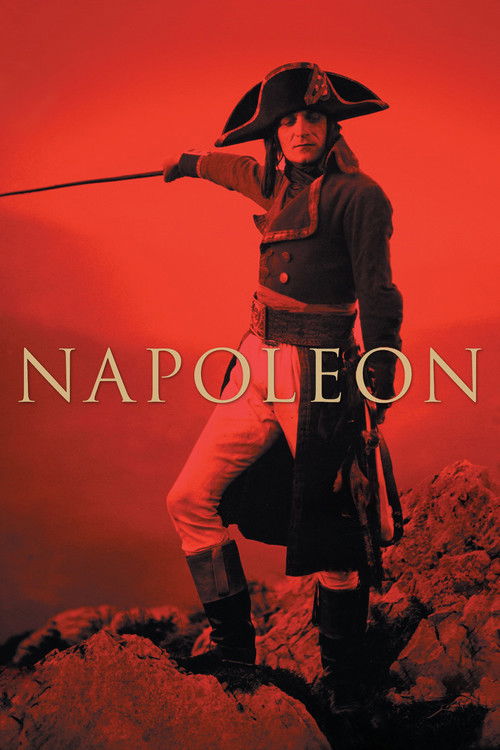
Napoleon
1927 · Abel Gance
For when you want a cinematic pilgrimage — an event screening, ideally with live score, rather than casual viewing. Choose it when you're curious what movies could do before anyone agreed on the rules.
What it's about
An enormous silent-era biography of Napoleon Bonaparte, beginning with a boyhood snowball fight at military school staged like a full military campaign and following him through the French Revolution, the Terror, and his flight from Corsica, up to the launch of the Italian campaign in 1797. It's history painted as legend: storms at sea intercut with the storm of politics, destiny announced in eagles and tricolor floods of imagery.
The experience
Overwhelming in the best sense — hours of cinema that feel like they're being invented as you watch, hurtling between intimate faces and delirious spectacle. Even a century on, the sheer audacity keeps you leaning forward; it's an endurance event that repays every minute.
Performances
Albert Dieudonné plays Napoleon as a man possessed by destiny, his gaunt, burning stare becoming the film's recurring exclamation mark — a performance pitched perfectly to the film's mythic scale.
The craft
Gance threw every technique he could invent at the screen: cameras strapped to horses, swung on pendulums, mounted on sleds; rapid-fire montage; superimpositions piled a dozen deep; and the legendary finale, where the image explodes into three synchronized screens — a widescreen triptych decades before widescreen existed. On a big screen with orchestral accompaniment it remains one of the most overwhelming experiences cinema offers.
Why it matters
A pinnacle of silent-film ambition whose restorations became landmark cinematic events in their own right, it anticipated widescreen and mobile-camera techniques by decades and stands as the great monument to what the silent era achieved at full stretch.
Snapshot
Abel Gance's Napoléon vu par Abel Gance is one of the great maximalist experiments of the silent era: a nearly six-hour biographical epic (in its fullest restored forms) that follows Bonaparte from a boyhood snowball fight at the military school in Brienne through the Revolution and the Terror to the opening of the 1796–97 Italian campaign. Conceived as the first installment of a projected six-film cycle that was never completed, the surviving film is at once a nationalist pageant and a laboratory of cinematic technique. It is remembered less for its politics than for its formal audacity — liberated, often violently mobile camerawork; percussive montage; and above all its climactic triptych, the three-screen Polyvision sequence that turns the final act into a widescreen spectacle decades before CinemaScope. The film's history is inseparable from its afterlife: mutilated and re-cut for distribution in the late 1920s, it was painstakingly reconstructed across half a century, most famously by the British historian Kevin Brownlow.
Industry & production
The film was produced through the Société générale de films, a French company assembled to back prestige productions, with additional financing drawn from a consortium of investors across Europe. Gance had already established himself as French cinema's most ambitious director with J'accuse (1919) and La Roue (1923), and Napoléon was mounted on a scale to match that reputation — a multinational shoot with a very large cast, extended location work (including in Corsica), and elaborate studio reconstructions of Revolutionary Paris.
The production was famously protracted and expensive, and Gance's ambitions repeatedly outran his resources; the original conception as a six-part life of Napoleon collapsed under the practical and financial impossibility of realizing it. The film premiered on 7 April 1927 at the Paris Opéra (Palais Garnier) in a gala presentation. Almost immediately, the length and the technical demands of the triptych finale — which required three synchronized projectors and a specially equipped auditorium — made wide exhibition difficult. Distributors, including in the American market, cut the film drastically, and the three-screen sequence was frequently dropped altogether. Precise budget and box-office figures are not something I can state reliably; the documentary record on the film's finances is genuinely uneven, and I will not invent numbers. What is certain is that the arrival of synchronized sound within months of the premiere helped strand the film commercially, leaving this monument of silent art orphaned at the very moment the silent era ended.
Technology
Napoléon is a catalog of technical innovation, most of it improvised in pursuit of expressive ends rather than developed as commercial systems. The signal invention is Polyvision: for the concluding Italian-campaign sequence, Gance filmed and projected across three adjacent screens. Sometimes the panels combine into a single panoramic widescreen image; at other times they carry three different images simultaneously — a central action flanked by mirrored or contrasting views — producing effects of symmetry, montage-in-space, and overwhelming scale. This anticipated widescreen and multi-screen cinema (Cinerama and its successors) by decades, though as a practical exhibition format it proved unsustainable.
Beyond Polyvision, the production pushed the physical camera to its limits. Gance and his operators mounted cameras in ways designed to free them from the tripod: strapped to the chests of running operators, fixed to horses, suspended on pendulums and wires, mounted on sleds, and — in the film's most-cited example — hurled or swung to plunge the viewer into the action. To achieve rapid superimposition and layered montage, the team relied on multiple-exposure work in the camera and in the laboratory, building images of great density. The film also made expressive use of tinting and toning, standard practice in the period but deployed here with unusual dramatic intent.
Technique
Cinematography
The principal cinematographer was Jules Kruger, working with a team of operators to realize Gance's demand for a camera that could move like a participant rather than an observer. The visual signature is kinetic subjectivity: the lens becomes a body in the world, careening through crowds, riding with cavalry, pitching on the sea. The celebrated double-storm sequence — Bonaparte fleeing Corsica in a small boat on a real, heaving sea, intercut with the "storm" of the Convention in Paris — literalizes this ambition, mounting the camera to swing with the boat so that the political tempest and the meteorological one share a single rocking rhythm. Elsewhere the cinematography ranges from intimate, sculpted close-ups (Bonaparte's face isolated in shadow) to vast crowd tableaux, and it exploits deep, dramatic contrast and expressive tinting to differentiate registers of feeling.
Editing
Editing is where the film's modernism is most concentrated, and Gance — working with his editor Marguerite Beaugé and cutting extensively himself — produced passages of montage whose speed and density were startling for 1927. He pushed toward extremely short shots, sometimes only a few frames long, to generate rhythmic, almost subliminal accumulations of imagery; he layered superimpositions so that multiple actions occupy the frame at once; and he built associative sequences that bind disparate spaces into a single emotional surge. This rapid, rhythmic cutting parallels the concerns of the Soviet montage filmmakers of the same decade, though Gance arrived at it by a different, more Romantic route — montage as ecstatic intensification rather than dialectical argument.
Mise-en-scène / staging
Gance stages history as a series of charged tableaux organized around symbolic rhyme. The Brienne snowball fight is directed as a miniature military campaign, the schoolboy Bonaparte marshalling his forces — a compositional pun that announces the film's method of reading destiny backward into childhood. The Revolutionary sequences fill the frame with massed bodies and iconographic detail: the Convention, the singing of "La Marseillaise" staged as collective delirium, the recurring imagery of eagles, flags, and the Republic. Set design reconstructs Revolutionary Paris at scale, and Gance repeatedly composes for symmetry and emblem, so that individual figures are absorbed into patterns of national meaning.
Sound
Napoléon is a silent film. For the 1927 Paris premiere it was accompanied by an orchestral score composed by Arthur Honegger, one of the leading modern French composers of the day — a mark of the production's prestige. As with most silent features, exhibition music varied by venue and print. The film's long restoration history has produced several major new scores, most notably Carl Davis's score for Kevin Brownlow's reconstruction and Carmine Coppola's score for the American Zoetrope presentation; these belong to the film's afterlife rather than its original release, and the distinction matters when the film is discussed as a "sound" object.
Performance
Albert Dieudonné plays the adult Bonaparte, and his performance fixes the film's image of Napoleon: severe, interior, eagle-eyed, more icon than man — a deliberately hieratic characterization that serves Gance's mythic conception. The supporting cast is notable for its avant-garde connections. Antonin Artaud — the poet and theorist of the "Theater of Cruelty" — appears as the revolutionary Jean-Paul Marat, and Gance himself plays Saint-Just. The acting idiom is broadly that of silent gesture, but Gance calibrates it toward emblem: figures are frequently held in expressive close-up so that a face becomes a historical sign.
Narrative & dramatic mode
The film is structured as a Romantic Bildungs-epic, tracing the formation of a "great man" through a sequence of formative trials rather than as a continuous chronological biography. Its dramatic logic is one of prefiguration and destiny: the child at Brienne already contains the general; the young officer buffeted by the Revolution is being forged for command; the double storm frames Bonaparte as the man who masters chaos. This is history rendered as fate, with Napoleon positioned as the Revolution's rightful heir and culmination — a providential reading that the film pursues with unembarrassed grandeur. Rather than dwelling on the later imperial career, the surviving film ends at the threshold of triumph, with the invasion of Italy, so that the whole functions as a prologue to a greatness the intended cycle would have gone on to depict.
Genre & cycle
Napoléon belongs to the tradition of the historical epic and the "great man" biopic, and specifically to the French vein of prestige historical spectacle. Within Gance's own output it forms part of a run of large-scale, morally and formally ambitious films (J'accuse, La Roue). It arrived near the close of the silent epic cycle — the era of vast historical and biblical spectacles — and stands as one of its most extreme and personal examples. Because the projected six-film series was never made, the film is, in genre terms, a magnificent fragment: an epic whose narrative arc was designed to continue across works that do not exist.
Authorship & method
The film is overwhelmingly an auteur's project. Gance wrote, directed, and heavily shaped the editing, and he pursued a method of total cinema in which every technical department was bent toward emotional and rhythmic intensity. His working method was maximalist and improvisatory in its engineering: if an existing tool would not produce the sensation he wanted, he had a new rig built or a new process devised. Key collaborators were essential to realizing this vision — cinematographer Jules Kruger and his camera team, who executed the mobile and multiple-exposure work; editor Marguerite Beaugé, who helped assemble the montage passages; and composer Arthur Honegger, who provided the premiere score. Gance also drew on avant-garde figures as performers, most strikingly Artaud, binding the film to the wider experimental culture of 1920s Paris even as its subject and rhetoric were nationalist and populist.
Movement / national cinema
The film sits within French silent cinema's avant-garde / Impressionist current of the 1920s — the milieu of filmmakers such as Louis Delluc, Germaine Dulac, Jean Epstein, and Marcel L'Herbier, who prized subjective camerawork, rhythmic editing, and the rendering of interior states through visual means. Gance is the most grandiose exponent of that impulse, applying its techniques of subjectivity and rhythm not to intimate psychological dramas but to a national historical epic. The film thus marks a point where French Impressionist technique meets the ambitions of the international historical spectacle, and where the concerns of 1920s European montage cinema more broadly find a distinctively Romantic French expression.
Era / period
Napoléon was completed at the very end of the silent era, on the eve of the sound revolution — a position that shaped both its form and its fate. It is a summa of everything silent visual storytelling had learned to do without recorded speech: montage, superimposition, mobile camera, expressive tinting, the eloquent close-up. Its release almost coincided with the breakthrough of synchronized sound, which rapidly rendered its silent idiom commercially obsolete and contributed to the truncation and neglect that followed. In this sense the film is both a culmination and a casualty of its historical moment.
Themes
The dominant theme is destiny — the shaping of a providential individual by history, and the reciprocal shaping of history by that individual. Bound to this is the film's vision of the French Revolution and the nation: the Republic as a sublime, chaotic force that requires and produces its master, with "La Marseillaise" and the Republican iconography treated as objects of near-religious fervor. There is a persistent motif of the mastery of chaos, most explicitly in the double storm, where political turbulence and natural violence are made analogs that Bonaparte alone can ride. Running beneath these is a Romantic conception of genius and solitude — the leader set apart, seen in isolating close-up, carrying a fate the crowd cannot. The film's celebratory, providential reading of Napoleon has also made its politics a subject of enduring critical debate, and honest assessment notes the tension between its formal radicalism and its heroic nationalism.
Reception, canon & influence
On its premiere the film was received as a prestige event, but its exhibition problems — extreme length and the demanding triptych — together with the almost immediate arrival of sound, undercut its circulation. Cut down for distribution, frequently shorn of its Polyvision finale, and superseded technologically, it slipped for decades into a compromised and partial existence; Gance himself returned to the material, producing a re-edited sound version (Bonaparte et la Révolution) later in his career.
Influences on the film (backward): Gance drew on the tradition of the silent historical epic and on the techniques of the French Impressionist avant-garde around him, extending the subjective camerawork and rhythmic montage of that movement to epic scale. His own earlier films, especially the montage experiments of La Roue, are the most direct precedent for the cutting in Napoléon.
Legacy (forward): The film's reputation was decisively restored by decades of reconstruction, above all Kevin Brownlow's, whose restored version — with the triptych intact — was presented from around 1980 onward (with orchestral scores by Carl Davis and, in the American Zoetrope presentation, Carmine Coppola) to revelatory acclaim. Further restoration work has continued in the decades since, including a major long-form reconstruction undertaken in France by the Cinémathèque française. Through these efforts the film has been re-established as a landmark of silent cinema and a touchstone for filmmakers and historians interested in the expressive possibilities of the moving camera, montage, and multi-screen imagery. Its Polyvision experiment is regularly cited as a forerunner of widescreen and Cinerama, and its liberated camera and rhythmic editing are invoked as anticipations of later kinetic styles. The film is now firmly canonical — routinely counted among the most important works of the silent era — even as debate continues over the relationship between its dazzling technique and its heroic vision of its subject.
A Deleuzian reading
A small boat on a real sea, pitching hard.
The full Deleuzian reading of Napoleon →
Reception
Hailed at its 1927 Paris Opéra premiere, then butchered abroad (MGM's US cut flopped) and nearly lost for decades — Kevin Brownlow's lifelong restoration project turned it into the holy grail of silent cinema, capped by the seven-hour 'Grande Version' unveiled at Cannes in 2024.
How Napoleon was received, from release to now →
How to watch Napoleon: what to notice on a first viewing
- Watch for the camera riding along with running men and horses. Operators strapped cameras to their chests, mounted them on horses, and swung them on pendulums, so the camera moves like a body in the crowd rather than a fixed observer. You aren't shown the chaos of the Revolution from a safe seat; you're thrown into the middle of it.
- Count how fast the cuts come during the crowd scenes. Some shots last only a few frames, piled together into rhythmic bursts of imagery rather than a legible sequence of events, especially where superimposed images layer several actions at once. At that speed a shot stops being a picture of something and starts being pure rhythm, a beat instead of a scene.
- Notice the snowball fight staged like an actual military battle. Young Bonaparte marshals his schoolmates with real tactical organization, a small joke that quietly announces the film's whole method of reading destiny backward into childhood. The boy at war with snowballs is being set up, scene by scene, as the general history will produce.
- Watch Albert Dieudonné's face held still in shadow. Dieudonné plays Bonaparte with a severe, unmoving intensity, sculpted by light rather than expressive gesture, so his face reads as an icon more than a person reacting. The stillness is the point; a face that doesn't react starts to feel like fate rather than character.
- Notice the tint of the film shift between scenes. Gance uses expressive color tinting alongside deep contrast and shadow to separate emotional registers, from intimate sculpted close-ups to vast crowd tableaux. The color itself is telling you what kind of scene you're in before anything happens.
The whole guide to watching Napoleon, with the keys for a rewatch →
Influences: the films it descends from and the films it influenced
- Cabiria (1914) — Pastrone's slow tracking dolly across colossal historical sets (the 'Cabiria movement') pioneered the mobile camera through architectural space that Gance escalated into a fully unmoored, hurled camera.
- Intolerance (1916) — Griffith's massed-extra historical spectacle cross-cut through accelerating parallel montage toward a climactic convergence supplied the epic-crowd grammar Gance inherited for his Revolutionary tableaux.
- La Roue (1923) — Gance's own railway-montage, cutting down to single-frame bursts to render speed and psychic frenzy, is the direct laboratory for Napoléon's rapid rhythmic montage assembled with Marguerite Beaugé.
- Coeur fidèle (1923) — Epstein's Impressionist fairground sequence fused subjective camera bolted to a carousel with lyrical montage, modeling the movement's technique of externalizing a character's inner vertigo that Gance scaled up.
- L'Inhumaine (1924) — L'Herbier's Impressionist avant-garde deployed rhythmic cutting and superimposed abstraction as prestige spectacle, part of the Parisian milieu whose formal experiments Gance absorbed and amplified.
- Der letzte Mann (The Last Laugh) (1924) — Karl Freund's 'entfesselte Kamera' — strapped to bicycles, bellies and rigs to move as a subjective participant — parallels and feeds Gance's liberated camera hurled, swung on pendulums, and mounted on horseback.
- Intolerance: Love's Struggle Throughout the Ages (1916) — Pushes Griffith's accelerated cutting and epic spectacle to delirium through ultra-rapid montage and triptych superimposition in the Polyvision finale.
- The Birth of a Nation (1915) — Gance scales Griffith's historical epic with triptych Polyvision, rapid-fire superimposed montage, and the compiled-orchestral synchronized score, extending the roadshow spectacle and historical-facsimile mode.
- J'Accuse (1919) — Scales J'Accuse's devices to the limit: crowd handled as a single choreographed organism, in-camera multiple exposure layered many deep, and text made physical — the human/typographic intertitle sequences grown directly out of the 1919 experiments.
- This Is Cinerama (1952) — Cinerama's three synchronized projectors filling a curved screen is the direct technological descendant of Gance's Polyvision triptych finale, widely cited as its forerunner.
- How the West Was Won (1962) — This three-panel Cinerama epic realizes at feature length the widescreen, multi-camera panoramic ambition that Gance prototyped with his three-camera Polyvision rig.
- Grand Prix (1966) — Saul Bass's multi-panel split-screen montage of simultaneous racetrack action extends Gance's Polyvision principle of dividing the frame into juxtaposed, rhythmically edited images.
- Woodstock (1970) — Wadleigh and editors (incl. Thelma Schoonmaker) tile multiple simultaneous images within one frame, a documentary heir to the composite triptych imagery of Gance's Polyvision.
- Napoléon (Brownlow reconstruction, Coppola/Davis presentation) (1980) — Brownlow's decades-long restoration reassembled the triptych and rapid montage to full length, with Carl Davis and Carmine Coppola scores, making the film's craft legible and directly influential again.
- Requiem for a Dream (2000) — Aronofsky's 'hip-hop montage' of ultra-short, rhythmically pulsed single-action shots to convey subjective frenzy is a late inheritor of Gance's accelerated near-single-frame cutting.
- Enter the Void (2009) — Noé's relentlessly untethered POV camera drifting and diving as a subjective consciousness pushes Gance's liberated, first-person camera to a digital extreme.
- JFK (1991) — Stone's assaultive, mixed-stock montage cross-cutting archival, staged and symbolic fragments to render a historical event as psychic torrent descends from Gance's montage-driven history-writing.
- The Scarlet Empress (1934) — Layered, cluttered frames and superimposition that crowd foreground objects between camera and subject prefigure Sternberg's veiling of the image through intervening textures.
- Triumph of the Will (1935) — Gance's liberated camera — strapped to bodies, swung over crowds, multiplied across screens to make a leader's arrival kinetic — anticipates Riefenstahl's sweeping crane and tracking moves that turn a static rally into surging movement.
- Mommy (2014) — Gance's Polyvision climax, physically widening the frame from one panel to a triptych for emotional and spectacular release, is the silent-era precedent for using aspect-ratio expansion as a liberation device.
- Children of Paradise (1945) — Established the massed historical crowd as kinetic spectacle, the model for treating the thronged Boulevard du Temple as a teeming animate organism rather than mere backdrop.
- Battleship Potemkin (1925) — Eisenstein's collision montage of the Odessa Steps, building emotional shock from graphic conflict between shots, is the contemporaneous montage counterpart to Gance's rhythmic cutting of crowds and storms.
- Man with a Movie Camera (1929) — Vertov's Kino-Eye kinetic camera and dense superimpositions pursue the same liberation of the lens from fixed vantage that drives Gance's mobile and multiple-exposure work.
- Sunrise (1927) — Murnau's gliding tracking shots through the marsh and his lyrical superimposition of a city over lovers share Gance's exact year and his commitment to the roving camera and layered image as emotional device.
- October (1928) — Eisenstein's intellectual montage of a revolution — accelerating symbolic cutting to render historical upheaval — pursues in the same moment the montage-as-history that Gance built into the Convention sequences.
- Napoleon (2023) — The acknowledged ur-text: Gance's subjective hand-held camera in the crowd and his vast triptych battle panoramas establish the immersive massed-battle grammar and the very iconography of Napoleon that Scott both inherits and answers.
Similar films
- Battleship Potemkin (1925) — influence & lineage · often watched together
- La Roue (1923) — influence & lineage
- Man with a Movie Camera (1929) — influence & lineage · often watched together
- The Battle of Algiers (1966) — often watched together
- J'Accuse (1919) — often watched together
- The Great Dictator (1940) — often watched together
- The Passion of Joan of Arc (1928) — often watched together
- PlayTime (1967) — often watched together