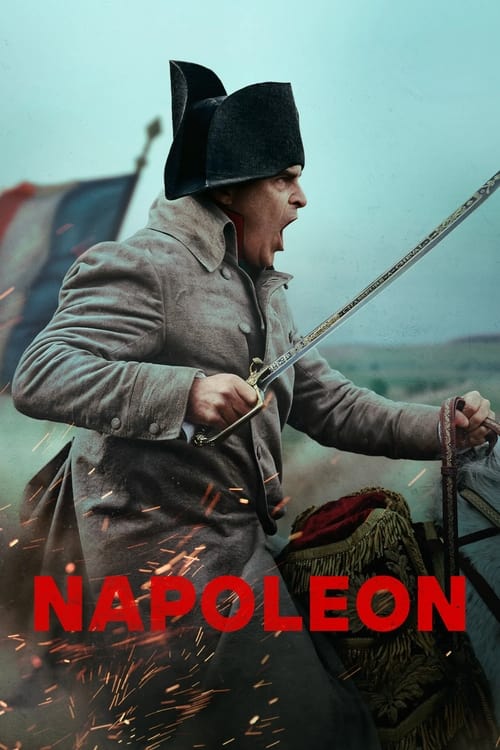
Napoleon
2023 · Ridley Scott
For when you want a big-canvas historical epic on the largest screen you have — empire, cannon fire, and a toxic romance — and you're happy for the hero to be fascinating rather than likable.
What it's about
Three decades of French history compressed into one man's rise and fall: Napoleon Bonaparte claws his way from artillery officer during the Revolution's Terror to Emperor of France, fighting his way through Toulon, Austerlitz, Borodino and Waterloo. Running underneath the conquest is his volatile, obsessive marriage to Joséphine — a relationship that drives him as much as any army, and the one campaign he can never quite win.
The experience
It swings between enormous, brutal battle spectacle and prickly, almost darkly comic intimacy — one hour you're watching cavalry charge across a frozen lake, the next you're trapped in a marriage of mutual need and humiliation. The tone is colder and stranger than the usual great-man biopic, and it moves fast for its length.
Performances
Joaquin Phoenix plays Napoleon as petulant, needy and unnervingly quiet rather than heroic — a genuinely odd, committed choice — while Vanessa Kirby's Joséphine matches him with a poise that keeps shifting who holds the power in the room.
The craft
Ridley Scott stages battles with the scale and logistical confidence almost no one else attempts anymore — massed troops, mud, smoke, and real geography you can follow. The period detail is sumptuous and the sound of artillery is physical; this is emphatically a big-screen, good-speakers film.
Why it matters
A late-career swing from one of the last directors trusted with old-fashioned epic scale, and a lightning rod on release — argued over for its history and its acid take on a legend, which became part of the event.
Snapshot
Napoleon is Ridley Scott's late-career attempt at the grand historical biopic, compressing roughly three decades of French history — from the Revolution's Terror through Waterloo and exile — into a single sweeping arc organized around two engines: the battlefield and the bedroom. Scott and screenwriter David Scarpa frame the rise and fall of Napoleon Bonaparte (Joaquin Phoenix) through his obsessive, corrosive marriage to Joséphine de Beauharnais (Vanessa Kirby), so that imperial conquest and erotic dependency become reflections of one another. The film is at once a spectacle of set-piece warfare — Toulon, Austerlitz, Borodino, Waterloo — and a chamber drama of a man whose appetite for power is inseparable from his inability to possess the one person he wants. Financed by Apple and released theatrically through Sony's Columbia Pictures in November 2023, it is a characteristic Scott object: enormous in scale, brisk and unsentimental in execution, and pointedly indifferent to the pieties of historical reverence. The result divided audiences and historians, but it stands as a significant statement of Scott's method in his ninth decade — a director still capable of marshaling vast logistical machinery toward a coldly modern, almost satirical reading of greatness.
Industry & production
Napoleon is a product of the streaming era's appetite for prestige spectacle. The film was financed by Apple Studios as part of Apple's strategy of acquiring marquee directors and theatrical-scale projects, with Sony Pictures handling the worldwide theatrical release before the film migrated to Apple TV+. This hybrid model — a costly, big-screen historical epic underwritten by a technology company and given a limited cinema window ahead of streaming — typifies the economics that made a film of this ambition viable in the early 2020s, when traditional studios had largely retreated from non-franchise historical drama.
Reported production budgets for the film vary across trade accounts, and I will not assert a precise figure; what is clear is that it ranks among the more expensive undertakings of Scott's career, with extensive location work, large-scale battle staging, and substantial costume and set construction. Scott produced through his Scott Free banner alongside producing partners including Kevin Walsh and Mark Huffam, with Joaquin Phoenix also credited as a producer. Principal photography took place across England and in France, including location work at heritage sites; the production's scale of extras and practical staging for the battle sequences was a central part of its publicity.
A defining feature of the project's release strategy was Scott's announced intention to issue a substantially longer cut on Apple TV+. The theatrical version ran roughly two and a half hours, while the extended cut — running well over three hours — restored material, particularly concerning Joséphine. This bifurcation became part of the film's reception story: critics noted that the theatrical edit felt compressed, and Scott openly positioned the longer version as the fuller realization of his intentions, a now-familiar pattern in his filmography (echoing Kingdom of Heaven, whose director's cut materially improved its standing).
Technology
Scott shot Napoleon digitally with Dariusz Wolski, his regular cinematographer since Prometheus (2012), using large-format digital capture suited to the film's wide vistas and low-light interiors. The defining technological characteristic of a Ridley Scott production, however, is less the camera format than the shooting methodology: Scott is renowned for operating multiple cameras simultaneously — frequently cited as upwards of ten or eleven on major sequences — covering action from many angles in a single take. This approach, which he has refined since Gladiator (2000), allows him to capture sprawling, chaotic events comprehensively and to edit for maximum coverage rather than re-staging for each setup. On the battle sequences it permits him to shoot real cavalry charges, cannon fire, and massed infantry once and harvest dozens of usable angles.
Visual effects extended the practical staging — multiplying crowds, building period cityscapes, and enabling the film's most discussed image, the artillery bombardment of frozen water at Austerlitz, where men and horses plunge through shattering ice. The blend favors practical foreground action augmented by digital scale, consistent with Scott's long-standing preference for tangible, in-camera spectacle as the bedrock onto which effects are layered.
Technique
Cinematography
Wolski's photography leans on the chiaroscuro tradition that has long defined Scott's historical work: candlelit and firelit interiors modeled on the tonal palette of period painting, set against cold, desaturated exteriors for the battlefields. The compositions favor painterly tableau — Napoleon dwarfed by landscape, or isolated within the geometry of a court — and the battle coverage exploits the multi-camera setup to cut between sweeping god's-eye scale and visceral ground-level violence. The film's look is deliberately austere and wintry, with the snow-and-mud palette of Austerlitz and the Russian campaign carrying much of its emotional weather.
Editing
Edited by Claire Simpson and Sam Restivo, the theatrical cut is notably elliptical, leaping years and campaigns with terse intertitles and abrupt transitions. This compression is the source of much critical debate: the film covers an enormous span in its running time, and the editing's brisk, almost montage-like movement through history was read by some as bracingly efficient and by others as airless. The battle sequences, by contrast, are cut for clarity and impact, organizing the multi-camera material into legible spatial action — a contrast between the patient build of a cannonade and the staccato chaos of the charge.
Mise-en-scène / staging
Production designer Arthur Max — Scott's collaborator since G.I. Jane and Gladiator — and costume designers Janty Yates (another long-term Scott partner) and Dave Crossman supply the film's dense material texture: Empire interiors, military uniforms, coronation regalia, and the layered fabrics of court dress. Scott's staging emphasizes the theatricality of power: the self-coronation at Notre-Dame, the formal cruelties of the imperial household, the spatial loneliness of command. The battle staging is the film's signature — massed formations, choreographed cavalry, and the use of real landscape to convey scale, with the frozen-lake sequence designed as the film's bravura centerpiece.
Sound
Sound design foregrounds the percussive brutality of Napoleonic warfare — the concussion of artillery, the thunder of cavalry, the splintering of ice — against the hushed, intimate registers of the domestic scenes. Martin Phipps's score eschews conventional martial bombast in favor of something more austere and unsettling, using choral and vocal textures and dissonance rather than triumphal themes, a choice consonant with the film's cool, ironizing view of its subject.
Performance
Joaquin Phoenix plays Napoleon against the heroic grain: petulant, socially graceless, sexually insecure, often mumbling and withdrawn, his grandeur undercut by childishness and need. The performance is a deliberate deflation of the Great Man, and it polarized viewers — some found it a brilliant study in arrested narcissism, others an anachronistic, affectless misfire. Vanessa Kirby's Joséphine supplies the film's other pole: worldly, self-possessed, and the locus of the power Napoleon cannot command. The Phoenix–Kirby dynamic, more than any battlefield, is the film's true theater of war.
Narrative & dramatic mode
The film's organizing conceit is the parallel between conquest and marriage. Scarpa's screenplay intercuts campaigns with letters and confrontations between Napoleon and Joséphine, proposing that his military insatiability and his erotic jealousy spring from the same wound. The dramatic mode is biographical episode rather than classical three-act drama: a procession of historical waypoints — Toulon, the coup of Brumaire, coronation, Austerlitz, the Russian disaster, abdication, Elba, the Hundred Days, Waterloo, St. Helena — punctuated by the recurring private scenes. This episodic compression is the film's most contested formal decision, sacrificing causal depth and political context for breadth and pace, and trusting the marriage to supply emotional throughline where the history is merely gestured at.
Genre & cycle
Napoleon belongs to the historical war epic and the biographical drama, two genres Scott has worked repeatedly. It sits within a long cinematic tradition of Napoleon films — most monumentally Abel Gance's Napoléon (1927) and, as an unrealized phantom, Stanley Kubrick's famously abandoned project — and within the modern lineage of large-scale battle pictures that Scott himself helped revive with Gladiator. Within his own filmography it joins Gladiator, Kingdom of Heaven, Robin Hood, Exodus: Gods and Kings, and The Last Duel as entries in his recurring engagement with the past as a site of violence, power, and institutional cruelty. Its self-consciously deflationary, ironic tone also aligns it with a contemporary skepticism toward the heroic biopic.
Authorship & method
The film is unmistakably a Ridley Scott production, bearing his hallmarks: the painterly low-key lighting, the multi-camera battle coverage, the brisk unsentimental tempo, and the recurring preoccupation with men consumed by power and ambition. Made when Scott was in his mid-eighties, it testifies to his undiminished logistical command and prolific late period (it arrived amid a remarkable run that included The Last Duel and House of Gucci, both 2021).
His key collaborators are largely a long-standing repertory company. Screenwriter David Scarpa had previously written All the Money in the World (2017) for Scott and would continue with Gladiator II. Cinematographer Dariusz Wolski has shot Scott's films since Prometheus. Production designer Arthur Max and costume designer Janty Yates are among his most durable creative partners, their work stretching back to Gladiator. Composer Martin Phipps brought a less conventional sensibility to the score. The casting of Joaquin Phoenix is itself an authorial gesture: Phoenix's breakthrough came as the venal emperor Commodus in Gladiator, and his return to a Scott historical epic — now as the title figure — frames Napoleon as a kind of late companion piece, the actor's twitchy, wounded register again deployed to anatomize the pathology of rule.
Movement / national cinema
The film does not belong to a national-cinema movement so much as to the transnational, English-language prestige-spectacle tradition — a British auteur directing American and British stars in a story of French history, financed by an American technology company and shot largely in the United Kingdom. This dislocation is itself notable: a defining national epic of France rendered in English by an outsider, which became part of the critical conversation, particularly in France, where the film's liberties and its anglophone framing drew pointed objections. It is best understood within the globalized commercial cinema of the streaming age rather than any school or national tradition.
Era / period
Napoleon is a 2023 release that exemplifies its moment in the industry: a director-driven historical epic that could only be financed at scale by a streaming-platform-backed model, given a theatrical window as event cinema before moving to subscription. It also exemplifies a creative tendency of the period — the revisionist, demythologizing biopic that treats canonical "great men" with irony and psychological reduction rather than reverence. Its period setting spans the French Revolutionary and Napoleonic eras (roughly 1793–1821), but its sensibility is firmly contemporary.
Themes
The film's central theme is the inseparability of power and need — the proposition that Napoleon's drive to dominate Europe is a displacement of his inability to secure love and certainty in his marriage. Around this it gathers related preoccupations: the vanity and theatricality of authority (the self-coronation as its emblem); the human cost of ambition, rendered in the film's recurring tallies of the dead; the fragility of the ego beneath the uniform; and the gap between the myth of the heroic conqueror and the petty, insecure man Scott insists on showing. Joséphine functions as the film's thematic key — the one domain Napoleon cannot conquer, and therefore the measure of all his other conquests. The film is finally less interested in history's causes than in the psychology of the man who made and unmade himself.
Reception, canon & influence
Critical reception was sharply divided. Admirers praised the film's battle sequences — Austerlitz in particular — as among the finest of Scott's career, and found Phoenix's anti-heroic characterization a bold, intelligent deflation of the biopic's usual hagiography. Detractors faulted the theatrical cut's compression and emotional coolness, Phoenix's deliberately unmagnetic performance, and above all the film's cavalier treatment of the historical record. Historians objected to numerous liberties and inventions — among the most discussed, the depiction of Napoleon ordering cannon fire on the Pyramids and the staging of events he did not personally witness — and Scott responded to such criticism with characteristic combativeness, publicly dismissing the objections of historians. (Specific quotations attributed to him circulated widely in the press; I report the gist rather than vouch for exact wording.) French critics were notably cool, both to the historical handling and to the spectacle of a foundational national figure rendered through an anglophone lens.
The influences on the film run backward through the long cinematic fascination with Napoleon — Gance's silent monument and Kubrick's legendary unmade screenplay loom over any modern attempt — and through Scott's own Gladiator, whose template for the modern battle epic he here revisits and ironizes. Its forward legacy is, at the time of writing, still taking shape: as a recent release, its lasting influence cannot yet be honestly assessed, and I will not overstate it. What can be said is that it functioned as a proof of concept for the streaming-financed historical epic and reaffirmed Scott's late-career stature as one of the few directors still able and willing to mount spectacle on this scale. The promised extended cut, restoring much of the Joséphine material, became part of the film's reception narrative and may, as with Kingdom of Heaven, prove the version on which its longer-term critical standing rests.
A Deleuzian reading
Watch the coronation.
The full Deleuzian reading of Napoleon →
Reception
Landed in late 2023 to a genuinely split reception — critics mixed, historians furious, box office soft — and it hasn't really been reappraised so much as put on hold: the discourse settled into 'wait for the director's cut,' with fans invoking Kingdom of Heaven as the precedent for a Ridley Scott epic redeemed in its longer form.
How Napoleon was received, from release to now →
Influences: the films it descends from and the films it influenced
- Waterloo (1970) — The previous serious attempt to film Napoleon's command in real space: massed cavalry charges and infantry squares filmed with armies of extras and overhead pattern-of-battle compositions that Scott revisits, ice-lake gambit and all, with digital augmentation.
- The Duellists (1977) — Scott's own debut, set in the Napoleonic army and shot in Barry Lyndon-derived natural light, is the origin point of his painterly period-image; Napoleon returns to that early register of low-key, weather-soaked Empire-era frames.
- Kingdom of Heaven (2005) — The closest formal sibling: a massed-siege historical epic whose theatrical cut was widely judged emotionally compressed and whose restored director's cut rescued its reputation — the exact reception arc Scott's extended Napoleon courts.
- Gladiator II (2024) — The immediate descendant: Scarpa's next screenplay for Scott extends the same arena-and-empire spectacle and large-format digital battle coverage refined on Napoleon.
- Napoléon (1927) — The acknowledged ur-text: Gance's subjective hand-held camera in the crowd and his vast triptych battle panoramas establish the immersive massed-battle grammar and the very iconography of Napoleon that Scott both inherits and answers.
- War and Peace (1966) — Bondarchuk's Austerlitz and Borodino — thousands of real soldiers choreographed into legible geometric formations shot from craning overhead vantage — is the direct staging model for Scott's Austerlitz, including the aerial reading of troop movement across terrain.
- Barry Lyndon (1975) — Kubrick's painterly natural- and candle-lit tableaux composed after period canvases, plus the cool ironic distance toward a social-climbing protagonist, supplies Scott's chiaroscuro interiors and the deflationary anti-heroic register; Kubrick's own unmade Napoleon haunts the project.
- Lawrence of Arabia (1962) — Lean's model of the episodic great-man biopic — large-format spectacle organized around an enigmatic, psychologically opaque figure whose ambition the film refuses to simply celebrate — underlies Napoleon's elliptical, chapter-like structure and ironized hero.
- Alexander Nevsky (1938) — The Battle on the Ice fuses massed combat choreography with a driving percussive score, the prototype for cutting battle to music; Scott's percussive-warfare sound design and ice-cracking Austerlitz climax descend from this audiovisual battle construction.
- Ivan the Terrible (1944) — Eisenstein's expressionist chiaroscuro modeling of a ruler's face and the theatrical staging of paranoid power give Scott a visual vocabulary for rendering authority as pathology in shadow-carved close-up.
- Gladiator (2000) — Scott's own template for the modern battle epic — multi-camera coverage cut into kinetic ellipsis — is here revisited and ironized; casting Joaquin Phoenix, his Commodus, reuses the same twitchy, wounded register to anatomize rule.
- All the Money in the World (2017) — David Scarpa's first screenplay for Scott, establishing the writer's terse, power-and-money-obsessed scene construction and reframing method that he then brings to Napoleon's episodic structure.
- The Last Duel (2021) — Made in the same late-period sprint with Dariusz Wolski's chiaroscuro lensing and Janty Yates's costumes, it shares the multi-camera medieval-combat coverage and the deliberately unglamorous, anti-heroic treatment of period masculinity.
- House of Gucci (2021) — Sibling product of the same prolific run, applying Scott's brisk, unsentimental tempo to a parallel ambition-and-marriage narrative — the conquest-and-domestic-collapse braiding that structures Napoleon's Joséphine material.
- Marie Antoinette (2006) — A prior revisionist biopic that renders a foundational French national figure through a deliberately anglophone, anti-reverent lens, prefiguring the irreverence French critics objected to in Scott's portrait.
- The Death of Stalin (2017) — Sibling in the revisionist deflation of tyranny: it strips the grandeur from an absolute ruler by playing power as petty, bodily and absurd — the same anti-hagiographic deflation Phoenix's unmagnetic Napoleon performs.
Similar films
- Barry Lyndon (1975) — influence & lineage · often watched together
- Napoleon (1927) — influence & lineage
- The Last Duel (2021) — influence & lineage
- Waterloo (1970) — influence & lineage
- The Duellists (1977) — influence & lineage
- Gladiator II (2024) — influence & lineage
- Marie Antoinette (2006) — influence & lineage
- Gladiator (2000) — influence & lineage
All the films related to Napoleon →
Watch it with: curated runs of related films
- Great Men, Grand Reckonings — A run of prestige true stories about singular, obsessive men chasing an epochal achievement — the bomb, the moon, the checkered flag, a nation — and reckoning with what it cost them and everyone around them.