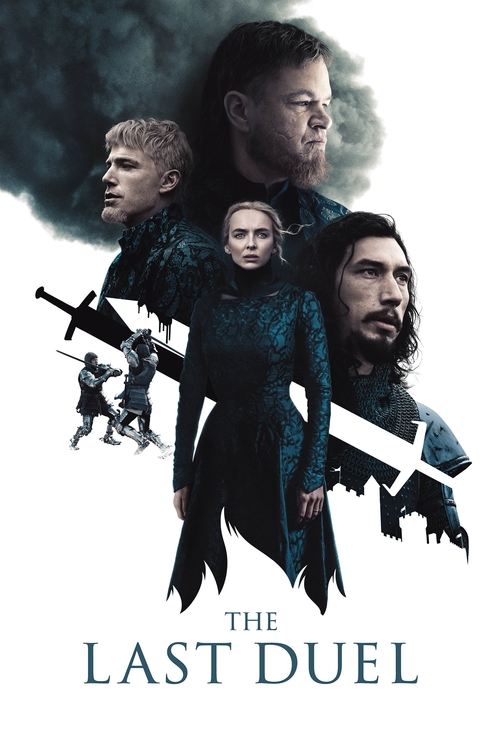
The Last Duel
2021 · Ridley Scott
As famous now for press-tour belligerence ("go f— yourself" to historical accuracy critics of Napoleon) as for the films; Gladiator II's "are you not entertained" marketing and shark-in-the-Colosseum discourse kept him meme-central in his late 80s. The industry's most quotable octogenarian.
For when you want a serious, meaty epic that respects your intelligence — a film to argue about afterward. It's a demanding watch, with an assault central to the story, but it earns the weight.
What it's about
In 14th-century France, a knight's wife accuses his former friend, a favored squire, of raping her — and when the courts fail, the king allows the dispute to be settled by a duel to the death, with her life staked on the outcome. The film tells the story three times, once from each of their perspectives, before the two men meet on the field.
The experience
Heavy, gripping, and quietly infuriating — each retelling shifts small details until you see how two men can narrate the same events and erase the woman at the center. It builds to a duel of genuinely brutal, breath-holding intensity.
Performances
Jodie Comer is the revelation, playing the same woman three ways with surgical precision, so the truth of her account lands with force. Adam Driver and Matt Damon calibrate their characters' self-regard scene by scene, and Ben Affleck is a scene-stealing pleasure as a decadent count.
The craft
Ridley Scott stages medieval France with mud-and-iron authenticity, and the climactic combat is choreographed with bone-jarring realism — big-screen, loud-speakers filmmaking. The script's trick is structural: the same scenes replay with tiny, damning differences, and the editing trusts you to catch them.
Why it matters
A box-office casualty of the streaming era that critics quickly reappraised, it became a rallying point in the debate over whether adult dramas can survive in theaters — and a late-career showcase of Scott's range.
Snapshot
Ridley Scott's adaptation of Eric Jager's 2004 historical account reconstructs the last legally sanctioned trial by combat in French history — a December 1386 judicial duel in Paris between Norman knight Jean de Carrouges and squire Jacques Le Gris, whose outcome determined whether Carrouges's wife Marguerite had been raped or was a liar subject to execution. The film is structured as three successive accounts of the same events, each titled as a competing truth, with the final chapter — Marguerite's — presented as the authoritative record. It is simultaneously a medieval procedural, a rape-survivor narrative, and a structural argument about whose testimony is granted epistemic credibility. At roughly 152 minutes and a reported production budget near $100 million, it was one of Scott's most ambitious period undertakings since Kingdom of Heaven (2005), and one of his most conspicuous commercial disappointments.
Industry & production
The project originated with Matt Damon and Ben Affleck, who had read Jager's book and conceived of it as a vehicle reuniting them as collaborators for the first time since Good Will Hunting (1997). They brought in Nicole Holofcener — whose work (Lovely & Amazing, Can You Ever Forgive Me?) is marked by a precise, unsentimental attention to female interiority — to write the third chapter, a deliberate authorial division of labor intended to give Marguerite's perspective a distinct and more credible narrative voice. Each writer thus owned the subjective reality of the character whose chapter they drafted.
The film was produced by Ridley Scott Productions and Pearl Street Films (Damon and Affleck's production company), distributed by 20th Century Studios under the Disney ownership that had absorbed Fox. Principal photography began in 2020, was interrupted by the COVID-19 pandemic, and resumed later that year. Locations included châteaux and medieval sites in France as well as the more versatile and cost-effective castle and countryside locations of Ireland, which has long served Hollywood productions requiring northern European medieval landscape. Scott is known for moving quickly and efficiently on location — a method partly necessity, partly temperament — and the pandemic shutdown imposed uncharacteristic delays on a director accustomed to driving production forward.
The film was released on October 15, 2021. Its worldwide theatrical gross was approximately $27–30 million, a severe underperformance relative to budget and marketing expenditure. Scott publicly attributed the failure in part to younger audiences consuming content on streaming platforms rather than in cinemas — remarks that generated considerable discussion about the viability of the mid-budget prestige adult drama in post-pandemic theatrical exhibition. The film has since found a more sustained life in streaming contexts.
Technology
Dariusz Wolski, who has served as Scott's director of photography on a run of films beginning with Prometheus (2012) — including The Martian, Alien: Covenant, All the Money in the World, and later House of Gucci — shot the film digitally, utilizing the ARRI Alexa platform that has become the industry standard for high-end production. The choice suits Scott's appetite for flexible, rapid coverage. Wolski and Scott maintained a deliberately muted, desaturated palette calibrated to evoke Northern European medieval illuminated manuscripts and panel painting — muddy ochres, cold grays, the damp gray-green of Norman countryside — rather than the heightened chromatic spectacle of earlier Scott epics.
The duel sequence at the film's climax, which had to fulfill the accumulated dramatic promise of the entire preceding structure, was achieved through a combination of practical stunt choreography, location shooting on the Champ de Mars approximation constructed for the production, and selective visual effects augmentation for crowd scale and environmental extension. Scott, trained as a graphic designer and with a background in advertising, remains a notably storyboard-intensive director — his preparatory visual thinking shapes shots before cameras roll, which enables the precise coverage his editing demands.
Technique
Cinematography
Wolski's visual strategy for The Last Duel navigates a structural challenge inherent to the triptych form: the same scenes must be photographed at least twice, sometimes three times, in ways that register subjective distortion without becoming merely illustrative. The approach is largely one of tonal and behavioral modulation rather than overtly expressionistic deviation — camera placement, proximity to Marguerite, and the degree to which her reactions are held in frame shift meaningfully between the Le Gris and Carrouges chapters versus her own. In Marguerite's chapter, the assault sequence is shot with a fixed, unflinching proximity that refuses the evasive cutting that the male chapters employ. The film's exterior photography leans on overcast natural light, giving interiors a candle-lit chiaroscuro and exteriors a bleak, scoured quality.
Editing
Claire Simpson, who had earlier won an Academy Award editing Oliver Stone's Platoon (1986) and has edited several Scott productions, here faces the particular demand of managing triple repetition without deadening the audience's engagement. The editorial strategy intensifies in each successive pass: Carrouges's chapter establishes spatial and narrative geography at a measured pace; Le Gris's chapter begins to complicate and contradict; Marguerite's moves with heightened urgency as the film's stakes crystallize. The final duel is cut for maximal physical viscerality — the choreography of armored combat in the fourteenth century was brutal and exhausting, and the editing sustains that register without stylizing the violence into spectacle.
Mise-en-scène / staging
Scott's longstanding production designer Arthur Max — another key Scott collaborator since Gladiator (2000) — constructed environments that read as functional medieval habitation rather than romanticized pictorialism: the Carrouges estate is cold, damp, and financially strained; the Count d'Alençon's court is comparatively louche and commodified. The staging repeatedly situates Marguerite at the edges or margins of compositions in the first two chapters, while centering her in her own. The courtroom and deposition scenes — in which Marguerite must make her accusation before male ecclesiastical authority — are staged with procedural flatness that underscores institutional indifference.
Sound
The sound design foregrounds the material weight of the medieval world: the clank and grind of plate armor, the noise of horses, fire, and stone. Harry Gregson-Williams, who composed for several of Scott's films, provides a score that keeps period signification — drone textures, sparse brass — in a more subdued register than the epic orchestral swell one might expect. The duel is accompanied by crowd noise and impacts rather than scoring designed to heighten emotional legibility, a choice that keeps the sequence in an uncomfortable register between spectacle and horror.
Performance
The film's critical center of gravity is Jodie Comer as Marguerite, and her performance earned the most uniform praise from reviewers. Comer calibrates Marguerite across the three chapters — performing the same scenes differently as filtered through the male narrators' distortions, then performing them with the full weight of autonomous interiority in her own. The technical demand of this structure, which requires continuous awareness of how the same moment reads from competing epistemological positions, is considerable. Adam Driver's Le Gris is built around a studied, self-deluding charm — the performance registers his genuine inability to interpret refusal as refusal, which is the film's most unsettling idea about how assault can coexist with a perpetrator's self-exculpatory sincerity. Damon's Carrouges is more deliberately opaque: vain, honorable in his own estimation, possessive without self-awareness. Ben Affleck plays Count Pierre d'Alençon with a deliberate anachronism of affect — languid, dissolute, contemporary in a way that makes the court's decadence readable to a modern audience.
Narrative & dramatic mode
The film's governing structural principle is Rashomon inheritance: the same events repeated from three first-person-aligned perspectives, each subtitled as a competing truth claim. The formal precedent is Akira Kurosawa's Rashomon (1950), but where Kurosawa's film ends in epistemological impasse — no single account verifiable, the "truth" of the bandit's killing undeterminable — The Last Duel distinguishes itself by insisting on the verifiability of Marguerite's account. The subtitling of the third chapter as "The Truth According to Marguerite de Carrouges" — maintaining the grammatical structure of the other two chapters while the film's framing material and the accumulated discrepancies of the male accounts position her testimony as the factually reliable one — constitutes a formal argument: the film uses Rashomon structure not to relativize truth but to demonstrate how institutional and social mechanisms work to discredit the testimony of the most credible witness. Dramatic irony is the primary affective register; the audience knows what the court refuses to know.
Genre & cycle
The Last Duel sits within the prestige Hollywood historical epic — a genre with roots in the studio epic cycle of the 1950s and 1960s, revived in the post-Gladiator moment — while departing from that genre's conventional investments in heroic agency and triumphalist narrative. It belongs to a more specific cycle of post-#MeToo Hollywood productions that revisit historical or institutional settings to examine how structural disbelief in women's testimony operates — films concerned less with the crime itself than with the mechanisms of its dismissal. The genre hybridization here is notable: the film has the production values and formal ambition of an awards-contending epic but the thematic agenda of a survivor drama. The disconnect between those registers may have contributed to its difficulty finding an audience.
Authorship & method
Ridley Scott, born 1937 in South Shields, England, trained at the Royal College of Art and built his visual sensibility in British television advertising — a formation that persists in his meticulous pre-visualization and his facility with rapid, high-quality coverage. His career encompasses an exceptional range of genre and scale, from Alien (1979) and Blade Runner (1982) through Thelma & Louise (1991), Gladiator (2000), Black Hawk Down (2001), and The Martian (2015). He is not primarily a theorized auteur in the French tradition but rather an industrious, technically gifted craftsman-director whose authorial signature is broadly stylistic rather than thematic: a command of production design, a preference for dense, layered visual composition, and an ability to sustain scale without sacrificing performance. The Last Duel is among the more explicitly thematically driven works in his late career.
Wolski's contribution as DP is significant: his ability to calibrate a visual system that serves three distinct subjective registers while maintaining overall tonal coherence is a non-trivial achievement. Holofcener's authorial presence in the third chapter is legible — its writing is more attuned to the texture of Marguerite's consciousness, the way social performance and internal experience diverge — and the decision to divide authorship along the lines of the film's structural argument is itself a meaningful creative and political choice.
Movement / national cinema
The film is an American studio production, but its creative lineage is substantially British: Scott is a British filmmaker working in the Hollywood system, a trajectory shared by collaborators including composer Gregson-Williams. It participates in the long tradition of British-inflected Hollywood period filmmaking — a tradition that includes David Lean's epics, the Merchant-Ivory productions, and the post-Braveheart wave of English-language medieval films. The French historical setting, shot partly in France with French heritage sites as locations, gives it a European texture that the purely Anglophone production context somewhat complicates. It is most usefully understood as late-career British-Hollywood prestige filmmaking rather than an expression of any national cinema in the bounded sense.
Era / period
The film was completed and released in the immediate post-#MeToo period of Hollywood production — roughly 2018–2023 — during which the film industry processed, in various registers and with varying degrees of seriousness, questions about sexual violence, institutional credibility, and who gets believed. It was also released during the acute crisis of mid-budget theatrical exhibition, at a moment when the pandemic had accelerated the collapse of the theatrical window for films that were neither tentpole franchise entries nor certified awards contenders with built-in prestige audiences. Its box office failure has been read as symptomatic of this structural moment as much as any failure specific to the film.
Themes
The film's central preoccupation is epistemological: how institutions, social structures, and narrative conventions work to discredit the testimony of sexually violated women and to substitute the credibility of male witnesses — even manifestly self-interested male witnesses — for the credibility of the actual victim. The rape trial scenes stage this as legal and ecclesiastical machinery; the repetition structure stages it as narrative machinery. The film is also concerned with the economics of medieval honor — how Carrouges's pursuit of the duel is entangled with property disputes, social humiliation, and masculine status in ways that make Marguerite's justice incidental to his agenda. The Count d'Alençon's court figures as a system of patronage and appetite in which men like Le Gris thrive by being useful to power and by inheriting that power's exemptions. The film does not reduce these to allegory but keeps them in historically specific texture.
Reception, canon & influence
Critical reception at release was broadly favorable, with particular consensus around Comer's performance and the structural audacity of the screenplay. Some reviewers found the Rashomon mechanics somewhat schematic — the differences between the male chapters occasionally telegraphed rather than discovered — but there was general agreement that the film's ambitions were serious and substantially realized. Its failure to find a theatrical audience was widely noted as a cultural phenomenon as much as a commercial one, generating debate about the market viability of adult-oriented prestige filmmaking and Scott's subsequent highly public commentary about audience behavior.
The film's primary formal debt is to Rashomon (1950), the foundational text of unreliable multiple-perspective cinema. More proximately, it engages with the revisionist medieval film tradition — Braveheart (1995), A Knight's Tale (2001), Kingdom of Heaven (2005) — while distinguishing itself from that tradition's tendency to project contemporary individual heroism backward onto the medieval past. Its refusal of heroic catharsis in the duel sequence — Jean de Carrouges's victory resolves the legal question but does nothing to address the structures that endangered Marguerite — is a deliberate genre defection.
Scott's own Gladiator (2000) is an inescapable reference point: Arthur Max's production design, the Roman-tinged spectacle vocabulary, the genre equipment. But where Gladiator is built around a protagonist whose virtue generates audience identification and triumph, The Last Duel distributes and complicates moral identification in ways that resist the satisfactions Gladiator delivers.
The film's forward legacy is, at this writing, still accruing. It arrived at a moment when the survivor drama had become a recognized sub-generic category — She Said (2022), Promising Young Woman (2020) — and it likely reinforced the formal interest in contested-testimony structures that other filmmakers were already exploring. Whether it enters the canon as a significant late-career Scott achievement or remains a notable, underappreciated work will depend partly on the longer critical life it develops on streaming and home video, where its theatrical failure no longer determines how audiences encounter it.
A Deleuzian reading
Watch where Marguerite stands in the frame.
The full Deleuzian reading of The Last Duel →
Reception
A famous box-office bomb in October 2021 — Ridley Scott blamed millennials and their cell phones for its failure — it was then rapidly reappraised on streaming and Letterboxd as one of his best late-career films, the poster child for 'the audience failed the movie.'
How The Last Duel was received, from release to now →
Influences: the films it descends from and the films it influenced
- Rashomon (1950) — Scott's triple-chapter structure directly inherits Kurosawa's editorial grammar: returning to identical scenes with the camera repositioned to register a different subjective account, using the repetition itself as the argument that no single version is authoritative rather than as a mystery to be solved.
- Gladiator (2000) — Production designer Arthur Max's oxidized-earth visual language for pre-modern spectacle carries directly into The Last Duel; Scott repurposes the same genre equipment — the arena, the institutional trial by combat — while systematically withholding the cathartic payoff Gladiator is structured to deliver.
- Kingdom of Heaven (2005) — Scott's previous medieval prestige epic establishes the procedural staging of feudal institutional life that The Last Duel inherits: fealty, lordship, and juridical process rendered without romantic inflation across extended sequences that treat bureaucratic mechanism as the site of dramatic revelation.
- Braveheart (1995) — The revisionist medieval epic whose formal grammar The Last Duel explicitly critiques: Gibson's golden-hour romanticization and swelling score secure male-protagonist identification through emotional manipulation that Wolski's desaturated palette and diegetic-over-score sound preference systematically deflate and argue against.
- The Accused (1988) — Establishes the rape-trial procedural drama in which the victim's account is structurally subordinated to institutional skepticism, foregrounding the legal apparatus's mechanics as the primary site of violence rather than the assault itself — the genre template Scott medievalizes and scales into a formal triptych argument.
- Thelma & Louise (1991) — Scott's own female-subjective genre film in which institutional disbelief of a woman's sexual assault account triggers the entire dramatic engine, establishing within his filmography the method of calibrating female performance registers against male-genre expectations that The Last Duel's multi-register performance work directly extends.
- The Duellists (1977) — Scott's literal return to the honor-duel structure, with the trial-by-combat as narrative climax and its choreography built for brutal, unromantic authenticity.
- Promising Young Woman (2020) — Uses pastel rom-com visual grammar as a rhetorical device — genre surface as argument — for demonstrating that institutional disbelief of women's assault testimony has been normalized into entertainment; the formal disjunction between visual register and subject matter develops the same genre-as-epistemology-argument The Last Duel pursues in historical costume.
- She Said (2022) — Inherits The Last Duel's post-MeToo procedural DNA by staging institutional disbelief as investigative mechanism; Bradford Young's flat, medium-distance staging of journalistic-procedure sequences applies the procedural-institutional-flatness grammar to contemporary survivor testimony, where the bureaucratic machinery that should protect women is shown doing the opposite.
- Hero (2002) — Extends the Rashomon model through chromatic chapter differentiation — each account assigned a distinct palette that externalizes the narrator's emotional investment — establishing the precedent for Wolski's triptych modulation strategy in which the three chapters' visual registers are calibrated to the subjectivity governing each.
- Courage Under Fire (1996) — Applies the Rashomon testimony structure to military institutional disbelief of a woman's combat record, with each successive witness account revealing how gendered suspicion and self-interest distort testimony about the same event — the same epistemic-credibility-as-dramatic-engine argument The Last Duel makes in a medieval juridical register.
- Vantage Point (2008) — Directly applies the Rashomon repetition grammar to genre thriller: the same 23-minute event replayed eight times from different perspectives, each chapter beginning at an identical temporal starting point and concluding when that perspective's information is exhausted — the same editorial architecture Scott's triple chapter structure employs.
- Atonement (2007) — A false witness's misread testimony structured so that the audience shares her false certainty before the frame corrects; McGarvey's cinematography uses POV alignment and interior-state lighting to build credibility into an erroneous account — the epistemic-certainty-as-rhetorical-trap that The Last Duel scales into a three-chapter system.
- The Handmaiden (2016) — Divided two-chapter structure in which the second chapter retroactively reframes every event in the first by repositioning subjective authority, with the mise-en-scène and performance register perceptibly recalibrated to signal whose consciousness governs the frame — directly analogous to Holofcener's authorial retuning of the third chapter's visual and tonal texture.
- Gone Girl (2014) — Flynn's screenplay constructs a first-person voice-over that builds false credibility for a self-serving account of victimhood, with Fincher's clinical shot selection maintaining the audience's epistemic alignment with the narrator until the structure forces correction — a formal cognate of the Le Gris chapter's self-exonerating logic and the film's argument that whose account is believed is a function of institutional power.
- A Separation (2011) — The dramatic engine is competing accounts of a disputed violent event adjudicated in a legal setting, with the institutional apparatus weighting testimony by gender, class, and religious standing; Farhadi's long-take staging of interrogation scenes materializes the epistemic pressure and credibility asymmetry that Scott's court sequences enact in a medieval frame.
- Napoleon (2023) — Made in the same late-period sprint with Dariusz Wolski's chiaroscuro lensing and Janty Yates's costumes, it shares the multi-camera medieval-combat coverage and the deliberately unglamorous, anti-heroic treatment of period masculinity.
- Gladiator II (2024) — Same-era Scott historical film using dense multi-camera coverage of physical combat and a Scarpa-circle scripting of institutional power crushing the individual.
Similar films
- Gladiator (2000) — influence & lineage
- Braveheart (1995) — influence & lineage
- Rashomon (1950) — influence & lineage
- Kingdom of Heaven (2005) — influence & lineage
- The Duellists (1977) — shared sensibility
- Napoleon (2023) — shared sensibility
- Gladiator II (2024) — shared sensibility
- The Count of Monte Cristo (2024) — shared sensibility