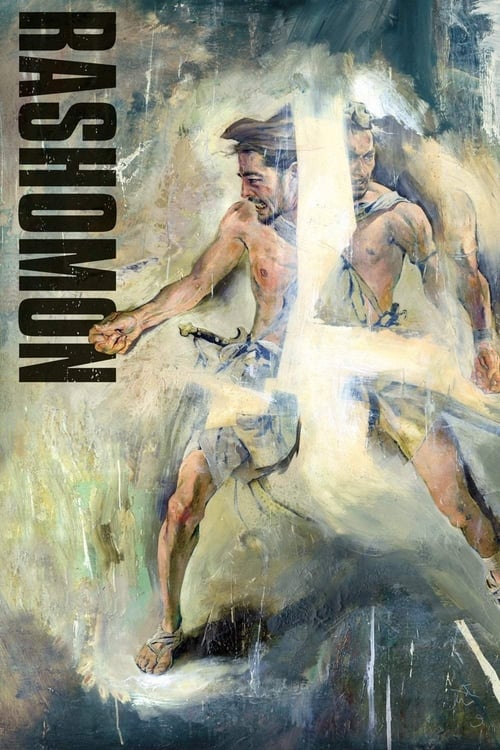
Rashomon
1950 · Akira Kurosawa
When you want a film to chew on — one you'll want to talk about the second it ends. Short enough for a weeknight, but bring your full attention.
What it's about
A samurai is dead in a forest grove, and four people tell the court what happened — a swaggering bandit, the samurai's wife, the dead man himself speaking through a medium, and a woodcutter who says he saw it all. Every version is different, and every teller has a reason to lie. Framed by three strangers sheltering from a downpour under a ruined city gate, it's a murder mystery where the mystery is whether the truth can be reached at all.
The experience
Gripping and strange at once — each retelling pulls you back into the same sun-dappled forest with the ground shifted under you, and by the end you're arguing with the film in your head. It moves fast, barely ninety minutes, but it lingers for days.
Performances
Toshiro Mifune's bandit is a feral, cackling force of nature — he plays a different shade of the man in every retelling. Machiko Kyō matches him, shifting from shattered victim to something far more slippery depending on whose story you're inside.
The craft
Kurosawa shoots straight into the sun through the forest canopy — light flickering across faces like the truth itself, half-glimpsed and moving. The dueling scenes are staged differently in each account, so the camera becomes part of the lying. Rain has rarely looked this heavy on screen; it pours like judgment.
Why it matters
Its Golden Lion at Venice in 1951 opened the West's eyes to Japanese cinema, and its structure gave the world a shorthand — the 'Rashomon effect' — for contradictory accounts of the same event. Few films have named an idea.
Snapshot
A samurai is found dead in a forest grove. Four witnesses give four irreconcilable accounts: the bandit Tajomaru (Toshiro Mifune), the samurai's wife (Machiko Kyō), the dead samurai himself speaking through a medium, and a woodcutter who claims to have witnessed the event. No account can be trusted; no authoritative version is ever supplied. Rashomon is the film that introduced world cinema to a fundamental epistemological problem — that human perception, self-interest, and memory conspire to make truth unreachable — and in doing so, it remade what a film narrative could do. Its 1951 Golden Lion at Venice was the first major Western festival prize for a Japanese film, initiating a sustained international recognition of Japanese cinema that would continue through the decade.
Industry & production
Rashomon was produced not by Toho, Kurosawa's usual studio, but by the smaller Daiei Motion Picture Company — a circumstance that shaped the film's scale and conditions. Kurosawa had been developing projects at Toho but found himself at Daiei for this production, adapting two short stories by Ryūnosuke Akutagawa: "In a Grove" (Yabu no Naka, 1922), which supplies the competing testimonies, and "Rashōmon" (1915), which furnishes the ruined gate and its atmosphere of moral collapse. The screenplay was co-written by Kurosawa and Shinobu Hashimoto, who would become a long-term collaborator. Daiei's production head, Masaichi Nagata, later submitted the completed film to Venice over reservations from some studio quarters about whether a Japanese film would find a foreign audience. The film was shot relatively quickly and on a constrained budget; the monumental Rashomon gate set was a constructed studio piece rather than a standing location, and its deliberate incompleteness — truncated columns, absent walls — was designed rather than merely economical. The Japanese domestic reception was cautious. The film confused audiences and reviewers in Japan who were uncertain about its structure, and Kurosawa himself noted that colleagues at Daiei had struggled with the script before production. The Venice prize and subsequent Oscar for Best Foreign Language Film transformed the film's domestic standing retroactively.
Technology
Rashomon is shot in 35mm black-and-white on standard Academy-ratio film stock using equipment available at Daiei in 1950. What distinguishes the film technologically is not its hardware but the unorthodox uses to which that hardware was put. The most discussed innovation is cinematographer Kazuo Miyagawa's direct photography into the sun — a technique considered inadvisable by standard studio practice because of the risk of damage to the film stock and camera optics. To accomplish the shots of dappled sunlight through the forest canopy, Miyagawa and his crew used mirrors to redirect and diffuse sunlight, allowing controlled exposure when shooting toward the light source. The result was imagery that had not appeared in Japanese cinema in quite this form: a luminous, slightly blinding quality to the forest sequences that gives the natural world an unstable, almost hallucinatory character. Kurosawa had long been interested in the expressive potential of natural light and would continue to push against studio conventions around it.
Technique
Cinematography
Miyagawa's forest photography is the film's signature visual achievement. Tracking shots follow characters through dense undergrowth at low angles; branches and leaves intervene between lens and subject; shafts of direct sun periodically overwhelm the image. The effect is that the forest — the site of the crime — is rendered as a space of partial visibility and deceptive surfaces, formally consistent with the film's epistemological argument. The Rashomon gate sequences, by contrast, are shot in heavy rain under flat, overcast light: no dappling, no revelation, only downpour. The courtyard testimony sequences use more static, frontal compositions, with characters addressing the camera directly as though giving testimony to the viewer as judge. Miyagawa's ability to modulate between these three visual registers — the unstable forest, the drenched ruin, the formal deposition — gives the film its structural coherence despite the fractured narrative.
Editing
Kurosawa edited the film himself, as he routinely did throughout his career, and the editing is central to how the competing accounts are differentiated and yet undermined. Each testimony is introduced with the same framing device — cut from the gate back to the grove — and each is structured to be internally coherent and visually persuasive. The editing does not cue the viewer toward skepticism during any individual account; each appears plausible while it runs. The doubt accumulates only in the aggregate, as the viewer registers the contradictions across the cuts back to the gate. Within individual sequences, Kurosawa employs rapid cutting during the combat scenes, most strikingly in Tajomaru's account, where the sword fight is edited with an almost frantic intensity. In later accounts the same duel is slowed and made tentative, the editing respecting the different emotional tenor of each narrator's version.
Mise-en-scène / staging
The film's staging vocabulary is distinctive and deliberate. Mifune's Tajomaru is staged with an almost animalistic restlessness: rolling in the grass, scratching, laughing at nothing, moving on diagonals and curves while other characters stand relatively still. This kinetic contrast is partly a performance choice and partly a staging decision — Kurosawa placed Mifune in motion against static backgrounds to make his energy read as feral rather than simply energetic. The medium sequence, in which the dead samurai speaks through a woman in trance, is staged with a precise attention to stillness: the wife's body barely moves as the voice enters it, and the courtyard is emptied of distraction. The Rashomon gate is consistently staged as a three-tier space — ground level, platform level, upper beam — allowing characters to occupy different elevations that register social and moral status. The gate's incompleteness is never disguised; its ruins are foregrounded.
Sound
Fumio Hayasaka composed the score, working from a brief given by Kurosawa that was influenced by Ravel's Bolero — a work built on obsessive repetition and incremental intensification rather than harmonic development. Hayasaka's main theme operates similarly, cycling through a narrow motif that accumulates tension not by modulation but by repetition and orchestral thickening. The effect is less conventional scoring than a musical correlate to the film's structure: the same events narrated again and again with slight variation. The rain at the gate is a constant ambient presence, functioning as a kind of structural punctuation between testimony sequences. Kurosawa uses sound silence — moments of ambient absence — sparingly but pointedly; the grove sequences occasionally achieve a quiet that makes the forest's visual instability more unsettling.
Performance
Toshiro Mifune and Machiko Kyō carry the film's central contradiction. Mifune's Tajomaru is the most physically committed performance in the film, drawing on a physicality Mifune had developed under Kurosawa's direction that combined Noh-influenced gesture with something rawer and less codified. The performance shifts in register between accounts: when Tajomaru tells his own story, Mifune plays pride and animal joy; when the woodcutter's account places Tajomaru in a more ambiguous, even cowardly light, the staging supports a different reading. Machiko Kyō, cast partly against her established persona as a glamorous screen presence, plays the wife across a range from helpless victim to calculating manipulator depending on whose account is running. The skill of both performances lies in their ambiguity: nothing in Mifune's or Kyō's work in any individual scene decisively marks its narrator as a liar. Masayuki Mori as the dead samurai and Takashi Shimura as the woodcutter anchor the frame narrative with a controlled, interior style that contrasts with the expressionist energy of the grove accounts.
Narrative & dramatic mode
Rashomon's narrative structure is a nested frame with four competing inner narratives. The outer frame — a woodcutter and a monk sheltering at the ruined Rashomon gate in the rain, in conversation with a commoner — establishes a situation of moral uncertainty that the four testimonies then investigate without resolving. Akutagawa's "In a Grove" had already presented the competing-testimonies structure in prose; Kurosawa and Hashimoto translated it to film while adding the gate framing from the second Akutagawa story and a concluding gesture — the discovery of an abandoned infant — that the screenplay introduces to test whether humanity can act with decency in a world where truth is ungovernable.
The film's dramatic mode is fundamentally interrogative rather than revelatory. Classical Hollywood narrative drove toward disclosure and resolution; Rashomon withholds both and refuses to supply a hierarchy among the accounts. It was unusual in world cinema at the time for a narrative film to make epistemological unreliability not a technique of suspense (leading toward revelation) but the subject itself. The woodcutter's account, revealed to be itself compromised, extends rather than resolves the uncertainty.
Genre & cycle
Rashomon belongs simultaneously to several genre categories — jidaigeki (Japanese period drama), courtroom drama, and mystery — and partially subverts each of them. The jidaigeki framework establishes the Heian-period setting and the samurai-bandit conflict; the courtroom structure (testimony, cross-examination, judgment) appears to promise resolution; the mystery genre typically ends in disclosure. Rashomon delivers none of these generic satisfactions. It is among the earliest film examples of what would later be identified as the unreliable-narrator mystery, though its emphasis is less on detection than on the nature of human self-deception. The film initiated a small international cycle of what critics would retrospectively call "Rashomon-structured" narratives — stories organized around multiple mutually exclusive accounts of the same event — which would surface in literature, television, and film for the following seven decades.
Authorship & method
Kurosawa's authorial signature on Rashomon is clear in the areas where his control was greatest: editing, composition, and the direction of Mifune. His working method with actors was intensive and improvisational within a heavily prepared mise-en-scène; for Rashomon he reportedly had Mifune draw on lions and other large predators for physical reference material, pushing toward a pre-social animality. Kazuo Miyagawa is the film's essential collaborator. Among the foremost cinematographers in Japanese film history, Miyagawa brought technical audacity (the direct-sun photography) and a compositional intelligence that was symbiotic with rather than subordinate to Kurosawa's visual intentions. Hashimoto's screenwriting contribution — working from Akutagawa's source texts — established the multiple-testimony architecture that the film depends on. Fumio Hayasaka, who would score several more Kurosawa films through the mid-1950s, provided a score whose structural properties (obsessive repetition, incremental intensification) are unusually integrated into the film's formal logic.
Movement / national cinema
Rashomon arrived at a particular juncture in Japanese cinema. The postwar occupation period had imposed production and content restrictions that were lifting by 1950, and Japanese studios were producing work of increasing formal ambition. The film is not straightforwardly aligned with any single movement within Japanese cinema — it lacks the social realism of contemporaries like Kenji Mizoguchi's work of the period or the quietism associated with Yasujirō Ozu — but it shares with both a willingness to approach subject matter with a formal rigor unusual in international commercial production. Its Venice prize and subsequent American release positioned it as the gateway film through which Western audiences encountered Japanese cinema in any sustained way, a function that gave it an outsized representative role that is partly an accident of its reception history rather than an intrinsic attribute of its position within Japanese film culture.
Era / period
The film belongs to the immediate postwar period in Japan, though it is set in the Heian period (roughly 794–1185 CE) during a time of political disorder and social dissolution — a setting that functions as a displaced commentary on instability and moral collapse that resonated in 1950 Japan. The occupation had ended the war five years prior; the reconstruction was ongoing; questions about accountability, self-deception, and complicity in wartime were not abstractly philosophical. Kurosawa did not articulate the film as a direct allegory for the war, and any such reading should be held carefully, but the Heian-period ruin populated by people unable to agree on what happened reads differently in 1950 than it might in a more settled historical context.
Themes
The film's primary thematic concerns are epistemological and ethical. Epistemologically, it proposes that human testimony is always self-serving: each narrator's account is the version that best preserves their dignity, honor, or sense of self, and this distortion operates independently of conscious deception. The bandit casts himself as a bold seducer; the wife as a tragic victim; the samurai as a man of pride who chose his own death; the woodcutter as a disinterested observer (until the commoner reveals that the woodcutter's account conceals its own self-interest). No narrator is innocent of narrative self-construction.
Ethically, the film poses the question of how one acts when truth cannot be established. The woodcutter's decision at the gate — to take in the abandoned infant despite having demonstrated his own unreliability — is proposed not as a resolution of the epistemological problem but as an act of moral choice that does not require epistemic certainty as its foundation. This is the film's most contested moment; some critics find it sentimental and inconsistent with the film's prior refusal of resolution, while others argue it is the film's necessary response to nihilism.
A secondary set of themes concerns masculine honor, social hierarchy, and violence. The samurai culture's framework of honor — in which reputation and status are worth dying for — is the context within which all the accounts operate, and the film exposes it as a system that incentivizes precisely the kind of self-serving distortion the testimonies display.
Reception, canon & influence
Backward influences. The immediate literary sources are Akutagawa's two stories, both of which Kurosawa had read and proposed adapting. Akutagawa himself drew on medieval Japanese setsuwa tales for his material. Kurosawa's visual influences include German Expressionism and the American silent cinema he had studied intensively in the 1930s; the forest photography has been compared in compositional terms to the chiaroscuro of Expressionist film, though the specific Rashomon treatment — light through leaves, direct sun — has no close precedent. The influence of Noh and Kabuki theater on the film's performance conventions and staging is acknowledged broadly in scholarship but difficult to trace with precision to specific sources.
Critical reception. The initial Japanese reception was uncertain, with reports of confusion among studio personnel and early reviewers. The Venice prize, the subsequent Oscar, and particularly the American critical reception — which was enthusiastic and positioned the film as a revelation of Japanese film culture — transformed how the film was understood in Japan. By the mid-1950s it had been absorbed into the Japanese art-film canon. In Western critical discourse it entered the canon quickly and has remained there, appearing on most significant critical surveys of world cinema.
Forward legacy. The term "Rashomon effect" entered common usage in journalism, law, and social psychology to describe situations where multiple witnesses offer incompatible accounts of the same event. The film's most direct formal legacy is the multiple-unreliable-narrator structure, which appears in disparate works including Kurosawa's own The Bad Sleep Well, various Western films, television episodes, and literary fiction. Specific films often cited in its formal lineage include Atom Egoyan's Exotica (though the debt is structural rather than acknowledged), Lawrence Kasdan's The Accidental Tourist, and numerous legal and courtroom dramas that foreground testimonial unreliability. Robert Altman's various multi-perspective films are cited in some scholarship, though direct lines of influence are difficult to establish. The film's influence on the American Western — which was absorbing Japanese genre conventions through the 1950s and 1960s — is plausible and widely noted; the specific transaction is clearer in the case of Kurosawa's later samurai films (Seven Samurai, Yojimbo) which were directly remade. Rashomon was itself remade as The Outrage (1964, dir. Martin Ritt), transposed to the American West — a film of modest reputation whose interest is primarily comparative. The film's place in film school curricula internationally has ensured its continuing influence on filmmakers as a foundational text in the pedagogy of narrative construction and point-of-view.
A Deleuzian reading
Start with the shot nobody was supposed to take.
The full Deleuzian reading of Rashomon →
Reception
Japanese critics and its own studio were lukewarm in 1950 — Daiei's boss reportedly didn't get it at all — then it won the Golden Lion at Venice in 1951 and an honorary Oscar, single-handedly opening Western screens to Japanese cinema. Now it's permanent world-cinema canon.
How Rashomon was received, from release to now →
Influences: the films it descends from and the films it influenced
- The Cabinet of Dr. Caligari (1920) — Establishes the nested-frame narrative in which an inner story is delivered by a narrator whose reliability is structurally undermined only upon return to the outer frame — the first film to make the gap between what a narrator claims and what the image shows a formal rather than incidental device.
- Genroku Chushingura (1941) — Mizoguchi's stately lateral tracking and staging of male honor as both social ritual and physical performance in the jidaigeki setting established the formal grammar Kurosawa consciously broke — replacing Mizoguchi's composed distance with low angles, restless movement, and animalistic disruption of ceremonial space.
- Alexander Nevsky (1938) — Kurosawa screened this during Rashomon's preparation specifically to study how Prokofiev composed a repeating musical motif in precise structural counterpoint to the edited image sequence; Fumio Hayasaka's Bolero-influenced ostinato directly applies this method of rhythm-as-argument rather than mood illustration.
- La Règle du jeu (1939) — Renoir's tracking shots through densely populated environments where simultaneous action at multiple depths competes for frame attention — a formal model Kurosawa acknowledged — gave Miyagawa the spatial logic for forest sequences in which branches at varying planes actively obstruct visibility between lens and subject.
- Citizen Kane (1941) — Multiple first-person flashback testimonies reconstruct a past figure from irreconcilable vantage points, each internally persuasive but collectively producing only a contradictory portrait; Kurosawa adopted this architecture and removed the implicit consolation that a truer version exists somewhere beyond the testimonies.
- Mildred Pierce (1945) — The legal interrogation frame that introduces first-person flashback testimony as the mechanism for reconstructing a past crime — authority present at the outer frame, witnesses speaking directly to it — supplies Rashomon's courtyard-testimony structure where characters address the camera as if testifying to the viewer as judge.
- Drunken Angel (1948) — Hayasaka's Boléro-derived ostinato laid impassively across the wife's testimony enlarges the counterpoint lesson learned here, while Mifune's scratching, insect-bitten animal physicality extends the twitchy body vocabulary he first built for Matsunaga.
- Ugetsu (1953) — Kazuo Miyagawa, who developed Rashomon's forest tracking shots and direct-sun photography, carried his technique directly into Ugetsu — long lateral tracks through partially obstructed space now used to dissolve the boundary between the visible and ghost worlds, extending Rashomon's visual instability into the supernatural register.
- Seven Samurai (1954) — Kurosawa extended Rashomon's rapid-cut combat editing — developed for Tajomaru's sword fight, where cutting rhythm enacts the narrator's emotional pitch — into the multi-camera climactic rain battle; Mifune's animalistic physicality, first codified as Tajomaru's rolling, scratching feral energy, becomes the formal template for Kikuchiyo's kinetic disruption of samurai ceremony.
- Last Year at Marienbad (1961) — Resnais adopted Rashomon's formal argument that memory constructs competing, irreconcilable versions of a shared past event and made it the visual grammar of the film itself — repeated sequences showing the same moment in contradictory versions, the editing refusing to arbitrate, extending Rashomon's epistemological uncertainty from narrative structure into moment-to-moment image.
- Harakiri (1962) — The film's nested testimony structure — a petitioner's account reframes and indicts the clan elder's prior counter-testimony, both narrators addressing an authority that is itself implicated — directly applies Rashomon's device of competing testimony delivered to a morally compromised judge, here extended into political critique of the samurai code rather than philosophical inquiry.
- The Outrage (1964) — Direct American remake transposing Rashomon's four-testimony structure to the post-Civil War Southwest — retaining the exact framing device of three bystanders sheltering in a ruin, reconstructing irreconcilable accounts of a violent encounter — the first major Hollywood film to adopt Rashomon's epistemological architecture as explicit formal subject.
- Blow-Up (1966) — Antonioni extends Rashomon's epistemological argument from verbal testimony to the photographic image itself as unreliable witness: the photographer's enlargements appear to reveal a murder, but increased scrutiny produces increased uncertainty — looking harder yields less truth, applying Rashomon's formal logic to the act of visual evidence-gathering.
- Days of Heaven (1978) — Nestor Almendros's magic-hour cinematography — shooting directly into the light source at its most technically inadvisable, producing a blinding luminosity that makes the visual field unstable — extends Miyagawa's direct-sun technique from Rashomon's black-and-white forest into color, treating the encounter with direct light as an ethical register for the unreliability of what is seen.
- Courage Under Fire (1996) — Applies Rashomon's testimony structure — multiple witnesses to a single combat incident giving irreconcilable accounts, each internally coherent and visually realized on screen, with no authoritative resolution — to a military investigation, demonstrating that the formal architecture Kurosawa developed for philosophical inquiry could be transplanted intact into a genre thriller about institutional truth-making.
- Memento (2000) — Nolan builds Rashomon's formal argument about testimony and credibility into the editing structure itself: the reverse chronology creates the same retroactive re-evaluation, where sequences that appeared credible when first seen are recontextualized by later information, making the sequence in which facts are presented — rather than the facts themselves — the instrument of belief.
- Rumble Fish (1983) — Time-lapse cloud photography deployed between scenes as a structural atmospheric device; the dossier directly links this technique to Kurosawa's cloud-photography work as the source Coppola drew on for the recurring time-lapse sky sequences.
- The Usual Suspects (1995) — Kurosawa renders each witness's self-serving testimony as fully visualized flashback sequences given equal photographic authority to contradictory accounts, establishing the cinematic grammar that shown images can be lies—the precise device Singer weaponizes when Verbal's fabrications materialize as trustworthy film.
- Joint Security Area (2000) — The four-witness structure that renders each testimony in full conviction before collapsing into irresolvable contradiction — JSA copies this architecture directly, including the framing investigator who cannot adjudicate between versions and the understanding that each account is psychologically true for its speaker.
- Stage Fright (1950) — Released the same year, Hitchcock independently deployed the lying flashback — showing on screen, as visually persuasive image, events the narrator claims are true but which are fabricated — arriving at the same epistemological experiment; Hitchcock later called the device a cheat, while Kurosawa made irresolvability its philosophical endpoint.
- Elephant (2003) — Template for recursive multi-perspective structure: a single event re-entered from different characters' vantage points, the overlapping-timeline device Elephant uses when it loops back to replay the same hallway moment through each student.
- Sansho the Bailiff (1954) — Kazuo Miyagawa's cinematography — the same operator as Sansho — pioneering camera movement through dappled forest light and direct shooting toward the sun, plus a shared Fumio Hayasaka score.
- Suddenly, Last Summer (1959) — Sibling in the contested-testimony mode — a death reconstructed through irreconcilable subjective accounts where the truth is the thing the structure withholds until the final telling.
- The Invisible Guest (2017) — Establishes the contradictory-retelling device where the same event is dramatized in mutually exclusive flashback versions, the exact machine Paulo runs when the defense lawyer forces the client to revise his account.
- Chikamatsu Monogatari (1954) — Cinematographer Kazuo Miyagawa pioneered here the mobile tracking through foliage and direct-sun low-key monochrome that he then brought to Mizoguchi's frame.
Similar films
- Harakiri (1962) — influence & lineage · same viewing thread · often watched together
- Seven Samurai (1954) — influence & lineage · often watched together
- Ugetsu (1953) — influence & lineage · often watched together
- Yojimbo (1961) — same viewing thread
- Samurai Rebellion (1967) — same viewing thread
- The Sword of Doom (1966) — same viewing thread
- Demons (1971) — same viewing thread
- 13 Assassins (2010) — same viewing thread
All the films related to Rashomon →
Watch it with: curated runs of related films
- The Samurai Code on Trial — A run of chanbara films that draw the sword only to turn it against the myth of honor itself — watch them together and the bushido ideal keeps curdling into cruelty, nihilism, and doubt.
Film essays and courses that include it
- The Unreliable Eye: Cinema's First Person
- Fade In to Fracture: The Screenplay from Architecture to Anarchy
- Akira Kurosawa
- Truth on Trial: The Courtroom Film from Dreyer to Triet
- The Japanese Eye: Stillness, Violence, and the Grammar of a Cinema
- The Lying Eye: A Century of the Unreliable Narrator
- Frames Within Frames: Cinema's Art of the Nested Story
- Premeditated: Cinema's Century of the Kill
- The Face Under Trial: A Century of Justice on Film
- The Japanese Invention: Seven Decades of Cinematic Grammar
- The Long Crossing: International Films That Made the World Watch
- The Director the West Kept Remaking
- The Machine That Remembers