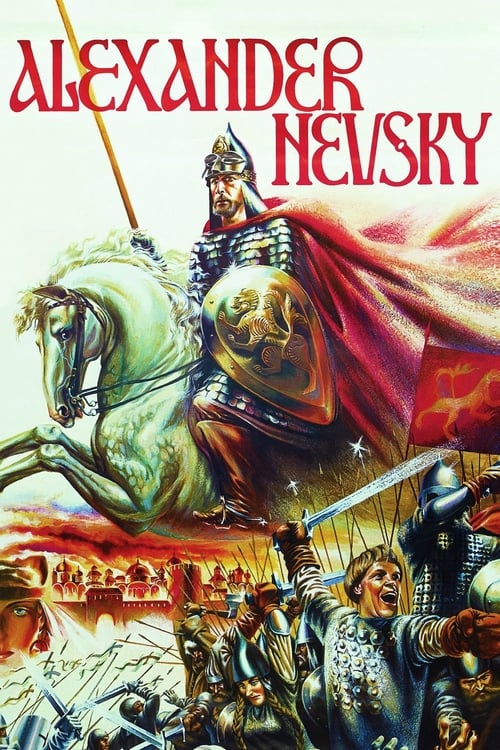
Alexander Nevsky
1938 · Sergei Eisenstein
For when you want spectacle with real weight — an old epic on a big screen, armies and ice and a score that carries you. It asks a little patience up front and pays it back in full.
What it's about
In the thirteenth century, armored Teutonic Knights push into Russian lands, sacking cities as they go, and the prince Alexander Nevsky is called to rally a people's army against them. The defense builds toward a massive winter confrontation on the frozen surface of a lake, while two friends in the ranks turn courage into a contest for the same woman's hand. It's a national legend told at mural scale — invasion, resistance, and one decisive day on the ice.
The experience
Stately and thunderous by turns: long stretches of ceremony and gathering dread, then a battle sequence that hits like an avalanche and takes up much of the film. It feels less like watching a story than watching a legend being carved in front of you.
Performances
Nikolai Cherkasov plays Alexander as a living monument — upright, calm, almost mythic — which is exactly the register the film wants, and he makes iconography feel human.
The craft
This is one of cinema's great director–composer collaborations: Sergei Eisenstein cut images and Sergei Prokofiev wrote music in genuine dialogue with each other, so the battle on the ice plays almost like an opera staged with cavalry. The compositions are stark and graphic — white robes, black crosses, horizon lines like woodcuts — and it absolutely rewards good speakers.
Why it matters
Made as an open warning about the German threat gathering in 1938, it restored Eisenstein's standing at home and became the template for how movies score and stage epic battle — its ice battle has been echoed in war and fantasy films ever since.
Snapshot
Alexander Nevsky dramatizes the thirteenth-century defense of the Russian lands against the invading Teutonic Knights, culminating in the 1242 Battle on the Ice on frozen Lake Chudskoe (Lake Peipus). It was Sergei Eisenstein's first completed sound film and his first finished feature in roughly seven years — a return to production after the collapse of his Mexican project, ¡Que viva México!, and the suppression of Bezhin Meadow in 1937. Conceived and executed under intense political scrutiny, the film is at once a patriotic epic, an open allegory of the German threat then gathering in Europe, and a laboratory for Eisenstein's evolving theory of audiovisual montage, realized through his landmark collaboration with composer Sergei Prokofiev. It rehabilitated Eisenstein's standing with the Soviet authorities, won official honors, and left a durable mark on how cinema stages mass battle and synchronizes music to image. Its reputation is double-edged: celebrated as a formal achievement, it is also routinely discussed as state propaganda, a tension that runs through nearly all serious writing on the film.
Industry & production
The film was produced at Mosfilm in 1938 under conditions shaped directly by Eisenstein's recent disgrace. Bezhin Meadow, halted in 1937 and denounced, had left him professionally precarious; Alexander Nevsky was both an assignment and a test of orthodoxy. Eisenstein was given a historical-patriotic subject aligned with the regime's needs, a narrowed creative latitude, and — in a telling institutional gesture — a co-director, Dmitri Vasilyev, widely understood as a reliable supervising presence assigned alongside him. The screenplay was written by Eisenstein with Pyotr Pavlenko, a politically trusted writer, a pairing that again reflects the oversight built into the project.
Production was governed by the calendar of looming war. The film entered work and was completed with notable speed for a project of its scale, and was released in late 1938 (November), at a moment when the Soviet Union still treated Nazi Germany as the principal adversary. Its subsequent fate is one of the most cited episodes in Soviet film politics: after the Molotov–Ribbentrop Pact of August 1939 realigned Soviet-German relations, the film's overt anti-German thrust became diplomatically inconvenient and it was withdrawn from circulation. After the German invasion of June 1941, it was returned to screens as urgent wartime mobilization. Eisenstein received high state recognition for the film, including the Stalin Prize (awarded 1941); the precise honors are documented in the standard sources, and I note them in summary rather than reciting an exhaustive list.
Technology
Alexander Nevsky was Eisenstein's first work in synchronized sound, a technology the Soviet industry had adopted later than Hollywood, and his engagement with it was theoretical as much as practical: he treated the soundtrack not as recorded accompaniment but as a compositional element to be structured against the image. The most discussed technical problem of the production was meteorological rather than electronic. The decisive Battle on the Ice — set in winter on a frozen lake — was filmed in summer heat, because the schedule could not wait for real ice. The production therefore built an artificial winter landscape on a field near the studio, using materials such as chalk, sand, liquid glass and other substances to simulate snow and ice under a summer sky, with the horizon and clouds carefully controlled in the frame. The specific recipe of materials is described variously across accounts; the reliable point is that the celebrated frozen battlefield is a constructed illusion shot in warm weather, a fact that has become part of the film's lore.
Technique
Cinematography
Eduard Tisse, Eisenstein's long-standing cinematographer, shot the film. Tisse's images favor monumental, sky-dominated compositions — low horizons with vast cloudscapes above, against which armored figures and standards are silhouetted. The visual rhetoric is sculptural and heraldic: faces and bodies are arranged as emblems, landscapes flattened into friezes. The artificial ice-field permitted an abstracted, almost stage-like white expanse across which the two armies are choreographed. The cinematography is less restlessly kinetic than in Eisenstein's silent work and more concerned with iconic, holdable images — a shift consistent with the film's operatic and emblematic ambitions.
Editing
The editing is the film's theoretical centerpiece, but it operates differently than the rapid collision montage of Battleship Potemkin or October. Here Eisenstein subordinated cutting to a synthesis of image and music. In the Battle on the Ice, the cutting builds the German advance through accumulating rhythm — the long, dread-laden approach of the knights, the gathering tempo, the clash, and the rout across breaking ice. Eisenstein famously analyzed a passage of this sequence in his own writing (collected in English as The Film Sense), laying out frame-by-frame diagrams to argue for a correspondence between the contour of Prokofiev's music, the movement of the eye across the composition, and the rhythm of the cut. That analysis is itself a primary document of montage theory; scholars debate how literally to take its claims, but it remains the canonical statement of "vertical" or audiovisual montage.
Mise-en-scène / staging
Staging is monumental and frieze-like. The two camps are sharply differentiated by design. The Russians are presented through warm, communal, vernacular imagery — peasants, craftsmen, the open assembly of Novgorod. The Teutonic Knights are rendered as a faceless, mechanized menace: enveloping helmets that mask the eyes, a bishop and monastic apparatus, an unsettling field organ, and insignia that evoke fascist iconography — a deliberate visual equation of medieval crusaders with contemporary German militarism. Crowds and armies are blocked as masses in motion, and individual figures are posed for maximal emblematic clarity rather than naturalistic incident.
Sound
Sound is inseparable from Prokofiev's score (see Authorship). Beyond music, the film uses sound symbolically — the dissonant, mechanical voice of the German side against the melodic, choral register of the Russians, including choral writing that carries the patriotic theme. Eisenstein conceived the soundtrack as a structural counterpoint to the image rather than as background, and the film is studied precisely as an early, self-conscious experiment in fusing the two.
Performance
Performance leans toward the heroic and statuesque rather than the psychological. Nikolai Cherkasov plays Alexander as a calm, granite embodiment of national resolve — a public, monumental hero more than an interior character; Cherkasov would go on to anchor Eisenstein's Ivan the Terrible. The secondary figures supply the human and comic register: the two warriors Vasili Buslai and Gavrilo Olexich, whose rivalry over a Novgorod maiden, Olga, threads through the war narrative, and the warrior-maiden Vasilisa who fights in the battle. Eisenstein's long-held principle of "typage" — casting and directing faces as social types — governs much of the playing, particularly in the crowd and among the Teutonic antagonists.
Narrative & dramatic mode
The film is built as patriotic epic rather than character drama. Its through-line is collective: the rousing of a people to defend the homeland, organized around a leader who articulates the national will. The dramatic mode is declarative and emblematic — episodes function as movements in an oratorio (the threat, the gathering, the call, the great battle, the triumph and lament). Personal stakes are deliberately modest and somewhat folkloric: the bravery-contest between Vasili and Gavrilo for Olga's hand provides romance, humor, and a human scale, but it is subordinated to, and ultimately folded into, the larger martial action. The film closes on a note of warning and resolve, with Alexander's admonition to invaders that those who come with the sword will perish by the sword — a line framed in scriptural cadence and pointed unmistakably at the contemporary moment.
Genre & cycle
Alexander Nevsky belongs to the Soviet historical-patriotic epic of the later 1930s, a cycle in which national history was mobilized to serve present political needs — the rehabilitation of pre-revolutionary heroes and a martial, defensive patriotism keyed to the threat of war. Within Eisenstein's own oeuvre it inaugurates his late "historical" manner, continued and complicated in the two parts of Ivan the Terrible. As a war film it is a foundational text in the staging of pitched medieval battle on screen, and as a propaganda film it sits squarely in the tradition of officially commissioned mobilization cinema.
Authorship & method
The film is the product of Eisenstein's authorship under constraint, executed with a tight circle of major collaborators. Sergei Eisenstein directed and co-wrote, working with the politically trusted Dmitri Vasilyev as assigned co-director and with Pyotr Pavlenko on the screenplay. Eduard Tisse, his cinematographer since the silent era, shot the film. The single most consequential collaboration was with composer Sergei Prokofiev, whose score was developed in close, reciprocal exchange with Eisenstein — in some passages music was written to cut footage and in others footage cut to the music, a genuinely integrated method that Eisenstein later theorized at length. Prokofiev subsequently reworked the film music into a concert cantata (Alexander Nevsky, Op. 78), which entered the standard repertoire and helped carry the film's reputation into musical culture. The method here marks a deliberate evolution in Eisenstein's thinking: away from the aggressive intellectual montage of the 1920s toward a "synthesis of the arts," an audiovisual whole in which editing, composition, and music are designed as a single contrapuntal structure. How much of that synthesis reflects sincere artistic development versus accommodation to Socialist Realist demands is a standing scholarly debate, and the honest answer is that both pressures were operating at once.
Movement / national cinema
The film is a central document of Soviet cinema in the Stalinist 1930s, the era of Socialist Realism, when the radical formalism of the silent avant-garde — Eisenstein, Pudovkin, Vertov, Dovzhenko — had been curtailed in favor of accessible, ideologically legible storytelling. Alexander Nevsky registers this transition vividly: it is recognizably the work of the montage theorist, yet far more conventional in narrative shape and emotional address than Potemkin or October. It thus occupies a hinge position in the history of Soviet film — the avant-garde master working within, and partly against, the constraints of the official aesthetic.
Era / period
Made in 1938, the film is inseparable from the immediate pre-war conjuncture and the broader climate of the late Stalin period: the aftermath of the Terror, the demand for ideological conformity in the arts, and the rising likelihood of war with Germany. Its medieval setting is a transparent vehicle for present concerns. The film's own circulation history — celebrated in 1938, shelved during the 1939–41 Nazi-Soviet rapprochement, triumphantly revived after the 1941 invasion — makes it an unusually exact barometer of the period's diplomatic swings, the rare case where a film's availability tracked geopolitics almost month to month.
Themes
The governing themes are the defense of the homeland against foreign invasion; the fusion of leader and people in a single national will; collective heroism over individual glory; and the moral clarity of just resistance. The enemy is figured as alien, mechanized, and clerical-cruel, the homeland as communal, organic, and rooted — an opposition that carries both a nationalist and an explicitly anti-German charge. Secondary motifs include earned valor (the warriors' bravery contest), the integration of women into the common defense (Vasilisa), and the sanctity of the land itself. Threaded through all of it is a warning to aggressors that doubles as contemporary deterrence.
Reception, canon & influence
On release the film restored Eisenstein to official favor and was embraced as a patriotic success, later honored by the state; its wartime re-release confirmed its mobilizing power. Critical reception over time has been divided in a characteristic way: the film is admired as a formal and audiovisual achievement — above all for the Battle on the Ice and the Eisenstein–Prokofiev synthesis — while frequently faulted, or at least qualified, as state propaganda and as a retreat from the radicalism of Eisenstein's silent masterpieces. Both positions are well established in the literature and are best held together rather than resolved.
Influences on the film (backward): Eisenstein drew on his own montage theory and silent practice, on the monumental traditions of Russian historical painting and iconography, on operatic and folk-epic forms of staging, and on the heroic-historical templates promoted under Socialist Realism. The depiction of the Teutonic order self-consciously borrowed the visual vocabulary of contemporary fascism to make its medieval enemy legible as a modern one.
Legacy (forward): The film's most concrete influence is theoretical and practical at once. Eisenstein's published analysis of the audiovisual structure of the Battle on the Ice became a foundational text for theories of music-image relations and is taught as such. The battle sequence itself became a model for staging large-scale combat in narrative cinema; its imprint is regularly traced in later epic battles — the medieval set-pieces of subsequent war and fantasy films are commonly discussed in its lineage — though specific attributions vary by source and should be treated as influence rather than direct citation. Prokofiev's cantata gave the work a second life in the concert hall. And within Eisenstein's career the film opened the path to Ivan the Terrible, extending the late historical manner and the partnership with Cherkasov. The film endures in the canon as the textbook instance of montage cinema reorganized around sound — and as a permanent case study in the entanglement of artistic innovation with state power.
A Deleuzian reading
The knights come on slowly.
The full Deleuzian reading of Alexander Nevsky →
Reception
A state-sanctioned smash in 1938 that rehabilitated Eisenstein after years in official disgrace — then yanked from Soviet screens in 1939 when the Nazi-Soviet pact made its anti-German fury inconvenient, and triumphantly re-released the moment Hitler invaded in 1941. Today it's canon, though often ranked a notch below Potemkin as 'the accessible Eisenstein.'
How Alexander Nevsky was received, from release to now →
Influences: the films it descends from and the films it influenced
- The Battleship Potemkin (1925) — Its Odessa Steps sequence established the rhythmic, mass-in-motion montage of crowds descending a diagonal space that the Battle on the Ice scales up and slows into frieze-like waves.
- October (Ten Days That Shook the World) (1928) — Eisenstein's intellectual/metric montage worked out here is repurposed in Nevsky as a contrapuntal audiovisual cut rather than a purely graphic collision.
- Strike (1925) — Pioneered typage — casting and framing non-actors by physiognomy as social types — the method Nevsky uses to make the Teutonic knights and Russian peasants legible at a glance.
- Intolerance (1916) — Its monumental historical reconstruction and large-scale battle crowd choreography set the template of the epic set-piece that Eisenstein studied and reorganized around editing.
- The Birth of a Nation (1915) — Established the choreographed massed-cavalry charge filmed across deep open ground, a staging grammar Eisenstein inherits and reworks on the frozen lake.
- Earth (Zemlya) (1930) — Its low-horizon compositions setting figures against vast empty sky are the precedent for Tisse's skyscape framing of the Russian host before battle.
- Triumph of the Will (1935) — Its frieze-like ordering of massed bodies into ornamental ranks supplied the fascist visual vocabulary Eisenstein deliberately quoted to render the Teutonic order as a modern enemy.
- Chapaev (1934) — Codified the Socialist Realist heroic-historical template — a charismatic leader rallying the masses — that Nevsky adopts and monumentalizes.
- Die Nibelungen: Siegfried (1924) — Prokofiev's through-composed leitmotif score fused to monumental frontal battle staging extends the Huppertz–Lang model of music welded to architectural image.
- Die Nibelungen: Kriemhild's Revenge (1924) — Deploys hieratic, emblematic figures in frieze-like battle tableaux cut to a leitmotif score (Prokofiev) fitted shot-to-music, the same score-to-action method as Huppertz's symphonic cues.
- Ivan the Terrible (1944) — Directly extends Nevsky's late manner: Cherkasov's statuesque heroic playing, Prokofiev's integrated score, and gesture composed as held, sculptural friezes.
- Henry V (1944) — William Walton's Agincourt music was built in the reciprocal cut-to-music / music-to-cut method Eisenstein theorized, and the battle's massed advance echoes the Battle on the Ice.
- Andrei Rublev (1966) — Conceived against Eisenstein's montage epic — its Tatar raid answers Nevsky's choreographed mass battle with durational long takes rather than rhythmic cutting.
- Chimes at Midnight (1965) — The Battle of Shrewsbury's fragmented, accelerating montage of bodies churning in mud descends directly from the cutting logic of the Battle on the Ice.
- The Lord of the Rings: The Two Towers (2002) — Helm's Deep stages a massed medieval clash with a cold, near-monochrome palette and choral leitmotif, regularly discussed as a modern descendant of the Battle on the Ice.
- Conan the Barbarian (1982) — Basil Poledouris scored it as a through-composed, leitmotif-driven structure modeled on Prokofiev's Nevsky cantata-as-integrated-design rather than incidental underscore.
- Star Wars (1977) — John Williams' return to leitmotif scoring and the audiovisual cutting of the trench run carry forward the Eisenstein–Prokofiev model of music and image designed as one structure.
- The Gospel According to St. Matthew (1964) — Casts non-professionals chosen for their faces as historical types — a direct continuation of Eisenstein's typage as a principle of historical embodiment.
- Seven Samurai (1954) — Eisenstein and Prokofiev's scored battle sequence established the grammar of synchronizing editing rhythm to musical tempo in mass combat; Kurosawa extends this with Fumio Hayasaka's taiko-percussion score driving the cut-to-cut momentum of the rain-battle finale.
- Rashomon (1950) — Kurosawa screened this during Rashomon's preparation specifically to study how Prokofiev composed a repeating musical motif in precise structural counterpoint to the edited image sequence; Fumio Hayasaka's Bolero-influenced ostinato directly applies this method of rhythm-as-argument rather than mood illustration.
- Throne of Blood (1957) — Eisenstein and Prokofiev's synchronization of choral score to choreographed image as co-equal structural elements — sound as architecture rather than accompaniment — is the direct model for Throne of Blood's Noh chanting and silence functioning as dramatic instruments coequal with the image.
- Ran (1985) — Eisenstein and Prokofiev developed audiovisual counterpoint here — score and image entering compositional dialogue rather than underscore relationship, with the ice-battle sequence structured through musical rhythm rather than diegetic sound — directly prefiguring the compositional method by which Takemitsu's score replaces battle sound in Ran, treating music as the primary informational channel during combat.
- Minin and Pozharsky (1939) — A contemporaneous patriotic anti-invader historical epic built on the same Socialist Realist mobilizing template of homeland defense against a foreign aggressor.
- Napoleon (2023) — The Battle on the Ice fuses massed combat choreography with a driving percussive score, the prototype for cutting battle to music; Scott's percussive-warfare sound design and ice-cracking Austerlitz climax descend from this audiovisual battle construction.
Similar films
- Strike (1925) — influence & lineage
- Andrei Rublev (1966) — influence & lineage
- Triumph of the Will (1935) — influence & lineage
- Knights of the Teutonic Order (1960) — often watched together
- Waterloo (1970) — often watched together
- The Red and the White (1967) — often watched together
- Battleship Potemkin (1925) — shared sensibility
- Dear Comrades! (2020) — shared sensibility
All the films related to Alexander Nevsky →