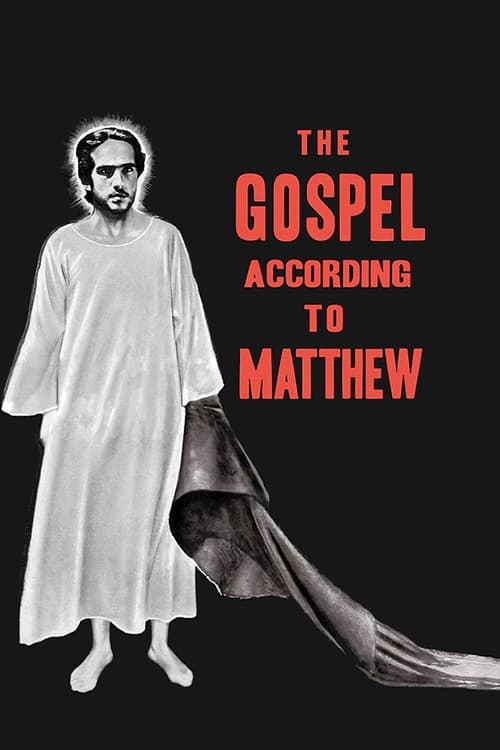
The Gospel According to St. Matthew
1965 · Pier Paolo Pasolini
For when you want to be moved and unsettled in equal measure — a contemplative, demanding watch that repays your full attention, believer or not. Not comfort viewing; closer to a pilgrimage.
What it's about
The life of Jesus, told using only the words of Matthew's Gospel and staged in the stony, sun-blasted villages of southern Italy with a cast of farmers, students, and locals rather than actors. This Christ is no serene icon — he's young, stern, and confrontational, striding from town to town delivering parables that read as direct challenges to the powerful, who begin to take notice.
The experience
Austere and quietly overwhelming — rough faces, bare landscapes, long silences broken by an unruly soundtrack that jumps from Bach to blues. It has documentary urgency; you feel you're watching events, not pageantry.
The craft
Pier Paolo Pasolini shoots the sacred story like newsreel — handheld cameras, non-professional faces found in the fields of southern Italy, stark black and white — and lets the unadorned text carry all the weight. The music choices are startling and the eroded landscapes are stunning; it's plainness raised to grandeur.
Why it matters
A Marxist atheist made what many, including Catholic institutions, still consider the most credible Jesus film ever shot — it won prizes at Venice and from the Church alike, and remains the benchmark every screen Gospel is measured against.
Snapshot
Il Vangelo secondo Matteo is Pier Paolo Pasolini's austere, ground-level retelling of the life of Christ, drawn word-for-word from the Gospel of Matthew and staged in the eroded landscapes of southern Italy with a cast of non-professionals. It is one of the central paradoxes of postwar cinema: a reverent, deeply moving Passion film made by an avowed Marxist, atheist, and homosexual, dedicated "to the dear, joyful, familiar memory of John XXIII." Premiered at the Venice Film Festival in 1964 (with international release following into 1965–66), it won the festival's Special Jury Prize and an award from the Catholic film office OCIC, and it remains widely regarded — including within Catholic institutions — as among the most credible screen treatments of the Gospels. Pasolini approached sacred material with the eye of a poet steeped in Renaissance painting and the politics of class, producing a Christ who is at once a revolutionary agitator and an object of devotional contemplation. The film occupies a hinge position in his career, extending the neorealist-derived manner of Accattone and Mamma Roma toward the more stylized, "contaminated" syntheses of his later work.
Industry & production
The film was an Italian–French co-production, financed on a modest budget characteristic of Pasolini's early features and produced through Arco Film (Alfredo Bini) with French partner participation. Bini, who had backed Pasolini's earlier films, was again the producer, and the project carried a degree of institutional risk: a self-described Marxist directing the life of Christ invited suspicion from both the Italian left and the Catholic establishment. Pasolini had already been prosecuted over the "La ricotta" episode of RoGoPaG (1963) on charges of insulting the state religion, which gives the comparative warmth of the Church's later reception of Il Vangelo its irony.
Production unfolded largely in the Italian south — the Sassi cave-dwellings of Matera in Basilicata, locations in Calabria and Puglia, and Mount Etna's volcanic terrain — chosen because their poverty-marked, archaic landscapes evoked an ancient Palestine without recourse to studio reconstruction. Pasolini's casting method drew on the people of these regions and on his own circle: Spanish university student Enrique Irazoqui, who had come to Italy in a political context rather than as an actor, was cast as Jesus; intellectuals, writers, and friends filled other roles; and the director's own mother, Susanna Pasolini, played the elder Virgin Mary. This is documented practice rather than legend. The economy of means — natural light, real locations, untrained faces — was both aesthetic conviction and budgetary fact.
Technology
Il Vangelo was shot in 35mm black-and-white, in the standard Academy-derived frame Pasolini favored in this period, eschewing the widescreen color spectacle that defined the contemporaneous Hollywood biblical epic (The Greatest Story Ever Told, King of Kings). The technological signature of the film is its embrace of lightweight, mobile shooting: handheld camerawork, the zoom lens, and reportage-style framing pushed cinematographic technique toward the documentary register even as the imagery aspired to the condition of fresco. Pasolini and his cinematographer exploited the responsiveness of available equipment to chase movement, faces, and crowds in the manner of a newsreel cameraman, then cut those fragments against frontal, static compositions. The soundtrack was constructed in post-production — Italian filmmaking of the era worked in post-synchronized sound as a matter of course — which freed the director to assemble dialogue, ambient sound, and a heterogeneous music track after the fact rather than recording synchronously on location.
Technique
Cinematography
The photography is by Tonino Delli Colli, Pasolini's frequent collaborator (and later cinematographer for Leone and others). The visual conception fuses two seemingly incompatible idioms. On one hand, a quasi-documentary handheld camera — restless, searching, often zooming in on weathered peasant faces — lends events the immediacy of witnessed reportage. On the other, Delli Colli and Pasolini compose passages of severe frontality and stillness explicitly modeled on early Renaissance painting, with the grave faces, hieratic groupings, and stark tonal contrasts that recall Piero della Francesca and Masaccio. The black-and-white is high in contrast and unglamorous, privileging texture — rock, cloth, skin — over polish. Close-ups of non-professional faces function as the film's primary expressive unit, a gallery of human physiognomy that carries more weight than landscape or spectacle. The result is a deliberately "rough" sacred image, neither the kitsch of the epic nor the smoothness of academic illustration.
Editing
Cut by Nino Baragli — another long-term Pasolini collaborator — the editing alternates between contemplative held shots and abrupt, almost jagged juxtapositions. Pasolini does not smooth the seams; reverse angles and zooms are sometimes assembled with a frankness that foregrounds the act of construction. The miracles, rather than being elaborated as effects, are frequently rendered through elliptical cutting — a withholding here, a sudden new state of affairs there — so that the supernatural is presented as fact without illustrative fuss. The rhythm shifts markedly across the film: the Sermon on the Mount unfolds in sustained, frontal address, while the Passion accelerates into a denser, more fragmented montage.
Mise-en-scène / staging
The staging is governed by Pasolini's principle of bringing sacred narrative down to the earth of the rural sub-proletariat. Costumes and production design — costume work associated with Danilo Donati, a key Pasolini collaborator of the period — borrow from Renaissance and even non-European sources, mixing periods and registers in the director's characteristic "contamination." Crowds are massed in painterly arrangements; the powerful (Pharisees, priests, Herod's soldiers) are visually marked by elaborate, hardened costume against the plain dress of the poor who follow Jesus. The barren landscapes are not backdrops but moral geography: the Beatitudes delivered to the dispossessed land the words with a polemical edge.
Sound
The sound design is among the film's most celebrated and radical features. Pasolini assembled an eclectic, anachronistic music track that yokes together high European sacred music and vernacular forms of suffering: passages associated with J. S. Bach (notably the St. Matthew Passion), Mozart, and Prokofiev sit alongside the Congolese Missa Luba, American spirituals and blues — including Odetta's rendition of "Sometimes I Feel Like a Motherless Child" — and other sources, in an arrangement credited to Luis Enríquez Bacalov. The effect of this juxtaposition is to universalize the Passion as a story of the oppressed across cultures and eras. Dialogue, post-synchronized, is taken verbatim from Matthew, so that Christ's words arrive as scripture rather than dramatized paraphrase; ambient sound is sparse, throwing the music and the spoken text into relief.
Performance
Pasolini's cast is overwhelmingly non-professional, and performance is calibrated against conventional acting. Enrique Irazoqui's Jesus is severe, brusque, and urgent — a stern teacher and agitator rather than a serene icon, his sermons delivered with confrontational directness. The faces around him are valued precisely for their untrained, lived quality; expression is often a matter of physiognomy and bearing rather than dramatic technique. Susanna Pasolini's elder Mary brings a weathered, grief-worn presence to the Passion. The overall performance register is anti-theatrical, aligned with the neorealist conviction that the real face of the poor carries an authenticity no professional could counterfeit.
Narrative & dramatic mode
The film's most consequential formal decision is fidelity to a single Gospel as text. Pasolini dramatizes Matthew and only Matthew, using its words as the script and inventing no dialogue of his own. This produces an unusual dramatic mode: episodic, paratactic, and elliptical, advancing through the Gospel's own sequence of teachings, parables, miracles, confrontations, and the Passion without the connective tissue of conventional screenwriting. Cause and effect are frequently left implicit; the narrative proceeds by accumulation and juxtaposition rather than psychological development. There is little interiority — Jesus is shown almost entirely from outside, through his words and acts — and the supernatural is presented matter-of-factly rather than explained. The mode is closer to liturgical recitation and painted altarpiece than to the well-made dramatic film, which is precisely the source of its gravity.
Genre & cycle
Il Vangelo belongs to the biblical/religious film, and specifically to the Christ film, but it defines itself against the dominant cycle of the period: the large-scale Hollywood and international biblical epic in color and widescreen. Where that cycle traded in spectacle, stars, and reverent grandeur, Pasolini offered austerity, non-professionals, and a politicized, neorealist intimacy. It thus reads simultaneously as a religious film and as a critique of how religious films were being made. Within Pasolini's own body of work it forms part of a loosely "sacred" or mythic strain — connected backward to the sub-proletarian Christ-figures of Accattone and Mamma Roma, and forward to his mythological adaptations (Edipo Re, Medea) — distinct from the bawdy Trilogy of Life and the final Salò.
Authorship & method
The film is unmistakably an auteur work, the product of Pasolini's idiosyncratic synthesis of Marxism, Catholic cultural inheritance, philology, and a painter's eye. His method here crystallizes ideas he articulated as a film theorist — the "cinema of poetry," the "free indirect subjective," and a practice of stylistic "contamination" that mixes registers (sacred and profane, high and folk, archaic and modern) without resolving them. His stated aim was reverence achieved by analogy rather than archaeology: to make the Gospel felt by transposing it into the recognizable world of the Italian rural poor.
He was served by a tight circle of major collaborators. Cinematographer Tonino Delli Colli translated the painterly-documentary fusion into image. Editor Nino Baragli shaped its distinctive rhythm. The music was arranged by Luis Enríquez Bacalov, realizing Pasolini's anachronistic compilation. Costume design is associated with Danilo Donati, whose work helped give the film its mixed-period visual texture. The casting of his mother as the elder Mary and of intellectuals and peasants in other roles was itself an authorial signature — an extension of Pasolini's conviction that the right face mattered more than the trained performance.
Movement / national cinema
The film is a product of Italian cinema's post-neorealist moment, carrying forward neorealism's location shooting, non-professional casting, and attention to the southern poor while transmuting these into something more stylized and mythic. Pasolini stands somewhat apart from his contemporaries Fellini, Antonioni, and Visconti: a poet, novelist, and critic who came to cinema from literature, bringing a philological and political sensibility distinct from the art-cinema mainstream. Il Vangelo belongs to the broader European art cinema of the 1960s in its formal ambition and authorial stamp, while its engagement with the Italian Mezzogiorno roots it firmly in a national tradition of representing the country's internal divisions of class and region.
Era / period
Made in the early-to-mid 1960s, the film sits within a charged historical conjuncture: the aftermath of the Second Vatican Council and the brief papacy of John XXIII, whose spirit of reform and dialogue Pasolini explicitly honored in the dedication; the ferment of the Italian and European left; and the international vogue for the biblical epic against which Pasolini reacted. The period's openness to dialogue between Marxism and Catholicism — the "Catholic-Communist dialogue" of the era — is the intellectual climate that made a sympathetic, materialist Christ both conceivable and resonant. The film's politics are of its moment: Christ as a figure of the poor, his message read with an emphasis on social rupture that spoke to 1960s radicalism.
Themes
At the film's core is the figure of Christ as revolutionary — a teacher whose parables and Beatitudes are weapons against established power, whose anger at the money-changers and the religious authorities is rendered as genuine social confrontation. Yet this reading coexists with authentic awe before the mystery and pathos of the Passion; the film refuses to collapse the sacred into the merely political. Poverty and the dignity of the dispossessed run throughout, materialized in landscape, face, and costume. The eclectic music universalizes suffering across cultures and histories. There is, too, a meditation on the word itself — the power and severity of Christ's speech, foregrounded by the verbatim use of Matthew — and on faith as something witnessed rather than explained. Underlying all is Pasolini's lifelong tension between Marxist materialism and a deep, unresolved attraction to the sacred and the archaic.
Reception, canon & influence
The film was widely and seriously acclaimed on release, winning the Special Jury Prize at the 1964 Venice Film Festival and recognition from the Catholic OCIC — a striking endorsement given the director's politics — and it later received Academy Award nominations in craft categories (its art direction, costumes, and music score). It has retained an exceptional reputation as a religious film admired across the ideological spectrum; it is frequently cited, including in Catholic contexts, as among the finest cinematic treatments of the Gospels, and it remains canonical in surveys of Italian and world cinema.
Its influences (backward) are legible and avowed: the neorealist legacy of location, non-professional casting, and the rural poor; early Italian Renaissance painting (Piero della Francesca, Masaccio) for composition and the grave dignity of faces; the European sacred-music tradition; and Pasolini's own prior sub-proletarian dramas. The verbatim-Gospel conceit reflects his literary and philological formation.
Its legacy (forward) lies in establishing a durable alternative model for the religious film — austere, materially grounded, politically alert, and visually indebted to painting rather than to epic spectacle. It demonstrated that sacred narrative could be rendered with documentary roughness and emotional power on a small budget, an example felt in subsequent art-cinema treatments of religious subjects and in the broader practice of staging myth and scripture through non-professional faces and real landscapes. Within Pasolini's career it consolidated the synthesis of neorealism and stylization that he would carry into his mythological films. The record on the film's precise, frame-by-frame influence on individual later directors is more a matter of critical attribution than of documented testimony, and is best stated with that caution; but its standing as the benchmark "serious" Christ film, against which later attempts are routinely measured, is secure.
A Deleuzian reading
Start with a face.
The full Deleuzian reading of The Gospel According to St. Matthew →
Reception
Whistled at by right-wing protesters at its 1964 Venice premiere — a gay Marxist atheist filming the life of Christ was a scandal on paper — yet it won the Special Jury Prize, and the Church came around so completely that the Vatican's own newspaper has since called it the best film about Jesus ever made.
How The Gospel According to St. Matthew was received, from release to now →
Influences: the films it descends from and the films it influenced
- The Passion of Joan of Arc (1928) — Established the unadorned human face in austere close-up as a spiritual document, with anti-theatrical playing and a script drawn verbatim from a primary text — the model for Pasolini's grave peasant faces and single-source Gospel fidelity.
- Battleship Potemkin (1925) — Supplied the principle of typage — casting by physiognomy rather than training — and the jagged collision-montage that Pasolini adapts for his elliptical, non-continuous staging of the miracles.
- The Flowers of St. Francis (1950) — Cast actual friars as themselves and built the film as paratactic episodes of holy anecdote shot in open fields — the direct precedent for non-professional sacred casting and elliptical, chapter-like scriptural structure.
- Rome, Open City (1945) — Codified the neorealist toolkit Pasolini inherits — real locations, non-professional bodies, post-synchronized sound, and a documentary roughness applied to grave subject matter.
- Diary of a Country Priest (1951) — Rendered grace through anti-theatrical 'models' and refusal of dramatic emphasis, deriving its sacred weight from a literary source — the austere, undemonstrative register Pasolini pursues without Bresson's interiority.
- Accattone (1961) — His own prior film established the 'contamination' method — sub-proletarian Roman faces framed frontally like icons with Bach on the soundtrack — that Matthew transposes wholesale onto the Gospel world.
- The Seventh Seal (1957) — Pasolini stages the Gospels using Italian medieval and early Renaissance fresco painting (Giotto, Masaccio) as a live compositional grammar, blocking non-professional actors in tableau arrangements quoting specific devotional images — extending Bergman's technique of treating church painting as a direct staging template rather than period atmosphere.
- Alexander Nevsky (1938) — Casts non-professionals chosen for their faces as historical types — a direct continuation of Eisenstein's typage as a principle of historical embodiment.
- Mamma Roma (1962) — The direct payoff of the Mamma Roma method — same crew (Delli Colli, Baragli), non-professional faces cast as Renaissance-painting types, sacred tableaux, and appropriated music replacing a composed score.
- Oedipus Rex (1967) — Carries the Matthew synthesis forward into pagan myth — non-professional faces, archaic real landscapes (Morocco), and anachronistic costume 'contamination' staging scripture-as-folk-ritual.
- The Tree of Wooden Clogs (1978) — Casts a whole Bergamasque peasant community as itself and sacralizes rural poverty through natural light and dialect — extending the neorealist-sacred fusion to a near-liturgical register.
- The Last Temptation of Christ (1988) — Adopts the Pasolinian demystified Christ — handheld documentary roughness, non-idealized faces, real desert locations — measuring itself explicitly against the austere alternative Matthew established.
- La Vie de Jésus (1997) — Uses untrained local non-actors, anti-theatrical blankness, and bleak rural landscape to locate metaphysical weight in the materially poor — the post-Pasolini sacred-materialist model in secular form.
- Silent Light (2007) — Casts a real Mennonite community as itself and treats landscape and durational silence as sacred, staging a miracle (resurrection) through ellipsis rather than spectacle — a direct heir to the non-professional-faces sacred.
- Birdsong (2008) — Deflates the Nativity myth via non-professional bodies, long static black-and-white takes, and bare landscape, extending Pasolini's strategy of staging scripture through anti-heroic real faces and contaminated registers.
- Stalker (1979) — Pasolini's use of actual impoverished southern Italian locations and non-professional performers to render sacred narrative in documentary materiality is the direct precedent for Tarkovsky's method of staging transcendence inside genuine post-industrial ruin rather than constructed sets.
- Theorem (1968) — Pasolini's own development of the B&W documentary ontology for the historically 'real' versus the color indexical present — the epistemological distinction between representational modes that he carries directly into Teorema's black-and-white factory sequences bracketing the color villa narrative.
- Satyricon (1969) — Danilo Donati's costume design — ancient-world textiles sourced ethnographically rather than archaeologically reconstructed — and Tonino Delli Colli's long-lens static procession shots established the frieze-composition vocabulary and non-actor bodily stillness that Fellini specifically hired Donati to bring to Satyricon.
- The Mission (1986) — Pasolini's austere, ground-level staging of Passion iconography with non-professional faces models the crucifixion/martyrdom tableaux that close The Mission.
- Salò, or the 120 Days of Sodom (1976) — Pasolini's method of staging reverent tableaux with Renaissance pictorial allusion and ironic high/low musical counterpoint — beauty framing meaning — is the formal grammar Salò inverts toward horror.
- A Dog's Will (2000) — Renders the sacred as popular, non-clerical folk realism among the rural poor, the plainspoken peasant-Catholic register that lets Christ and the Virgin appear without pomp.
- Andrei Rublev (1966) — Renders sacred history through material roughness, weathered non-glamorous faces, and painterly black-and-white composition rather than epic gloss — the same anti-spectacular treatment of holy subject matter.
- Au hasard Balthazar (1966) — Conveys grace and Passion through expressionless models and elliptical omission of climaxes, a parallel austerity that locates the sacred in flat affect rather than performance.
- The Messiah (1975) — Stages the life of Christ with didactic plainness, natural light, and a refusal of miracle-spectacle — Rossellini answering the same anti-epic, materially grounded brief Pasolini set.
- Caravaggio (1986) — Builds the film from painterly tableaux composed after the canvases themselves and deliberate anachronistic intrusions (modern objects in period frames) — the same painting-as-composition source and high/low 'contamination' Pasolini practiced.
- The Postman (1994) — Luis Bacalov's scoring craft—folk-inflected melodic lines acting as an emotional narrator—originates in his work here and resurfaces as Il Postino's Oscar-winning theme.
- Nazarín (1959) — Films sanctity in a stark, unsentimental neorealist idiom with nonprofessional-flavored faces and deadpan neutrality, sharing Nazarín's refusal to romanticize the figure of the man of God.
- The Given Word (1962) — Renders the Passion in austere high-contrast monochrome using non-actor faces and popular-religious immediacy, sacralizing the peasant body as Duarte sacralizes Zé do Burro.
- Marketa Lazarová (1967) — Non-professional elemental faces and rough documentary-ethnographic texture applied to sacred history, austere and hieratic.
- Lord of the Flies (1963) — Pasolini films non-professional faces with reportage handheld framing in bare landscape while setting sacred choral music against brutality — the same counterpoint Brook builds between Leppard's boy-choir Kyrie and the hunt.
Similar films
- The Last Temptation of Christ (1988) — influence & lineage · same viewing thread
- Accattone (1961) — influence & lineage
- The Flowers of St. Francis (1950) — influence & lineage
- Rome, Open City (1945) — influence & lineage
- Andrei Rublev (1966) — influence & lineage
- Diary of a Country Priest (1951) — influence & lineage
- Au Hasard Balthazar (1966) — influence & lineage
- The Tree of Wooden Clogs (1978) — influence & lineage
All the films related to The Gospel According to St. Matthew →
Watch it with: curated runs of related films
- The Testing of Faith — Watch these together when you want cinema that puts belief on the rack — devout men pushed to the brink of renouncing everything while their bodies are broken and their souls interrogated.