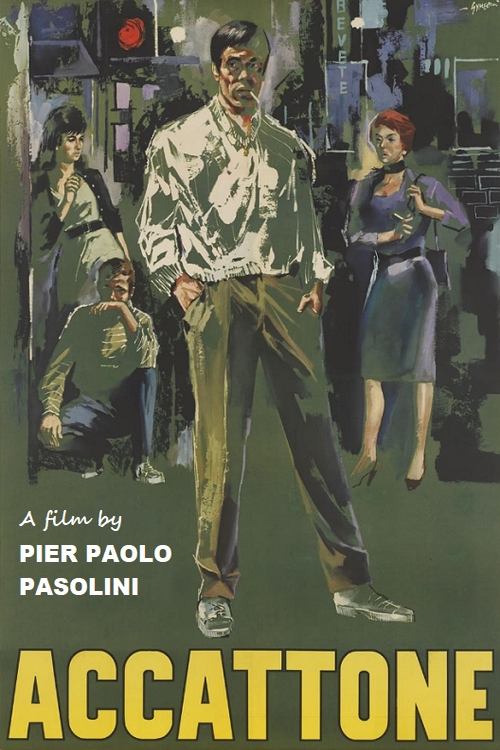
Accattone
1961 · Pier Paolo Pasolini
For when you want cinema stripped to the bone — unglamorous, humane, and morally serious. A challenge rather than a comfort, best when you're ready to sit with hard lives honestly shown.
What it's about
Vittorio, nicknamed Accattone, is a small-time pimp drifting through the shantytowns on the edge of Rome, living off the earnings of the prostitute Maddalena. When she's sent to prison, his fragile existence starts to collapse, and a tender attachment to an innocent young woman named Stella dangles the possibility of another kind of life — if he can bring himself to work for it. It's a portrait of a man, and a whole world, that official Italy preferred not to see.
The experience
Stark, raw, and strangely tender — squalor shot with the gravity usually reserved for saints. It's slow-burning and fatalistic, but there's rough humor and real feeling in its street-corner banter, and it lingers like a bruise.
Performances
Franco Citti, a non-professional plucked from the very world the film depicts, is unforgettable as Accattone — swaggering, pathetic, and soulful all at once, a face the camera treats like an icon.
The craft
Pasolini, already a celebrated poet and novelist, shot his first film with blunt frontal compositions and a cast of non-actors from Rome's periphery, then set their degradation to the music of Bach — a collision of the sacred and the gutter that defines the film. The grainy black-and-white images have a rough-hewn monumental quality that still startles.
Why it matters
A landmark debut that pushed beyond neorealism into something harsher and more mythic, it launched one of the most provocative directorial careers in European cinema and put Rome's subproletariat on screen with unprecedented force.
Snapshot
Accattone is Pier Paolo Pasolini's directorial debut, a stark black-and-white portrait of a small-time pimp and layabout named Vittorio "Accattone" Cataldi (Franco Citti) drifting through the borgate — the ragged shantytown periphery of Rome. When his source of income, the prostitute Maddalena, is jailed, Accattone flirts with reform through a fragile love for the innocent Stella, tries and fails at honest labor and petty theft, and dies in a motorcycle accident during a botched escape from the police. Made after Pasolini had already established himself as a poet, novelist and screenwriter, the film transposes the subproletarian world of his novels Ragazzi di vita (1955) and Una vita violenta (1959) to the screen. It stands as both a late outgrowth of neorealism and a decisive break from it: Pasolini films the underclass not with sociological pity but with a grave, sacral reverence, borrowing the compositional grammar of early Italian religious painting and scoring the squalor to Bach. It announced one of postwar cinema's most singular authorial voices.
Industry & production
The film was produced by Alfredo Bini through Arco Film, the producer who would back most of Pasolini's early features. The genesis is bound up with Federico Fellini: Pasolini had contributed to the screenplays of Fellini's Le notti di Cabiria (1957) — supplying dialogue and expertise on the Roman low-life milieu — and Fellini's newly formed production outfit, Federiz, was initially poised to produce Accattone. According to the well-established account, Fellini financed test footage but, unpersuaded by Pasolini's raw, technically unschooled shooting, withdrew, and Bini stepped in. Whatever the precise details, the collapse of the Federiz arrangement is a documented turning point that left Pasolini to make the film outside the orbit of Italy's dominant art-cinema figure.
Production was low-budget and shot on location in the Roman borgate — districts such as the Pigneto — using the actual inhabited landscape of postwar Rome's margins rather than studio sets. Casting drew heavily on nonprofessionals: Franco Citti, brother of Pasolini's collaborator and dialect consultant Sergio Citti, was not a trained actor, and much of the surrounding cast came from the neighborhoods depicted. Bernardo Bertolucci, then very young, served as assistant director — his first significant film-industry role, before his own directing career. The film premiered at the 1961 Venice Film Festival, where it provoked disturbances; the record consistently notes hostility from neo-fascist demonstrators, and the film's frank subject matter drew censorship friction in Italy, consistent with the moral and political controversy that would shadow Pasolini's entire career.
Technology
Accattone is a conventional 35mm black-and-white production of its era, presented in the standard Academy-adjacent ratio then normal for Italian dramatic features rather than in the widescreen formats increasingly fashionable at the time. As was typical of Italian filmmaking of the period, sound was post-synchronised (dubbed in post-production) rather than recorded live, a practice that both eased location shooting in noisy environments and allowed careful control of the dialect-heavy Roman speech. There is no technological novelty being showcased here; the interest lies almost entirely in how deliberately un-virtuosic the tools are handled. Pasolini approached the camera as a near-novice, and the film's aesthetic force comes from constraint and refusal — of camera movement, of optical flourish — rather than from any new apparatus.
Technique
Cinematography
The cinematographer was Tonino Delli Colli, in the first of his many collaborations with Pasolini. The photography is celebrated for its severity: high-contrast black-and-white, faces isolated against sky or blank wall, figures framed frontally and often from slightly below so that the ragged men of the borgate acquire a monumental, iconic weight. Pasolini famously described his early visual method as essentially reverential and painterly, favouring the fixed frame and a restricted lens vocabulary — by his own later account he relied heavily on a standard (roughly 50mm) lens and distrusted the zoom and the tracking shot as too "naturalistic." The result is a cinema of the held gaze: shots that present rather than follow, that compose the human face the way a fresco composes a saint. The debt Pasolini repeatedly acknowledged was to early Renaissance and pre-Renaissance Italian painting — the frontality and gravity of Masaccio in particular — and Delli Colli's lighting realizes that ambition in the tonal register of documentary poverty.
Editing
Editing was by Nino Baragli, another collaborator who would recur across Pasolini's filmography. The cutting reinforces the film's frontal, tableau-like rhythm: shots tend to be assembled as discrete, weighted units rather than dissolved into fluid continuity, and the montage serves the accretive, episodic movement of Accattone's days rather than a tightly engineered suspense structure. The famous set-piece — a dream/premonition sequence in which Accattone attends what amounts to a vision of his own funeral — is shaped in the cutting into one of the film's clearest instances of the sacred intruding on the profane.
Mise-en-scène / staging
The staging is the film's signature. Pasolini composes the borgata as a stage for a kind of debased passion play: card games, brawls, idle loitering and casual cruelty are blocked with a formality that lifts them out of naturalism. The environment — unpaved lots, unfinished apartment blocks, the muddy Roman periphery — is not backdrop but subject, the physical proof of a world abandoned by the postwar "economic miracle." Bodies are arranged with an eye to painterly grouping; a swim in the Aniene river or a fistfight is framed to recall composition in a fresco. This deliberate elevation of the lumpen to the iconic is the core of what critics mean when they call the film Pasolini's "sacralisation" of the subproletariat.
Sound
The most discussed choice is the music. Rather than an original dramatic score, Accattone is dominated by Johann Sebastian Bach — above all passages from the St. Matthew Passion — laid over scenes of squalor, violence and death. (A conventional musical-direction credit exists in the film's paperwork, but the expressive substance is Bach's.) The effect is deliberately incongruous and transformative: the sacred music confers tragic dignity on a brawl in the dirt, insisting that these discarded lives carry the weight of a Passion. Combined with the post-synchronised, dialect-thick Roman dialogue, the soundtrack sets a register of vernacular reality against one of transcendence — the film's central tension made audible.
Performance
The performances are drawn largely from nonprofessionals directed toward presence rather than psychological "acting." Franco Citti's Accattone is the anchor: sullen, charming, indolent and doomed, a face and body more than a performed interiority. Franca Pasut plays Stella, the fragile innocent, and Silvana Corsini the prostitute Maddalena. Pasolini's method treated these figures less as characters to be inhabited than as human material to be composed and photographed — a use of the nonprofessional that descends from neorealism but is pushed toward the emblematic and the typological.
Narrative & dramatic mode
The narrative is loose, episodic and picaresque, tracking Accattone's aimless days rather than building a tightly causal plot; its dramatic mode is tragic in a specifically fatalistic key. Accattone cannot escape what he is — his single gesture toward redemption (love, work) is doomed from the outset — and the film moves with the inevitability of a passion narrative toward his death. The famous last line, delivered as he dies from the motorcycle crash, registers a strange peace ("now I'm alright"), an ending that reads simultaneously as defeat and as a bleak absolution. The mode is neither the problem-solving arc of classical drama nor the ironic open-endedness of much modernist cinema; it is closer to hagiography inverted, the life and death of an anti-saint.
Genre & cycle
Nominally a social drama, Accattone sits at the tail end of, and in argument with, the Italian neorealist cycle that had defined the country's cinema since Rossellini and De Sica in the mid-1940s. By 1961 neorealism as a movement was widely considered exhausted, giving way to the modernism of Antonioni and the fabulism of Fellini. Accattone belongs to a small, personal cycle within Pasolini's own work — continued directly in Mamma Roma (1962) and the short La ricotta (1963) — that mines the Roman subproletariat. It can also be read as inaugurating a strand of Italian and European cinema devoted to the criminal and marginal underclass treated with tragic seriousness rather than genre thrill.
Authorship & method
Accattone is a foundational text of Pasolini's cinematic authorship. He came to film already a major literary figure — poet, novelist, essayist, and screenwriter for directors including Fellini and Mauro Bolognini — and he treated cinema as an extension of his poetics rather than a craft to be mastered in the industry's terms. His method, as articulated in his later theoretical writings (collected in Empirismo eretico / Heretical Empiricism, including the influential essay "The Cinema of Poetry," 1965), prized the frontal, "sacred" image and a subjective, poetic use of the camera over transparent storytelling. Key collaborators established here would recur: cinematographer Tonino Delli Colli and editor Nino Baragli as long-term technical partners; Sergio Citti as an indispensable consultant on Roman dialect and milieu; his brother Franco Citti as recurrent screen presence; and Alfredo Bini as producer. Rather than an original composer, Pasolini's authorial choice was to appropriate Bach. The screenplay was Pasolini's own, grown directly from his novels. Bertolucci's presence as assistant director makes the film a node in the lineage of Italian auteur cinema as well.
Movement / national cinema
The film is a central document of Italian cinema's passage out of classical neorealism. It inherits neorealism's location shooting, nonprofessional casting and commitment to the poor and marginal, but rejects its documentary humanism and its implicit faith in social explanation. Where neorealism observed, Pasolini stylizes and sacralises; where neorealism looked toward reform, Pasolini looks toward fatality and the sacred. Critics have accordingly placed Accattone at the origin of a distinctly Pasolinian, and more broadly modern, Italian cinema — one contemporary with, yet sharply distinct from, Fellini's La dolce vita (1960) and Antonioni's early-1960s trilogy. As national cinema, it is inseparable from the specific reality of postwar Rome's periphery and the dialect and dispossession of its inhabitants.
Era / period
Accattone is a film of the Italian "economic miracle" seen from its underside. While much of Italy in 1961 was experiencing rapid industrial growth and rising consumption, Pasolini's borgate register the populations left out of that prosperity — a subproletariat surviving in the physical and moral rubble at the city's edge. The period detail is exact and unglamorous: the half-built housing, the informal economies of theft and prostitution, the idleness of men without work. The film thus functions as a critical counter-image to the era's official narrative of modernization, and prefigures Pasolini's lifelong lament for the archaic, "sacred" world he believed the consumer boom was destroying.
Themes
The film's governing theme is the collision of the sacred and the profane — the insistence that the degraded lives of the underclass carry spiritual gravity, made explicit by the Bach and the painterly framing. Related to this are the themes of fatalism and predestination (Accattone cannot escape his nature or his end); the impossibility of redemption within a world that offers the poor no viable path to it; and the dignity and beauty Pasolini finds in the very populations society discards. There is a pointed critique of labor and the wage economy — honest work appears to Accattone as a kind of death — and, running beneath, Pasolini's characteristic elegy for a pre-modern, pre-bourgeois world he saw as authentic and doomed. The recurring motif of the vision of one's own funeral crystallizes the film's fusion of the material and the metaphysical.
Reception, canon & influence
On release Accattone was immediately controversial, both for its unsparing subject matter and for the political charge attached to Pasolini's name; the Venice premiere disturbances and Italian censorship friction are part of the documented record, though the precise administrative details are best treated with caution here. Critically, it was quickly recognized as a startling and accomplished debut, and it has since entered the canon as a foundational work of modern Italian cinema and the cornerstone of Pasolini's filmography.
Its influences run backward into Pasolini's own literary work — the novels Ragazzi di vita and Una vita violenta — into the neorealist tradition he both extends and repudiates, and, crucially, into art history: the frontality and gravity of early Italian painting, especially the Renaissance and pre-Renaissance masters (Masaccio prominently among those Pasolini cited), and the appropriated authority of Bach's sacred music. Its influence forward is substantial. It launched Pasolini's own cinema, leading directly to Mamma Roma and beyond; it helped train Bernardo Bertolucci; and its fusion of the sacred and the abject, its ennobling of the underclass, and its incongruous use of canonical classical music over scenes of poverty and violence became widely absorbed reference points. More broadly, Accattone is routinely cited as a hinge between neorealism and the European art cinema of the 1960s, and as the origin point of a filmmaking practice — poetic, iconographic, morally and politically incendiary — that would make Pasolini one of the most influential and contested directors of the postwar era.
A Deleuzian reading
A man is being beaten in the dirt at the edge of Rome.
The full Deleuzian reading of Accattone →
Reception
Its 1961 Rome premiere was stormed by neo-fascist thugs and the film ran into censorship trouble for its unvarnished look at the Roman slums — now it's canonized as one of the great directorial debuts, the moment Italian cinema moved past neorealism.
How Accattone was received, from release to now →
How to watch Accattone: what to notice on a first viewing
- Watch how still and frontal the camera stays during fights. Delli Colli holds a fixed, slightly low angle on the men, the way a painting frames a figure rather than a documentary following one. The stillness gives these ordinary men a weight usually reserved for saints in old paintings.
- Listen for Bach playing over a brawl in the dirt. Passages from the St. Matthew Passion are laid directly over scenes of squalor and casual violence, with no dramatic score written for the film at all. Sacred music over a street fight is claiming these throwaway lives carry real weight.
- Notice how posed and grouped the men look during idle scenes. Card games and loitering are blocked with a formality that lifts them out of ordinary realism, bodies arranged like figures in a fresco. Nothing here looks accidental; every idle moment has been composed on purpose.
- Watch Citti's face held still against sky or a blank wall. Pasolini directs a nonprofessional cast toward pure presence rather than acted emotion, so faces register as images rather than performances. You're reading a face the way you'd read an icon, not the way you'd read a character.
- Notice the unpaved lots and unfinished buildings all around him. The ragged Roman periphery is filmed as the actual subject of the film, not scenery behind the characters. This is what Italy's postwar prosperity left behind, shown as plainly as the people in it.
The whole guide to watching Accattone, with the keys for a rewatch →
Influences: the films it descends from and the films it influenced
- Rome, Open City (1945) — Established the neorealist practice of shooting in real Roman streets with a partly nonprofessional cast, the raw location-and-face method Accattone strips of melodrama and re-sacralizes.
- Bicycle Thieves (1948) — Cast a nonprofessional (a factory worker) as lead and built its narrative from a poor man's aimless wandering through Rome, the picaresque-of-the-underclass template Pasolini inherits and hardens.
- The Passion of Joan of Arc (1928) — Frontal, iconic facial close-ups that treat the human face as a sacred image — the compositional gravity Pasolini transposes onto his borgate faces via Delli Colli's fixed frames.
- Pickpocket (1959) — Rendered a petty criminal through nonprofessional 'models' and fragmented gesture, ennobled by appropriated liturgical/classical music — directly prefiguring Bach laid over Accattone's thefts.
- Nights of Cabiria (1957) — Pasolini himself wrote the Roman-dialect dialogue for the borgate underworld here, feeding the exact milieu, cadence, and speech he would then direct in Accattone.
- La notte brava (1959) — Pasolini scripted this ragazzi-di-vita film first, developing on another director's set the subproletarian Roman material and picaresque drift he later took behind the camera himself.
- Mamma Roma (1962) — Immediate successor reusing Franco Citti's milieu and Delli Colli's frontal photography, climaxing in a Mantegna-derived death tableau that literalizes the sacred-abject fusion pioneered in Accattone.
- The Gospel According to St. Matthew (1964) — Extends Accattone's nonprofessional cast, Bach appropriation, and Masaccio-derived frontal compositions into an explicitly Christological subject, confirming the method as a poetics.
- La commare secca (1962) — Directed immediately after Bertolucci apprenticed as assistant on Accattone, from a Pasolini story, carrying the Roman-periphery subproletarian world into his own debut.
- La Vie de Jésus (1997) — Imposes nonprofessional casting, fixed frontal framing, and sacred gravity on the inarticulate provincial underclass — the most literal modern reconstruction of Pasolini's iconographic method.
- Rosetta (1999) — Extends the neorealist descendant line to a fatalist study of a subproletarian's survival, ennobling the underclass through relentless attention (via handheld rather than fixed frame).
- Mean Streets (1973) — Absorbs the sacred-profane device of laying canonical/pop music over street-level Catholic violence and petty crime, transposing Pasolini's Bach-over-thievery incongruity to Little Italy.
- Gummo (1997) — Builds an episodic, painterly tableau-portraiture of nonprofessional outcasts, extending the picaresque-of-the-abject and its fragmented, plotless structure.
- Even Dwarfs Started Small (1971) — Pasolini's black-and-white 35mm filming of non-professional performers enacting physical degradation and endurance in socially marginal space establishes the grammar of the unidealized body as political-aesthetic statement — the refusal to make suffering legible as either tragedy or critique — that Even Dwarfs carries forward.
- Last Tango in Paris (1972) — Bertolucci's mentor Pasolini supplies the transgressive materialism — bodies, degradation, and a sub-proletarian frankness about sex and flesh treated as sacred subject — that licenses Last Tango's eroticism as serious art rather than exploitation.
- The Best of Youth (2003) — The Pasolinian debt (Giordana filmed 'Pasolini, un delitto italiano') — location-shot working-class Rome and a political-poetic realism whose very title 'La meglio gioventù' quotes Pasolini's verse.
- Time of the Gypsies (1988) — Sacralizes sub-proletarian outcasts by casting non-professionals and framing them with iconic gravity against location squalor, scored to elevate the marginal.
- Seven Beauties (1975) — Tonino Delli Colli's photography of subproletarian bodies isolated in bleak Roman space — the DP method Wertmüller hired to build her two-register look and figure-dwarfed-in-space framing.
- Rocco and His Brothers (1960) — Contemporaneous treatment of the same economic-miracle underclass — southern migrants in the northern city — but rendered through operatic melodrama rather than Pasolini's frontal austerity.
- Il Posto (1961) — A same-year Italian film built entirely on nonprofessional performers observing economic-miracle life, a parallel commitment to casting real faces over trained actors.
- Vivre sa vie (1962) — A concurrent 'cinema of poetry' work using tableau-episodic structure (twelve chapters) and appropriated classical scoring over a fallen protagonist's fatalist arc.
- The Executioner (1963) — Shot the same period by cinematographer Tonino Delli Colli in the same austere deep-focus black-and-white — a sibling in Delli Colli's mature low-life realist photography.
Similar films
- Mamma Roma (1962) — influence & lineage · same viewing thread
- Bicycle Thieves (1948) — influence & lineage · same viewing thread
- Rocco and His Brothers (1960) — influence & lineage · same viewing thread
- Nights of Cabiria (1957) — influence & lineage
- Rome, Open City (1945) — influence & lineage
- Pickpocket (1959) — influence & lineage
- Il Posto (1961) — influence & lineage · same viewing thread
- Obsession (1943) — same viewing thread
All the films related to Accattone →
Watch it with: curated runs of related films
- Neorealism and Its Shadows — Watch these together to see Italy from the ground up — the unemployed, the sharecropped, the compromised — from neorealism's birth to its stylish, sinister heirs.