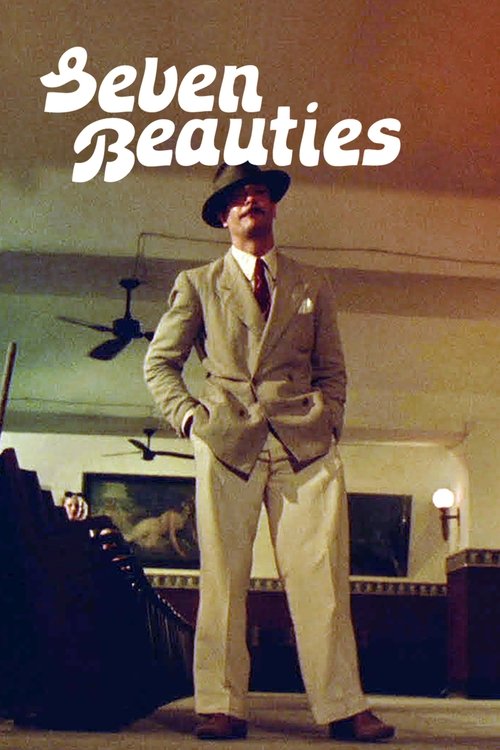
Seven Beauties
1975 · Lina Wertmüller
For when you want cinema that gambles everything — a film to argue about afterward, not to relax with. Reach for it when you're ready to be provoked, unsettled, and genuinely challenged.
What it's about
Pasqualino "Seven Beauties" is a strutting Naples hustler who lives off his seven sisters while loudly defending their honor — until a murder, an asylum, and a world war send him tumbling from petty crime into a Nazi concentration camp. There, his lifelong talent for charming his way out of trouble faces its ultimate, most degrading test: seducing the camp's monstrous commandant to stay alive.
The experience
Whiplash by design — it swings from riotous, operatic comedy to some of the darkest material a film can touch, sometimes within a single scene. It's funny until it's horrifying, and it leaves you shaken about what survival is worth.
Performances
Giancarlo Giannini is astonishing, using those enormous mournful eyes to chart a man's slide from peacock vanity to abject survival — a performance that earned him an Oscar nomination and stands among the great screen turns of the 1970s.
The craft
Wertmüller yokes the broad grotesquerie of Italian comedy to Holocaust horror, flipping between the sun-baked color of prewar Naples and the ashen gray of the camp. The tonal control it takes to hold farce and atrocity in the same frame is the film's high-wire act, and few directors before or since have attempted it.
Why it matters
It made Lina Wertmüller the first woman ever nominated for the Best Director Oscar, and its audacious mixing of comedy and the Holocaust ignited a critical firestorm that still frames debates about what comedy is allowed to touch.
Snapshot
Seven Beauties (Italian: Pasqualino Settebellezze) is Lina Wertmüller's most ambitious and most contested film: a picaresque tragicomedy that follows a Neapolitan small-time thug from the operatic squalor of prewar Naples into the abyss of a Nazi concentration camp, where his instinct for survival curdles into abjection. Giancarlo Giannini, in the fourth and most punishing of his collaborations with the director, plays Pasqualino Frafuso — "Settebellezze," Seven Beauties — a strutting guardian of his seven sisters' "honor" who murders a pimp, is committed to an asylum, volunteers for the army to escape it, deserts, is captured, and finally seduces the monstrous female commandant of a camp in a bid to stay alive. The film's audacity is its yoking of the broad grotesquerie of commedia all'italiana to the Holocaust, and its wager is that a comic-picaresque form can indict the ethic of survival-at-any-cost more sharply than solemnity could. That wager made it a cause célèbre: it earned Wertmüller a place in Oscar history as the first woman nominated for Best Director, and it drew one of the most famous denunciations ever written about a film, Bruno Bettelheim's essay on its falsification of the camp. Roughly two hours long, structured as a lattice of flashbacks, it remains the definitive test case for whether atrocity can be metabolized through farce.
Industry & production
The film emerged from the most commercially and critically buoyant stretch of Wertmüller's career, the mid-1970s run of features built around Giannini that had made her — briefly — the most internationally visible Italian director after Fellini. It was an Italian production of the mid-decade art-cinema economy, released in Italy in late 1975 and reaching the United States in 1976, where it became an art-house sensation; the specifics of its financing, budget, and Italian box-office returns are not well documented in the reliable English-language record, and I will not invent figures. Its American distribution was handled through the specialty-distribution ecosystem that carried European auteurs to U.S. campuses and repertory houses in this period (Donald Rugoff's Cinema 5 is associated with its U.S. release, though the surviving documentation on the deal is thin). What is unambiguous is the film's awards afterlife: at the 49th Academy Awards (1977) it received four nominations — Best Director and Best Original Screenplay for Wertmüller, Best Actor for Giannini, and Best Foreign Language Film for Italy — winning none, with Wertmüller losing to John G. Avildsen for Rocky and Giannini to Peter Finch for Network. The Best Director nomination was itself historic, the first for a woman, and it converted Wertmüller from an art-house name into a subject of mainstream American cultural argument.
Technology
Seven Beauties is a conventional 35mm color production of its moment, and it makes no claim on technical novelty; its interest lies entirely in how standard tools are bent to expressive ends rather than in any innovation of apparatus. It was shot on film in color and mixed in mono, the industry norm for a mid-1970s European feature of this scale. The relevant "technology" is really craft deployment — the manipulation of color timing, lens choice, and location versus set construction to hold two irreconcilable worlds (teeming Naples, deathly camp) inside one movie — rather than any new device. There is no evidence of experimental format, process work, or novel sound technology, and I will not manufacture any.
Technique
Cinematography
The photography is by Tonino Delli Colli, one of the great Italian cinematographers of the postwar era — the eye behind much of Pasolini's work and later Leone's Once Upon a Time in America and Benigni's Life Is Beautiful. His contribution is central to the film's argument. The Naples sequences and the prewar/wartime flashbacks are staged with the warm, crowded, gesturing plasticity of Italian popular comedy — faces packed into frames, color and clutter and movement. The camp, by contrast, is drained: cold, gray-blue, cavernous, the human figure dwarfed by the architecture of extermination. Delli Colli's compositions in the camp repeatedly reduce Pasqualino to a small scrabbling shape within vast, depopulated spaces, so that the visual scale enacts the moral scale — the tiny man who will do anything to persist against a machinery indifferent to him. The stylistic gulf between the two registers is deliberate and is the picture's most controlled formal gesture.
Editing
The film is built as a nonlinear braid, cross-cutting between Pasqualino's flight and capture in wartime Europe and the Naples backstory that explains the man — the murder, the dismemberment, the asylum, the volunteering. The editing (associated with Franco Fraticelli, Wertmüller's frequent cutter of this period, per the standard credits) is what makes the tonal collision legible rather than merely chaotic: comic set pieces are guillotined by hard cuts into the camp, so that the audience's laughter is repeatedly caught and shamed. The structure withholds full understanding of Pasqualino until late, letting the picaresque accumulate before the film springs its trap — that the same survival reflex which was buffoonish in Naples becomes damnable in the camp.
Mise-en-scène / staging
Wertmüller stages in two grammars. The Neapolitan material is theatrical, frontal, operatic — the sceneggiata tradition of Neapolitan melodrama pushed toward caricature, with Pasqualino's macho posturing framed as ridiculous performance. The camp is anti-theatrical: bare, symmetrical, monumental, the mise-en-scène of institutional death. The great hinge scene — Pasqualino's grotesque seduction of the vast, impassive German commandant — is staged as a horrific parody of a courtship, the swaggering Latin lover reduced to servicing a body that regards him with clinical contempt. Everything Wertmüller has built about masculine "honor" is here inverted and destroyed in a single set piece.
Sound
The film's most discussed sonic element is its opening: a montage of newsreel-style imagery of the fascist and wartime era carried by a mordant, litany-like song whose ironic refrain sets the film's sardonic key before a line of story is told. The score is credited to Enzo Jannacci, the Milanese singer-songwriter, and its cabaret-bitter idiom is essential to the film's refusal of solemnity. Otherwise the soundtrack alternates the din of Naples with the terrible quiet of the camp — noise as life, silence as death.
Performance
Giannini's performance is the film's engine and its greatest achievement, a full-body transformation from cock-of-the-walk to broken supplicant, his enormous expressive eyes carrying the descent from vanity through terror to a survival that has hollowed the man out entirely. It is one of the definitive performances of 1970s European cinema and the reason the Best Actor nomination reads as earned rather than reflected glory from the film's controversy. Opposite him, the American actress Shirley Stoler (indelible from The Honeymoon Killers) plays the commandant as a mountain of affectless authority, her stillness the perfect foil to Giannini's frantic motion. The supporting gallery — including the anarchist Pedro, whose choice of death over degradation supplies the film's moral counter-argument — is drawn broadly, in the grotesque-comic register Wertmüller favors.
Narrative & dramatic mode
The dramatic mode is picaresque tragicomedy — the episodic career of a low rogue — deliberately colliding with the historical sublime of the Holocaust. Structurally the film is a memory-braid, its flashbacks explaining a present-tense ordeal, so that the comic past is constantly recontextualized as the seedbed of a shameful present. The governing rhetorical move is irony: the film invites laughter at Pasqualino's Neapolitan buffoonery and then makes that laughter complicit, as the survival instinct that was funny becomes monstrous. Its argument is dialectical rather than sentimental. Against Pasqualino's creed — survive at any cost, "we must live" — it sets the anarchist's opposite choice, dignity even unto death, and it refuses to resolve the two cleanly, leaving the survivor alive but morally annihilated. The famous closing beat, a hollow-eyed Pasqualino contemplating a future of mere persistence, is an anti-catharsis.
Genre & cycle
Seven Beauties sits at the far, dark end of commedia all'italiana, the postwar Italian tradition of social satire through comedy associated with directors like Monicelli, Risi, and Comencini, which specialized in the cowardly, compromised Italian everyman. Wertmüller takes that tradition's stock figure — the vain, self-deceiving male — and marches him into the concentrationary universe, fusing comedy, war film, and Holocaust narrative in a hybrid that had few precedents. Within Wertmüller's own output it is the culminating film of her great Giannini cycle: The Seduction of Mimi (1972), Love and Anarchy (1973), Swept Away (1974), and Seven Beauties (1975), a sequence unified by their satires of Italian machismo, class, and politics through a single volcanic star persona. It is the cycle's darkest and most extreme entry.
Authorship & method
Wertmüller wrote and directed, and Seven Beauties is auteur cinema in the strong sense — script, structure, and provocation all bear a single signature. Trained in theater and puppetry, she had worked as an assistant on Fellini's 8½ before her 1963 debut The Lizards, and the Fellinian inheritance shows in her love of the grotesque face, the operatic tableau, and moral seriousness carried by carnival. Her method here is the fusion of popular comedic form with explicit political-philosophical argument (anarchism, survival, gender, fascism), delivered through a repertory sensibility and a star she understood completely. Her indispensable collaborators define the film's texture: Giannini as the fully instrument-like lead; Delli Colli, whose two-register photography makes the thesis visible; the editing (Fraticelli) that weaponizes the braided structure; and Jannacci's acidic score. Wertmüller's authorship also encompasses the film's provocations — she courted the accusation of bad taste as a mode of moral confrontation, and the controversy is not incidental to her method but its intended effect.
Movement / national cinema
The film is a product of Italian cinema in its last great commercial-auteur phase, drawing on neorealism's descendant traditions — location Naples, the popular classes as subject — while rejecting neorealist sobriety for grotesque stylization. It belongs to the politically committed Italian art cinema of the long 1970s, kin in ambition (if not in style) to the era's reckonings with fascism by Bertolucci (The Conformist, 1900) and Pasolini. Wertmüller's particular strand is the satirical-popular, rooted in commedia all'italiana and Neapolitan theatrical melodrama rather than in modernist austerity, which is precisely why her treatment of the camp was so destabilizing to audiences who expected atrocity to be handled in a high, grave mode.
Era / period
Made in the mid-1970s, the film speaks to a moment when European cinema was re-litigating fascism and the war a generation on, and when Italian intellectual life was saturated with debates over political commitment, anarchism versus organized resistance, and the compromises of the "average" citizen under tyranny. Its arrival in the U.S. coincided with an American appetite for European auteurs and with early-second-wave feminist attention to a rare high-profile woman director — an attention that made Wertmüller's ambivalent sexual politics a live controversy. The film is thus doubly periodized: as a 1970s Italian reckoning with the fascist past, and as a mid-'70s American art-house and awards phenomenon.
Themes
The controlling theme is survival and its price — whether staying alive is itself a value or whether there are conditions under which mere persistence is a kind of death. Pasqualino embodies survival-at-any-cost; the anarchist Pedro embodies its refusal; the film sets them in unresolved tension. Braided through this is a savage critique of Italian machismo: Pasqualino's entire prewar identity is built on masculine "honor" and the policing of female sexuality, and the film systematically demolishes that identity, culminating in the seduction scene where his virility is conscripted into his own degradation. Fascism is figured not as spectacular evil but as the logical extension of the everyman's cowardice and conformism — the small compromises that scale into complicity. Gender and power run throughout, complicated by Wertmüller's refusal of easy positions (a refusal her feminist critics read variously as bracing or reactionary). And beneath all of it lies the question the film cannot stop asking: what is a human life worth to the person living it, once dignity has been stripped away?
Reception, canon & influence
Critically, Seven Beauties was among the most polarizing films of its moment. Wertmüller had ardent American champions — most notably the critic John Simon, who promoted her as a major artist — while others, Pauline Kael prominent among them, grew skeptical of the acclaim and of the film's coherence and politics. The controversy crystallized in Bruno Bettelheim's celebrated essay attacking the film for what he considered a fundamental falsification of the concentration camp and of the psychology of survival — a critique from a survivor and psychologist that reframed the debate as an ethical rather than merely aesthetic one, and that remains the essential counter-text to any defense of the film. The picture's four Oscar nominations, and the historic first for a woman as Best Director, sealed its prominence even as the arguments raged.
Its influences run backward to commedia all'italiana and its cowardly everymen, to Neapolitan melodrama, to the Fellinian grotesque under which Wertmüller trained, and to the broader Italian cinematic reckoning with fascism. Its forward legacy is twofold and durable. First, as the pivotal artifact in the long argument over representing the Holocaust through comedy or the grotesque — the debate it detonated prefigures the reception of later films that filter the camps through comedy or fable, and it remains a fixed reference point in Holocaust-representation scholarship. Second, as a landmark in the history of women directors, Wertmüller's 1977 nomination stood as the singular fact cited for decades whenever the Academy's record on women was discussed, a status formally acknowledged when she received an Academy Honorary Award late in her life. Seven Beauties endures less as a settled classic than as a permanent provocation — the film that dares you to laugh, and then makes the laughter the subject of the trial.
Reception
A genuine American phenomenon in 1976 — four Oscar nominations and think-piece frenzy, including Bruno Bettelheim's famous New Yorker takedown of its concentration-camp comedy — before Wertmüller's stock cooled for decades; her 2019 honorary Oscar and the restorations of her '70s run have pulled it back into the conversation.
How Seven Beauties was received, from release to now →
How to watch Seven Beauties: what to notice on a first viewing
- Watch the color drain out once the story reaches the camp. Delli Colli shoots Naples in warm, crowded, plastic color and the camp in cold gray-blue, so the visual register itself changes completely between the two worlds. The palette tells you the moral temperature of the scene before anything happens in it.
- Watch how small Pasqualino looks inside the camp's spaces. Delli Colli's camp compositions repeatedly reduce him to a scrabbling shape inside vast, depopulated architecture, a sharp contrast to the crowded, face-filled frames of the Naples scenes. The scale of the frame is doing the moral math, showing you exactly how little this machinery cares about one man.
- Notice a laugh get cut off hard by the camp. The film keeps guillotining its own comic set pieces with hard cuts straight into the concentration camp, catching you mid-laugh more than once. The editing is designed to make you feel complicit in your own laughter.
- Listen for a cheerful-sounding song under scenes of wartime carnage. The opening montage sets newsreel-style images of fascism and war to a mordant, list-like song with a sardonic refrain, before a single line of story has been told. The song tells you the film's tone before it tells you the plot, and it never fully lets that tone go.
The whole guide to watching Seven Beauties, with the keys for a rewatch →
Influences: the films it descends from and the films it influenced
- 8½ (1963) — Wertmüller apprenticed as assistant director here and inherits its grotesque-face casting and the operatic carnival tableau in which the protagonist is swamped by a parade of caricatured bodies.
- La Grande Guerra (The Great War) (1959) — Supplies the commedia all'italiana blueprint of the cowardly everyman who survives war by evasion and clowning until catharsis is abruptly denied — the picaresque-tragicomic anti-hero Giannini's Pasqualino descends from.
- Big Deal on Madonna Street (1958) — Codifies the commedia all'italiana ensemble whose schemes deflate into ironic failure, the tonal deflation-of-the-scheme Wertmüller later weaponizes.
- General Della Rovere (1959) — A small-time survivor-impostor morally tested inside a fascist prison, giving Wertmüller the trial-under-the-regime structure staged in neorealist detention settings.
- Accattone (1961) — Tonino Delli Colli's photography of subproletarian bodies isolated in bleak Roman space — the DP method Wertmüller hired to build her two-register look and figure-dwarfed-in-space framing.
- Once Upon a Time in the West (1968) — Delli Colli's compositions that shrink the human figure against vast oppressive landscape, the framing grammar reused for the camp exteriors.
- Dr. Strangelove (1964) — Scores atrocity with an ironic pop song (Vera Lynn over nuclear annihilation), the model for the acidic opening song laid over war/fascist newsreel and the refusal of catharsis.
- The Great Dictator (1940) — Establishes comedy as a mode of moral confrontation with fascism — the bad-taste dare Wertmüller adopts as method.
- To Be or Not to Be (1942) — Stages farce inside the Nazi machine, licensing the tonal hard cuts between slapstick and terror that structure Seven Beauties.
- Love and Anarchy (1973) — Same author and star, with Giannini as fully pliable instrument in a brothel-set anti-fascist tragicomedy that also ends in deliberately denied catharsis.
- The Tin Drum (1979) — A picaresque grotesque narrated by a stunted survivor threading the fascist years, extending the grotesque-fable-of-fascism form into German cinema.
- Life Is Beautiful (1997) — The pivotal heir that filters the concentration camp through comedy and fable, inheriting the precise ethical controversy over Holocaust-as-comedy that Seven Beauties detonated.
- Jojo Rabbit (2019) — Satirizes Nazism with tonal hard cuts between broad comedy and sudden horror, extending the laugh-first-then-indict strategy Wertmüller pioneered.
- The Conformist (1970) — The Italian settling of accounts with fascism through expressive two-register color and the explicit linking of fascist obedience to sexual pathology (critique-of-machismo).
- The Night Porter (1974) — A woman director's grotesque-seduction set piece eroticizing the camp power relation — the exact staging register of Wertmüller's commandant scene.
- Salò, or the 120 Days of Sodom (1975) — Delli Colli-shot tableaux of degradation deployed as anti-cathartic indictment of fascist power, made the same year with the same cinematographer's clinical eye.
- Cabaret (1972) — The bitter cabaret number used as ironic counterpoint to rising fascism — the same sound strategy as Jannacci's acidic, mocking score.
- Swept Away (1974) — Wertmüller/Giannini class-and-sex power allegory built on grotesque seduction and the survival-at-any-cost logic, made immediately before the seed.
Similar films
- Life Is Beautiful (1997) — influence & lineage · same viewing thread
- Love and Anarchy (1973) — influence & lineage
- The Night Porter (1974) — influence & lineage
- Cabaret (1972) — influence & lineage
- 8½ (1963) — influence & lineage
- Schindler's List (1993) — same viewing thread
- Hitler: A Film from Germany (1978) — same viewing thread
- The Fifth Seal (1976) — same viewing thread
All the films related to Seven Beauties →
Watch it with: curated runs of related films
- In the Shadow of the Reich — A run of films about ordinary people inside the Nazi era — surviving it, resisting it, or trying to reckon with how it happened — that rhyme on conscience, complicity, and who chooses to act.