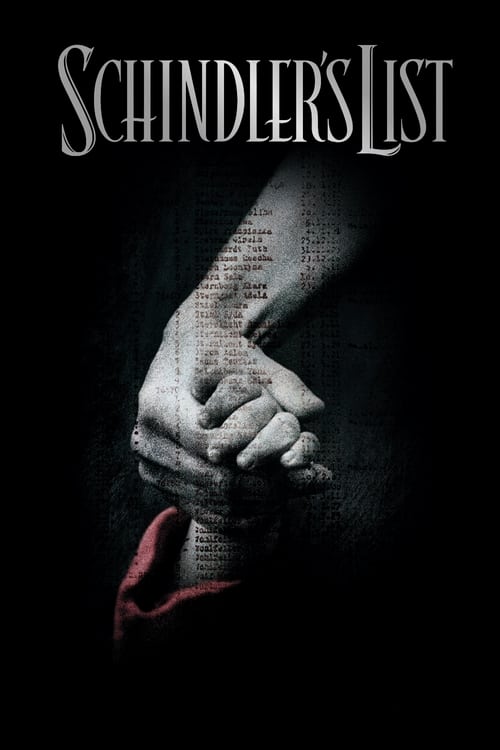
Schindler's List
1993 · Steven Spielberg
For when you're ready for a heavy, essential film — the kind you watch because you feel you should, and then discover it's also a gripping story. Not a casual pick; give it a full evening and your full attention.
What it's about
Oskar Schindler is a German businessman who arrives in occupied Kraków to get rich off the war — charming officials, throwing parties, staffing his enamelware factory with Jewish forced labor because it's cheap. As the Nazi machinery of the ghetto and the camps closes in around his workers, the profiteer finds himself, almost against his own nature, becoming their protector. It's a true story: over a thousand people survived the Holocaust because of him.
The experience
Harrowing, sober, and finally overwhelming — it doesn't flinch from atrocity, but it's built around a current of decency that keeps it from being unbearable. Three hours pass with total command; you come out drained and grateful.
Performances
Liam Neeson gives Schindler a salesman's charm concealing a conscience he doesn't want to acknowledge; Ben Kingsley is quietly devastating as his accountant Itzhak Stern; and Ralph Fiennes is terrifying as the camp commandant Amon Göth — evil played as boredom and appetite.
The craft
Shot in stark black and white on location in Poland, with handheld, documentary-style camerawork that makes scenes feel witnessed rather than staged. John Williams's mournful violin score is one of his finest. A single flash of color becomes one of the most famous images in modern cinema.
Why it matters
Seven Academy Awards including Best Picture, and a turning point for Spielberg — proof the great entertainer could make a film of historical witness. It remains the reference point for how Hollywood portrays the Holocaust, imitated and debated ever since.
Snapshot
A black-and-white historical epic tracking the moral transformation of Oskar Schindler — a German war profiteer who exploits Jewish forced labor in occupied Kraków and, through incremental stages of conscience and crisis, engineers the survival of more than a thousand workers. Shot on location in Poland with a documentary-inflected visual grammar, the film represents Spielberg's deliberate break from the entertainment register that had defined his career, and stands as the defining Hollywood treatment of the Holocaust. Winner of seven Academy Awards including Best Picture and Best Director, it crystallized a mode of "witness cinema" that subsequent filmmakers have embraced, argued with, and reacted against in roughly equal measure.
Industry & production
The project traced a circuitous route to Spielberg. Universal acquired rights to Thomas Keneally's 1982 Booker Prize-winning novel Schindler's Ark shortly after publication, and Spielberg was attached early — then repeatedly deferred, steering the project toward Sidney Pollack, Martin Scorsese, and Roman Polanski (who declined, citing personal proximity to the events as a survivor). Spielberg finally committed in the early 1990s, reportedly feeling he had matured sufficiently to approach the material responsibly. He waived his director's fee, later channeling profits into the USC Shoah Foundation he established in 1994 to record survivor testimonies.
The production budget — in the range of twenty to twenty-five million dollars — was modest by Spielberg's standards and reflected the stripped-down, location-dependent approach Kamiński and Spielberg had agreed upon. Principal photography ran roughly seventy-two days, mostly in Kraków, with the Schindler factory enamelware works (Emalia) and the Płaszów labor camp surroundings serving as primary locations. Auschwitz-Birkenau interiors were not filmed at the memorial site itself; a replica set was constructed nearby. The choice to shoot in Poland rather than on Universal backlot sets was a foundational creative decision: the actual streets and buildings of the Kazimierz district imposed an authenticity of scale and texture that studio reconstruction could not have replicated.
Casting followed an unconventional logic Spielberg described publicly: he cast unfamiliar faces in the Jewish roles to prevent audience comfort through star recognition, while assigning well-known character actors to Nazi roles — the instinct being that recognition breeds dangerous comprehension of the oppressor's point of view. Ralph Fiennes, then largely unknown to American audiences, was cast as Amon Göth after a screen test in which Spielberg reportedly wept.
Technology
Spielberg and Kamiński chose to shoot the film in black-and-white 35mm, a decision that was commercially unusual in 1993 and required a waiver negotiation with Universal, who feared reduced theatrical and television revenues. The black-and-white was not a nostalgic conceit but a deliberate evocation of wartime photojournalism and documentary newsreel — a visual language already carrying the imprint of historical witness. Kamiński used high-contrast stocks and practical and available lighting where possible to push grain and shadow into the image. The resulting visual texture departs markedly from the polished monochrome of Classical Hollywood; its roughness was intentional.
The selective use of color — most famously the red coat of a child glimpsed and then spotted again in a mass of gray — was achieved in-camera and in post through careful exposure and timing rather than digital compositing, which was limited at this period. The device is used twice with the red coat and once at the film's close, when survivors place stones on Schindler's grave: the shift into full color marks a crossing from the historical past into the present tense of memory.
Handheld cameras, operated extensively by Kamiński himself and by additional operators, were used throughout to produce the mobile, unstable framing associated with documentary and newsreel footage. This was not ubiquitous — certain scenes deploy locked-down or steadily tracked compositions — but the handheld register dominates the crowd sequences and acts of violence, producing spatial disorientation that functions as an ethical position: the camera cannot achieve the clean, composed distance of classical Hollywood syntax in the face of these events.
Technique
Cinematography
Kamiński's work on Schindler's List established the dominant visual vocabulary for Holocaust representation in American cinema. Working from the grammar of wartime documentary — harsh top-lighting, high grain, deep shadow, rack-focus used to isolate figures within crowds — he produced an image that reads simultaneously as fiction and archival record. Light sources are frequently practical: candles in ghetto apartments, bare industrial bulbs in the factory, searchlights at the camp. The daylight sequences at Płaszów are often overcast or harshly white, bleaching detail from the sky and throwing faces into relief against the pale background.
The extended sequences of the Kraków ghetto liquidation are particularly notable for their management of spatial chaos. The camera moves through the action without the orienting coverage of conventional action editing — there is no establishing shot that maps the carnage; the viewer is placed inside the event rather than above it. This is the key cinematographic decision in the film: the refusal of the omniscient vantage point.
Editing
Michael Kahn, Spielberg's longtime collaborator, edited the film. The Kraków liquidation sequence is the film's central editing achievement: roughly forty minutes of crosscut action involving dozens of spatial threads, multiple characters tracked in parallel, organized without conventional action-editing rhythms. The sequence withholds resolution; it accumulates rather than drives. Kahn's work throughout leans against the cause-and-effect clarity of mainstream Hollywood cutting, allowing scenes to end on ambiguous or deflating beats rather than cathartic peaks.
Mise-en-scène / staging
Spielberg stages crowd scenes — the ghetto clearing, the factory roll-call, the Auschwitz processing — with a controlled chaos that resists the heroic foreground/background hierarchy of conventional war cinema. Individual figures emerge from masses and recede into them; the geometry of staging communicates that individual fate is contingent rather than guaranteed. The shower scene at Auschwitz, in which the women believe they are entering a gas chamber, is staged as a sustained withholding: the camera stays with the women inside the chamber, cutting away from the plumbing before the liquid is identified. The dramatic tension is entirely constructed through staging and editing rhythm; there is no score in the sequence.
Sound
John Williams's score is built around a solo violin, performed by Itzhak Perlman — a timbre that carries associations with Ashkenazi musical tradition without quoting specific liturgical sources. The score is notably restrained by Williams's standards: large sections of the film carry no music at all. The silence is deliberate; Spielberg later described instructing Williams to score less rather than more. The sound design in the liquidation and camp sequences foregrounds ambient industrial and crowd sound — the mechanics of mass movement — over any orchestral frame.
Performance
Liam Neeson navigates a difficult arc: Schindler must be credibly venal in the film's first hour and credibly transformed by its close without the transformation reading as either conversion narrative or sentimental rescue fantasy. Neeson accomplishes this partly through physical scale — he dominates frames without dominating fellow performers — and partly through a quality of attention that registers Schindler's gathering comprehension of what he is witnessing without explaining it. Ben Kingsley as Itzhak Stern plays restraint against Neeson's expansiveness; Stern's moral clarity is communicated almost entirely through what Kingsley withholds from the performance.
Ralph Fiennes's Göth is the film's most discussed performance. Fiennes plays the commandant as banal and appetitive — a man whose cruelty is legible in terms of ordinary vice: laziness, vanity, sexual possessiveness — rather than ideological fervor. The performance drew on Hannah Arendt's concept of the banality of evil without making the debt explicit. It became the template for subsequent Hollywood portrayals of Nazi perpetrators.
Narrative & dramatic mode
The film follows a three-act transformation structure borrowed from classical Hollywood biography: Schindler arrives in Kraków as an opportunist; the liquidation of the ghetto breaks something in his moral economy; the list and the bribes and the final breakdown constitute the restitution. This structure is clear and legible, and critics — most persistently Claude Lanzmann and subsequently other scholars — have argued that its clarity is itself a problem: that classical Hollywood's faith in individual moral transformation imposes a redemptive arc on events that resist redemption.
Spielberg does partially acknowledge this critique within the film. Schindler's closing breakdown — "I could have got more... I could have got more, I don't know, if I'd just... I could have got more..." — insists that the story is not a success story; the list is also a remainder that marks everything the list excludes. Whether this undercutting of the redemptive arc is sufficient has remained the film's central critical debate.
Genre & cycle
Schindler's List belongs to the American prestige historical epic, a genre running from The Birth of a Nation (1915) through Lawrence of Arabia (1962) and Gandhi (1982) to the 1990s-2000s cycle in which Spielberg himself is a central figure (Amistad, Lincoln). It also participates in the specifically European Holocaust film cycle — from Alain Resnais's Night and Fog (1956) through The Sorrow and the Pity (1969), Shoah (1985), and Europa Europa (1990) — while departing from that cycle's art-cinema and documentary modes in favor of classical narrative.
Its commercial and awards success catalyzed a Hollywood Holocaust cycle through the 1990s and 2000s: Life Is Beautiful (1997), The Thin Red Line (1998, a different war but related mode), The Pianist (2002), and many others. It also provoked reactive counter-films: László Nemes's Son of Saul (2015) was explicitly conceived as a refusal of Spielberg's representational strategy, restricting its visual field to a narrow depth of field around the protagonist to deny the viewer the panoramic witness the earlier film provides.
Authorship & method
Steven Spielberg had by 1993 produced the defining popular blockbusters of the New Hollywood era (Jaws, the Indiana Jones series, E.T.), but had not received serious critical recognition as an auteur. Schindler's List was widely read as a bid for that recognition — and was also, Spielberg consistently maintained, a personal obligation as a Jewish-American filmmaker of his generation. The film marked the beginning of a sustained engagement with historical subject matter that would continue through Amistad (1997), Saving Private Ryan (1998), and Lincoln (2012).
Janusz Kamiński was thirty-three and had not worked on a film of this scale when Spielberg hired him. Their collaboration — which has continued on every Spielberg film since — was decisive for American cinematographic aesthetics in the 1990s. The desaturated, grain-heavy, available-light aesthetic Kamiński developed here was subsequently applied to Saving Private Ryan and diffused broadly through prestige war and historical drama.
Steven Zaillian's screenplay substantially compressed and restructured Keneally's novel, which is written in a quasi-documentary mode with extensive historical annotation. Zaillian's adaptation converted the novel's dispersed episodic structure into a coherent dramatic arc centered on Schindler's interiority. The compression involved significant omissions — secondary characters, documentary texture — that critics of the film have read as simplification.
John Williams's score earned its own Academy Award nomination. His choice to anchor the score in solo violin — reportedly made in consultation with Spielberg about the specific cultural resonance of that timbre — represents one of his most restrained and specifically calibrated compositions.
Movement / national cinema
The film is a product of the American studio system — Universal, Amblin Entertainment — but its production is deeply inflected by Polish cinema. The choice of location brought Spielberg and his crew into contact with Polish film culture; several Polish actors appear in supporting roles, and the visual grammar of the film draws on the realist tradition of Polish cinema (Wajda, Kieślowski) as well as on Italian neorealism. Kamiński has cited Resnais and Kieślowski as visual references. The film belongs formally and industrially to American cinema but aesthetically to a European mode it consciously invokes.
Era / period
The film was released in December 1993, fifty years after the events it depicts. The timing was not accidental: Spielberg was alert to the mortality of the survivor generation and shaped the Shoah Foundation around that urgency. The early 1990s also brought renewed public engagement with Holocaust memory as the generation of witnesses began to age out of direct testimony — the film participated in and amplified that cultural moment. The 1990s prestige-film cycle, driven partly by expanded awards campaigning and partly by a post-Cold War appetite for moral clarity about the twentieth century's worst atrocities, provided the industrial context in which the film's commercial ambitions and its pedagogical claims could coexist.
Themes
The film's central thematic tension is between individual moral agency and systemic evil — whether a single actor's transformation can constitute a meaningful response to an apparatus of genocide. Schindler's rescue saves roughly 1,200 people; the apparatus kills six million. The film holds this tension without fully resolving it, though its narrative structure tilts toward the individual.
Adjacent themes include complicity (Schindler's initial dependence on and exploitation of the slave-labor system that sustains the genocide), the relationship between commerce and conscience (the factory as both instrument of exploitation and instrument of rescue), and the limits of representation. The list of the film's title functions as both plot device and symbol: it is the instrument of salvation and simultaneously the artifact that makes visible the selectivity — the arbitrariness — of survival.
Reception, canon & influence
Schindler's List opened to near-universal critical acclaim. Roger Ebert awarded it four stars and called it a great film; it appeared on numerous year-end best-of lists and entered the cultural discussion immediately as a canonical work. It received twelve Academy Award nominations and won seven, including Best Picture, Best Director (Spielberg's first), Best Adapted Screenplay (Zaillian), Best Cinematography (Kamiński), and Best Original Score (Williams). The Directors Guild, the Writers Guild, and the British Academy awards followed. Its box office performance — roughly $320 million worldwide against a production budget under $25 million — demonstrated that serious subject matter could be commercially viable, a lesson the industry absorbed.
The primary influence on the film runs from European documentary and art cinema: Resnais's Night and Fog for the mode of historical address; Lanzmann's Shoah for the moral weight placed on testimony; Italian neorealism (De Sica, Rossellini) for the documentary texture of the location photography; and Polish realist cinema for the specific visual and atmospheric register of occupied Kraków. The influence of war photojournalism — the grainy, high-contrast images associated with Life magazine and wire services from the 1940s — is direct and acknowledged.
The film's forward influence is extensive and contested. It established the visual and narrative grammar that subsequent Hollywood treatments of the Holocaust were obliged to engage with or argue against. Polanski's The Pianist (2002) acknowledged the debt while narrowing its moral focus to a single survivor's endurance, deliberately withholding the rescue-arc structure. Tim Blake Nelson's The Grey Zone (2001) explored Sonderkommando complicity as a direct rebuttal to the redemptive narrative. Nemes's Son of Saul (2015) constructed its entire formal strategy — the constricted field of vision, the refusal of wide-angle witness — as an argument against the epistemological premises of Spielberg's film.
Saving Private Ryan (1998) extended the Kamiński visual grammar to combat cinematography and is inconceivable without Schindler's List; its opening Omaha Beach sequence is the direct stylistic heir of the Kraków liquidation.
The debate about representation that the film provoked — whether Hollywood narrative can bear witness to the Holocaust without falsifying it; whether classical structure imposes a moral grammar incompatible with the events — has become a generative fault line in film theory and Holocaust studies. The film did not settle that debate. It is, rather, the argument's central exhibit.
A Deleuzian reading
You remember the coat.
The full Deleuzian reading of Schindler's List →
Reception
Instantly hailed in 1993 as the film where 'the entertainer became an artist' — it swept 7 Oscars and finally won Spielberg Best Director. It remains canonical, but the decades have added a counter-current of heavyweight skepticism about whether Hollywood should dramatize the Holocaust at all.
How Schindler's List was received, from release to now →
Influences: the films it descends from and the films it influenced
- Rome, Open City (1945) — Rossellini's wartime location shooting in Nazi-occupied Rome using practical light sources, non-studio grain, and non-professional faces established the foundational documentary-inflected visual grammar that Kamiński consciously extended — rough texture, location-authenticated space, available-light shadow — for Schindler's refusal of the polished studio monochrome.
- Night and Fog (1956) — Resnais's alternation of black-and-white archival footage with color present-tense camera to formally demarcate historical past from living memory is the direct ancestor of Spielberg's red-coat device and the film's final transition into full color at Schindler's grave — both use the color/B&W cut as an ethical marker, not a stylistic one.
- The Pawnbroker (1964) — Lumet and Boris Kaufman's deployment of high-contrast black-and-white photography for a Holocaust survivor's fractured psychological interiority was the first Hollywood instance of this aesthetic applied to this subject matter, establishing that the standard polished studio monochrome was ethically unavailable — a precedent Kamiński's grain-heavy, high-contrast stock directly acknowledges.
- The Battle of Algiers (1966) — Pontecorvo and Marcello Gatti's handheld pseudo-documentary grammar for crowd atrocity — mobile camera threading through action without orienting establishing shots, spatial disorientation as ethical stance — is the primary formal ancestor of Kamiński's Kraków liquidation cinematography; both films refuse to let the viewer achieve the safe overhead vantage of classical historical spectacle.
- Lacombe Lucien (1974) — Malle's available-light, unglamorous visual grammar for a collaborator whose moral status remains productively unresolved throughout — neither condemned nor exculpated by the camera — feeds directly into Spielberg's characterization strategy for Schindler: the film refuses to explain or moralize its protagonist's transformation, trusting accumulation of observed behavior over interior motivation.
- Shoah (1985) — Lanzmann's refusal to use archival footage or dramatic reconstruction — the nine-hour film is built entirely from present-tense witness testimony — established the ethical parameters around Holocaust representation that Spielberg's film is in explicit argument with; Spielberg's choice to reconstruct rather than document is a formal counter-position that the film's entire visual grammar has to justify against Lanzmann's prohibition.
- Come and See (1985) — Klimov and Alexei Rodionov's extreme-wide-angle handheld camera placing the viewer inside wartime atrocity rather than above it — the subjective-witness position that refuses omniscient coverage — is the direct Soviet precursor to Kamiński's mobile camera in the ghetto liquidation; both films use lens distortion and unstable framing as an ethical position, not a stylistic flourish.
- Au Revoir les Enfants (1987) — Malle's observational, available-light witness cinema for depicting the deportation of Jewish children from a French boarding school — camera as recorder rather than interpreter, climax withheld rather than performed — established the ethical stance of the restrained historical witness film that Spielberg adopted and then amplified into studio-prestige scale.
- Gandhi (1982) — Janusz Kamiński's strategy of available-light, non-Hollywood-fill cinematography — refusing glamorizing key lights in favor of practical and ambient sources to authenticate historical horror — extends Gandhi's documentary-lighting approach to the moral-witness biopic, deploying deliberate visual austerity as an ethical stance rather than a technical limitation.
- Raging Bull (1980) — Spielberg and Kamiński shot in black-and-white within a color era explicitly invoking Raging Bull's rationale that monochrome reads as durable, timeless record rather than period artifact.
- Don't Look Now (1973) — Isolates a single red figure in a desaturated frame as a tracked color motif — the bereavement-charged red coat reading directly descends from Roeg's red-coated harbinger.
- The Human Condition I: No Greater Love (1959) — High-contrast monochrome epic of complicity and conscience inside wartime atrocity, using documentary-styled realism to confront a nation's culpability.
- Life Is Beautiful (1997) — Benigni's film entered the Holocaust film cycle Schindler's List crystallized and adopted an opposed formal strategy — comedy register, performance-within-performance structure, saturated color — to manage the same material, generating the same controversy about whether aesthetic pleasure can be ethically reconciled with Holocaust representation; both films were attacked for aestheticizing what Lanzmann had forbidden.
- The Pianist (2002) — Polanski and cinematographer Pawel Edelman's handheld location shooting in Warsaw and available-light grammar for ghetto sequences is in direct formal dialogue with Kamiński's Kraków cinematography; Polanski's own wartime experience as a Warsaw ghetto survivor inflects his deliberate refusal of the redemptive transformation arc that Schindler's List had established as the genre's default structure.
- Ida (2013) — Pawlikowski and Łukasz Żal's Academy-ratio black-and-white photography with static long-takes and deep compositional austerity constitutes a formal counter-argument to Kamiński's kinetic handheld approach for Polish Holocaust subject matter — both films agree that black-and-white is the ethically obligatory register for this history, but Ida's immobility explicitly refuses Schindler's documentary-movement grammar.
- Son of Saul (2015) — Nemes and Mátyás Erdély take Schindler's refusal-of-omniscient-vantage to its logical formal extreme — extreme rack-focus locks the camera on the protagonist's face throughout, rendering the mass violence of the Auschwitz Sonderkommando as peripheral blur — inverting Kamiński's crowd-immersion grammar into strict perceptual confinement, extending the ethical argument by tightening it.
- The Zone of Interest (2023) — Glazer extends Schindler's 'banality of evil' performance register to its conceptual terminus by removing the Holocaust entirely from the visual field — the camera stays inside the Höss family's domestic space while Mica Levi's sound design carries the atrocity — a direct formal counter-argument to Kamiński's immersive documentary, testing whether the image can carry ethical weight by refusing to show what it bears witness to.
- The Lost World: Jurassic Park (1997) — Where Kamiński developed the expressive high-contrast, low-key lighting sensibility he then imported to darken the sequel's visual character.
- Bridge of Spies (2015) — Origin of the Spielberg–Kamiński prestige-history grammar—desaturated palette and blown-out, window-backlit highlights—that returns as Bridge of Spies' blue-gray photochemical look.
- The Resistance Banker (2018) — Establishes the businessman-resister who weaponizes accounts, lists, and financial cover, with desaturated period imagery and a document/procedural structure the seed echoes in banking terms.
- Minority Report (2002) — Where the Spielberg–Kamiński team first weaponized blown-out overexposure, handheld immediacy and severe high-contrast monochrome — the photographic grammar Minority Report secularizes into its desaturated dystopia.
- Lincoln (2012) — Inaugurates Spielberg's sober 'serious historian' mode with Kamiński's high-contrast monochromatic light and Kahn's restraint, the house style Lincoln extends into color.
- American History X (1998) — Codifies the monochrome-as-historical-conscience grammar within a single contemporary film, using the absence of color to mark moral weight — the prestige-cinema precedent for Kaye's choice to shoot Derek's hatred in silver and his redemption in color.
- Sin City (2005) — Canonized the single spot of color in a high-contrast monochrome image (the red coat) as a meaning-bearing device, the grammar Sin City weaponizes for its splashes of selective color.
- Saving Private Ryan (1998) — Spielberg and Kamiński directly transferred the handheld available-light bleach-bypass grammar developed for Schindler's List to WWII combat in the Omaha Beach sequence — desaturated stock, high shutter speed for strobed motion, camera moving through rather than above the action — producing the dominant visual language for subsequent war cinematography.
- Munich (2005) — Spielberg and Kamiński apply the same available-light handheld grammar and the morally ambiguous protagonist-in-transformation structure developed in Schindler's List to post-Holocaust Israeli state violence — the accumulative crosscut structure across multiple assassination threads mirrors the Kraków liquidation's accumulative editing logic, now applied to perpetrator rather than victim perspective.
- Clear and Present Danger (1994) — Sibling through screenwriter Steven Zaillian, whose conscience-driven moral architecture — a competent man forced to choose integrity against institutional complicity — shapes Ryan's arc.
Similar films
- Life Is Beautiful (1997) — influence & lineage · same viewing thread · often watched together
- The Pianist (2002) — influence & lineage · same viewing thread
- Shoah (1985) — influence & lineage · same viewing thread
- The Zone of Interest (2023) — influence & lineage · same viewing thread
- Son of Saul (2015) — influence & lineage · same viewing thread
- Saving Private Ryan (1998) — influence & lineage · often watched together
- Munich (2005) — influence & lineage
- Ida (2013) — influence & lineage
All the films related to Schindler's List →
Watch it with: curated runs of related films
- In the Shadow of the Reich — A run of films about ordinary people inside the Nazi era — surviving it, resisting it, or trying to reckon with how it happened — that rhyme on conscience, complicity, and who chooses to act.