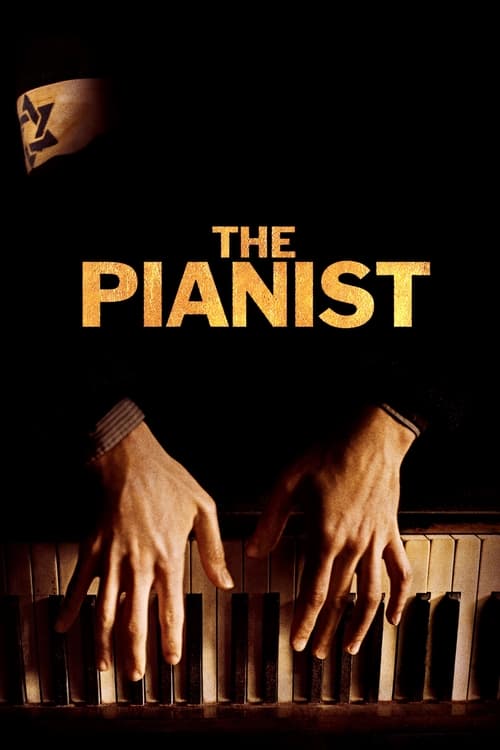
The Pianist
2002 · Roman Polanski
For when you're ready for something heavy and true — a film that demands your full attention and stays with you for days. This is challenge viewing, not comfort, but it repays every minute.
What it's about
The true story of Władysław Szpilman, a Polish-Jewish concert pianist in Warsaw when the Germans invade in 1939. As Jewish life in the city is strangled step by step — armbands, confiscations, the sealed ghetto, starvation, deportations — Szpilman is separated from his family and survives first as forced labor, then in hiding amid the ruins of the city, a starving witness to war and uprising.
The experience
Sober, unflinching, and quietly devastating — it withholds melodrama and simply shows, which makes it hit harder. The second half becomes an almost wordless survival story, tense and desolate, with moments of grace that can leave you in pieces.
Performances
Adrien Brody won the Oscar for his physically transformative, largely internal performance — a man reduced almost to a ghost, whose gauntness and silence carry the film's final hour.
The craft
Polanski, himself a child survivor of the Kraków ghetto, directs with rigorous restraint: atrocity is observed from windows and doorways, at the distance Szpilman actually saw it, which makes it more chilling than any staged spectacle. The production design of occupied and ruined Warsaw is staggering, and the piano music does the emotional work the dialogue refuses to.
Why it matters
It won the Palme d'Or at Cannes and three Oscars including Best Director and Best Actor, and stands as one of the definitive films about the Holocaust — widely regarded as Polanski's most personal work.
Snapshot
The Pianist is Roman Polanski's adaptation of the memoir of Władysław Szpilman, a Polish-Jewish concert pianist who survived the German occupation of Warsaw and the destruction of its Jewish community. The film follows Szpilman from the eve of the 1939 invasion — interrupted mid-broadcast at Polish Radio by the first bombs — through the progressive strangulation of Jewish life: the armbands, the confiscations, the sealing of the ghetto, the slow starvation, and finally the deportations of 1942 that sent his family to Treblinka. Pulled from the line to the cattle cars by a Jewish policeman who knows him, Szpilman survives as forced labor, escapes to the "Aryan" side, and passes the remainder of the war in a series of hiding places, an increasingly spectral witness to the 1943 Ghetto Uprising and the 1944 Warsaw Uprising, both of which he observes from windows rather than participates in. In the ruined, depopulated city he is discovered by a German officer, Wilm Hosenfeld, who — moved by hearing him play Chopin — protects rather than denounces him. The film is distinguished by its refusal of the conventional consolations of the Holocaust drama: it offers little heroism, scant redemptive uplift, and a protagonist who survives less through agency than through luck, the kindness of strangers, and the thread of his art. Its register is observational, restrained, and almost documentary in its accumulation of atrocity, and it carries the unmistakable weight of having been made by a director who lived a version of the same history as a child.
Industry & production
The Pianist was a major European co-production assembled across France, Poland, Germany, and the United Kingdom, produced by Polanski together with Robert Benmussa and Alain Sarde, with Polanski's R.P. Productions joined by partners including the Polish producer Lew Rywin's Heritage Films and the facilities of Studio Babelsberg outside Berlin. Principal interiors were shot at Babelsberg while exteriors and ruined-city sequences were filmed in Warsaw and on large-scale sets and standing locations in Poland and Germany; the production reconstructed the ghetto and the bombed-out wartime city through a combination of period architecture, built sets, and extensive set dressing. The film's budget was substantial by European standards — commonly reported in the mid-tens of millions of dollars — though I will not assert a single precise figure, as accounts vary. It was a strong commercial performer worldwide, recouping its cost many times over, but the specific grosses circulate in differing forms and I avoid quoting an exact number.
The project's industrial significance is inseparable from its personal genesis. Polanski, himself a survivor of the Kraków ghetto whose mother was murdered at Auschwitz, had previously declined Steven Spielberg's invitation to direct Schindler's List, judging the material too close to his own experience; Szpilman's memoir, with its cooler and less redemptive account of survival, gave him a way into the subject on his own terms. The film premiered at the Cannes Film Festival in 2002, where it won the Palme d'Or, and went on to win three Academy Awards: Best Director for Polanski, Best Actor for Adrien Brody, and Best Adapted Screenplay for Ronald Harwood. Polanski did not attend the American ceremony — his unresolved 1977 United States legal case made travel impossible — and the directing award was accepted on his behalf, a circumstance that became part of the film's public story.
Technology
The Pianist was made with conventional early-2000s 35mm photochemical technology, and its interest is not as a technical landmark but as a demonstration of large-scale practical reconstruction in the late analog era. The destruction of Warsaw — block after block of gutted, rubble-choked streets — was realized substantially through physical sets, location work, and practical art direction rather than through the digital environments that would soon become standard for period spectacle. Where digital tools were used, they served to extend and complete the reconstructed cityscape rather than to generate it wholesale, and the film deliberately keeps its effects invisible and unspectacular, in keeping with its sober address. The piano performances heard in the film are real recordings of Chopin, with the playing dubbed by the Polish pianist Janusz Olejniczak; Brody learned to perform convincingly at the keyboard so that the hand and body movements would read as authentic on camera. The film's technological choices are throughout subordinated to realism: the aim is the erasure of artifice, not the display of it.
Technique
Cinematography
The cinematography, by the Polish director of photography Paweł Edelman, is restrained, lucid, and emotionally disciplined. The palette is cool and desaturated — grays, ash, faded interiors, a wintry light — refusing both the warm nostalgia and the high-contrast expressionism that often attend period war films. Edelman favors a steady, observing camera and clean, legible framing; the visual approach is closer to witness than to commentary. As Szpilman's world contracts, the photography increasingly isolates him within the frame, watching the city's catastrophe through windows and from rooftops, so that the spectator shares his position as a powerless onlooker. The film's most celebrated image — Szpilman emerging to walk through an immense expanse of flattened, snow-dusted ruins — depends on this restraint: the camera does not editorialize, it simply reveals the scale of annihilation. The lighting is naturalistic, sourced and motivated, and the overall effect is of a controlled documentary gravity rather than pictorial beauty.
Editing
The editing, by Hervé de Luze, is built for duration and accumulation rather than acceleration. The film is paced to convey the grinding, attritional experience of occupation and hiding — long stretches in which little happens punctuated by sudden, arbitrary violence — and the cutting resists the montage compressions and emotional underlining that the material might invite. Scenes of atrocity are frequently allowed to play in extended takes, the camera and cut declining to look away or to soften, which gives the film's worst moments their flat, irrefutable horror. As Szpilman's isolation deepens in the film's second half, the editing slows further, organizing the narrative around waiting, silence, and the long intervals of a hidden life. This patient construction is central to the film's ethic: it asks the viewer to endure time alongside the protagonist rather than to be hurried through his ordeal.
Mise-en-scène / staging
The staging, anchored by the production design of Allan Starski, is the film's great material achievement: the graduated transformation of a living city into a ghetto and then into a wasteland is rendered with documentary specificity. The early Warsaw of cafés and apartments gives way to the overcrowded, fenced ghetto with its walls, bridges, and corpses on the pavement, and finally to the lunar emptiness of the destroyed city. Polanski stages the historical set-pieces — the deportation at the Umschlagplatz, the random executions, the burning of the ghetto during the uprising — with a deliberate refusal of spectacle, often framing them at a slight remove, as Szpilman himself would have glimpsed them. Within the hiding-place sequences the staging contracts to the geography of single rooms, and the blocking emphasizes confinement, stillness, and the danger of sound. The mise-en-scène consistently privileges historical texture and spatial truth over dramatic heightening.
Sound
Sound is one of the film's most expressive registers, and the contrast between silence and music carries much of its meaning. For long passages the soundtrack is dominated by quiet — the held breath of the hidden man, the menace of footsteps, the distant noise of a city at war — making the eruptions of violence all the more shocking. Against this silence, Chopin functions as the film's spiritual through-line: the opening live broadcast of the Nocturne in C-sharp minor, interrupted by bombing; the imagined or remembered playing during the years when Szpilman dares not make a sound; and, climactically, the Ballade he performs for Hosenfeld, where music becomes both a plea for his life and an assertion of an interior self the war has not destroyed. Wojciech Kilar's original scoring is used sparingly, ceding the field to Chopin and to the eloquence of near-silence. The sound design's discipline — its willingness to withhold music and to let quiet do the work — is integral to the film's seriousness.
Performance
Adrien Brody's performance as Szpilman is a study in diminishment and endurance. Rather than building a heroic or even strongly active protagonist, Brody plays a man progressively stripped of agency, family, profession, and finally almost of speech, until survival itself becomes the only act. He physically transformed for the role — losing considerable weight to embody Szpilman's starvation — and the performance is calibrated to interiority and watchfulness, registering horror through the eyes and the body rather than through declamation. The supporting performances are pitched to the same naturalism: Thomas Kretschmann's Hosenfeld is deliberately underplayed, his rescue of Szpilman rendered as quiet enigma rather than sentimental conversion, and the ensemble of family members and ghetto figures is sketched without melodrama. The acting throughout serves the film's anti-heroic design: these are ordinary people caught in catastrophe, not figures of tragedy enlarged for effect.
Narrative & dramatic mode
The Pianist operates in a mode of survivor's testimony rather than conventional dramatic arc. Its protagonist is fundamentally a witness — frequently passive, often saved by chance or by others, denied the agency that classical narrative grants its heroes — and the film organizes itself as a chronicle of attrition rather than a story of struggle and triumph. There is no redemptive structure imposed on the events: families are destroyed without meaning, kindness and cruelty arrive arbitrarily, and survival carries no moral reward beyond itself. The dramatic interest lies in endurance and observation, in the accumulating weight of what Szpilman sees and outlives. This refusal of the heroic and the consolatory is the film's central narrative decision, and it aligns the work with a documentary, testimonial ethic: the obligation is to record truthfully, not to shape suffering into uplift. The Chopin motif supplies the film's only counter-current of transcendence, and even that is carefully qualified — art preserves the self but saves no one but its bearer, and only then by accident.
Genre & cycle
The film belongs to the Holocaust drama and the wider category of the historical war film, and it is best understood in relation to the cycle of major Holocaust pictures bracketing the turn of the millennium — most obviously Spielberg's Schindler's List (1993), against which it implicitly defines itself, and Roberto Benigni's Life Is Beautiful (1997), whose fabular optimism it utterly rejects. Where many films in the cycle locate redemption in rescue, resistance, or the affirmation of life amid horror, The Pianist offers a colder, more austere account centered on a survivor who neither resists meaningfully nor is saved by design. It also draws on the tradition of European occupation cinema and on the memoir-adaptation form. Within the genre it stands as a deliberately anti-heroic instance, valued precisely for its refusal of the cycle's customary catharsis, and it helped reinforce a critical preference for restraint and historical sobriety in the screen treatment of the Shoah.
Authorship & method
The Pianist is among the most personal films of a major auteur, and its authorship is doubly legible — as Polanski's and as Szpilman's. Polanski's method here is one of disciplined restraint: a director long associated with claustrophobia, paranoia, and the menace of confined spaces (Repulsion, Rosemary's Baby, The Tenant) brings those instincts to bear on the literal experience of hiding, while suppressing the stylization that might have called attention to itself. His own survival of the Polish ghettos as a child grounds the film's authenticity and its refusal of sentiment; he reportedly drew on memory for specific details of occupation life. The screenplay by Ronald Harwood, adapting Szpilman's memoir, preserves the book's cool first-person witness and its episodic, undramatized structure. Among collaborators, cinematographer Paweł Edelman and production designer Allan Starski supplied the film's documentary surface; editor Hervé de Luze shaped its patient rhythm; and composer Wojciech Kilar, working alongside the foregrounded Chopin, kept the original scoring restrained. The source author, Szpilman — whose memoir was first published in Poland shortly after the war and reissued internationally in the late 1990s — is in a real sense the film's co-author, his survivor's voice setting the terms the adaptation honors. The figure of Hosenfeld, the German officer, is drawn from the historical record preserved in Szpilman's account.
Movement / national cinema
The film is a transnational European production with a profoundly Polish core. Its subject is Warsaw and the Polish-Jewish catastrophe; its director, source author, cinematographer, and production designer are Polish; and it draws on the deep tradition of Polish cinema's engagement with the Second World War and the occupation, a lineage running through the postwar Polish Film School and figures such as Andrzej Wajda. Polanski himself is a product of that culture and of the Łódź film school before his émigré international career, and The Pianist represents in part a homecoming to Polish history and locations after decades of working in France, Britain, and the United States. At the same time the film's financing and facilities were spread across France and Germany, making it characteristic of the pan-European art-cinema co-production model of its era. It is thus simultaneously a Polish national film about a national trauma and a continental European prestige production.
Era / period
The Pianist depicts 1939–1945 Warsaw with sustained historical fidelity, and it is also very much a film of its own moment, the early 2000s. It arrived at a point when the Holocaust drama had become an established prestige genre and when surviving witnesses to the events were passing from living memory, lending testimonial films a new urgency of preservation. Its sober, anti-redemptive aesthetic reflects a maturing critical discomfort with the more consoling or spectacular treatments of the subject that had preceded it. Technologically it belongs to the final period of predominantly photochemical, practically-built historical filmmaking, before digital reconstruction came to dominate the period epic. Its reception was also shaped by the era's awareness of Polanski's own biography and unresolved legal status, which framed the film's public life in ways inseparable from its moment.
Themes
The film's governing themes are survival, witness, and the precariousness of culture against barbarism. Survival is presented without heroism: Szpilman lives not because he is brave or clever but because of luck and the intermittent mercy of others, and the film insists on the moral arbitrariness of who lives and who dies. Witness is the protagonist's true vocation — he sees the destruction of his community and the city, and the film positions the audience alongside him as observers compelled to look. The role of art is the film's most resonant and most carefully qualified theme: Chopin's music is both Szpilman's inner sanctuary and, finally, the literal instrument of his rescue, yet the film resists any easy claim that art redeems history — it preserves one man's humanity without arresting the catastrophe around him. Related threads include the spectrum of human conduct under occupation, from collaboration through indifference to the singular, unexplained decency of Hosenfeld, and the dehumanization that the bureaucratic machinery of genocide enacts. Throughout, the film treats these themes with documentary restraint rather than rhetorical emphasis.
Reception, canon & influence
The Pianist was received as a major work and a significant return to form for Polanski. Its Palme d'Or at Cannes and its three Academy Awards — Director, Actor, and Adapted Screenplay — established its prestige immediately, and Adrien Brody's win as Best Actor was widely noted, the actor being among the youngest ever to receive the award. Critical response was broadly admiring, praising the film's restraint, its historical authenticity, and its refusal of sentimentality, with much commentary drawing attention to the resonance between the material and Polanski's own survival; I avoid quoting specific reviews I cannot reproduce precisely. The film's public reception was inevitably complicated by Polanski's legal situation and absence from the Oscar ceremony, a fact that became part of its history.
Looking backward, the film's influences are clear and acknowledged: Szpilman's memoir as its direct and faithful source; the Polish wartime-cinema tradition and Polanski's own thematic preoccupation with confinement and threat; and an implicit dialogue with the dominant Holocaust films of the preceding decade, especially Schindler's List, whose redemptive structure The Pianist deliberately declines.
Looking forward, its legacy is considerable. It stands as one of the canonical Holocaust films of the new century and reinforced a critical standard favoring restraint, ambiguity, and survivor testimony over catharsis in the screen depiction of genocide. It revived Polanski's late career and confirmed his standing as a major director. It transformed Adrien Brody's trajectory, marking him as a serious dramatic lead. And it has become a frequently cited model for how historical atrocity might be rendered with sobriety rather than spectacle — its image of the pianist playing Chopin amid the ruins enduring as one of the period's defining cinematic figures for art's fragile persistence within catastrophe.
A Deleuzian reading
Start with the windows.
The full Deleuzian reading of The Pianist →
Reception
It arrived already garlanded — Palme d'Or at Cannes, then the 2003 Oscar shocker where Adrien Brody and Polanski both won as underdogs — and unlike many awards darlings it has only climbed since, now a fixture on Letterboxd's top-250 and routinely ranked among the great Holocaust films.
How The Pianist was received, from release to now →
Influences: the films it descends from and the films it influenced
- Repulsion (1965) — Polanski's confined-apartment subjective dread — a mind besieged within four walls — is transposed here onto the literal architecture of hiding.
- Rosemary's Baby (1968) — The apartment-as-trap and the slow tightening of unseen menace around a passive, increasingly powerless protagonist.
- The Tenant (1976) — Paranoid confinement and the watcher-at-the-window staging — threat observed from inside a room — that becomes Szpilman's vantage in the ruined attics.
- A Man Escaped (1956) — Undramatized survival rendered through patient duration and amplified diegetic sound (footsteps, scraping, locks), with attention fixed on physical tasks rather than heroics.
- Kanal (1957) — The Polish School's rubble-and-sewer staging of Warsaw's destruction and its pointed refusal of redemptive uplift.
- Ashes and Diamonds (1958) — The Polish wartime tradition's anti-heroic protagonist set against a morally exhausted occupation landscape.
- Germany Year Zero (1948) — Neorealist reconstruction of a bombed city as documentary surface, a lone diminished figure wandering real ruins.
- Night and Fog (1955) — Establishes the restrained, anti-cathartic register for depicting genocide that The Pianist adopts over spectacle.
- Shoah (1985) — The primacy of first-person survivor testimony over reenacted spectacle as the ethical basis for screening the Holocaust.
- Come and See (1985) — The witness camera that registers atrocity through a passive, physically degrading face rather than through action or plot.
- Au revoir les enfants (1987) — The director mining personal childhood memory of occupation for autobiographical restraint, suppressing stylization to honor lived detail.
- Schindler's List (1993) — The dominant ghetto-liquidation reconstruction and desaturated period surface whose redemptive structure The Pianist deliberately declines.
- The Counterfeiters (2007) — Extends the morally ambiguous, anti-redemptive survivor account in which staying alive — not heroism — is the only achievement.
- Ida (2013) — Carries forward Polish post-Holocaust austerity: static observational framing and withheld emotion over dramatized catharsis.
- Son of Saul (2015) — Pushes the observational witness camera to a single immersive POV, keeping atrocity at the blurred edge of the frame, never offered as spectacle.
- Phoenix (2014) — Postwar survivor identity rendered without catharsis, the protagonist reduced and unrecognized rather than redeemed.
- The Zone of Interest (2023) — Takes 'spectacle at a remove' to its limit — genocide kept entirely offscreen and conveyed through diegetic sound design and overheard noise.
- The Painted Bird (2019) — Eastern European wartime atrocity observed through a wandering, near-silent child witness in long-take monochrome.
- A Real Pain (2024) — Places Chopin solo piano at the emotional and national spine of a Polish-Jewish Holocaust story shot on Polish locations, the precise sound-and-place fusion Eisenberg inherits.
- Downfall (2004) — Released two years before Downfall, Polański's film shares Klausmann's grammar of practical-source interior lighting for Warsaw period reconstruction, 35mm photochemical grain as documentary authenticator, and patient scene durations in confined urban spaces — establishing a contemporary European standard that refuses Hollywood war-film montage rhythms.
- Europa Europa (1990) — A Polish-authored survival narrative built on passive endurance and restraint rather than heroics, the body reduced to a bare instrument of staying alive — the same anti-melodramatic register.
Similar films
- Schindler's List (1993) — influence & lineage · same viewing thread
- The Zone of Interest (2023) — influence & lineage · same viewing thread
- Shoah (1985) — influence & lineage · same viewing thread
- Son of Saul (2015) — influence & lineage · same viewing thread
- A Man Escaped (1956) — influence & lineage
- Ida (2013) — influence & lineage
- The Painted Bird (2019) — influence & lineage
- Europa Europa (1990) — same viewing thread
All the films related to The Pianist →
Watch it with: curated runs of related films
- In the Shadow of the Reich — A run of films about ordinary people inside the Nazi era — surviving it, resisting it, or trying to reckon with how it happened — that rhyme on conscience, complicity, and who chooses to act.