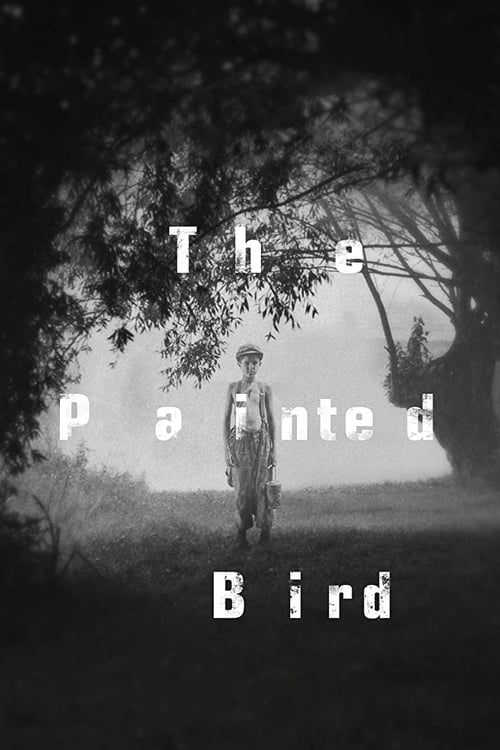
The Painted Bird
2019 · Václav Marhoul
For when you want cinema at its most serious and unflinching — a film you endure and then can't shake. This is a challenge, not a comfort; save it for a night when you have the stomach and the stamina.
What it's about
A young boy, separated from his parents in Eastern Europe during World War II, drifts from village to village looking for shelter while the war grinds on around him. Presumed Jewish or Romani, he passes through the hands of one stranger after another — peasants, soldiers, healers, priests — and each stop teaches him something new about what ordinary people are capable of. It's an odyssey through the countryside of the war, far from the battlefields, where survival is a matter of who takes you in.
The experience
Punishing, hypnotic, and almost wordless — nearly three hours of stark black-and-white images that are as beautiful as they are hard to sit through. It doesn't build to relief; it accumulates, and it leaves you hollowed out and quiet.
Performances
Petr Kotlár carries the film as the boy in an almost entirely wordless performance, absorbing everything with his eyes; around him, Stellan Skarsgård, Harvey Keitel, and Udo Kier appear as the strangers who shape his journey.
The craft
Shot in ravishing monochrome widescreen, with the dialogue spoken in an invented pan-Slavic language so the horrors belong to no single nation. The compositions are painterly and exact, the sound spare and pitiless — it demands a big screen and total attention, and rewards both with images you won't forget.
Why it matters
A famously divisive festival premiere — walkouts and standing ovations — that revived the notorious Jerzy Kosiński novel and staked a claim as one of the most formally rigorous war films of its century.
Snapshot
A nameless boy — dark-haired, dark-eyed, presumed Jewish or Romani — wanders the peasant backlands of Eastern Europe as the Second World War consumes everything around him. Village by village, captor by captor, he absorbs cruelties that accumulate without teleological resolution: rape, blinding, drowning, atrocity administered by ordinary hands. Václav Marhoul's adaptation of Jerzy Kosiński's notorious 1965 novel is shot in monochrome widescreen over a punishing 169 minutes, spoken in a constructed pan-Slavic language that assigns the events to no specific nation. The result is one of the most formally deliberate and morally contested war films of the twenty-first century — a work that places itself consciously in the lineage of Elem Klimov while staking a distinct, unsparing aesthetic position of its own.
Industry & Production
The Painted Bird was a Czech-Slovak-Ukrainian co-production, financed largely through Czech public and European co-production mechanisms over an unusually extended gestation. Marhoul spent approximately seven years developing, casting, and completing the project; principal photography began in 2014 and continued across multiple seasons in the Czech Republic, Slovakia, and Ukraine. The scale — hundreds of extras, livestock, period-accurate village reconstruction — required the logistical infrastructure of a mid-budget European prestige production, though the film's deliberate refusal of conventional spectacle meant that money rarely reads as such on screen. It premiered in competition at the 76th Venice International Film Festival (August 2019), where it generated immediate controversy over its sustained depictions of violence; audience walkouts at press screenings were widely reported. The film was selected as the Czech Republic's submission for Best International Feature Film at the 92nd Academy Awards. Czech production company Silver Screen produced alongside co-producers across the three countries; Marhoul himself served as producer as well as writer and director.
Technology
The film was shot on 35mm black-and-white film stock — a deliberate, expensive commitment at a moment when digital acquisition had become industry default. The choice of photochemical capture aligns the image with a historical memory of mid-century European cinema, invoking the visual grammar of the films it engages in dialogue with (Dreyer, early Bergman, the Czech New Wave) while also subtly anachronizing the subject matter. Cinematographer Vladimír Smutný worked with anamorphic lenses to produce an image at once expansive in its horizontal register and suffocating in its tonal compression: blacks are deep and mineral, whites are never blown, the gray scale is managed with precision to distinguish mud from shadow from sky. The 1.33:1 or near-Academy aspect ratio — the precise ratio confirmed in some exhibition materials as close to the classic boxy frame — constricts the image vertically, closing off escape routes and pressing figures into the earth or the frame edge. Post-production preserved the grain structure of the originating stock rather than processing it away, giving the image a texture that functions as both period citation and existential grit.
Technique
Cinematography
Vladimír Smutný, one of the most accomplished Czech cinematographers of his generation, applies a static or near-static camera discipline that refuses the subjective identification typically cued by tracking shots or point-of-view edits. Wide-angle compositions frequently position the boy small within a landscape that dwarfs and endangers him — a compositional strategy that echoes Tarkovsky's use of the long shot as moral stance. Smutný favors available or available-augmented natural light, and sequences set in interiors have the quality of Flemish painting: raking sidelight, deep shadow, faces that emerge and recede. There is very little camera movement for its own sake; when the camera does move, the motion carries weight. Long takes dominate, and the patience of the framing denies viewers the escape of cutting away from what is happening. Several episodes are photographed as single, sustained compositions — the act of watching becomes implicated in the act of witnessing.
Editing
The film's editorial rhythm enacts its thematic structure. Each chapter is separated by an intertitle naming the figure who will entangle the boy in a new ordeal; the chapter structure, borrowed from the novel, also rhymes with the episodic organization of picaresque literature and with the fragmented testimonial form of survivor narrative. Within chapters, Marhoul (or his collaborating editor — the precise editing credit is not always prominently sourced in available materials, and the record here is thin) allows scenes to play at a pace that feels ethnographic rather than dramatic, refusing to build or release conventional tension. Cuts tend to arrive after the event rather than during it, denying the rhythmic relief of classical scene construction. The overall 169-minute duration is not experienced as bloat but as accumulation — the film insists on duration as a form of moral accounting.
Mise-en-scène / Staging
Marhoul's staging is at once naturalistic and rigorously composed. Peasant communities are rendered without sentimentality or picturesque softening: dwellings are dark, figures move slowly, violence arrives embedded in the texture of daily life rather than erupting from it. Locations in rural Czech, Slovak, and Ukrainian countryside were chosen and sometimes dressed to eliminate anachronistic markers, but the production design does not fetishize period accuracy in the manner of mainstream historical cinema. The aim is symbolic space rather than documentary reconstruction. The use of animals — horses, birds, livestock — is consistent and purposeful; the film inherits from the novel the image of caged birds released and destroyed by their own kind as a parable for social annihilation of the different, and Marhoul stages the novel's key bird episode with unflinching literalism. Crowd staging in village scenes has a quality of ritual or collective behavior that drains individual agency, implicating community in atrocity.
Sound
The sound design operates with unusual restraint. Dialogue is sparse — the constructed Interslavic language makes the speech of most characters partially opaque even to Slavic-speaking audiences, achieving a defamiliarization that amplifies the boy's isolation and the viewer's. Petr Malásek's original score is used selectively; the film relies heavily on diegetic and ambient sound — wind, animal noise, the acoustic properties of stone and mud — to create a sonic environment that is both materially specific and psychologically relentless. The score, when it appears, tends toward plain, unornamented choral and string textures that avoid emotional manipulation. Silence is deployed strategically and is often more disturbing than any underscoring.
Performance
The central performance by Petr Kotlár — a non-professional actor, then in his early teens, cast after an extensive search — is one of the film's most discussed achievements and most ethically fraught decisions. Kotlár's performance is largely non-verbal; the boy observes, endures, and survives, and the film's ethical project depends on the viewer's relationship to a child body subjected to sustained depicted harm. Marhoul has stated in interviews that he worked extensively to protect his lead actor during production, though the ethics of putting a child performer through such material were widely debated in reception. The film assembles a constellation of European and international character actors in supporting roles: Harvey Keitel, Stellan Skarsgård, Udo Kier, Barry Pepper, and Julian Sands each appear in individual chapters, their faces and presence functioning as anchoring points within the episodic structure. Their casting in relatively brief roles has a quality of cameo that some critics read as distracting; others saw it as a device for fragmenting narrative coherence in service of the film's anti-totalization argument. Performances are calibrated to be neither caricature nor redemptive — even figures who show brief kindness do so within a social world that forecloses lasting protection.
Narrative & Dramatic Mode
The film refuses the arc structure of most Holocaust or war narrative. There is no rescue, no liberation rendered as emotional culmination, and no bildungsroman trajectory in which suffering transforms into wisdom or identity. The dramatic mode is cumulative rather than developmental — Kosiński's episodic structure, which Marhoul preserves almost schematically, draws more from medieval exemplum or picaresque fiction than from the redemptive realism of canonical WWII cinema. The boy is a passive witness and recipient of events; his interiority is almost entirely withheld, which prevents identification in the conventional sense while sustaining a disturbing form of proximity. The film asks whether witness itself — whether the act of looking at documented atrocity — constitutes a form of moral response or merely voyeurism, and it does not resolve the question.
Genre & Cycle
The Painted Bird belongs to the small, intensely contested category of war films that use extreme depiction of violence as epistemological method — works that argue the camera must not look away precisely because official memory does. Its most direct generic predecessor is Elem Klimov's Come and See (1985), against which it will inevitably be measured: both films center a boy whose passage through the Eastern Front registers the war's full barbarism; both use prolonged witness as their primary formal strategy. Marhoul's film is more formally austere and less expressionistically subjective than Klimov's — it does not enter its protagonist's psychological fragmentation the way Come and See does. Within the European art cinema of the 2010s, it participates in a cycle of formally rigorous, historically grounded films addressing the war's eastern genocidal geography — a cycle that includes Michael Haneke's The White Ribbon (2009) and László Nemes's Son of Saul (2015), though it differs from both in its commitment to wide-angle landscape and to narrative diffusion over formal containment.
Authorship & Method
Václav Marhoul is a Czech director and producer whose previous features — including Tobruk (2008) and We Are Family (2004) — showed genre competence without preparing audiences for the scale and severity of The Painted Bird. His method here is that of a maximally faithful adapter who nonetheless makes decisive formal choices: the addition of the constructed language, the insistence on 35mm, the near-decade of production time all indicate a directorial stance oriented toward permanence rather than expediency. Marhoul wrote the screenplay himself, compressing and chapter-organizing a novel that was already structurally episodic. The collaboration with Vladimír Smutný appears to have been foundational — Smutný's cinematographic discipline is inseparable from the film's moral argument. Petr Malásek, who has scored numerous Czech films, provided a score that is deliberately subsidiary to image and ambient sound. The editing, at whatever level of collaboration with Marhoul, constitutes one of the film's most distinctive authorial choices in its management of duration and restraint.
Movement / National Cinema
The Painted Bird is unmistakably a Czech production, but its relationship to Czech national cinema is complicated by its subject matter, its international cast, and its deployment of a constructed trans-Slavic language that explicitly refuses national specificity. Czech cinema has a long engagement with WWII and occupation narratives — from Jiří Menzel's Closely Watched Trains (1966) onward — but Marhoul's film is less interested in Czech particularity than in a pan-European reckoning with perpetration, collaboration, and indifference among ordinary populations. In this respect it aligns with a post-1989 willingness in Eastern European cinema to examine complicity rather than victimhood. The film also participates in a broader tradition of Czech literary adaptation, the Czech New Wave having established a practice of treating challenging literary source material with formal seriousness; Marhoul invokes this tradition while producing a work that in its violence exceeds New Wave precedents considerably.
Era / Period
The film belongs to the mid-to-late 2010s moment in European art cinema characterized by historical reckoning and formal austerity: Son of Saul (2015), Ida (Pawlikowski, 2013), Cold War (Pawlikowski, 2018), and The Favourite (Lanthimos, 2018) share its commitment to monochrome cinematography as a form of temporal citation. Its premiere at Venice 2019 placed it at the end of a decade in which the Holocaust and WWII Eastern Front returned insistently to European screen culture, often in formally demanding modes resistant to the feel-good catharsis of mainstream historical drama. The controversy it generated at Venice — walkouts, accusations of exploitation, counter-defenses of the film's moral seriousness — maps onto a wider critical argument of the period about the limits of cinematic witness and the ethics of depicting atrocity.
Themes
The film's central themes are the social production of violence, the mechanisms by which ordinary communities sanction and perpetrate cruelty, and the question of what survives prolonged dehumanization. Superstition and folk religion are presented not as picturesque local color but as cognitive systems that organize persecution: the boy is feared as a carrier of plague or evil eye, which assigns his treatment a pseudo-rational logic that is more chilling than pure sadism would be. The film is also deeply concerned with the politics of difference — ethnicity, appearance, foreignness — and with how otherness is constructed and policed at the village level, outside any institutional framework. The question of whether witness produces ethical response or merely traumatic repetition runs beneath the film's surface throughout. Some critics have also read the film as a meditation on language and the impossibility of testimony — the Interslavic device foregrounding the degree to which atrocity resists translation into any single national narrative or language.
Reception, Canon & Influence
Critical reception was deeply divided. Many major critics — at Sight & Sound, The Guardian, in American publications covering Venice — acknowledged the film's formal rigor while debating whether its extreme content served its argument or overwhelmed it. The film was accused by some of wallowing in suffering without sufficient interpretive frame, and its status as an adaptation of a novel whose autobiographical claims were extensively discredited (Kosiński's account of his wartime experiences was challenged by Polish investigators and journalists from the 1980s onward) complicated reception further. Defenders argued that the episodic violence was neither gratuitous nor exceptional given the historical record, and that the film's formal severity was itself an ethical argument against easy consumption of WWII narrative. Audience reactions were polarized; the Venice walkouts became part of the film's public identity.
Influences on the film (backward): Come and See (Klimov, 1985) is the inescapable precursor — the boy-and-war-landscape structure, the Eastern Front geography, and the commitment to unrelenting witness all derive from or converse with Klimov's film. Tarkovsky's landscape grammar (Andrei Rublev, Mirror, Stalker) informs Smutný's wide-angle spatial compositions and the film's patience with duration. Carl Theodor Dreyer's austere monochrome, particularly Ordet and The Passion of Joan of Arc, is legible in the film's approach to the human face under extremity. Pasolini's Salò (1975) — another adaptation of a literary work of extreme violence undertaken as an argument about fascism — provides precedent for using graphic content as analysis rather than spectacle, though Marhoul's film is less systematic in its allegorical ambitions. Within Czech literary cinema, Menzel, Forman, and Chytilová established a practice of treating morally uncomfortable material from fiction with formal rigor rather than softening.
Legacy and influence (forward): The film is too recent and too contested for its influence on subsequent filmmaking to be fully traceable, and the record here is genuinely thin — it premiered in 2019 and its influence on a new generation of filmmakers is a matter of emerging rather than established critical history. It has, however, entered syllabi and critical discussions as a reference point in debates about Holocaust cinema, extreme cinema, and the ethics of adaptation. Its commitment to 35mm in a digital era, and its willingness to spend nearly a decade on a formally demanding project with limited commercial prospects, has been noted as exemplary by cinematographers and directors interested in photochemical image-making. Whether it ultimately stands with Come and See or Son of Saul as a canonical work of WWII cinema, or remains a powerful outlier defined by controversy, is a question that critical time has not yet settled.
A Deleuzian reading
Start with the bird.
The full Deleuzian reading of The Painted Bird →
Reception
It premiered at Venice 2019 as 'the walkout movie' — dozens fled screenings there and at TIFF — yet it also drew a standing ovation and became the Czech Oscar submission. Years on, its notoriety has softened into respect, with many now filing it beside the great East European war films rather than the shock canon.
How The Painted Bird was received, from release to now →
Influences: the films it descends from and the films it influenced
- Come and See (1985) — The boy-protagonist-as-helpless-witness moving through an Eastern Front landscape of escalating atrocity, shot with total immersion in ambient sound and available light, is the structural and ethical template The Painted Bird directly inherits — the boy's face as the film's moral instrument, landscape as indifferent witness.
- Andrei Rublev (1966) — The chapter-intertitle episodic structure, 35mm anamorphic monochrome, and the figure of the passive witness embedded in scenes of historical violence collectively supply The Painted Bird's formal architecture, including Smutný's wide-angle spatial compositions derived from Vadim Yusov's landscape grammar.
- Ivan's Childhood (1962) — The monochrome boy-in-wartime film with available-light landscape photography and a passive child protagonist absorbed into the machinery of adult violence directly anticipates both the formal posture and the ethical refusal of heroism that define The Painted Bird.
- The Passion of Joan of Arc (1928) — Dreyer's sustained monochrome attention to the face under physical and spiritual extremity — refusing melodramatic release while demanding spectator endurance — establishes the template for Smutný's treatment of Joska's face as an ethical surface registering suffering without psychological commentary.
- Ordet (1955) — Dreyer's static long-take grammar treating monochrome composition as moral discipline — the camera positioned as witness rather than agent, duration enforced as ethical demand — informs Marhoul's formal argument that visual severity is itself a stance against comfortable spectatorship.
- Salò, or the 120 Days of Sodom (1975) — Pasolini's adaptation of an extreme literary work as systematic ideological argument about fascism — using graphic content as analysis rather than spectacle, organized in titled circles — provides the ethical and structural framework for The Painted Bird's refusal to soften Kosiński's episodic violence into legible tragedy.
- Au Hasard Balthazar (1966) — Bresson's passive protagonist passed from handler to handler across a landscape of human cruelty — accumulating suffering without psychological interiority or narrative agency — is the narrative template Marhoul inherits for Joska's picaresque structure as pure, voiceless witness.
- Sátántangó (1994) — Tarr's use of chapter intertitles, 35mm monochrome, ultra-extended static long takes, and duration-as-accumulation as primary formal strategy — not ornament but argument against narrative consolation — establishes the grammar The Painted Bird deploys at compressed scale.
- The Tin Drum (1979) — Schlöndorff's adaptation of Grass's extreme modernist novel uses a child protagonist's outsider perspective to organize episodic WWII-era atrocity — the passive child accumulating trauma across self-contained encounters with adult cruelty — establishing the passive-child-witness picaresque as a viable formal vehicle for European literary extremity that The Painted Bird extends with greater austerity.
- Landscape in the Mist (1988) — Two child protagonists as passive picaresque witnesses moving through a landscape of adult violence, shot with Angelopoulos's signature extended static long takes and available-light compositions that treat landscape as an absorbing force rather than backdrop, provide a formal European art-cinema precedent for The Painted Bird's treatment of childhood in extremity.
- The Turin Horse (2011) — Fred Kelemen's available-light Rembrandt-esque 35mm monochrome, extended static long takes in an oppressive single landscape, and duration-as-accumulation as formal argument against narrative resolution make this the most proximate contemporary European influence on Smutný's cinematographic discipline in The Painted Bird.
- The Pianist (2002) — Eastern European wartime atrocity observed through a wandering, near-silent child witness in long-take monochrome.
- The White Ribbon (2009) — Christian Berger's anamorphic 35mm monochrome, wide-angle Central European rural landscape, episodic village-level violence witnessed through a child's limited comprehension, and non-professional cast inhabit the same formal toolkit as The Painted Bird, both arguing that monochrome austerity is the only ethical register for European systemic violence against the innocent.
- Ida (2013) — Łukasz Żal and Ryszard Lenczewski's 35mm monochrome with severe available-light discipline in a Polish post-war landscape, combined with static long takes and deliberate use of empty frame space as moral weight, places Ida within the same 2010s European photochemical revival that The Painted Bird extends — both arguing that 35mm monochrome is the ethical material for representing mid-century Eastern European violence.
- Son of Saul (2015) — Both films emerged from the 2010s European art-cinema conversation about formal ethics in Holocaust representation; where Nemes uses extreme handheld shallow-focus immersion and a dense constructed ambient sound design, Marhoul uses long-take observational distance and the constructed language Interslavic, but both formally refuse heroism and narrative closure as available responses to atrocity.
- Cold War (2018) — Łukasz Żal's anamorphic 35mm monochrome, static long takes, and available-light compositions share the formal vocabulary of The Painted Bird, with both films positioning photochemical anamorphic monochrome as an ethical argument about Eastern European mid-century experience rather than a nostalgic or merely aesthetic choice.
Similar films
- Ivan's Childhood (1962) — influence & lineage · same viewing thread
- The White Ribbon (2009) — influence & lineage
- Son of Saul (2015) — influence & lineage
- Come and See (1985) — influence & lineage
- Au Hasard Balthazar (1966) — influence & lineage
- Andrei Rublev (1966) — influence & lineage
- The Tin Drum (1979) — influence & lineage · same viewing thread
- The Boy in the Striped Pyjamas (2008) — same viewing thread
All the films related to The Painted Bird →
Watch it with: curated runs of related films
- War Through a Child's Eyes — Watch these in a run for how each sets a small, watchful child in front of a history far too big to understand — occupation, civil war, dictatorship, genocide — so the child's innocence throws the adult brutality into unbearable relief.