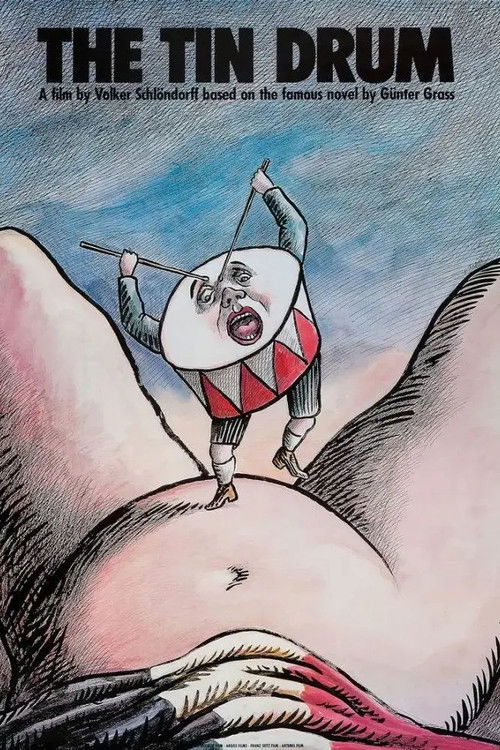
The Tin Drum
1979 · Volker Schlöndorff
For when you want a film to chew on for days — challenging, strange, and morally serious. Choose it when you're up for provocation, not comfort.
What it's about
In the Free City of Danzig between the wars, a boy named Oskar decides on his third birthday that the adult world is not worth joining — so he throws himself down the stairs and simply stops growing. Armed with a tin drum he beats incessantly and a scream that shatters glass, he watches from waist height as his family, his neighbors, and his city slide into Nazism. It's German history retold as a dark fairy tale, with a child-sized narrator who refuses to grow up as everything around him grows monstrous.
The experience
Grotesque, surreal, and deliberately confrontational — by turns blackly funny, disturbing, and haunting. It's not an easy watch and doesn't want to be; some images will stay with you whether you like it or not.
Performances
David Bennent, who was twelve when he played Oskar, is uncanny — an ageless, unblinking presence who makes the film's impossible premise feel disturbingly real.
The craft
Volker Schlöndorff turns Günter Grass's famously 'unfilmable' novel into vivid, tactile images, filming the world from a child's low vantage so history literally towers overhead. The blend of fairy-tale logic and period realism — carnival grotesquerie against the machinery of fascism — is the film's signature.
Why it matters
It shared the Palme d'Or at Cannes and won the Oscar for Best Foreign Language Film, becoming the biggest international triumph of the New German Cinema and a landmark in Germany's cinematic reckoning with its past.
Snapshot
The Tin Drum (Die Blechtrommel) is Volker Schlöndorff's adaptation of Günter Grass's landmark 1959 novel, a grotesque, picaresque reckoning with German history seen through the eyes of Oskar Matzerath — a boy who, on his third birthday, wills himself to stop growing and registers his protest against the adult world by hammering a tin drum and shattering glass with his scream. Set in the contested Free City of Danzig from the 1920s through the Second World War, the film fuses fairy-tale fabulism with unsparing political allegory: petit-bourgeois complacency curdling into Nazism, witnessed from waist height by a child-narrator who refuses to participate in growing up. It stands as one of the defining international successes of the New German Cinema, the movement's most conspicuous bid to confront the national past through a canonical literary text. Sharing the Palme d'Or at Cannes with Apocalypse Now in 1979 and winning the Academy Award for Best Foreign Language Film, it became the first German film to take that Oscar — a milestone for a national cinema still working in the long shadow of 1945.
Industry & production
The film was a flagship European co-production, organized chiefly through German and French money. Franz Seitz produced (and shares screenplay credit), with the French producer Anatole Dauman and his company Argos Films — long associated with the postwar art cinema of Resnais, Marker, and others — among the partners, alongside backing connected to West German television (the public broadcasters were central financiers of New German Cinema throughout the 1970s). Mounting Grass's sprawling novel was an expensive, logistically demanding undertaking by the standards of the German industry: period reconstruction of pre-war Danzig (filming took place in Poland, including in and around Gdańsk, as well as in studios and other locations), large crowd and parade sequences, and a long production calendar. Grass's novel had been considered effectively unfilmable for two decades, in part because of its scale and in part because of its scabrous, scatological, sexually frank content; Schlöndorff's project carried both the prestige and the risk of adapting a book regarded as a monument of postwar German literature. The decision to film only the first two of the novel's three books — ending the story in 1945 rather than following Oskar into the postwar Federal Republic — was a structural and commercial choice that shaped the film's coherence and its reception alike.
Technology
The Tin Drum was made with the conventional 35mm photochemical apparatus of late-1970s European feature production and does not announce itself as a technical innovator in the manner of, say, contemporaneous Hollywood blockbusters. Its real technological problem was a profilmic and effects challenge rather than a question of new cameras or stocks: how to render Oskar's two signature impossibilities — his arrested growth and his glass-shattering scream. The first was solved primarily through casting and staging rather than optical trickery (see Performance), the second through sound design and practical breakage effects coordinated with the camera. The period setting placed the emphasis on production technology of the art-department kind — costuming, set dressing, vintage vehicles, and the material culture of interwar Danzig — rather than on lab or lens novelty. Where the record of specific technical methods used for individual gags is thin, it is better to acknowledge that than to reconstruct it speculatively.
Technique
Cinematography
The Slovak cinematographer Igor Luther shot the film, and his images are central to its distinctive register. Much of the visual scheme is organized around Oskar's low vantage — a child's-eye line of sight that turns adults into looming, faintly monstrous presences and domestic interiors into theaters of grown-up folly. Luther's photography balances earthy, period-accurate naturalism with a heightened, almost storybook expressivity appropriate to a narrative that is part historical chronicle, part grotesque fable. Crowd and ceremonial scenes — most famously the Nazi rally that Oskar disrupts by drumming the marching band into a Strauss waltz — are staged for ironic spectacle, the camera finding the absurdity inside the choreography of fascist mass culture.
Editing
Suzanne Baron edited the film. The cut must negotiate an unusually wide tonal range — fairy tale, family melodrama, war film, picaresque comedy, political allegory — and a long time span compressed from a dense novel. The editing's chief task is rhythmic management of episodes: stitching Oskar's set-piece interventions and the family saga into a forward-moving chronicle without losing the digressive, anecdotal texture of Grass's prose. The pruning of the novel's third book is itself, in effect, a macro-editorial decision that gives the film its terminal point in the collapse of 1945.
Mise-en-scène / staging
The film's mise-en-scène is its most discussed formal dimension. Schlöndorff stages the petit-bourgeois world of the Matzerath grocery, the Kashubian countryside, and the streets of Danzig with a dense materiality — food, furniture, bodies, and bric-a-brac crowding the frame — that grounds the fabulist conceit in tactile reality. Several images have become iconic in their own right: the eels drawn from a horse's head on the beach, a sequence of nauseating force that crystallizes the film's linkage of appetite, disgust, and mortality; the four skirts of Oskar's grandmother in the potato field that open the story; Oskar perched beneath the speaker's rostrum at the rally. The staging consistently exploits scale — Oskar's smallness against adult bodies and institutional architecture — as both a visual motif and a thematic argument.
Sound
Sound is constitutive rather than decorative here, because Oskar's scream — the Glaszertrümmernder Gesang, the glass-shattering song — is a plot mechanism and a metaphor. The film must make audible a voice that is at once a child's tantrum and a quasi-supernatural weapon, and the soundtrack treats the scream as a recurring sonic event with destructive consequence. The drum itself supplies a percussive through-line, a rhythmic signature of Oskar's refusal and resistance. Diegetic period music and the marching bands of the political sequences are deployed for irony, never more pointedly than when Oskar's drumming hijacks a rally's martial cadence.
Performance
The film rests on the casting of David Bennent as Oskar. Bennent — around eleven or twelve during production, and small for his age owing to a constitutional condition — made it possible to present an "adult" Oskar who remains physically a child, finessing the novel's central impossibility through casting rather than effects, and lending the boy an uncanny, ageless intensity. His wide-eyed, watchful presence anchors a performance style that is at once naturalistic and slightly otherworldly. Around him, a strong ensemble — including Mario Adorf as Alfred Matzerath, Angela Winkler as Oskar's mother Agnes, Daniel Olbrychski as her cousin and lover Jan Bronski, and Katharina Thalbach as Maria — sustains the family melodrama beneath the allegory. The performances of the adults are pitched to be legible from Oskar's ironizing distance: vivid, appetitive, self-deceiving.
Narrative & dramatic mode
The film's dominant mode is the picaresque chronicle filtered through an unreliable, willfully arrested narrator. Oskar's voice-over frames events with a child's literalism and a sardonic detachment that refuses moral or emotional maturation, and this withholding is the film's central dramatic strategy: history happens around a protagonist who declines to grow into it. The result is a deliberately episodic structure — a string of grotesque incidents and family entanglements — rather than a tightly causal plot. Fable and allegory operate simultaneously: Oskar's stunted body is at once a literal narrative fact and a transparent figure for a society's refusal to mature, for the regressive infantilism Grass diagnosed in the German embrace of Nazism. The tonal register is magic-realist before that term was commonplace in European cinema, holding the marvelous and the historical in the same frame without resolving the tension between them.
Genre & cycle
The Tin Drum sits at the intersection of the prestige literary adaptation, the historical/war film, and the European art film of the grotesque. It belongs to a 1970s cycle of German films reckoning with the Nazi past and the texture of everyday complicity, and within Schlöndorff's own career to a sustained line of literary adaptations. More broadly it participates in an international art-cinema vein of magic realism and political allegory, kin in spirit (if not in direct lineage) to other fabulist treatments of fascism and childhood. Its sharing of the 1979 Palme d'Or with Apocalypse Now placed it, fittingly, alongside another epic, hallucinatory war film — both works straining the conventional war film toward the mythic.
Authorship & method
Schlöndorff was, among the New German Cinema directors, the consummate adapter — the filmmaker most identified with bringing major literary works to the screen, in contrast to the more idiosyncratically authorial Fassbinder, Herzog, or Wenders. His method on The Tin Drum was collaborative and text-respecting: the screenplay is credited to Schlöndorff, the veteran French screenwriter Jean-Claude Carrière (a frequent Buñuel collaborator, whose presence signals the film's surrealist-grotesque affinities), and producer Franz Seitz, with Günter Grass himself involved in shaping the adaptation — an unusual degree of authorial sanction from a novelist of Grass's stature. The collaboration extended to a distinguished crew: Igor Luther's cinematography, Suzanne Baron's editing, and a score by the French composer Maurice Jarre, whose music underlines the film's fabulist and historical scales. The governing authorial decision — to end in 1945 and omit the novel's postwar third book — reflects Schlöndorff's reading of the material as fundamentally a chronicle of the road into catastrophe, and remains the film's most debated interpretive choice.
Movement / national cinema
The film is a central document of the New German Cinema (Neuer Deutscher Film), the generation that emerged in the wake of the 1962 Oberhausen Manifesto and reached international visibility through the 1970s, supported by a distinctive funding ecology of film subsidy and public television. Among that cohort, Schlöndorff occupied a particular position: more classical and accessible in form than many of his peers, and oriented toward the literary canon and toward international audiences. The Tin Drum became the movement's most decorated single achievement on the world stage, its Cannes and Academy honors lending the whole German revival a prestige and visibility that more avant-garde works had not secured. It thus functioned as both an artistic statement and an ambassador for a national cinema in the midst of its postwar renewal.
Era / period
The film is doubly periodized: it depicts the interwar and wartime years (roughly 1899 in its prologue through 1945), and it was made at the end of the 1970s, a moment when West German culture was engaged in intensive, often anguished public reckoning with the Nazi era. Its depicted period — the precarious, ethnically mixed Free City of Danzig, a flashpoint whose status helped trigger the war — lets the film render the slide into fascism at the granular level of shopkeepers, neighbors, and family, where grand history is lived as petty appetite and accommodation. Made decades after the events, by a generation that did not perpetrate them but inherited their weight, the film belongs to the broader European current of 1970s historical revisitation, distinguished by its refusal of consolation or heroism.
Themes
At its core the film is about arrested development as both personal pathology and political diagnosis: Oskar's refusal to grow is a mirror held to a society that retreated into a destructive infantilism rather than assume adult moral responsibility. Surrounding this are Grass's persistent preoccupations — appetite and disgust (the eel sequence, the relentless eating and coupling), the entanglement of the erotic and the grotesque, the petit-bourgeois roots of fascism, and the contested, hybrid identity of the Danzig borderland (German, Polish, Kashubian) as a microcosm of Central European catastrophe. The drum is a figure for art-as-protest and art-as-noise alike, the scream a figure for the impotent and destructive cry of refusal. Childhood here is neither innocent nor redemptive but watchful, complicit, and strange.
Reception, canon & influence
The Tin Drum was received as a major international event. The shared Palme d'Or at Cannes in 1979 and the Academy Award for Best Foreign Language Film — the first won by a German film — established it immediately as a canonical work and as the most visible success of the New German Cinema. Critical response, then and since, has been substantial and not uniformly adulatory: admirers praised its audacity, its imagery, and Bennent's performance; some critics found the adaptation's grotesquerie wearying or judged that the omission of the novel's third book left the film thematically incomplete. The film's frank treatment of Oskar's childhood sexuality later made it a flashpoint for censorship — most notoriously in Oklahoma in 1997, where a court ruling briefly led authorities to seize copies as alleged child pornography, an episode widely condemned as an overreach and emblematic of the film's enduring capacity to provoke.
Looking backward, the film draws on Grass's novel above all — its magic realism, its picaresque structure, its political allegory are the source's — and, through Carrière and the broader European tradition, on a surrealist-grotesque lineage in which Buñuel is a touchstone. Looking forward, its influence is felt less in direct imitation than in the legitimacy it conferred: it demonstrated that German cinema could confront the national past in a register at once popular and serious, and it became a fixed reference point in discussions of magic realism on film, of literary adaptation, and of cinematic representations of fascism seen through a child's eyes. Schlöndorff returned to the third book of Grass's novel only decades later in supplementary form, but the 1979 film remains the definitive screen Tin Drum — the work by which both the director and, to a considerable degree, the New German Cinema's international standing are measured.
A Deleuzian reading
A man hauls a horse's head out of the Baltic surf, and from its eye sockets and gaping mouth the eels come pouring — fat, black, alive.
The full Deleuzian reading of The Tin Drum →
Reception
It arrived a double champion — sharing the 1979 Palme d'Or with Apocalypse Now and winning West Germany its first-ever Best Foreign Language Film Oscar — and it's still held up as the crowning moment of New German Cinema's international breakthrough, though today it gets talked about less than Herzog or Fassbinder.
How The Tin Drum was received, from release to now →
Influences: the films it descends from and the films it influenced
- Los Olvidados (1950) — Establishes the template of puncturing child-poverty realism with surrealist-grotesque dream inserts — the very Buñuelian register Carrière carries into Oskar's fabulist world.
- The Discreet Charm of the Bourgeoisie (1972) — Jean-Claude Carrière's deadpan method of staging petit-bourgeois ritual as absurd set-piece is the direct screenwriting lineage he brings to the film's satire of the Matzerath household.
- Amarcord (1973) — Models the episodic, carnivalesque chronicle of small-town fascism filtered through grotesque caricature and an adolescent's appetitive gaze that Schlöndorff's compression echoes.
- Zéro de conduite (1933) — Origin of the anarchic child-revolt set against authoritarian order, where a small body's refusal becomes a formal weapon — Oskar's willed dwarfism is its descendant device.
- Young Törless (1966) — Schlöndorff's own coolly observational study of proto-fascist cruelty in a closed institution rehearses the detached, diagnostic eye he turns on Danzig's road into catastrophe.
- Lawrence of Arabia (1962) — Maurice Jarre's scoring of fabulist historical scale through sweeping motif is the technique he reprises to underline the film's oscillation between fairy tale and history.
- The Damned (1969) — Renders petit-bourgeois fascism as domestic decay within a single family, the chamber-scale allegory of complicity that The Tin Drum localizes to the grocer's shop.
- Diary of a Chambermaid (1964) — Carrière co-scripted; the rise-of-fascism undertow rendered through grotesque deadpan, carrying forward the Carrière screenwriting method seeded here.
- Forbidden Games (1952) — Applies the child-as-satirist device to expose adult and clerical hypocrisy through a boy's willful refusal of the grown-up world, a grotesque escalation of the anticlerical ritual-mockery.
- The Bridge (1959) — The New German Cinema confrontation with the Nazi past that Die Brücke prefigured from within Germany — a domestic film insisting cinema face the war seriously and without absolution.
- Seven Beauties (1975) — A picaresque grotesque narrated by a stunted survivor threading the fascist years, extending the grotesque-fable-of-fascism form into German cinema.
- Mephisto (1981) — Extends the prestige literary adaptation of fascism that wins the Foreign Oscar, dramatizing collaboration through a single grotesque-comic performer in close-up.
- Europa Europa (1990) — Picaresque survival-through-Nazism told as ironic chronicle of a youth whose body and identity must shapeshift, inheriting the unreliable-survivor narration.
- Like Water for Chocolate (1992) — Carries forward magic realism organized around appetite-and-disgust, where food and ingestion become the literal vehicle of the supernatural and the political.
- Underground (1995) — Balkan magic-realist picaresque using a brass-band's diegetic irony and grotesque excess as political allegory of a nation's descent — Oskar's drum amplified to a marching band.
- Pan's Labyrinth (2006) — The definitive heir to magic-realist fascism-through-a-child's-eyes, building low-angle fairy-tale grotesquerie around a small protagonist who refuses the adult order.
- The Painted Bird (2019) — Episodic picaresque of a wandering child passing through wartime atrocity, each chapter a compressed grotesque tableau — the structural DNA of Oskar's serial encounters.
- Life Is Beautiful (1997) — The child's-eye fabulist distortion of the Nazi years, in which a boy's invented private logic becomes a refusal of and shield against the surrounding horror.
- The Unbearable Lightness of Being (1988) — Carrière's earlier screenplay proving an 'unfilmable' novel of ideas could be pruned to its dramatic core — the direct adaptation-by-distillation template applied to Kundera's narrator-heavy text.
- Jojo Rabbit (2019) — Renders Nazi Germany through a child's grotesque, distorted gaze, legitimizing the heightened, childlike sightline on fascism that Jojo adopts.
- The Boy in the Striped Pyjamas (2008) — Pioneers the literal child-height camera and low, waist-level framing that renders the rise of Nazism as something glimpsed from below by a boy who refuses or fails to comprehend it.
- Never Look Away (2018) — The Vergangenheitsbewältigung epic that threads one protagonist through successive German regimes — including Nazi euthanasia and the war's rubble — providing the three-regime sweep von Donnersmarck compresses into a bildungsroman.
- Empire of the Sun (1987) — A child as uncanny, grotesque witness who aestheticizes wartime horror rather than moralizing it — prefiguring Ballard's cool strangeness Spielberg tries to preserve.
- The Spirit of the Beehive (1973) — Pioneers fascism rendered through a child's uncomprehending low-angle gaze, the framing strategy that lets a small protagonist measure the adult catastrophe around him.
- The Marriage of Maria Braun (1979) — Same-year New German Cinema reckoning with the national past (Vergangenheitsbewältigung), using one figure's biography as ironic allegory of the German trajectory.
- The Lost Honor of Katharina Blum (1975) — Schlöndorff's text-respecting prestige-literary-adaptation method — faithful structural transposition of a major German novel — is the working procedure he scales up here.
- Woyzeck (1979) — Schlöndorff's adaptation of Grass compresses a multi-episode novel into continuous causality through the same NGK literary-compression strategy, while deploying grotesque institutional figures — Nazi bureaucrats, petty bourgeois townspeople — as social determinants of a protagonist whose madness is diagnosed by the institutions that produce it.
- When Father Was Away on Business (1985) — History and fascism apprehended through a child's perspective inside a grotesque-comic domestic frame charged with political catastrophe.
Similar films
- The Painted Bird (2019) — influence & lineage · same viewing thread
- Pan's Labyrinth (2006) — influence & lineage
- Europa Europa (1990) — influence & lineage
- The Spirit of the Beehive (1973) — influence & lineage · same viewing thread
- Germany, Year Zero (1948) — same viewing thread
- The Boy in the Striped Pyjamas (2008) — same viewing thread
- The President's Cake (2026) — same viewing thread
- Ivan's Childhood (1962) — same viewing thread
All the films related to The Tin Drum →
Watch it with: curated runs of related films
- War Through a Child's Eyes — Watch these in a run for how each sets a small, watchful child in front of a history far too big to understand — occupation, civil war, dictatorship, genocide — so the child's innocence throws the adult brutality into unbearable relief.