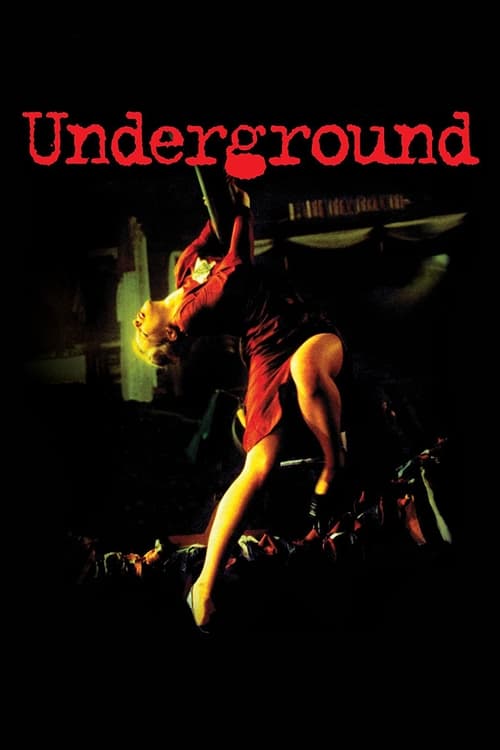
Underground
1995 · Emir Kusturica
For when you want a big, wild epic that grabs you by the collar — a party of a movie that turns out to be about something devastating. This is a challenge-night pick, not a comfort watch, and it earns its running time.
What it's about
Two Belgrade con men, the swaggering Blacky and the smooth-operating Marko, get rich running guns to the resistance during the Nazi occupation — until Marko pulls off a monstrous con of his own. He hides Blacky, his friends, and a whole community in a cellar and keeps them there for decades, convinced the war never ended, while he rises through the ranks of the new Yugoslavia above their heads. The film follows the lie across half a century, from the bombing of Belgrade in 1941 to the country's violent unraveling in the 1990s.
The experience
Loud, drunken, and relentless — a brass band seems to be playing in nearly every scene, weddings collapse into brawls, and the tragedy sneaks up on you inside the farce. It runs long and hits hard: you come out exhilarated, a little exhausted, and genuinely moved by where the carnival ends up.
Performances
Predrag 'Miki' Manojlović makes Marko's charm and treachery inseparable, while Lazar Ristovski plays Blacky at full roar — a bull of a man whose obliviousness becomes heartbreaking.
The craft
Kusturica directs at maximum density: crowded frames full of animals, musicians, smoke, and motion, with the camera diving through parties and battles alike. The brass-band score drives the whole film like an engine, and the underground sets give the central deception a real, lived-in weight. It rewards a big screen and good speakers — this is a film you should feel in your chest.
Why it matters
Winner of the Palme d'Or at Cannes in 1995, it became one of the most argued-over films of the decade — a ferocious allegory for the collapse of Yugoslavia released while the wars were still burning. It cemented Kusturica's brand of Balkan magic realism as a force in world cinema.
Snapshot
Underground — released in the former Yugoslavia under the title Bila jednom jedna zemlja ("Once Upon a Time There Was a Country") — is Emir Kusturica's sprawling tragicomic allegory of Yugoslavia across half a century, from the Nazi bombing of Belgrade in 1941 to the wars of secession in the 1990s. Built around two con men, the swaggering Blacky (Lazar Ristovski) and the manipulative Marko (Predrag "Miki" Manojlović), it uses a monstrous central deception — a cellar full of people kept manufacturing weapons for decades in the belief that the Second World War never ended — as a metaphor for the lie of Titoist Yugoslavia itself. The film is loud, carnivalesque, and relentlessly kinetic: brass bands, weddings, animals, gunfire, and drink swirl through a mode of Balkan magic realism that Kusturica had been developing across the previous decade. It won the Palme d'Or at the 1995 Cannes Film Festival — Kusturica's second, after When Father Was Away on Business (1985) — and almost immediately became the center of one of the most bitter political controversies in modern European cinema, accused by French intellectuals of pro-Serbian apologetics even as it was hailed as a masterpiece of exuberant political filmmaking. Few films of the 1990s so completely fused formal virtuosity with contested meaning.
Industry & production
Underground was a major international co-production, financed principally through the French company CiBy 2000 — the production house of Francis Bouygues that also backed auteurs such as Jane Campion, David Lynch, and Pedro Almodóvar in this period — with German and Hungarian partners and Serbian participation. This transnational financing structure was itself a source of later controversy, as critics probed whether the film had received support connected to Slobodan Milošević's Serbia and its state broadcaster; Kusturica and his defenders disputed the more extreme characterizations, and the precise accounting has remained a subject of polemic rather than settled record, so I flag it here rather than assert a figure.
The production was logistically ambitious and lengthy, involving large physical sets — above all the vast subterranean world of the cellar — with shooting distributed across locations including Belgrade and studio work at Barrandov in Prague, then a favored hub for large European productions. The screenplay was adapted from and with the Serbian playwright Dušan Kovačević, whose theatrical sensibility for grotesque farce shaped the film's structure. Kusturica also produced a much longer version conceived for television, running to roughly five hours as a multi-part serial under the Bila jednom jedna zemlja title; the theatrical cut runs around 170 minutes. The film's Cannes triumph — the jury that year was presided over by Jeanne Moreau — made it a commercial and prestige event across art-house Europe, though it was received far more warily in some quarters once the political reading took hold.
Technology
Underground is a photochemical, analog production shot on 35mm film, and its aesthetic belongs squarely to the pre-digital tradition of physically staged spectacle. Its "effects" are overwhelmingly practical: real crowds, real animals, real pyrotechnics, elaborate constructed environments, and mechanical stunts rather than optical or digital compositing. The picture's most memorable images — a bombed Belgrade zoo with animals loose amid the rubble, a wedding that erupts into chaos, a brass band that seems to follow the characters through history — derive their force from the fact that they were built and performed in front of the camera. Where the film reaches for the fantastical, it does so through in-camera means and staging rather than post-production illusion, which is consistent with Kusturica's roots in a European production culture that prized the tangible, weighty presence of the profilmic world. The existence of a long-form television version also reflects the era's practice of shooting extensive coverage that could be recut for broadcast serialization.
Technique
Cinematography
The cinematography is by Vilko Filač, Kusturica's most important visual collaborator, who had shot his earlier features including When Father Was Away on Business and Time of the Gypsies. Filač's camera in Underground is almost never still: it plunges into crowds, cranes over banquets, tracks alongside running figures, and weaves through the chaos of celebration and violence with a mobility that makes the frame feel physically alive. The visual register is warm, dense, and often golden — a saturated, tactile look suited to the film's Bacchanalian energy. Compositions are packed with incident, foreground and background competing for attention, so that the image itself dramatizes the film's theme of excess and simultaneity. This restless, immersive camerawork is central to how the film generates its intoxicating momentum.
Editing
Cut by Branka Čeperac, Underground moves at a breathless clip, its editing keyed to the rhythms of brass music, drink, and mayhem. The film's overarching architecture is a three-movement historical scheme — commonly read as "War," "Cold War," and "War" again — and the editing must both sustain the frenetic within-scene tempo and manage vast temporal leaps across decades. The cutting frequently rides the momentum of the score and of physical action, favoring propulsion over repose; scenes of celebration are assembled to feel as if they might spin out of control at any moment. This tension between formal control and represented chaos is one of the film's signature achievements.
Mise-en-scène / staging
Staging is the beating heart of Kusturica's method here. Underground is organized around set-piece gatherings — weddings, feasts, funerals, reunions — that function as pressure cookers of human appetite, where music, food, sex, jealousy, and violence collide. The mise-en-scène is maximalist: every frame teems with bodies, animals (a chimpanzee, geese, and other creatures recur as anarchic presences), banners, instruments, and props. The central conceit gives the staging its allegorical spine: an entire community living underground, laboring at a permanent war economy, their subterranean world an elaborate theater of deception maintained from above. The vertical geography of surface and cellar becomes a spatial metaphor the film returns to again and again.
Sound
Sound is inseparable from the film's identity, above all the omnipresent brass. The score, by Goran Bregović — Kusturica's key musical collaborator across this era — draws on the driving, syncopated idiom of Balkan Roma brass bands, producing music that is at once festive and militaristic, celebratory and ominous. Themes associated with the film became widely known in the world-music circulation of the 1990s. Bregović's compositional practice, which drew heavily on traditional and folk sources, has itself been the subject of debate about authorship and attribution within the broader discourse around his career; within Underground, the effect is unmistakable — the band is a near-constant diegetic and non-diegetic force, a musical embodiment of a people who dance through catastrophe.
Performance
The performances are pitched to the film's operatic, farcical scale. Miki Manojlović's Marko is a study in charismatic treachery, sliding from black-market hustler to Party grandee while betraying everyone around him. Lazar Ristovski's Blacky is his boisterous, wounded counterpart — a man of appetite and violence whose credulity makes him the film's tragic engine. Mirjana Joković plays Natalija, the actress caught between them, and Slavko Štimac brings a fragile pathos to Marko's stammering brother Ivan and his beloved chimpanzee. The ensemble sustains a broad, physical, quasi-theatrical style — shouting, brawling, weeping, singing — that matches the maximalism of the staging without collapsing into mere caricature.
Narrative & dramatic mode
The dramatic mode is tragicomic allegory in the register of the grotesque. Adapted from Kovačević's material, the narrative fuses farce with historical tragedy: its comedy is broad and bodily, its tragedy national and irreversible. The story unfolds as a sustained fable, structured across the three great phases of Yugoslav twentieth-century history, and it repeatedly ruptures realism with fantastical flourishes — most famously a closing image in which a piece of land breaks away and floats off, accompanied by a valediction for a country that no longer exists. This is not naturalism but myth-making, a deliberately theatrical, hyperbolic mode in which characters stand for historical forces and the deception at the plot's core operates simultaneously as story and as political parable.
Genre & cycle
Underground sits at the crossroads of war film, historical epic, political satire, and magic-realist tragicomedy. It belongs recognizably to a Balkan cinematic vein of carnivalesque excess — brass, weddings, animals, drink — that Kusturica had done much to define. As war cinema it is anti-heroic and anti-monumental, treating grand historical events as farce shot through with grief. As satire it targets the mythology of Yugoslav socialism and the opportunism that outlives every regime. It can be productively grouped with the wave of films reckoning with the collapse of Yugoslavia in the 1990s, though its allegorical ambition and comic scale set it apart from more sober contemporaries.
Authorship & method
Underground is a paradigmatic Kusturica film and, for many, the fullest expression of his method. That method is collaborative and remarkably consistent: the director worked repeatedly with cinematographer Vilko Filač, whose fluid, immersive camera is a defining authorial signature, and with composer Goran Bregović, whose Balkan brass idiom is nearly synonymous with Kusturica's cinema of this period. The screenplay was written with the playwright Dušan Kovačević, whose theatrical sense of grotesque political farce is woven into the film's DNA, while editor Branka Čeperac shaped its propulsive rhythm. Kusturica's authorial signature lies in orchestrating human, animal, and musical chaos into an image of history as perpetual, intoxicated catastrophe — a vision by turns exhilarating and despairing. His well-documented immersion in Balkan Roma culture and brass music, his fondness for physically staged spectacle over illusion, and his refusal of tidy political closure all converge here.
Movement / national cinema
Kusturica emerged from the Yugoslav cinema of the late socialist period, and Underground is one of the last and greatest films to speak from — and about — Yugoslavia as an idea even as the state itself was dissolving. It is deeply enmeshed with questions of national cinema precisely because the nation in question was disintegrating: the film's transnational financing, its Serbian creative core, and its subject matter made it a lightning rod for arguments about who could represent the Yugoslav catastrophe and from what position. Kusturica, born in Sarajevo, occupied an especially contested vantage. The film thus belongs less to a stable "national cinema" than to the traumatic unbinding of one, which is central both to its power and to the controversy it provoked.
Era / period
The film is a product of the mid-1990s, made in the shadow of the very wars it stretches toward in its final act. That immediacy is inseparable from its reception: to make a grand tragicomic allegory of Yugoslavia's whole history while that history was still violently unraveling was an act of extraordinary ambition and, to its critics, of dangerous timing. The mid-1990s art-house economy — big European co-productions, festival prestige as commercial engine, world music's crossover moment — is legible throughout the project, from CiBy 2000's backing to Bregović's internationally circulated score.
Themes
At its core, Underground is about deception and betrayal as the founding conditions of a nation. The literal underground — people kept below the surface, laboring for a war they are told still rages — is a merciless metaphor for how populations are sustained in illusion by those who profit from the lie. Around this central image cluster the film's recurring preoccupations: the seductive theatricality of politics; the opportunist who thrives under every regime; appetite and celebration as both life force and self-destruction; and the persistence of violence across generations. The film mourns a lost country while refusing to sentimentalize it, insisting that the same appetites which make its people vividly, joyously alive also make them prey to demagogues and cheats. Its closing benediction — the land literally severed and adrift — crystallizes a vision of Yugoslavia as a dream that could not hold.
Reception, canon & influence
Critically, Underground was received at Cannes as a tour de force and awarded the 1995 Palme d'Or, cementing Kusturica's standing among the leading European auteurs of his generation. Almost simultaneously it became the object of a fierce political controversy centered in France: the philosopher Alain Finkielkraut published a widely cited denunciation in Le Monde accusing the film of serving Serbian nationalist propaganda — a charge he leveled, notoriously, before having seen it — and the debate drew in numerous other intellectuals; Slavoj Žižek was among the prominent critics who read the film's mythologizing of Balkan vitality as politically compromised. Kusturica defended the work as anti-nationalist and anti-war, and the affair was widely reported to have contributed to his announcement of a withdrawal from filmmaking, from which he subsequently returned. The precise contours of the funding and political accusations remain contested, and I present them as a documented controversy rather than a settled verdict.
Influences on the film (backward): Underground draws on Kusturica's own prior cinema — the carnivalesque magic realism of Time of the Gypsies especially — and on Dušan Kovačević's tradition of grotesque political farce. Critics have long placed its maximalist, music-drenched spectacle in a lineage of exuberant humanist excess, with Federico Fellini frequently invoked as a touchstone; its blend of magic realism and historical allegory also resonates with a broader European and Latin American literary imagination, though such comparisons are interpretive rather than documented borrowings.
Legacy (forward): The film consolidated a recognizable "Kusturica mode" — brass bands, animals, weddings, and frenzied human chaos as a vernacular for Balkan history — that shaped perceptions of the region's cinema abroad and influenced how the wars of Yugoslav succession were narrated on screen. Bregović's score helped drive the 1990s world-music appetite for Balkan brass, an influence audible well beyond the film itself. And the Underground controversy became a standing case study in film-studies and political-philosophy discussions of representation, propaganda, and the ethics of allegory in times of atrocity — a debate the film continues to anchor. It remains Kusturica's most ambitious and most argued-over work, and one of the defining European films of its decade.
A Deleuzian reading
A bomb falls on the Belgrade zoo and the animals walk out.
The full Deleuzian reading of Underground →
Reception
Won Kusturica his second Palme d'Or in 1995, then got engulfed in a firestorm — French intellectuals branded it pro-Serb propaganda mid-Yugoslav-wars, and a bruised Kusturica briefly announced his retirement. Today the politics row has faded and it's widely embraced as the great delirious epic of Yugoslavia's collapse.
How Underground was received, from release to now →
How to watch Underground: what to notice on a first viewing
- Watch the camera plunge into crowds instead of holding still. Filač's camera cranes over banquets, tracks with runners, and rarely settles, making each gathering feel physically alive. This restless camera is where the film gets its drunken, unstoppable momentum.
- Listen for the brass band under scenes of celebration and violence. Bregović's syncopated Balkan brass plays through weddings, gunfire, and grief alike, never pausing to distinguish one from the other. The music refuses to tell you when to feel safe, so ask what is actually happening under the trumpet.
- Notice the staircase between the party above and the cellar below. Kusturica keeps returning to the same vertical geography, a world underground and a world on the surface, connected by one passage. The staircase does the film's thinking for it: one nation, two floors, two entirely different realities.
- Notice the animals loose among the actors, geese, a chimpanzee. A chimpanzee, geese, and other creatures recur as anarchic presences moving freely through weddings, feasts, and battles alike. Their indifference to the chaos around them makes the human mayhem look even more absurd.
- Notice how each decade arrives with the same brass, drink, and brawling. The film leaps across fifty years of Yugoslav history, but its set-piece gatherings, weddings, feasts, funerals, repeat the same appetites each time. The repetition suggests history is less a story moving forward than a cycle that keeps re-arriving at itself.
The whole guide to watching Underground, with the keys for a rewatch →
Influences: the films it descends from and the films it influenced
- When Father Was Away on Business (1985) — Kusturica's first template for narrating Yugoslav political history obliquely through a family's domestic farce and a child's-eye vantage — the allegorical strategy Underground scales into national epic.
- Time of the Gypsies (1988) — Established the Kusturica-Filač signature of levitating objects and bodies achieved through practical in-camera effects, plus the Roma-brass sonic world and immersive fluid camera that Underground inherits wholesale.
- Amarcord (1973) — Fellini's brass-band processions and communal carnival set-pieces staged as collective memory are the direct model for Kusturica's maximalist wedding-and-funeral spectacles and nostalgic historical tableaux.
- 8½ (1963) — The circus-parade choreography of massed human, musical chaos into a single orchestrated crowd movement is the staging grammar Kusturica adopts for his frenzied ensemble finales.
- The Tin Drum (1979) — Pioneered the grotesque magic-realist allegory of national catastrophe filtered through a carnivalesque, arrested body — the mode of history-as-intoxicated-farce that Underground's basement mythology extends.
- WR: Mysteries of the Organism (1971) — The Yugoslav Black Wave's satirical collage fusing political ideology with bodily and sexual excess gives Underground its native tradition of anarchic anti-authoritarian montage.
- The Firemen's Ball (1967) — Czech-New-Wave model of the single communal gathering escalating into chaotic farce as veiled political allegory — the compressed-social-microcosm structure behind Underground's cellar society.
- The Red and the White (1967) — Central-European precedent for the choreographed, continuously mobile camera sweeping across historical wartime violence, staging bodies and terrain as a single kinetic tableau.
- The Eccentrics (1974) — Balkan folk magical realism driven by a live brass-band lyrical score, sustaining the eccentric-as-hero and whimsy-as-resistance template across a fabulist national epic.
- Roma (1972) — Builds an entire buried society out of Roma's Metro-dig premise, driving it with a brass-band score used as continuous propulsive presence in the Rota manner and choreographing crowds through deep foreground-to-background traffic.
- Black Cat, White Cat (1998) — Distills the exact Kusturica machine — brass bands, animals, weddings, propulsive Čeperac-style editing — into pure Roma-comedy, isolating the vernacular Underground built from historical allegory.
- Life Is a Miracle (2004) — Recycles the Underground formula of brass score, livestock, and slapstick love against a Yugoslav-war backdrop, confirming the 'Kusturica mode' as a repeatable authorial system.
- Pretty Village, Pretty Flame (1996) — Builds its war satire around a literal tunnel/underground trapping men in a subterranean limbo, mirroring Underground's vertical geography of a buried population manipulated by those above.
- No Man's Land (2001) — Extends the Balkan anti-war satire into absurdist chamber allegory — two enemies trapped in a trench — inheriting Underground's refusal of tidy political closure and its farce-atop-atrocity register.
- Ee.Ma.Yau. (2018) — The brass-band-scored, carnival-into-catastrophe choreography of crowds — source music (the funeral band) driving the mise-en-scène and grief flipping into chaotic spectacle, exactly Prashant Pillai's diegetic-band strategy here.
- Arizona Dream (1993) — Made immediately prior in the same authorial mode, it shares the dreamlike maximalist excess, animal motifs, and operatic-theatrical performance register that Underground pushes to political epic.
- Cabaret Balkan (1998) — Shares the frenzied interlocking-ensemble chaos and grotesque-farce-as-national-diagnosis approach, staging Balkan self-destruction as one propulsive, escalating nocturnal machine.
- Train de Vie (1998) — Scored by Goran Bregović in the same Balkan-brass idiom, it applies Underground's tragicomic-allegory strategy — a persecuted community musicking its way through catastrophe — to the Holocaust.
- Gadjo Dilo (1997) — Shares the immersion in Roma brass-band musical culture as an organizing cinematic principle, letting live music and dance drive rhythm and staging in the manner of Kusturica's sound-led ensembles.
- Devils on the Doorstep (2001) — A contemporaneous carnivalesque of grotesque ensemble and ironic brass-band scoring driving farce that curdles into war tragedy.
- Queen Margot (1994) — Bregović-scored, delirious crowd choreography turning national-historical chronicle into frenzied tragic spectacle, a parallel use of the same composer's ritual music.
- We Are Not Angels (1992) — Pairs relentless brass-band pop energy with a literalized national allegory (the cellar-as-Yugoslavia), the same post-Yugoslav strategy of driving allegory-made-literal with wall-to-wall music.
- Before the Rain (1994) — The rival post-Yugoslav festival object, using temporal impossibility toward the opposite register: characters kept in a cellar in a falsified chronology, so history is dramatized as manufactured time rather than as a broken loop.
Similar films
- Black Cat, White Cat (1998) — influence & lineage
- Pretty Village, Pretty Flame (1996) — influence & lineage
- When Father Was Away on Business (1985) — influence & lineage
- Time of the Gypsies (1988) — influence & lineage
- No Man's Land (2001) — influence & lineage
- Soundtrack to a Coup d'Etat (2024) — shared sensibility
- Ulysses' Gaze (1995) — shared sensibility
- The Fifth Seal (1976) — shared sensibility