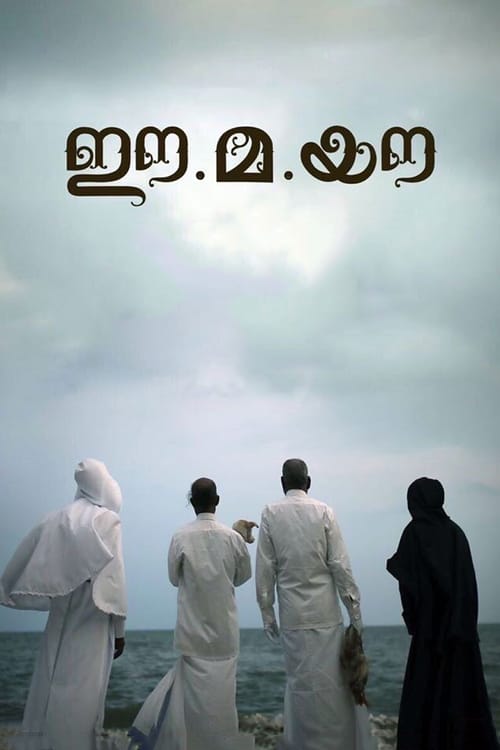
Ee.Ma.Yau.
2018 · Lijo Jose Pellissery
For when you want something alive and unruly — a film that treats death with gallows humor and real feeling at once. Best when you're up for total immersion in a place rather than a tidy plot.
What it's about
In a Latin Catholic fishing village on the Kerala coast, the old carpenter Vavachan Mesthiri comes home drunk and expansive one evening — and dies. His son Eeshi once promised him a grand funeral, and the film spends one rain-lashed day and night watching that promise collide with everything: money he doesn't have, relatives with opinions, village gossip, the church's rules, and the sheer logistics of burying a man with dignity. It's a comedy about death that keeps turning into a tragedy about the living, and back again.
The experience
Chaotic, darkly funny, and finally wrenching — grief here arrives as noise: wailing mourners, arguments over cash, a brass band, rain hammering on roofs. The film swings between farce and heartbreak sometimes within a single shot, and the cumulative effect is strangely cathartic.
Performances
Chemban Vinod Jose anchors the film as Eeshi, a son coming apart under an impossible obligation, with Vinayakan lending soulful support as his loyal friend; the ensemble's wailing, bickering mourners feel documentary-real.
The craft
Lijo Jose Pellissery orchestrates huge ensemble scenes in long, roving takes, conducting dozens of villagers, weather, and animals like a piece of music — the craft is in how choreographed the chaos is. Rain and ambient sound do as much storytelling as dialogue, and the coastal village becomes a character in itself. Good speakers help; this is a film you hear as much as watch.
Why it matters
A high point of the Malayalam cinema renaissance, it confirmed Pellissery as one of India's most formally daring directors and became a touchstone for ensemble filmmaking built on controlled chaos.
Snapshot
Ee.Ma.Yau. is a Malayalam-language chamber tragedy-comedy that compresses the aftermath of a single death into roughly a day and a night in the Latin Catholic fishing hamlet of Chellanam, on the coast south of Kochi. The title is itself the film's thesis: "Ee.Ma.Yau." is the Malayalam abbreviation of "Eeso, Mariam, Ouseppe" — Jesus, Mary, Joseph — the invocation Latin Christians murmur over the dying and inscribe on tombstones, the local equivalent of "R.I.P." When the old carpenter Vavachan Mesthiri collapses and dies after returning home drunk and expansive, his son Eeshi is left with a promise made in a lighter moment: to give his father a grand, dignified funeral. What follows is the slow, farcical, and finally devastating unraveling of that promise against the frictions of money, kinship, drink, gossip, church authority, and weather. Directed by Lijo Jose Pellissery at the height of a remarkable creative run, and written by the novelist P.F. Mathews, the film is at once a granular ethnography of a coastal Catholic community's death rites and a metaphysical meditation on the impossibility of a "good death" under material constraint. It is widely regarded as one of the signal works of twenty-first-century Malayalam cinema.
Industry & production
The film belongs to the mid-budget, artistically ambitious wing of the Malayalam industry that flourished after roughly 2011 — a sector willing to bankroll director-driven, star-light projects rooted in specific regional milieus. It emerged directly from the collaborative circle around actor-writer-producer Chemban Vinod Jose, who plays the son Eeshi and whose Chembosky Motion Pictures banner was central to Pellissery's preceding hit Angamaly Diaries (2017); the public record on the full slate of co-producers is not entirely consistent, and I will not assert figures I cannot verify. What is clear is the production model: modest resources, a compact ensemble drawn largely from Kerala's theater and character-actor pool rather than marquee stars, and heavy reliance on real coastal locations in and around Chellanam. Shooting on location among a working fishing community — with its tight lanes, church, shoreline, and unpredictable sea weather — was both the film's aesthetic engine and its logistical burden.
Ee.Ma.Yau. opened theatrically in Kerala in May 2018 to strong critical response and a respectable if not blockbuster commercial life; precise box-office totals I cannot confirm and will not invent. Its wider afterlife came substantially through streaming: a Netflix release carried it to festival-literate audiences in India and abroad, where it consolidated Pellissery's international reputation. The film also performed strongly on the awards circuit, most notably at the Kerala State Film Awards for 2018, where Pellissery's direction was honored and the film's sound work was recognized; I flag that the exact category list is best checked against the official record.
Technology
Ee.Ma.Yau. was made with digital capture, and its technical identity is inseparable from that choice. The film lives in interiors lit by low-wattage domestic bulbs, in narrow lanes at dusk, and outdoors under a churning, overcast coastal sky — conditions that reward the latitude and low-light sensitivity of contemporary digital sensors. (I don't have verified camera-and-lens specifications and won't fabricate them.) The practical payoff is a near-documentary mobility: the camera can follow bodies through cramped rooms and crowds without the rigging a lit, film-stock production would demand. Equally important is the sound technology. The film's dense, near-continuous sonic field — rain on tin, the surf, keening, band instruments, overlapping dialect chatter, thunder — depends on location recording and meticulous post-production mixing to build an environment that feels captured rather than assembled. The film is, in a real sense, a showcase for what layered digital sound design can do dramatically, not just atmospherically.
Technique
Cinematography
Shyju Khalid, Pellissery's frequent collaborator and one of Malayalam cinema's most accomplished cinematographers, shoots the film as an immersive, roving observer. The camera is predominantly handheld and mobile, threading through the house and the village as if it were another mourner, another gossip, another body pressed into a crowded room. Rather than composing death as a series of solemn tableaux, Khalid keeps the frame busy, off-balance, and physically implicated, so that grief, comedy, and bureaucratic irritation share the same restless space. The palette is muted and weather-bound — grays, blues, the sodium warmth of interior bulbs against a bruised sky — and light sources are kept naturalistic. As night and storm arrive, the imagery grows more expressionistic without breaking the documentary contract, so that the coastal weather reads simultaneously as literal condition and cosmic commentary.
Editing
Deepu Joseph's cutting sustains a paradoxical rhythm: the film feels like it unfolds in something close to real time, honoring the tedium and repetition of a wake, yet it is precisely shaped to time its comic beats and its emotional gut-punches. The editing tolerates duration — long stretches of waiting, arguing, and small logistical failure — because that duration is the subject. Deaths in this world do not resolve on a dramatic clock; they drag, stall, and compound. The cut's discipline lies in knowing when to hold on a face or a stalled negotiation and when to release the accumulated tension into farce or catastrophe.
Mise-en-scène / staging
Staging is the film's supreme achievement. Pellissery choreographs large ensembles in confined domestic spaces with a theatrical density, orchestrating simultaneous actions — the corpse being tended, relatives bickering over arrangements, neighbors intruding, children underfoot, the band tuning up — so that the single-room set becomes a stage of overlapping human business. The corpse itself is a fixed compositional anchor around which the living organize their vanities and anxieties. Details are specific and lived-in: the economics of a coffin and a band, the politics of who is fed and who is slighted, the exact social grammar of a Latin Catholic fishing village. This ethnographic precision, rather than plot machinery, generates the drama.
Sound
Sound design, credited to Renganaath Ravee, is arguably the film's most celebrated craft dimension and functions as a co-author of meaning. The soundscape is thick and near-continuous — surf, wind, rain, thunder, the funeral band, wailing, prayer, and dialect chatter braided into an enveloping field. The sea is a constant sonic presence, a low pressure beneath every scene, and the storm's escalation is registered as much through sound as image, building toward a climax where the aural environment tips from realism into something apocalyptic. The mix refuses the tidy silences of conventional grief cinema; it insists that death here is loud, crowded, and physically overwhelming.
Performance
The acting is ensemble realism of a high order. Chemban Vinod Jose gives Eeshi a mounting desperation — a son crushed between filial love, wounded pride, and insolvency — that carries the film's tragic weight. Vinayakan, fresh from his breakthrough in Kammatti Paadam (2016), plays the friend Ayyappan with volatile, live-wire energy. Dileesh Pothan — himself a major director (Maheshinte Prathikaaram, Thondimuthalum Driksakshiyum) — is cast as the parish priest whose institutional doubts and delays become an engine of both comedy and cruelty. Pauly Valsan and the wider cast of character players and apparent non-professionals lend the crowd scenes their unforced authenticity. Performances are pitched to overlap and interrupt, prioritizing the texture of a real community over individual showcase moments.
Narrative & dramatic mode
The film's dramatic mode is tragicomedy stretched over a deliberately narrow span — the TMDB framing of "events between two evenings" is apt. Its engine is not a whodunit or a quest but a simple, escalating logistical failure: a promise of dignity colliding with money, weather, drink, church procedure, and human pettiness. Structurally it resembles a pressure cooker or a chamber play, confining its action largely to one house and its village and letting complications accrete rather than branch. Tonally it oscillates without warning between the broadly comic and the genuinely harrowing, refusing to let the audience settle into either mourning or satire. Underneath the naturalism runs a thread of the uncanny — omens, folk beliefs about the passage of the soul, and a storm that behaves like judgment — so that the film's realism is porous to the metaphysical, culminating in an ending that pushes past documentary observation into something closer to allegory.
Genre & cycle
Nominally "Drama, Comedy," Ee.Ma.Yau. is more precisely a death-ritual film — a subgenre concerned less with dying than with the social machinery that death sets in motion. It sits within a small international lineage of funeral- and wake-centered films that mine the comedy and horror of arrangements, and within Indian cinema it belongs to a regional realist current preoccupied with community, caste, religion, and economic precarity. Within Pellissery's own career it forms part of a loose cycle of films that treat a collective — a town, a mob, a village — as the true protagonist, bracketed by Angamaly Diaries (2017) before it and Jallikattu (2019) after. Where those films erupt into kinetic, near-choreographed chaos, Ee.Ma.Yau. turns the same crowd energy inward and downward, toward stasis, waiting, and grief.
Authorship & method
Pellissery's method here is immersive, ensemble-driven, and location-bound: he builds films from the specific social texture of a place and stages large groups in continuous, overlapping action rather than isolating stars in clean coverage. His authorial signature — the community as protagonist, virtuosic long-form staging, an appetite for chaos that can flip into the sublime — is fully present, but Ee.Ma.Yau. channels it into a more contained, grief-saturated register than his more explosive work. Crucial to the film's identity is the screenplay by P.F. Mathews, a respected Malayalam novelist and screenwriter long preoccupied with death and the coastal Latin Catholic milieu; his intimacy with the community's idiom and rites gives the film its ethnographic authority and grounds Pellissery's formal energy in lived specificity. The core craft team reads as a roster of the era's Malayalam talent: cinematographer Shyju Khalid, composer Prashant Pillai (a frequent Pellissery collaborator whose work bridges score and source music, including the funeral band), editor Deepu Joseph, and sound designer Renganaath Ravee. The result is genuinely collaborative authorship — a writer's world, a director's staging, and a sound team's environment fused into a single sensibility.
Movement / national cinema
The film is a flagship of what is often called "New Generation" Malayalam cinema — the post-2011 wave that broke from star-vehicle formula toward realist, regionally specific, director-led storytelling with naturalistic performance and location shooting. Malayalam cinema has long carried a reputation within India for literary seriousness and social realism, and Ee.Ma.Yau. both extends that tradition and modernizes it, marrying documentary-grade observation to bold formal ambition. It is also a portrait of a minority community — Kerala's Latin Catholic coastal fisherfolk — whose faith, labor, and death customs are rarely rendered with this degree of insider detail on screen, making the film a significant act of regional and communal specificity within the national cinema.
Era / period
Ee.Ma.Yau. is a contemporary-set film of the late 2010s, and it arrives at a moment when Malayalam cinema was consolidating international critical attention and when streaming was beginning to redraw the reach of regional Indian films. It is very much of its industrial era: digitally shot, festival- and platform-aware, star-light, and confident that a hyper-local story told without compromise could travel. Within Pellissery's own periodization it marks the peak of his 2017–2019 hot streak, the point at which he moved from being an admired Malayalam director to a filmmaker discussed in international art-cinema terms.
Themes
At its center is the collision between the dignity we wish to grant the dead and the material conditions that make such dignity a commodity — a funeral as an economic transaction the grieving cannot afford. Around that spine cluster the film's other concerns: faith versus institution, dramatized through a Church that withholds and delays even as it presides; masculinity and the weight of a son's promise; debt, obligation, and the humiliations of poverty; the corrosive intimacy of a small community where grief is inseparable from gossip and status. The sea and the storm supply a governing metaphor — indifferent, engulfing, elemental — against which human vanities are measured and found small. And beneath the social satire runs a genuine metaphysical unease about death itself: what the soul's passage means, whether a "good death" is even possible, and how the living perform ritual to manage a mystery they cannot master.
Reception, canon & influence
Critically, Ee.Ma.Yau. was received as a major work — praised for its staging, sound design, ensemble performances, and the audacity of its tonal shifts — and it strengthened Pellissery's standing as one of Indian cinema's most distinctive contemporary directors. Its awards recognition, including honors at the Kerala State Film Awards for 2018 (Pellissery's direction and the film's sound work are the most commonly cited; the precise categories should be verified against the official list), affirmed its critical standing, while its Netflix availability extended its reach well beyond Kerala.
Looking backward, the film's influences are less a matter of specific cited models than of confluence: the social-realist and literary traditions of Malayalam cinema, P.F. Mathews's own novelistic preoccupation with death and the coastal Catholic world, and the international lineage of ensemble funeral films and observational realism. Pellissery's staging bears the imprint of directors who treat crowds and communities as living organisms, though he transmutes such influences into a personal idiom.
Looking forward, Ee.Ma.Yau. helped cement a template that reverberated through subsequent Malayalam cinema: the hyper-local, community-immersion film that trusts regional specificity and formal ambition over star power and plot mechanics, and that treats sound design as a primary storytelling instrument. Together with Angamaly Diaries and Jallikattu, it is central to the critical case for Pellissery as an auteur, and it stands as a frequently cited reference point in discussions of the artistic maturity of 2010s Malayalam cinema. Its longer-term canonical position continues to consolidate, and where the historical record on its precise industrial and reception details remains thin, that thinness — rather than embellishment — is the honest account.
Reception
Released in May 2018 as the quiet, arthouse-leaning follow-up to the crowd-pleasing Angamaly Diaries, it earned strong reviews but modest box office — then awards season and streaming turned it into what many now call Lijo Jose Pellissery's masterpiece and a defining film of the Malayalam New Wave.
How Ee.Ma.Yau. was received, from release to now →
Influences: the films it descends from and the films it influenced
- The Funeral (1984) — Establishes the tragicomic funeral-procedural template Ee.Ma.Yau. inherits — treating the logistics of a death rite (procuring the coffin, feeding mourners, managing the body) as the engine of comedy and grief simultaneously rather than as backdrop.
- The Death of Mr. Lazarescu (2005) — Model for near-real-time observation of a body and the failing institutions circling it, mining dark comedy from bureaucratic and procedural delay around a corpse — the same fusion of duration, dignity, and institutional indifference Pellissery stages around Vavachan's funeral.
- Festen (1998) — Dogme handheld, available-light ensemble staging of a family gathering that detonates from within — the chamber-play-in-a-crowd structure and tonal rupture Pellissery adopts for the Mathews screenplay.
- Underground (1995) — The brass-band-scored, carnival-into-catastrophe choreography of crowds — source music (the funeral band) driving the mise-en-scène and grief flipping into chaotic spectacle, exactly Prashant Pillai's diegetic-band strategy here.
- Werckmeister Harmonies (2000) — Long-take staging of a crowd as a single restless organism moving through a town — the community-as-protagonist grammar Pellissery uses to shoot the coastal village en masse rather than in star-isolating coverage.
- La Promesse (1996) — Handheld, shoulder-height observational following of working-class figures under economic strain — the dignity-versus-poverty realism and camera-attached-to-body method behind Shyju Khalid's cinematography.
- Amma Ariyan (1986) — Malayalam precedent for a death catalyzing a roving collective, with the community rather than an individual as the true subject — the regional social-realist lineage Pellissery draws from.
- Chemmeen (1965) — Foundational coastal-community social realism in Malayalam cinema, adapting a literary source to render the idiom, labor, and faith of a fishing village — the ethnographic-authority tradition Mathews's screenplay extends.
- Kummatty (1979) — Uses ritual as structural spine rather than subject — a funeral's protocol dictates scene order and duration — and handles the coastal village crowd as a single choreographed body over post-synchronised ambience, the Aravindan inheritance the recent Malayalam resurgence keeps being measured against.
- Jallikattu (2019) — Pushes the crowd-as-organism escalation and Renganaath Ravee's layered, near-percussive sound design to a frenzied extreme — the community mob and sound-as-coauthor experiment that Ee.Ma.Yau. incubated.
- Churuli (2021) — Extends the immersive, place-bound ensemble method and dense enveloping soundscape into disorienting genre territory, retaining the overlapping-dialogue naturalism and digital low-light shooting of Ee.Ma.Yau.
- Thondimuthalum Driksakshiyum (2017) — Naturalistic-lighting, near-real-time ensemble realism where a procedural situation unfolds in patient long-form staging — the observational, anti-melodramatic method of the New Gen wave Ee.Ma.Yau. helped legitimize.
- Kumbalangi Nights (2019) — Coastal-community immersion trusting regional idiom, layered ambient sound, and ensemble texture over star mechanics — the template of location-bound New Gen filmmaking Ee.Ma.Yau. crystallized.
- Nayattu (2021) — Carries forward the faith/dignity-versus-institution pressure and handheld, ensemble-realist observation of ordinary people ground down by systems, in the streaming-era regional register Ee.Ma.Yau. exemplified.
- Aasha (2026) — A death inside a Christian household staged as a siege of neighbours — bodies crowding the doorframe, sync-sound keening, rain and generator hum doing the work of score — so that community attention itself becomes the antagonist.
- Angamaly Diaries (2017) — Immediate sibling in the Pellissery crowd cycle — its virtuoso multi-strand ensemble choreography and single-take climactic melee are the explosive register that Ee.Ma.Yau. redirects into a grief-saturated, contained key.
- Maheshinte Prathikaram (2016) — New-generation Malayalam hyper-local immersion — building the whole film from the specific social texture of one small town and its ensemble of non-star faces, the regional-specificity-over-plot ethos Ee.Ma.Yau. shares.
- Kammattipaadam (2016) — Shares the handheld-observational, cinematographer-as-documentarian approach to a marginalized coastal-adjacent community, grounding drama in lived social texture and dignity-versus-poverty realism rather than plot spectacle.
- Manas (2024) — Communal ensemble realism staged in a coastal village with overlapping naturalist performance, extending regional-realism's crowded human-scale staging.
- Manjummel Boys (2024) — Another Shyju Khalid film built on a densely populated naturalist ensemble in a constricted coastal community, prioritizing lived texture over plot mechanics.
- Maheshinte Prathikaaram (2016) — Single coastal-village setting and ensemble naturalism turning a death ritual into comedy-drama, sharing MP's lived-in provincial texture and observational staging.
Similar films
- Kumbalangi Nights (2019) — influence & lineage
- Pariyerum Perumal (2018) — shared sensibility
- Kadaisi Vivasayi (2022) — shared sensibility
- Maheshinte Prathikaaram (2016) — shared sensibility
- Kishkindha Kaandam (2024) — shared sensibility
- Premam (2015) — shared sensibility
- Manjummel Boys (2024) — shared sensibility
- Vaaranam Aayiram (2008) — shared sensibility