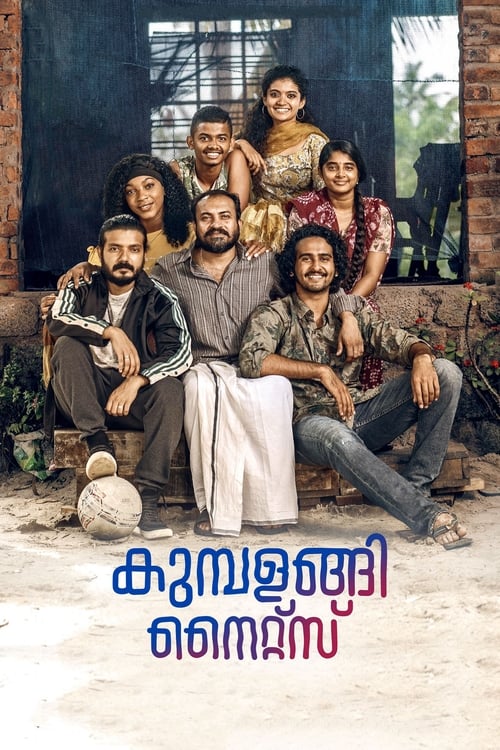
Kumbalangi Nights
2019 · Madhu C. Narayanan
For when you want to feel something real about family and forgiveness without being manipulated into it — comfort cinema with actual teeth. A wonderful pick when you're ready to fall for a film from a tradition you may not know yet.
What it's about
In a ramshackle house on a scrap of backwater island near Kochi live four half-brothers — motherless, mutually resentful, adrift — who can barely share a meal without a fight. When the most feckless of them falls in love, the brothers have to reassemble themselves into something like a family, while across the water the woman's brother-in-law — a mustache-grooming control freak who keeps announcing himself 'a complete man' — stands in the way.
The experience
Gentle, funny, and quietly devastating by turns — it moves at the rhythm of the backwaters, building drama out of small domestic negotiations rather than plot machinery. By the end the warmth is enormous, but there's a genuine chill running through it too.
Performances
Fahadh Faasil gives one of the decade's great unsettling performances as the brother-in-law Shammi — a portrait of smiling patriarchal menace so precise it became a cultural shorthand in India. The four brothers, led by Soubin Shahir's aching turn as the eldest, are just as lived-in.
The craft
Syam Pushkaran's script is a marvel of construction disguised as looseness — every small kindness and slight pays off — and debut director Madhu C. Narayanan shoots the fishing hamlet with such affection that the house and the water become characters. It quietly dismantles the idea of the 'complete man' scene by scene.
Why it matters
A cornerstone of the Malayalam new wave, Kerala's quietly radical popular cinema of the 2010s, and the film that sent viewers across India and beyond digging into what that movement was doing with masculinity, family, and everyday realism.
A cornerstone of the Malayalam new wave, the Kerala-based movement that produced India's most quietly radical popular cinema of the 2010s. In a ramshackle house on a scrap of backwater island near Kochi live four half-brothers — mutually resentful, motherless, adrift — and when the most feckless of them falls in love, the household must reassemble itself into something like a family. Madhu C. Narayanan directs, in his debut, from a Syam Pushkaran script that builds drama out of small domestic negotiations rather than plot machinery, while across the water Fahadh Faasil gives one of the decade's great unsettling performances as a mustache-grooming brother-in-law who repeatedly announces himself 'a complete man.' The film's real project is the demolition of that phrase — patriarchal self-regard examined until it cracks — answered by a portrait of masculinity as care: cooking, mending, staying put. Shyju Khalid shoots the lagoon in greens and lamplight until the humble house becomes one of recent cinema's most quietly desirable addresses.
A Deleuzian reading
A man stands at a mirror, combing his mustache.
The full Deleuzian reading of Kumbalangi Nights →
Reception
An instant critical and word-of-mouth hit in Kerala in early 2019, it then found a second, bigger life on streaming — becoming the gateway film through which non-Malayali audiences discovered the Malayalam New Wave, and it's now routinely cited among the best Indian films of its decade.
How Kumbalangi Nights was received, from release to now →
Influences: the films it descends from and the films it influenced
- Maheshinte Prathikaaram (2016) — The same Syam Pushkaran screenplay and Shyju Khalid lens establish the plotless, small-town slice-of-life template — conflict emerging from the texture of ordinary routine rather than an imposed dramatic engine.
- Thondimuthalum Driksakshiyum (2017) — Pushkaran's dedramatized construction built from mundane procedure, plus Fahadh Faasil dissolving his star persona into a marginal figure, model the same submerged-performance realism Kumbalangi extends.
- Annayum Rasoolum (2013) — Rajeev Ravi's handheld, available-light Kochi-harbor naturalism gave Malayalam cinema its unvarnished coastal-labor milieu, the ground Shyju Khalid's backwater imagery later refines.
- Kammatipaadam (2016) — Location-shot realism among Kochi's urban underclass, with caste and marginality rendered through lived environment rather than exposition, feeds Kumbalangi's rooted-in-place social realism.
- Elippathayam (1981) — Adoor's study of an inert, decaying feudal Kerala patriarch anatomizes stagnant masculinity as a structural rot — the critical lineage behind Shammy's 'complete man' pathology.
- Chemmeen (1965) — The foundational Malayalam film to treat a coastal fishing community and its waterways as a total social world, establishing the backwater milieu Kumbalangi inhabits.
- Pather Panchali (1955) — Ray's ambient natural-light realism and ensemble family portraiture — meaning accreting from everyday rhythm and non-actorly faces — is the deep grammar of this domestic-drama mode.
- Bicycle Thieves (1948) — Italian neorealism's location shooting, working-class dignity, and non-professional texture is the root method for narrative built from the mundane that the Malayalam new wave inherits.
- Ee.Ma.Yau (2018) — Shyju Khalid shoots the same coastal Kerala Catholic community in a near-single-locale ensemble with layered ambient sound, the twin of his Kumbalangi backwater staging.
- Bangalore Days (2014) — Carries the ensemble-family naturalism to its apex — a household of brothers observed with location realism, restrained performance and comedy braided into serious emotion — extending the craft Bangalore Days brought to popular success.
- Premam (2015) — Extends the New Generation available-light ensemble realism into a study of male-bond texture in an unglamorous backwater locale, the observed-community craft Premam advanced.
- Super Deluxe (2019) — An ensemble of fractured masculinity confined largely to one locale, carrying forward the anti-judgment humanism and single-location character orchestration of the regional new-wave surge.
- Joji (2021) — The identical Pushkaran–Pothan–Shyju Khalid–Fahadh unit turns family and inherited patriarchy into a chamber tragedy, carrying forward the naturalist team method into darker register.
- The Great Indian Kitchen (2021) — Renders patriarchy critique through repetitive quotidian domestic labor inside a house, sharpening into gender-politics the household-as-battlefield lens Kumbalangi opened.
- Aavasavyuham (2022) — Returns to the Kochi backwater ecosystem as living milieu, extending the island-and-water staging into a mockumentary-naturalist register of marginal outsiders.
- Home (2021) — Reconstitutes a fractured family around a misunderstood patriarch through low-key domestic naturalism, extending the family-reconstitution and reconceived-masculinity arc.
- Manjummel Boys (2024) — Direct craft-unit ancestor: Shyju Khalid's naturalist handheld coverage of a male ensemble plus Sushin Shyam's score, in the actor-driven Malayalam new-generation production model Soubin Shahir also inhabits.
- Aavesham (2024) — Sushin Shyam's mood-driven scoring and Fahadh Faasil's Shammy — the smiling, self-mythologizing, volatile-magnetic man — directly seed the Ranga register and the score's propulsive elevation cues.
- Sudani from Nigeria (2018) — Extends masculinity-as-care through maternal tenderness and un-macho male leads embedded in an unhurried Malappuram community texture — the same reconstruction of gentle manhood.
- Angamaly Diaries (2017) — A sprawling young-male ensemble whose local food, geography, and micro-culture drive the film shares Kumbalangi's method of building character from place-specific communal detail.
- Ozhivudivasathe Kali (2015) — A single-location study of a male group whose banter curdles into toxic hierarchy performs the same clinical exposure of masculine self-regard that Kumbalangi dramatizes through Shammy.
- Kishkindha Kaandam (2024) — Shares the humid, saturated-green Kerala palette and backwater-village staging, using landscape texture and natural light as an emotional register within an ensemble frame.
- Manas (2024) — Ensemble realism of a fractured household where character is revealed through mundane interaction, sharing Manas's ensemble-realism and character-actor texture.
Similar films
- Maheshinte Prathikaaram (2016) — influence & lineage
- Ee.Ma.Yau. (2018) — influence & lineage
- Bangalore Days (2014) — shared sensibility
- Meiyazhagan (2024) — shared sensibility
- Kishkindha Kaandam (2024) — shared sensibility
- Manjummel Boys (2024) — shared sensibility
- Aavesham (2024) — shared sensibility
- C/o Kancharapalem (2018) — shared sensibility