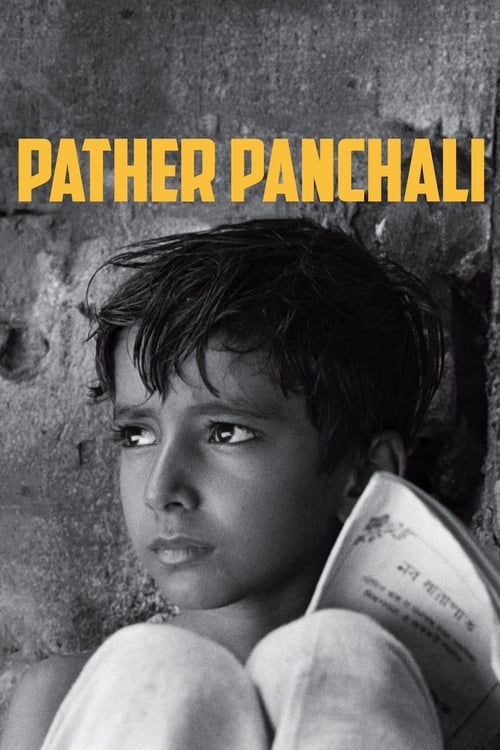
Pather Panchali
1955 · Satyajit Ray
For when you want something patient and profound — a film to surrender to rather than be entertained by, one that leaves you tender for days. Bring your full attention and maybe a handkerchief.
What it's about
In a poor Bengal village, a dreamer of a father leaves to find work, and his wife is left to hold the family together: a spirited daughter, a wide-eyed little boy named Apu, and an ancient aunt who lives on scraps and stories. There's almost no plot — just seasons, small pleasures, daily humiliations, and the slow accumulation of joy and loss as the children discover the world beyond their village.
The experience
Unhurried and quietly overwhelming — it moves at the pace of village life, then catches you off guard with moments of pure wonder and pure grief. Few films feel this close to actual lived childhood.
Performances
The largely non-professional cast is miraculous — the children feel entirely unperformed, and Chunibala Devi's ancient aunt Indir is unforgettable, half-comic and half-tragic.
The craft
Satyajit Ray, a first-time director working with amateurs over three interrupted years, shot it with a documentary eye and a poet's sense of image — rain on a pond, a train seen across a field of white grass. Ravi Shankar's sitar score threads through it all; the black-and-white photography rewards the biggest, quietest screen you can find.
Why it matters
It announced Indian cinema to the world, launched the Apu Trilogy, and made Ray one of the defining filmmakers of the century — a founding document of humanist world cinema.
Snapshot
Pather Panchali ("Song of the Little Road") is Satyajit Ray's first feature and the opening movement of what would become the Apu Trilogy, completed by Aparajito (1956) and Apur Sansar (1959). Adapted from Bibhutibhushan Bandyopadhyay's 1929 Bengali novel, it follows the impoverished Roy family in a Bengal village: the dreaming, often-absent priest Harihar; his careworn wife Sarbajaya; the spirited daughter Durga; the watchful boy Apu; and the ancient, half-comic, half-tragic aunt Indir. There is little plot in the conventional sense — the film accumulates incident, season, and loss until a death breaks the family and a journey begins. Made by an advertising illustrator with no prior directing experience, shot largely with non-professionals over roughly three interrupted years, and rescued financially by the Government of West Bengal, it arrived as the founding work of Indian art cinema and one of the most influential debuts in film history.
Industry & production
Ray came to filmmaking from outside the Indian film industry. He worked as a commercial artist and art director at the British-run advertising agency D.J. Keymer in Calcutta and had co-founded the Calcutta Film Society in 1947 with Chidananda Dasgupta, immersing himself in European and American cinema. A commission to illustrate a new edition of Bandyopadhyay's novel deepened his attachment to the material and seeded the visual sense of the eventual film. Two encounters proved decisive: assisting and observing Jean Renoir, who shot The River in Bengal in 1949–50, and seeing Vittorio De Sica's Bicycle Thieves during a 1950 posting to London, which persuaded Ray that a film could be made on real locations with ordinary people.
Production was famously precarious. Ray began shooting in 1952 with his own savings and a small, mostly inexperienced crew, financing the work in fits and starts. When money ran out, the project stalled for long stretches; the well-known account is that the Government of West Bengal eventually stepped in to fund completion, classifying its support in a manner that treated the film almost as a public-works undertaking. The protracted schedule created real continuity hazards — child actors aged, seasons turned — yet Ray and his team folded this into the film's texture of time passing. The film premiered at the Museum of Modern Art in New York in 1955 before its Indian release, and went on to Cannes in 1956, where it received the prize commonly cited as the Prix du document humain (Best Human Document). Specific budget and box-office figures vary across sources and should be treated cautiously rather than quoted as precise.
Technology
Pather Panchali was shot on 35mm black-and-white film. The production was technologically modest by the standards of contemporary Bombay studio cinema: location shooting in and around the village of Boral, near Calcutta, with limited equipment and a crew learning on the job. Sound was post-synchronized rather than recorded clean on location, as was standard for the period and circumstances. The most consequential technical development associated with the trilogy is cinematographer Subrata Mitra's pioneering of "bounce lighting" — diffusing illumination off a reflective surface to imitate the soft, sourceless quality of natural daylight indoors. While the most celebrated demonstration of the technique comes in the Benares courtyard of Aparajito, the naturalistic lighting approach was developed across the trilogy and is rooted in the available-light aesthetic Mitra began cultivating here. The film's technological signature is less about novel apparatus than about achieving expressive results with constrained means.
Technique
Cinematography
Subrata Mitra was a still photographer with no prior motion-picture experience when Ray engaged him, and the film's images carry a photographer's patience and compositional rigor. Mitra favored a naturalistic register: deep, observational framings of the courtyard and forest, faces caught in soft available light, and an attentiveness to weather and surface — rain on a pond, wind through the kaash (white pampas-like grass). The most famous sequence, in which Durga and Apu run across a field of kaash to glimpse a distant train trailing smoke, fuses landscape, movement, and the intrusion of modernity into a single lyric image. Mitra's camera tends to watch rather than dramatize, holding on small gestures and letting meaning settle.
Editing
Dulal Dutta, who would become Ray's lifelong editor, cut the film in a deliberately unhurried rhythm that mirrors village time. The editing privileges duration and observation over momentum; scenes are allowed to breathe, and ellipses jump across months or seasons so that the children visibly grow. The structure is episodic and cumulative — a string of incidents (the sweet-seller, the theater troupe, the stolen fruit, the rains) rather than a tightly causal plot — and the cutting sustains this loose, life-sized organization while reserving its sharpest compressions for moments of shock, most devastatingly around Durga's illness and death.
Mise-en-scène / staging
Art director Bansi Chandragupta, another figure who would become central to Ray's working method, helped realize a densely lived-in physical world: the crumbling family house, the overgrown courtyard, the encroaching forest, the pond and paths of the village. Staging is built around thresholds and enclosures — doorways, verandas, the boundary between the family's decaying property and the wider world — and around the daily labor of poverty: cooking, fetching water, mending, scavenging. Ray composes domestic space so that the family's straitened circumstances are legible in the frame itself, without underlining.
Sound
Ravi Shankar composed the score, built around sitar and flute, with a principal theme that has become one of world cinema's most recognizable melodies. The widely repeated account is that Shankar, already a celebrated musician, recorded the music in a single extended overnight session; the score is sparing and motival, used to inflect rather than saturate. Beyond music, the film's sound design leans on the ambient world — wind, rain, insects, the distant train, the rumble of the monsoon — so that nature becomes an active presence. The monsoon storm sequence in particular marries image and sound into an overwhelming sensory event.
Performance
The casting mixes amateurs and a few experienced players, directed toward understatement. Subir Banerjee, an untrained boy, plays Apu largely as a pair of watching eyes. Uma Dasgupta gives Durga her mischief and longing. Karuna Banerjee's Sarbajaya carries the film's accumulating grief and hardening pride, while Kanu Banerjee's Harihar embodies amiable, ineffectual hope. The performance most often singled out is Chunibala Devi's Indir, the toothless, querulous, indomitable old aunt — Chunibala was an elderly former actress brought out of long retirement, and her presence gives the film much of its earthy comedy and its first great death. Ray's direction of these largely inexperienced performers toward such restraint is among the film's quiet achievements.
Narrative & dramatic mode
The film operates in an observational, episodic mode closer to lyric or chronicle than to plotted drama. There is no antagonist and no engineered crisis; the "events" are the textures of a poor family's days, punctuated by arrivals, departures, and deaths. Drama emerges from accumulation — small humiliations, deferred dreams, the slow attrition of the family's resources — until loss arrives with the force of inevitability rather than contrivance. The point of view gradually consolidates around Apu, framing the film as the beginning of a coming-of-age that the trilogy will complete. Ray withholds melodramatic emphasis; the famous death scenes are staged with ellipsis and restraint, their grief registered in the survivors' faces and silences.
Genre & cycle
Nominally a drama, the film is better understood as a humanist chronicle and the first panel of a Bildungsroman spanning three features. It belongs to no commercial genre cycle of its national industry; rather, it inaugurated a new strand. As the opening of the Apu Trilogy, it is built for continuation — its ending is a literal setting-out — and its concerns (childhood, poverty, the pull between tradition and modernity, the journey from village to city) carry forward across the cycle.
Authorship & method
Ray is the film's defining author — director, screenwriter, and, through his background as an illustrator, the source of its strong graphic and compositional sensibility; he is also widely associated with detailed pre-visualization through drawings and notebooks. But Pather Panchali is also a foundational collaboration that assembled the core of his future unit. Subrata Mitra (cinematography) and Bansi Chandragupta (art direction) shaped its visual world and would remain crucial collaborators; Dulal Dutta (editing) began a decades-long partnership here. Ravi Shankar's score, though the work of a guest musician rather than a permanent collaborator, is inseparable from the film's identity. Ray's method on this debut — location shooting, non-professional casting, patient improvisatory problem-solving under financial duress — established the artisanal, director-led model that distinguished his cinema from the studio system around it.
Movement / national cinema
The film is the cornerstone of Indian "art" or "parallel" cinema, the alternative to the song-and-dance commercial mainstream centered in Bombay. Its lineage is explicitly transnational: Italian Neorealism (above all Bicycle Thieves) supplied the example of real locations, ordinary people, and quotidian subject matter, while Renoir's humanism and compositional ease offered another model. Yet Ray indigenized these influences thoroughly, rooting the film in Bengali literature, landscape, music, and domestic life. Within Indian film history it stands as the work that proved a regional, realist, author-driven cinema could command international attention, and it became the touchstone for later Indian art-cinema figures.
Era / period
Pather Panchali appeared in 1955, in the early years of post-independence India (independence came in 1947) and the Nehruvian moment of nation-building and modernization. Though its source novel and setting are earlier — rural Bengal of an earlier generation — the film's recurring motif of the railway slicing through the countryside speaks directly to the period's tension between an agrarian past and an industrializing future. Internationally, it arrived amid the postwar ferment that had produced Neorealism and would feed the coming new waves, and it was quickly absorbed into that global conversation about a more realist, humane cinema.
Themes
At its center is poverty observed without condescension or melodrama — the daily indignities and small joys of people the cinema rarely centered. Around this gather the film's other concerns: childhood and the formation of a sensibility (Apu's watching, Durga's wildness); the bond and rivalry of siblings; the burdens borne by women, with Sarbajaya's pride and exhaustion set against Harihar's dreaming passivity; old age and mortality, embodied in Indir and consummated in Durga's death; and the encroachment of modernity, figured in the train and the road of the title. The "little road" itself is the governing image — life as a path walked through hardship toward an unknown elsewhere, a journey the trilogy will extend from village to city.
Reception, canon & influence
The backward lines of influence are clear and acknowledged: Neorealism, especially De Sica, and Renoir's humanism, filtered through Bengali literary and musical tradition and Ray's own graphic training. Reception abroad was largely rapturous after its MoMA premiere and Cannes recognition, though not uniform. A frequently cited dissent is Bosley Crowther's lukewarm notice in The New York Times around the American release, which faulted the film's pace; and there is a much-repeated anecdote that François Truffaut reacted with impatience to its subject matter — a story often told but worth flagging as anecdotal rather than firmly documented. Against such reservations stands a chorus of admiration, including Akira Kurosawa's oft-quoted tribute to Ray's cinema.
Forward, the film's legacy is immense. It launched the Apu Trilogy, established Ray as a major world director, and effectively founded Indian parallel cinema, opening a path for generations of Indian art filmmakers. Its influence on international directors is widely attested, with filmmakers such as Martin Scorsese championing its restoration and figures including Wes Anderson citing Ray's example. It remains a permanent fixture of canon-defining critical polls and best-film lists, and its restoration has kept it in circulation for new audiences. Few debuts have so durably reshaped a national cinema and so thoroughly entered the global canon; its standing as a landmark of humanist filmmaking is, by now, beyond serious dispute.
A Deleuzian reading
Two children push through a field of white kaash grass, chasing a sound.
The full Deleuzian reading of Pather Panchali →
Reception
A debut shot on borrowed money with amateur actors, it stunned Cannes in 1956 (winning a special 'Best Human Document' prize) and has only climbed since — now a fixture of Sight & Sound polls and the default answer to 'where does Indian art cinema begin?'
How Pather Panchali was received, from release to now →
Influences: the films it descends from and the films it influenced
- Bicycle Thieves (1948) — De Sica's neorealist method of non-professional casting and on-location shooting of the poor — observed undramatized — is the template Ray adapted; he famously credited seeing it in London as the spark to make Pather Panchali.
- The River (1951) — Ray apprenticed as a location scout on Renoir's Bengal-shot film, absorbing its humanist long-take observation of riverside daily life and respect for landscape rhythm — Renoir's deep-focus humanism directly shaped Ray's patient, non-judgmental staging.
- Rome, Open City (1945) — Rossellini's available-light, documentary-grained shooting of real streets established the rough naturalist surface Subrata Mitra reached for, prioritizing authenticity of texture over studio polish.
- Umberto D. (1952) — Its commitment to dead-time and the durational observation of mundane domestic gesture — the maid waking, the old man's routines — models the unhurried episodic-cumulative structure Ray uses to let poverty register without plot mechanics.
- L'Atalante (1934) — Vigo's lyrical fusion of poetic imagery with everyday poverty — finding transcendence in the ordinary (water, light, small wonder) — prefigures Ray's famous train-and-telegraph-wires reverie that lifts realism into poetry.
- La Terra Trema (1949) — Ray exports the neorealist method — non-professional cast, real village locations, drama drawn from poverty's daily texture — that Terra Trema crystallized, into Bengali cinema.
- Toni (1935) — Ray, mentored by Renoir during The River, shot on location with non-actors in available Bengal light, transplanting Toni's natural-light, environmental-milieu method to rural India.
- Aparajito (1956) — The direct sequel continues Apu's bildungsroman with the same unit — Mitra's bounce lighting, Dutta's elliptical cutting, Shankar's score — extending the episodic chronicle of a life across tradition-versus-modernity.
- The World of Apu (1959) — Completes the trilogy carrying forward Ray's artisanal location-shot method and the technique of compressing years through elliptical time-passing edits between life chapters.
- Bounce lighting / Subrata Mitra works — The Big City (1963) — Mitra perfected here the bounce-board diffused-light technique he pioneered on Pather Panchali, the cinematographic innovation that let interiors read as soft naturalist daylight without studio lamps.
- Ankur (1974) — Benegal builds the Indian parallel-cinema project Ray founded — rural location shooting, lived-in poverty mise-en-scène, and poverty depicted without melodrama as social observation.
- Elippathayam (1981) — Extends Ray's tradition-versus-modernity chronicle through patient observational long takes and ambient-sound design, mapping a decaying feudal order in the parallel-cinema idiom Pather Panchali licensed.
- Where Is the Friend's House? (1987) — Kiarostami extends the non-professional child-centered observational chronicle in real locations, finding drama in small everyday stakes — the same humanist refusal of melodrama Ray modeled.
- Killer of Sheep (1978) — Burnett applies the Pather Panchali model — episodic-cumulative vignettes of poverty rendered with lyrical available-light photography and ambient sound, dignity without melodrama — to Black Los Angeles.
- The Apple (1998) — Continues the parallel-cinema use of non-professional cast playing near-versions of themselves in real impoverished locations, observed with documentary patience descended from Ray's artisanal naturalism.
- Pari (1995) — Ghosh, an explicit Bengali heir to Ray, carries forward the restrained domestic observation and humanist chronicle of Bengali family life within the parallel-cinema tradition Ray founded.
- My Father's Shadow (2025) — Establishes non-professional children and a journey/everyday-observation structure as the engine of drama, where wandering and small incident carry the weight a plot normally would.
- Cactus Pears (2025) — Founds the Indian parallel-cinema grammar Cactus Pears inherits — location shooting, available light, and patient observation of rural domestic routine that lets emotion accrete from gesture rather than dialogue.
- Ratcatcher (1999) — Ray's poetic realism — ambient environmental sound, natural light, and physical-world textures as the primary emotional register alongside a child protagonist in poverty — is a formal precursor to Ramsay's atmospheric approach to social subject matter.
- Bhuvan Shome (1969) — A founding work of the Indian New Wave that Pather Panchali enabled, extending the parallel-cinema model of non-professional performance and observational regional realism against the Bombay studio musical.
- The Spirit of the Beehive (1973) — Shares Ray's method of telling history through a child's uncomprehending observation, using available light, ambient natural sound, and elliptical structure rather than expository plot.
- The 400 Blows (1959) — A near-contemporaneous humanist childhood bildungsroman built on location shooting and a non-professional child's-eye perspective, sharing neorealism's lineage and the elliptical observation of a young life.
- Pyaasa (1957) — A contemporaneous Indian counter-model that, like Ray, brought lived-in poverty and social compassion to the screen through expressive available-light cinematography, sharing the post-independence humanist impulse.
- Shoeshine (1946) — Ray explicitly cited the neorealists; replicates Shoeshine's location shooting, non-professional cast, and child's-eye observation of poverty with Cicognini-style scoring transposed to Ravi Shankar.
- My Sweet Orange Tree (2012) — Ray's method of building a poverty narrative from loosely-strung rural vignettes that accumulate toward a premature death gives the film its episodic-vignette structure and its elegiac register of dignity amid want.
- The Music Room (1958) — Established the Ray unit Jalsaghar reuses: Subrata Mitra's naturalistic bounce-lit interiors and Dulal Dutta's contemplative, duration-led cutting.
Similar films
- Aparajito (1956) — influence & lineage · same viewing thread · often watched together
- The World of Apu (1959) — influence & lineage · same viewing thread
- The River (1951) — influence & lineage · same viewing thread
- Pyaasa (1957) — influence & lineage
- Charulata (1964) — same viewing thread · often watched together
- Devi (1960) — same viewing thread · often watched together
- The Music Room (1958) — same viewing thread · often watched together
- The Cloud-Capped Star (1960) — same viewing thread · often watched together
All the films related to Pather Panchali →
Watch it with: curated runs of related films
- Satyajit Ray's Bengal — A run through Ray's Bengal — the mud-and-monsoon village of the Apu films, the decaying aristocracy of The Music Room and Devi, the hushed Calcutta drawing rooms of Charulata — where ordinary lives turn quietly monumental.