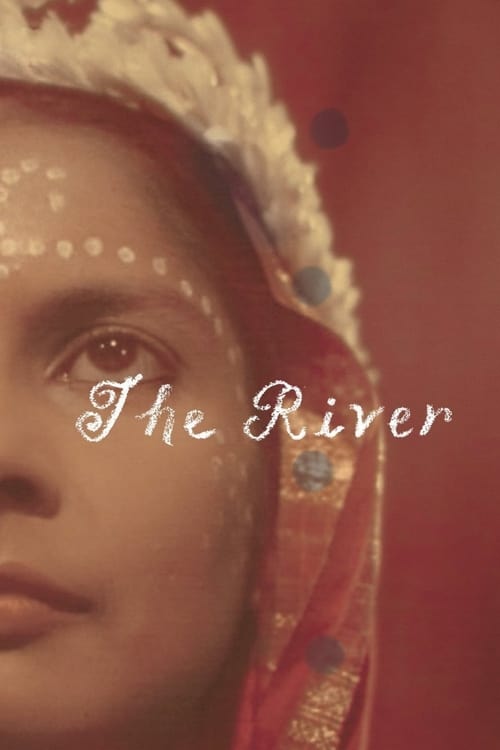
The River
1951 · Jean Renoir
For a slow Sunday when you want beauty and reflection rather than incident — when you'd rather be immersed in a place and a feeling than gripped by a story. Comfort viewing with real emotional depth underneath.
What it's about
An English family lives beside the Ganges in Bengal, where the father runs a jute press and the children roam the riverbank. When Captain John, an American veteran who lost a leg in the war, comes to stay next door, three young women — the dreamy narrator Harriet, the beautiful Valerie, and the half-Indian Melanie — each fall for him in her own way. Around their first loves and growing pains, the river keeps flowing, indifferent and eternal.
The experience
Unhurried and quietly ravishing — it moves at the pace of the river itself, trading plot for texture: festivals, kite flying, afternoon light on water. It's tender about young heartbreak in a way that sneaks up on you, and it leaves you calm and a little wistful.
The craft
Renoir's first color film, shot entirely on location in Bengal, and the Technicolor is astonishing — saturated greens, river light, marketplace color that people still talk about seventy years on. The filmmaking is patient and observational, folding documentary passages of Indian life into the fiction. See it big and let the color do its work.
Why it matters
A landmark of location shooting and color cinematography that marked Renoir's rebirth after Hollywood, and its Indian production famously helped set a young Satyajit-Ray-era generation of filmmakers in motion.
Snapshot
The River is Jean Renoir's first film in color and his first feature after nearly a decade in Hollywood — a lyrical, plotless-seeming meditation on adolescence, death, and renewal, shot entirely on location in Bengal. Adapted from Rumer Godden's semi-autobiographical 1946 novel, it observes an English family living beside the Ganges on the grounds of a jute press, and centers on three young women — the narrator Harriet, the auburn-haired Valerie, and the half-Indian Melanie — as they each fall, in different registers, for Captain John, an American war veteran who has lost a leg. Against their intense, transient longings runs the constant of the river itself, and the film organizes its emotional life around the Hindu cycle of birth, death, and rebirth rather than around conventional plot. Widely regarded as one of the most beautiful of all early color films and a pivotal work of Renoir's late career, it also occupies a singular place in film history for the young Satyajit Ray's proximity to its making.
Industry & production
The film's origin is one of the more improbable in postwar cinema. Its producer, Kenneth McEldowney, was a Beverly Hills florist with no filmmaking background; the standard account, which McEldowney himself propagated, holds that his wife — an MGM publicist — complained about Hollywood's misrepresentations of India, and that he resolved to make an authentic film there. He acquired the rights to Godden's novel and, after other directors fell away, brought in Renoir, who had read and admired the book. Production was mounted independently through McEldowney's Oriental International Films, with distribution in the United States by United Artists.
Renoir traveled to India in 1949 for an extended pre-production and scouting period before shooting in 1950 near Calcutta, on the Hooghly (a distributary of the Ganges). The independent, patron-financed structure gave Renoir something the studio system had denied him during his American years: near-total creative control and the freedom to shoot slowly, on real locations, with a largely non-professional or little-known cast. The film premiered in 1951 and won the International Prize at the Venice Film Festival that year. Precise budget and box-office figures are not something I can state reliably, and the fuller commercial record is thin enough that I'd rather flag the gap than invent numbers.
Technology
The River was photographed in three-strip Technicolor, and its status as Renoir's first color feature is inseparable from its ambitions. Technicolor in 1950 was a cumbersome, light-hungry system built around bulky cameras and demanding laboratory control, normally the province of studio-bound productions. To use it on location in the heat, dust, and humidity of Bengal — rather than in a controlled soundstage — was genuinely difficult, and the achievement of stable, saturated color under those conditions is central to the film's reputation. Post-production color processing was handled by Technicolor's facilities in London. The film's later life has also been shaped by technology: it survives today largely through a photochemical restoration undertaken to recover the fidelity of its Technicolor palette, which had degraded in circulating prints, and it is this restored version through which most modern viewers know it.
Technique
Cinematography
The cinematography, by Claude Renoir — Jean's nephew and a grandson of the painter Auguste Renoir — is the film's most celebrated technical dimension. Rather than exoticizing India, the camera treats color as a substance of everyday life: the reds and ochres of saris and marigolds, the green of the river's banks, the earthen tones of the jute works. The Renoirs use color contemplatively, holding on the textures of ordinary activity — a woman grinding spices, kite-flying, the daily traffic of boats — so that documentary observation and painterly composition become the same gesture. The influence of Auguste Renoir's Impressionism is frequently invoked, and not merely as family lineage: the film's attention to dappled light, foliage, and the warmth of skin and cloth reads as an inheritance made cinematic. The camera tends toward calm, deliberate movement and depth rather than montage-driven intensity, a continuity with the deep-space aesthetics of Renoir's 1930s French work.
Editing
Editing (credited to George Gale) is subordinated to Renoir's preference for duration and observation. Scenes are allowed to breathe; the cutting rarely calls attention to itself, and the film's rhythm derives more from the recurrence of the river and the turning of the seasons than from accelerating dramatic construction. The structure is frankly episodic and framed as recollection — Harriet, remembering her Indian girlhood — so that the editing serves a memory-logic of return and repetition rather than tight cause-and-effect. Set-piece sequences, most famously a stylized dance evoking the god Krishna and Radha, are handled as embedded reveries, marked off from the surrounding naturalism.
Mise-en-scène / staging
Mise-en-scène is where Renoir's authorship is most legible. He stages family life in and around real interiors and gardens, choreographing children, adults, and servants within continuous space, and folds the surrounding Indian world — festivals, work, worship, the river's traffic — into the frame as a living environment rather than a backdrop. The great recurring set is the Diwali festival and the daily ritual life along the water, which Renoir integrates so that the family's private drama is always visibly nested inside a larger, indifferent, continuing order. This nesting — private emotion against communal and natural permanence — is the film's structural principle rendered as staging.
Sound
The soundtrack pointedly refuses a conventional Western orchestral score. Renoir drew on Indian classical and traditional music, performed on indigenous instruments, so that the film's sonic world emerges from its setting rather than being imposed on it. Ambient sound — the river, festival drums, birds, the machinery of the jute press — carries substantial weight. Voice-over narration frames the film as Harriet's adult recollection, lending the images an elegiac, retrospective coloring. The precise credits for musical direction I'd rather not specify from memory than risk misattribution, but the governing choice — authentic Indian music over a composed Hollywood-style score — is well established and central to the film's ethnographic tact.
Performance
Renoir cast largely outside the star system, favoring freshness and presence over polish. Patricia Walters plays Harriet, Adrienne Corri the vivid Valerie, and the Indian dancer and actress Radha plays Melanie, the daughter of the Anglo-Indian Mr. John; Thomas E. Breen — himself a wounded veteran — plays Captain John, the object of the girls' affections. The performances are keyed to a naturalistic, sometimes deliberately unactorly register; Renoir's method extracts feeling from behavior and physical presence rather than from theatrical projection. Radha's dance sequence stands apart as a moment of formal, trained performance embedded in the surrounding naturalism.
Narrative & dramatic mode
The film's dramatic mode is decisively anti-melodramatic. It has the ingredients of a romance — three young women, one desirable outsider — but refuses to resolve them competitively; no one "wins" Captain John, and the love-triangle geometry dissolves into a broader study of first longing and its disappointments. The single sharpest event, the sudden death of Harriet's small brother Bogey from a cobra bite, is not milked for suspense but absorbed into the film's larger rhythm of loss and continuation. Narrative is organized cyclically rather than climactically: the seasons turn, the river flows on, a birth answers a death, and the girls are left changed but not "concluded." This retrospective, memory-framed, seasonal structure — closer to the tempo of a novel of remembered childhood than to classical screen dramaturgy — is the source of both the film's reputation for serenity and, for some early viewers, its apparent lack of plot.
Genre & cycle
Nominally a drama and romance and a coming-of-age story, The River sits athwart conventional genre. It draws on the "remembered childhood" tradition and on the colonial-milieu family story, but it is fundamentally a lyric, contemplative film rather than a genre exercise. It belongs less to any Hollywood cycle than to a lineage of humanist, observational art cinema — and, historically, it stands at the threshold of a new kind of internationally financed, location-shot art film. Its treatment of India by a European filmmaker also places it in the fraught category of the outsider's film about a colonized culture, a framing later critics have examined with more skepticism than the film's admiring early reception did.
Authorship & method
By 1950 Renoir's authorship had passed through three phases: the celebrated French films of the 1930s (La Grande Illusion, La Règle du jeu), the Hollywood exile of the 1940s, and now an independent internationalism. The River is the hinge. Renoir's enduring method — deep space, mobile but unhurried camera, ensemble staging, a humanist refusal to divide characters into heroes and villains, and an interest in the porousness between individual lives and the larger flow of nature and society — is fully present, now inflected by color and by a genuine, if outsider's, curiosity about Indian life. Renoir co-wrote the screenplay with Rumer Godden, adapting her own semi-autobiographical novel; her lived Bengal childhood grounds the film's texture and gives the adaptation unusual authority. His key collaborators define the work: cinematographer Claude Renoir, carrying the Renoir painterly inheritance into Technicolor; Godden as source author and co-writer; editor George Gale; and the ensemble of little-known and non-professional performers. The much-discussed presence of the young Satyajit Ray — then a commercial artist who sought Renoir out, accompanied him on location scouting, and absorbed his working method — belongs to authorship in a broader sense: the film became a school for the filmmakers who watched it being made.
Movement / national cinema
The River resists easy national placement. It is a Renoir film and thus part of the French tradition, yet it was American-financed, English-language, adapted from a British novel, and shot in India with substantial Indian participation and setting. It is most consequential not for the movement it came from but for the one it helped catalyze: it stands at the doorstep of the Bengali and broader Indian art cinema that would emerge mid-decade. The film's on-location realism and its refusal of studio artifice offered a working demonstration, on Indian soil, of a humanist cinema attentive to everyday life.
Era / period
The film arrives at the opening of the 1950s, in the immediate aftermath of the Second World War (Captain John's amputation and displacement are quiet emblems of that war's cost) and, crucially, in the first years after Indian independence in 1947. It depicts a colonial-era world — an English family running a jute press on the river, servants and a settled hierarchy in place — from a vantage just after that world's political dissolution, which lends the whole an elegiac, backward-looking cast even beyond its personal nostalgia. Technologically and industrially it belongs to the moment when color and international independent financing were beginning to open art cinema to new geographies.
Themes
The river is the film's master symbol: the flow of time, the continuity of life through change, the indifference of nature to individual grief, and the Hindu cycle of birth, death, and rebirth. Around it cluster the film's principal themes — the passage from childhood to adulthood and the pain of first love; the coexistence of death (Bogey's) and renewal (a birth) as parts of a single order; the acceptance of loss as the price of continuing life; and the encounter between cultures, as Europeans live inside, and are quietly reshaped by, an Indian world they do not command. Melanie's mixed heritage and the recurring festival life keep the question of belonging and cultural blending in view. Underlying all of it is Renoir's characteristic conviction that reconciliation with the flow of things — "consent," in a sense — is the mature response to a world that will not stop for our sorrows.
Reception, canon & influence
The River was recognized early as a major achievement, taking the International Prize at the 1951 Venice Film Festival and drawing particular admiration for its color and its serene humanism; some contemporaries found it slow or plotless, a reservation that has followed the film but which later criticism largely reread as its virtue. Over time it has settled firmly into the canon as one of Renoir's essential late works and a landmark of early color cinematography.
Its influences run backward to the Impressionist painting of Auguste Renoir and, more directly, to Rumer Godden's autobiographical source novel, whose remembered Bengal childhood supplies the film's substance. Its forward influence is unusually concrete. The young Satyajit Ray's contact with Renoir during the production is repeatedly cited as a spur to his own filmmaking; Ray went on to make Pather Panchali (1955) and found Indian art cinema, and the still photographer Subrata Mitra, associated with the film's milieu, became Ray's cinematographer. Beyond India, the film has been claimed as a touchstone by later directors drawn to its color, its stillness, and its treatment of India — Wes Anderson's The Darjeeling Limited (2007) is often discussed as paying homage — and it has been championed by filmmaker-cinephiles in the restoration era as a work deserving rescue. Modern criticism has also grown more attentive to its position as a European's vision of a recently decolonized India, weighing its evident tenderness and observational care against the limits of an outsider's gaze. That double reading — ravishing humanist masterpiece and colonial-era artifact — is now part of how the film is transmitted.
A Deleuzian reading
The first thing that stays with you isn't a plot point.
The full Deleuzian reading of The River →
Reception
A hit on release — it won the International Prize at Venice in 1951 and ran for months in New York — but its real ascent came later, when Scorsese-era restoration culture recrowned it as one of the most beautiful Technicolor films ever made.
How The River was received, from release to now →
How to watch The River: what to notice on a first viewing
- Notice the reds and greens used for ordinary daily life. Claude Renoir shoots saris, marigolds, and the river's green banks the same contemplative way, so documentary observation and painterly composition become one gesture. Color here is not decoration. It is how the film pays attention to the texture of everyday life.
- Listen for Harriet's adult voice narrating her own girlhood. The film is framed throughout as her recollection, so every image carries the coloring of memory rather than presenting events as they happen. You are watching a grown woman remember, not a story unfolding live, and that distance shapes everything you see.
- Watch how often the family's scenes include the wider Indian world. Festivals, boats, and work along the river are folded into the same frame as the family's private moments, never pushed to background as mere setting. Their small dramas are always visibly nested inside a larger, continuing world that does not pause for them.
- Track how often the film cuts back to the river itself. Boats crossing, the daily traffic of the water, keep interrupting the human story, holding on activity that advances no plot. The river keeps proving that a life continues around any single person's story, whether or not anyone is watching.
The whole guide to watching The River, with the keys for a rewatch →
Influences: the films it descends from and the films it influenced
- Partie de campagne (1936) — Renoir's first sustained transposition of Auguste Renoir's Impressionist riverbank light and the river-as-passing-time motif into cinema — the exact painterly-nature inheritance The River carries into Technicolor.
- La Règle du jeu (1939) — Codifies Renoir's deep-focus ensemble staging and humanist refusal to sort characters into heroes and villains, the authorial method carried whole into The River.
- Toni (1935) — Renoir's early reliance on non-professional performers and real locations for documentary texture, later reused to ground the Bengal household in lived reality.
- Man of Aran (1934) — Observational duration filming a community inside its own daily and ritual rhythms rather than plot — the ethnographic-tempo mode Renoir adopts for the family's nested communal rituals.
- L'Atalante (1934) — Poetic-realist use of the river/barge as a living current carrying love and mortality, treating water itself as narrative flow rather than backdrop.
- Becky Sharp (1935) — First three-strip Technicolor feature, pioneering the deliberate design-driven palette control that The River applies with painterly restraint.
- Black Narcissus (1947) — Jack Cardiff's Technicolor cinematography, modeled on Old Master and Impressionist canvases to render the subcontinent as saturated painterly color — the immediate precedent for Claude Renoir's palette.
- Pather Panchali (1955) — Ray, who scouted locations with Renoir and absorbed his method, transposes the unhurried observation, non-professional casting, and river-as-life motif into indigenous Indian art cinema.
- Aparajito (1956) — Extends The River's episodic, memory-driven coming-of-age logic across an entire growing life rather than a single season.
- Jalsaghar (The Music Room) (1958) — Subrata Mitra's cinematography and long-duration observation of a decaying feudal ritual carry forward Renoir's patient, ceremony-centered staging.
- The World of Apu (1959) — Completes the birth/death/rebirth cyclical structure The River pioneered, resolving the Apu trilogy through the same river-of-life anti-melodramatic rhythm.
- Kanchenjungha (1962) — Ray's first color feature, applying painterly natural color to Indian landscape and unfolding in near-real-time observation as Renoir had modeled.
- Days of Heaven (1978) — Magic-hour painterly natural-light color paired with a child's recollecting voiceover narrating episodic memory over long observational duration — Renoir's remembered-childhood mode in American register.
- The Tree of Life (2011) — Episodic memory-logic editing and a cosmic river/cycle framing of a remembered childhood, extending The River's birth-death-rebirth structure to metaphysical scale.
- The Darjeeling Limited (2007) — Explicit homage staging an outsider's journey through a painterly, ritual-laden India structured around a river crossing, borrowing the film's saturated color and cross-cultural gaze.
- Gate of Hell (1953) — An early non-Hollywood demonstration that color could be quiet and painterly rather than garish, anticipating Gate of Hell's argument against saturated spectacle.
- Charulata (1964) — Ray apprenticed on this Bengal-shot production and absorbed Renoir's fluid, depth-staged camera and humanist mise-en-scène, the grammar of unhurried domestic observation that governs Charulata's interiors.
- Devi (1960) — Ray apprenticed as location scout and Mitra worked as still photographer; Renoir's on-location, available-light approach to Bengal seeded the naturalist lighting philosophy Mitra later systematized.
- The Big City (1963) — Ray, Mitra, and Chandragupta observed Renoir's Bengal shoot firsthand; Renoir's humanist deep-space staging and refusal to judge his characters is the observational grammar Ray carried into his own domestic scenes.
- Ugetsu (1953) — Contemporaneous humanist cinema built on the mobile, unhurried long take and recurring water imagery to frame a cyclical fable of loss and return.
Similar films
- Pather Panchali (1955) — influence & lineage · same viewing thread
- Aparajito (1956) — influence & lineage · same viewing thread
- The World of Apu (1959) — influence & lineage · same viewing thread
- Toni (1935) — influence & lineage
- Charulata (1964) — same viewing thread
- The Music Room (1958) — same viewing thread
- The Big City (1963) — same viewing thread
- The Hero (1966) — same viewing thread
All the films related to The River →
Watch it with: curated runs of related films
- Satyajit Ray's Bengal — A run through Ray's Bengal — the mud-and-monsoon village of the Apu films, the decaying aristocracy of The Music Room and Devi, the hushed Calcutta drawing rooms of Charulata — where ordinary lives turn quietly monumental.