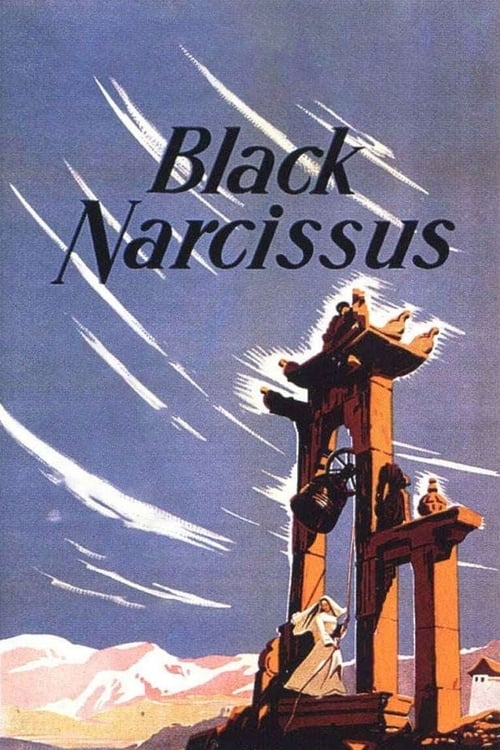
Black Narcissus
1947 · Emeric Pressburger
For a night when you want gorgeous, transporting, slightly dangerous cinema — something sensuous to lose yourself in that turns the screws as it goes. It rewards full attention and a darkened room.
What it's about
A small order of Anglican nuns, led by the young and ambitious Sister Clodagh, is sent to establish a school and hospital in a former palace perched on a windy Himalayan cliff. The altitude, the strangeness of the place, and the presence of the worldly local agent Mr. Dean begin to work on the sisters — loosening old memories, stirring buried desires, and pushing one of them, Sister Ruth, toward obsession.
The experience
Hypnotic and slowly, deliciously unnerving — a film that starts as a stately mission drama and tightens, almost imperceptibly, into psychological thriller territory. The colors alone put you in a heightened, feverish state; by the last act your pulse is up without a single conventional scare.
Performances
Deborah Kerr gives Sister Clodagh a proud composure that keeps cracking to reveal the woman underneath, and Kathleen Byron's Sister Ruth is one of the great unravelings in movies — a few looks from her carry more charge than most films' entire scripts.
The craft
Astonishingly, the Himalayas here are almost entirely studio sets, matte paintings, and English gardens — and the artifice makes it more potent, not less. Jack Cardiff's Technicolor cinematography is a landmark of expressive color, every hue tuned to emotional temperature, and the climax plays out almost like silent cinema, cut to music. One of the most beautiful films ever made, and it demands the biggest screen you can find.
Why it matters
A benchmark for color cinematography that generations of directors and cinematographers still study and cite, and one of the crown jewels of the Powell–Pressburger partnership at the height of British cinema.
Snapshot
A group of Anglican nuns dispatched to a remote Himalayan palace find their spiritual discipline dissolving under the pressure of altitude, heat, memory, and desire. Shot almost entirely on studio sets and English gardens, Black Narcissus is among the most formally daring color films of the studio era: a psychological melodrama disguised as an imperial adventure, and one of the supreme achievements of British cinema. Its cinematography by Jack Cardiff remains a benchmark for the expressive use of color in the medium.
Industry & production
Black Narcissus was produced by The Archers, the independent production company formed in 1943 by Michael Powell and Emeric Pressburger under the banner of J. Arthur Rank's distribution empire. The partnership operated with unusual creative autonomy for the period — their films were credited jointly as "Written, Produced and Directed by Michael Powell and Emeric Pressburger," a collective authorship rare in British industry practice. The note in the prompt attributing sole direction to Pressburger reflects the occasional critical tendency to foreground one partner, but the Archers model was genuinely collaborative: Pressburger shaped the screenplay and structural architecture while Powell directed actors on the floor and drove the visual conception with cinematographer Cardiff. In practice, the two are inseparable on this film.
The property was Rumer Godden's 1939 novel of the same name, a slim, precisely observed book drawing on Godden's own years in India. The Archers acquired the rights and Pressburger wrote the adaptation. Godden, who maintained her own strong opinions about her work throughout her career, expressed reservations about certain aspects of the adaptation — the precise nature of her objections is documented in her biography and correspondence but is perhaps most succinctly summarized as a sense that the film had tilted the novel's careful ambiguity toward something more overtly sensational. The question of how faithfully a source novel should be served was one the Archers rarely prioritized above their own cinematic vision.
The production was mounted during a period of acute postwar austerity in Britain. Foreign location shooting in the Indian Himalayas was financially and logistically prohibitive. The solution — building the entire Himalayan world on the stages at Pinewood Studios, supplemented by location work at Leonardslee Gardens in West Sussex — transformed what could have been a constraint into an aesthetic achievement. The Sussex rhododendrons and terraced gardens doubled as the palace's high-altitude grounds with remarkable plausibility, and the studio-built interiors and matte environments gave Cardiff complete control over light that a genuine location would never have permitted.
Production design was led by Alfred Junge, whose meticulously constructed sets — the crumbling Mopu palace with its wide painted arches, its bell tower perch over a painted void, its rooms haunted by an earlier, more sensuous life — defined the film's peculiar geography of desire and ruin.
Technology
The film was shot in three-strip Technicolor, the dominant color process of the era, which required a bulky camera rig housing three separate film strips simultaneously recording through color filters. Three-strip Technicolor was notoriously demanding: the camera was heavy, the process required high light levels (itself shaping how cinematographers composed and lit), and the Technicolor company assigned its own consultants to productions to ensure the process was used according to their prescribed standards. Cardiff, working on Black Narcissus fresh from A Matter of Life and Death (1946) with the same team, was already one of the few cinematographers who understood that Technicolor's constraints could be subverted — that the process's tendency toward heightened, somewhat operatic color could be pushed further toward subjective and emotional registers rather than merely decorative ones.
The matte paintings executed by W. Percy Day (known professionally as "Poppa" Day) were integral to the film's visual world. Day's work creating the Himalayan vistas — the vertiginous drops visible from the bell tower, the mountain ranges dissolving into painted sky — fused seamlessly with the studio foregrounds. Matte painting in Technicolor required particular skill, since the richer gamut of the three-strip process made tonal and color mismatches harder to conceal. Day's contributions are largely invisible, which is precisely their success.
Technique
Cinematography
Jack Cardiff's work on Black Narcissus is one of the landmark achievements in the history of color cinematography. His declared approach was to study Old Master paintings — in particular Vermeer's handling of light falling through windows onto skin — and to find equivalents in the physical arrangement of arc lamps and reflectors. Cardiff used this approach not merely to produce pictorial beauty but to modulate the psychological temperature of scenes. He lit the film's earlier passages in cooler, more diffuse light, allowing the whiteness of the habits and the pale stone of the palace to anchor the image. As Sister Ruth's obsession deepens, his lighting becomes more saturated and directional, the shadows harsher.
The most celebrated single image in the film is arguably his close-up of Kathleen Byron's face in the film's climactic sequence — Ruth having shed her habit, applied red lipstick, her eyes wild with a grief and rage that Cardiff frames in near-theatrical isolation. The lighting in this shot is stark, almost expressionistic, with deep shadows carving the face into something approaching a mask. Cardiff later described this as among the shots he was most proud of in his career (documented in his 1996 memoir Magic Hour). The color choices — the red against pale skin, the shadows — carry meaning that dialogue could not.
Cardiff also exploited the distorting potential of unusual lenses and close-focus techniques to give the film's more delirious passages a slightly unstable visual quality, reinforcing the sense of perception coming loose from its moorings.
Editing
Reginald Mills edited Black Narcissus, working at a pace that accommodates Powell's characteristic interest in rhythm as an almost musical property of cinema. The editing is not ostentatious; its most important quality is a willingness to hold shots, to allow the compositions Cardiff built to register. Cutting in the Powell-Pressburger films tends toward the measured, trusting that what is placed in frame will accumulate weight over time. The climactic sequence at the bell tower deploys editing more aggressively — shorter cuts, fragmented geography — to stage the confrontation between Sister Clodagh and the knife-wielding Ruth as genuine suspense rather than melodramatic tableau.
Mise-en-scène / staging
Powell and Pressburger were alert to the theatrical and artificial dimension of cinema in ways that distinguished them sharply from British documentary realism. Black Narcissus makes no pretense at naturalism. The sets are too vivid, the colors too coordinated, the light too controlled. This is not negligence but program. The palace's history — established early as a former pleasure house, its walls still decorated with frescoes of dancers, its rooms saturated with erotic memory — is embedded in the mise-en-scène itself. Alfred Junge's production design makes the building an active agent: the murals and painted tiles press upon the nuns from within the architecture, as if the palace itself cannot be converted to the purposes of Christian abstinence.
The staging of Sister Ruth's disintegration follows a precise visual logic: as she abandons her vocation, she moves toward reds and warm darkness; Sister Clodagh's scenes, increasingly inflected by flashbacks to her Irish past (shot in warmer, slightly softer light to mark the subjective register), perform a parallel drama of memory intruding on austere present-tense devotion. Space and color are psychological instruments.
Sound
Brian Easdale composed the score, his second major collaboration with the Archers after the wartime pictures and before The Red Shoes (1948). The music for Black Narcissus is less foregrounded than his later work; Powell and Pressburger use it selectively, allowing the wind and altitude — evoked through spare sound design — to carry much of the atmospheric burden. The bell itself, which punctuates the film from its first introduction, functions as a recurring sonic motif: its tolling marks crisis, calls characters to attention, and in the film's final act becomes inseparable from the sense of catastrophe in progress.
Performance
Deborah Kerr plays Sister Clodagh with contained precision, communicating the effort of self-suppression as a continuous physical project rather than a naturalized state. Her face in the film's flashback passages — warmer, softer, less guarded — establishes the cost of vocation by showing what it displaces. Kathleen Byron's Sister Ruth is the film's most explosive performance, a controlled disintegration that Byron modulates from brittle resentment to something closer to psychosis. Byron reportedly worked closely with Powell on the character's arc and the physical business of the role; her performance in the film's final act remains a touchstone for a certain kind of extreme emotional register in British cinema. David Farrar plays Mr. Dean — the secular, embodied, unhelpfully attractive government agent — with an easy physicality that makes his magnetism comprehensible without rendering him wholly sympathetic.
Narrative & dramatic mode
The film works primarily as psychological melodrama, organized around the gradual revelation of inner states rather than the progression of external plot. The nominal mission — establishing a school and hospital — recedes quickly; what the narrative tracks is the erosion of the nuns' institutional identities under the pressure of place, memory, and desire. The Himalayan setting functions not as documentary location but as a projection screen for the unconscious. Powell and Pressburger treat the palace and its altitude as a force that strips away cultural and spiritual conditioning, returning their characters to something ungoverned.
The film's structure distributes its psychological material across two main characters: Sister Clodagh's story is one of memory and the past reasserting itself; Sister Ruth's is one of projection, obsession, and the complete breach of the boundary between interior and exterior life. The two trajectories converge at the bell tower in a climax that has more in common with Gothic horror than with literary realism.
Genre & cycle
Black Narcissus participates in several overlapping generic formations. It is a melodrama, and specifically a "women's film" in the sense that its drama is organized around female interiority and desire rather than male action. It is also colonial Gothic — a subgenre in which the encounter between Western subjects and non-European spaces produces psychological disorder or revelation. The palace's history as a pleasure house invokes the exoticist tradition of "Eastern" settings as spaces of liberated or transgressive desire that European colonial fiction and cinema had drawn upon for decades; Black Narcissus is unusual in the degree to which it turns this formula critically, or at least ambiguously, upon its own protagonists rather than projecting disorder safely onto the other.
The film does not sit comfortably as a simple imperial narrative. The Himalayan community and the General's young heir are observed with less contempt than the conventions of the time would have permitted. The destabilization the film diagrams happens inside the Western subjects, not as something done to them by the East.
Authorship & method
The Archers at their peak — roughly 1944 to 1949 — represent one of the most sustained authorial projects in studio-era cinema. Black Narcissus falls squarely at the center of this period, alongside A Canterbury Tale (1944), I Know Where I'm Going! (1945), A Matter of Life and Death (1946), and The Red Shoes (1948). The collaborators were largely stable across these productions: Cardiff as cinematographer, Junge as designer, Easdale as composer, Mills as editor. This continuity produced a house style identifiable across films — a willing embrace of artifice, a musical approach to pacing, an interest in the irrational and the visionary, and an unusual willingness to center female consciousness.
Powell's role on the floor was to orchestrate visual and performative elements; Pressburger's was to construct the narrative logic and dialogue. Cardiff has written of Powell's instinctive feel for what color and light could do at an emotional level — not as a technician but as a director who pushed his cinematographer toward effects that were outside established practice. The result is a collaboration in which it is impossible and probably unhelpful to separate the contributions: the film's achievement is precisely the fusion.
Movement / national cinema
Black Narcissus belongs to a brief postwar flowering of prestige British cinema — a moment, roughly 1945–1950, when several major productions combined European art-cinema ambition with the resources of a functioning studio system. This cycle included the Archers' own films, David Lean's literary adaptations, Carol Reed's collaborations with writers like Graham Greene, and the Ealing comedies. These films were made self-consciously for international audiences and carried something of a national-prestige function in the immediate postwar period.
The Archers occupy an eccentric position within British cinema at large: their romanticism, their interest in the supernatural, their visual extravagance, and their European inflections (Pressburger was Hungarian-born; the Archers' sensibility owes as much to Central European expressionism and French cinema as to any British tradition) placed them at some distance from both the documentary sobriety associated with the British realist tradition and the genteel adaptation model of much mainstream British production.
Era / period
The mid-to-late 1940s were a transitional moment in global cinema: the wartime period of austerity and collective purpose giving way to postwar anxiety, the Hollywood studio system at its commercial apex but beginning to face the pressures that would transform it in the following decade, and Technicolor color films increasing in prestige and number without yet having displaced black-and-white as the default register of seriousness. Black Narcissus arrives near the end of the period when three-strip Technicolor carried a particular charge of luxury and expressiveness — before the introduction of Eastmancolor and cheaper monopack processes in the early 1950s democratized color and in doing so somewhat flattened its connotations.
Themes
The film's central thematic territory is repression and its failures: the question of what happens to desire and memory when they are disciplined by vocation, and what occurs when that discipline loosens. The Himalayan palace functions as a literalized version of the unconscious — a space where the suppressed past resurfaces and where institutional identity cannot hold. Sister Clodagh's Irish memories of a man she once loved, and Sister Ruth's fixation on Mr. Dean, are both versions of the same irruption of the biographical self through the shell of the institutional self.
Black Narcissus is also, inescapably, a film about the limits of colonial mission. The nuns arrive to improve, educate, and heal; they leave (those who survive) having failed at every institutional objective and having been unsettled at the level of identity. The film does not moralize this outcome — it observes it. The palace, with its layered history of pleasure, remains after the nuns depart exactly as it was. Place outlasts project.
Additional thematic threads include: the male body as destabilizing presence in an all-female community; the relationship between memory and identity; altitude and atmosphere as psychological forces; and the Gothic motif of a building with memory, a house that shapes its inhabitants.
Reception, canon & influence
Critical reception: Black Narcissus was a critical and commercial success on its British release in 1947 and performed well in the American market. The film won two Academy Awards at the 20th ceremony (1948): Best Cinematography (Color) for Jack Cardiff, and Best Art Direction-Interior Decoration (Color) for Alfred Junge and Paul Sheriff. These recognitions reflected a Hollywood establishment that understood the film's technical achievement even if its psychological boldness was somewhat unsettling to period taste. Some contemporary reviewers expressed discomfort with the frank treatment of sexuality in a religious context — the film's encounters with censors varied by territory. In Britain, the subject matter was considered provocative, though the film escaped serious censorship interference.
Influences on the film (backward): The most direct source is Godden's novel. Visually, Cardiff has cited the Old Masters — Vermeer especially — as formative influences on his lighting philosophy. German Expressionism, with its interest in light and shadow as psychological instruments, is legible in the film's more extreme passages, mediated through the kind of studio-trained craftsmanship Cardiff and Powell shared. Earlier three-strip Technicolor productions, including the American prestige films of the late 1930s and early 1940s, established the baseline against which the Archers' more idiosyncratic use of color can be measured. The tradition of the "Eastern" or "orientalist" British film provided a generic framework the film simultaneously deploys and quietly critiques.
Legacy and forward influence: Black Narcissus has had a long, growing afterlife in film culture. Its most direct continuation is within the Archers' own subsequent work — The Red Shoes (1948) pushes the same expressive Technicolor logic further into pure abstraction, with Cardiff again as cinematographer. Martin Scorsese has cited the Archers' use of color as a formative influence on his own approach to cinematography, and Powell's work was a direct touchstone for Scorsese's personal campaign to have Powell's films rediscovered and appreciated by American audiences. The film's influence on subsequent directors who use color as a psychological and dramatic instrument — Pedro Almodóvar's saturated domestic spaces, Wong Kar-wai's color-coded emotional geography, Alfonso Cuarón's deployment of production design as interiority — is real, if not always directly acknowledged.
The film was championed through canonical restoration and preservation efforts, most notably by Criterion, whose release and accompanying materials helped consolidate its status as a canonical work. Its current academic reputation rests on several pillars: its cinematographic achievement (Cardiff's work is now routinely studied in cinematography programs), its engagement with colonial representation (the film is regularly discussed in postcolonial film studies contexts as a complex rather than straightforwardly imperial text), and its interest in female psychology and repressed desire (which places it in ongoing feminist film scholarship on melodrama and the "women's film"). A BBC/Sky limited series adaptation was produced in 2024, directed by Charlotte Bruus Christensen, indicating the material's continuing cultural currency.
The bell tower sequence — Sister Ruth, knife in hand, in her red dress against the void of the painted mountain abyss, while Sister Clodagh clings to the rope — is one of the most reproduced images in discussions of British cinema. As pure cinema, as the meeting of color, composition, performance, and vertigo, it has few equivalents.
A Deleuzian reading
Start with the lipstick.
The full Deleuzian reading of Black Narcissus →
Reception
Acclaimed on release — it won Oscars for Jack Cardiff's cinematography and its art direction — but US censors (under Legion of Decency pressure) trimmed it for its 'erotic' treatment of nuns; today it's canonized as perhaps the peak of Technicolor filmmaking, its reputation lifted by the Scorsese-led Powell & Pressburger revival.
How Black Narcissus was received, from release to now →
Influences: the films it descends from and the films it influenced
- The Cabinet of Dr. Caligari (1920) — Cardiff's expressionist extreme close-ups of Sister Ruth's disintegrating sanity — lit to eliminate naturalism, framed to distort — inherit the Expressionist technique of using artificial mise-en-scène to externalize mental collapse rather than depict it realistically.
- Rebecca (1940) — George Barnes's atmospheric chiaroscuro in elaborately dressed, confining interiors establishes the Gothic-institutional melodrama template — oppressive architecture as female psychological prison — that Black Narcissus inherits and translates into color expressionism.
- Gone with the Wind (1939) — As the flagship three-strip Technicolor prestige production, it codified the color-harmony conventions (Natalie Kalmus's supervisory system) that Cardiff deliberately violated to achieve psychological expressionism rather than decorative naturalism.
- Leave Her to Heaven (1945) — Leon Shamroy's Technicolor cinematography — which won the Academy Award Cardiff later claimed — established the template of using saturated color to dramatize female possessive obsession; Cardiff extends Shamroy's color-as-psyche logic into explicitly Gothic territory.
- Henry V (1944) — British prestige Technicolor that openly licensed theatrical studio artifice — painted backdrops, unconcealed construction — as aesthetic declaration; Black Narcissus's fully built Himalayan exteriors at Pinewood inherit this permission to make the artificial the site of psychological truth.
- The Scarlet Empress (1934) — Cardiff's wholly studio-built, anti-realist hothouse — painted backings and emotionally keyed light standing in for a real place — is the postwar heir to Sternberg's décor-as-feeling.
- The Life and Death of Colonel Blimp (1943) — Alfred Junge's wholly studio-built world plus Jack Cardiff's expressive Technicolor push Blimp's color-as-psychology further, with violence and desire withheld and displaced rather than shown.
- The Thief of Bagdad (1940) — Day's glass shots and Junge's Himalaya constructed at Pinewood turn the Bagdad artifice inward: Cardiff's Technicolor palette shifts from spectacle to psychological state, color and matte painting doing the work dialogue is denied.
- The Red Shoes (1948) — Cardiff immediately extends Black Narcissus's expressive Technicolor logic into the ballet sequence, pushing color to pure abstraction; the performance-disintegration arc (Moira Shearer's compulsive, fatal vocation) mirrors Sister Ruth's, and the same vertical death-fall climax returns.
- All That Heaven Allows (1955) — Russell Metty's Technicolor and Sirk's compositional strategy — saturated color, reflective surfaces, windows as psychological frames — directly extends the Powell-Pressburger method of using domestic production design and color as social-psychological notation in women's melodrama.
- Vertigo (1958) — Robert Burks deploys VistaVision color (the green neon wash, Kim Novak's gray-to-emerald costuming palette) as obsessive psychological instrument; the bell tower vertigo — visual disorientation as psychological dissolution — structurally mirrors Sister Clodagh's climactic rope sequence.
- Picnic at Hanging Rock (1975) — Russell Boyd's soft, over-exposed, diffused cinematography renders colonial institutional landscape as a force of psychological dissolution for repressed female desire, applying Black Narcissus's spatial logic: school-as-cloister and void landscape as destabilizing abyss.
- Suspiria (1977) — Luciano Tovoli shot on genuine three-strip Technicolor — one of the format's last uses — specifically to emulate Black Narcissus's expressionist saturation; female institutional Gothic space becomes psychological horror through the same principle of color-as-affect rather than color-as-description.
- In the Mood for Love (2000) — Christopher Doyle and Mark Lee Ping-bin's cinematography — narrow corridors, deep color saturation, shallow focus — makes production design (wallpaper, curtains, cramped staircases) the primary register of repressed desire and memory, extending Cardiff's technique of color-coded space as psychological interiority.
- Portrait of a Lady on Fire (2019) — Claire Mathon's cinematography explicitly applies Old Master lighting (Vermeer, Georges de La Tour) — the precise aesthetic sources Cardiff cited for his own practice — to female interiority; the arc of composed performance giving way to controlled disintegration mirrors Kathleen Byron's Sister Ruth beat for beat.
- The Testament of Ann Lee (2025) — Chiaroscuro of religious enclosure and sublimated ecstasy, staging an austere female religious community pushed by repression toward a visionary breaking point.
- The African Queen (1952) — Jack Cardiff developed his core Technicolor methodology here — saturated color fields against which faces register intimately, simulated directional natural light, and two-shot compositions in confined spaces — techniques he carried directly into The African Queen four years later.
- Dreams (1990) — Achieves a saturated Technicolor pictorial palette entirely on constructed studio sets backed by painted matte landscapes, the studio-as-painting approach Kurosawa adopts for 'The Peach Orchard' and 'Mount Fuji in Red.'
- Senso (1954) — Jack Cardiff's painterly Technicolor mise-en-scène using color itself as the carrier of erotic hysteria — color-as-emotion rather than verisimilitude.
- Moulin Rouge (1952) — Jack Cardiff's studio-bound Technicolor treated light and saturation as emotional instruments over matte-painting compositions — the expressive-color method Morris extends into desaturation.
- A Canterbury Tale (1944) — The immediately preceding Archers production developed Cardiff's and Alfred Junge's shared vocabulary of landscape-as-psychological-pressure and production design as the primary seat of meaning, within the same authorial collaboration that would produce Black Narcissus.
- I Know Where I'm Going! (1945) — The Archers' preceding exploration of a woman's desire, vocation, and landscape-induced crisis — with Junge's design philosophy and the same production partnership — develops the thematic-formal premises Black Narcissus inherits and pushes to melodramatic extremity.
- A Matter of Life and Death (1946) — Cardiff's first three-strip Technicolor feature with Powell-Pressburger uses color and its withdrawal as metaphysical registers — life versus death — establishing the expressive color grammar the team then refined into Black Narcissus's psychological color system.
- Walkabout (1971) — British forebear of erotically-charged, color-saturated landscape filmmaking where environment and repressed sexuality fuse through expressive cinematography rather than plot.
- Caravaggio (1986) — Its frankly artificial, studio-built painterliness is the British art-cinema lineage of anti-naturalist design Jarman extends against location realism.
- Great Expectations (1946) — Alfred Junge's forced-perspective sets and glass shots, lit by Cardiff with hard key against deep shadow, argue the identical Rank-era proposition — that a wholly fabricated interior world beats location, with in-frame scale carrying the drama.
Similar films
- Leave Her to Heaven (1945) — influence & lineage
- The Red Shoes (1948) — influence & lineage
- Suspiria (1977) — influence & lineage
- Picnic at Hanging Rock (1975) — influence & lineage
- Cries and Whispers (1972) — shared sensibility
- Moulin Rouge (1952) — shared sensibility
- Nosferatu (2024) — shared sensibility
- The English Patient (1996) — shared sensibility
All the films related to Black Narcissus →