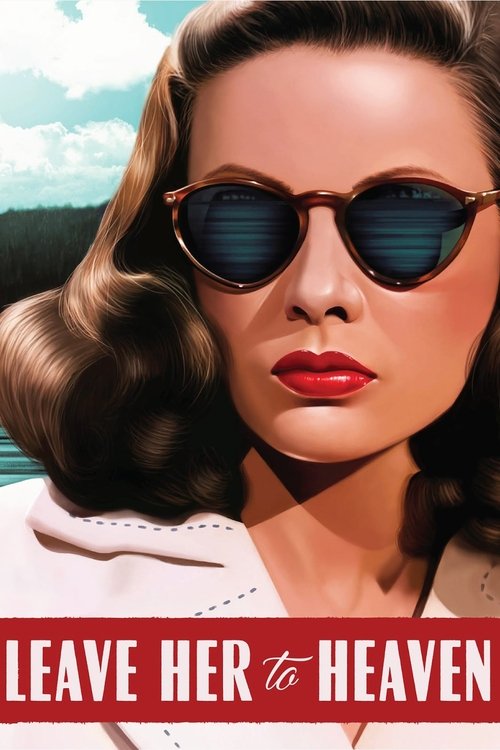
Leave Her to Heaven
1945 · John M. Stahl
When you want elegance with venom — a ravishing old-Hollywood picture that doubles as a portrait of obsession. Perfect for a night when you want to be seduced and disturbed at the same time.
What it's about
A novelist meets a beautiful, magnetic socialite on a train, and within days she has decided he belongs to her — entirely. After they marry, her love reveals itself as something closer to possession: she cannot tolerate sharing him with his family, his work, or anyone else, and her jealousy begins to turn dangerous.
The experience
Unnerving in a way that sneaks up on you — everything looks like a lush 1940s romance, sun, lakes and gorgeous color, while something cold moves underneath. It's a slow-tightening grip rather than a shock machine, and certain quiet scenes are among the most chilling in classic Hollywood.
Performances
Gene Tierney gives one of the great performances of the era: serene, poised, almost affectless, which makes her character's possessiveness genuinely frightening. She earned an Academy Award nomination for it.
The craft
This is famously a film noir shot in blazing three-strip Technicolor — Leon Shamroy's Oscar-winning cinematography turns lakes, deserts and drawing rooms into a paradise with a poisoned core. The beauty isn't decoration; the film weaponizes it, letting horror play out in broad daylight and postcard scenery.
Why it matters
A huge hit in its day and now a canonical anomaly — proof that noir is a mood, not a lighting scheme — it has become a touchstone for filmmakers drawn to beautiful surfaces hiding monstrous feeling.
Snapshot
Leave Her to Heaven is the great anomaly of 1940s American cinema: a film noir shot in luminous three-strip Technicolor, a woman's picture whose heroine is a murderer, and a melodrama whose emotional temperature is set by the absence of feeling rather than its excess. Adapted from Ben Ames Williams's best-selling 1944 novel and produced by Twentieth Century-Fox, it centers on Ellen Berent (Gene Tierney), a beautiful, possessive socialite who marries the novelist Richard Harland (Cornel Wilde) and then, unable to tolerate any rival for his attention, contrives to eliminate everyone who shares it — his disabled younger brother, their unborn child, and finally, from beyond the grave, her own adoptive sister. Directed by John M. Stahl, a veteran of the sound-era "weepie," and photographed by Leon Shamroy (who won an Academy Award for the work), the film fuses the plush surfaces of the prestige melodrama with the moral vertigo of noir. It was among Fox's most commercially successful releases of the decade and earned Tierney her only Oscar nomination. Its reputation has grown steadily; it is now widely regarded as a landmark of color noir and one of the most disquieting studies of pathological love in the Hollywood canon.
Industry & production
The film was a top-tier Fox production of the mid-1940s, mounted by studio head Darryl F. Zanuck's operation as a prestige adaptation of a proven literary property. Ben Ames Williams's novel had been a major popular success, and Fox's decision to shoot it in Technicolor signaled ambition: color was expensive and generally reserved for musicals, historical spectacles, and adventure pictures, not psychological dramas. Producing the film in color for a story of murder and obsession was itself a bet — one that paid off both commercially and, in the trade of prestige, at the Academy.
The screenplay was written by Jo Swerling, an experienced studio writer, who compressed Williams's sprawling narrative and preserved its flashback frame, in which Harland's story is recounted to a listener during his return from prison. Casting was central to the film's design. Gene Tierney, then one of Fox's most valuable stars, was cast against the grain of her established image as a sympathetic beauty; the role of Ellen required her to remain outwardly serene while committing acts of escalating cruelty. Cornel Wilde played the passive, encircled husband; Jeanne Crain, another rising Fox star, played the wholesome cousin Ruth; and Vincent Price took the role of Ellen's spurned former fiancé, the district attorney Russell Quinton, whose courtroom prosecution supplies the film's final act. Darryl Hickman played Danny, the crippled younger brother whose drowning is the film's most notorious sequence.
Regarding budget and grosses, the record repeated in most histories is that the film was one of Fox's biggest earners of the 1940s; precise figures vary across sources and I will not assign a number to it here. What is firmly established is its awards profile: four Academy Award nominations — Best Actress for Tierney, Best Color Cinematography, Best Color Art Direction, and Best Sound Recording — with a single win for Shamroy's cinematography.
Technology
The defining technological fact of Leave Her to Heaven is its use of the three-strip Technicolor process, the dye-transfer system that from the mid-1930s through the early 1950s produced the richest color images Hollywood could make. The Technicolor camera exposed three separate negatives through a beam-splitter, requiring intense lighting, a bulky camera blimp, and the on-set supervision of the Technicolor company's color consultants (the department long overseen by Natalie Kalmus, whose name appears on the film's credits per standard studio practice). The process was demanding and photochemically conservative, tending toward bright, saturated, evenly lit images — which is precisely why the film's application of it to a noir subject is so striking. Rather than fighting the medium's brilliance, Shamroy and Stahl exploited it, using the very lushness of Technicolor to make health, wealth, and sunlight feel oppressive. The film thus stands as a key case study in how a technology developed for spectacle could be turned toward psychological menace.
Technique
Cinematography
Leon Shamroy's Oscar-winning cinematography is the film's signal achievement and the reason it recurs in every discussion of "color noir." Where classic monochrome noir relies on shadow, Shamroy generates dread out of light: wide, deep exteriors under hard sun; interiors of glossy, upholstered comfort; and faces rendered with a cool, poreless perfection. The palette itself carries meaning — Ellen's world is one of expensive greens, blues, and burnished golds — and the film's most famous image weaponizes clarity rather than darkness. In the lake sequence, Ellen sits in a rowboat wearing sunglasses, her face a beautiful blank behind the dark lenses, and watches without moving as Danny, unable to swim back, tires and drowns in bright open water. The horror is that nothing is hidden; the crime unfolds in full daylight, in full color, in total visual legibility. Shamroy also handles the location material — mountain lakes, rocky shorelines, the New Mexico ranch — with a landscape painter's breadth, making the natural world both gorgeous and indifferent.
Editing
James B. Clark's editing serves the film's flashback architecture and its long-take confrontations. The narrative is framed as retrospect, and the cutting manages the movement between the courtroom present and the recounted past without disorienting the viewer. In the set pieces, the editing is notably patient: the drowning is built through a controlled alternation between Danny's struggle and Ellen's stillness, letting duration do the work of horror — we are made to wait, as she waits. Elsewhere the film favors sustained shots that hold on Tierney's composed face, trusting the audience to read the calculation behind it, and reserves sharper cutting for moments of overt crisis such as the staircase fall.
Mise-en-scène / staging
The film's art direction (credited to Lyle Wheeler and Maurice Ransford, with set decoration by Thomas Little) constructs a world of enveloping affluence: the desert ranch, the Maine lodge "Back of the Moon," the coastal house. These are spaces of leisure and privilege, and the staging repeatedly places Ellen as their controlling center — she arranges people as she arranges rooms. Stahl blocks the domestic scenes so that Ellen is forever managing proximity, drawing Richard toward her and pushing others to the margins of the frame. The famous scene in which Ellen deliberately throws herself down a staircase to induce a miscarriage is staged with cold economy, the grand interior turned instrument. Costume and color coordinate with character: Ellen's poised elegance is part of the trap, the surface that makes her lethality unreadable to those around her.
Sound
Alfred Newman, Fox's music director and one of the most important composers of the studio era, supplied the score, which underlines the film's romantic surface while allowing menace to seep through. The film was nominated for Best Sound Recording, a recognition of the technical quality of its sound work. Newman's music tends to swell in the register of the woman's picture — lush, yearning — which produces a productive dissonance against what we are watching, so that the romantic idiom itself becomes suspect.
Performance
Gene Tierney's Ellen is one of the most controlled performances in American film of the 1940s and the engine of the whole picture. The role's difficulty is that Ellen must never signal her own villainy from within; Tierney plays possessiveness as devotion, cruelty as love, and lets the audience — not the other characters — perceive the pathology. Her stillness in the boat, her calm after the staircase, her measured self-poisoning at the climax: these depend on withholding rather than display, and the performance's refusal of the expected "mad scene" is what makes it modern. Cornel Wilde plays Richard as a man slow to grasp his own encirclement, and Jeanne Crain provides the warmth Ellen lacks. Vincent Price, as the vindictive prosecutor, brings a mordant edge to the courtroom finale, and Darryl Hickman's Danny earns the sympathy the drowning betrays.
Narrative & dramatic mode
The film operates in a flashback confessional mode: the story of Ellen is told after the fact, framed by Richard's return, so that we watch a marriage we already know has ended in catastrophe. Its dramatic engine is dramatic irony — the audience reads Ellen's actions long before her victims do — and its mode is the melodrama of the "woman's film" turned inside out. Where that genre typically centers a suffering, sympathetic heroine, here the heroine is the source of suffering. The structure escalates through a series of eliminations (brother, child, self), each more premeditated than the last, culminating in Ellen's masterstroke: a suicide staged to look like murder, designed to send her sister to the gallows. The final act shifts into the courtroom, where the melodrama resolves as legal thriller.
Genre & cycle
Leave Her to Heaven sits at the intersection of several cycles and belongs fully to none, which is the source of its fascination. It is a melodrama in its milieu and emotional grammar, a romance in its framing, and a thriller in its plotting — but its deepest affinity is with film noir. It shares noir's fatalism, its flashback confession, its criminality lurking beneath ordinary surfaces, and above all its figure of the deadly woman. Ellen is a variant of the femme fatale, but a domestic rather than a metropolitan one: her arena is marriage, not the underworld. The film's radical move is to relocate noir's iconography from urban shadow to sunlit affluence and to render it in Technicolor, making it a foundational reference point whenever critics argue that noir is a matter of mood and morality rather than lighting. It also stands within the mid-1940s cycle of psychological "obsession" pictures that probed pathology within the home.
Authorship & method
John M. Stahl is the film's crucial and somewhat under-recognized author. In the 1930s Stahl had been a leading director of the sound-era woman's picture, making the original versions of Imitation of Life (1934) and Magnificent Obsession (1935) — melodramas later famously remade by Douglas Sirk. Stahl's directorial signature is restraint: where Sirk would use color and framing expressionistically, Stahl favors a cool, measured classicism, and that reticence is exactly what Leave Her to Heaven needs. By refusing to overheat the material, Stahl lets the horror emerge from ordinary surfaces and lets Tierney's composure stand unchallenged by directorial editorializing. He died in 1950, and the film is often regarded as the summit of his late career.
His key collaborators define the achievement as much as he does: cinematographer Leon Shamroy, whose color work won the film's Oscar and remains its most cited feature; composer Alfred Newman, whose romantic score supplies the ironic surface; editor James B. Clark, who manages the flashback structure; screenwriter Jo Swerling, who shaped Williams's novel into taut dramatic form; and art directors Lyle Wheeler and Maurice Ransford, who built the world of poisoned comfort. The title itself comes from Hamlet — the Ghost's injunction concerning Gertrude, "Leave her to heaven, / And to those thorns that in her bosom lodge" — framing Ellen as a woman to be left to divine and internal judgment.
Movement / national cinema
The film is a product of classical Hollywood at its industrial and aesthetic peak — the mature studio system of the mid-1940s, with its integrated production, star apparatus, and technical departments. It does not belong to a self-conscious movement in the European sense, but it participates in the loosely defined body of work later grouped as American film noir, and it is central to the retrospective critical project of expanding that category beyond black-and-white. As American national cinema, it exemplifies Hollywood's capacity to smuggle genuinely dark and transgressive material inside the reassuring packaging of the prestige romance.
Era / period
Released in 1945, the film belongs to the closing months of the Second World War and the immediate transition into the postwar period. It reflects, obliquely, the era's anxieties about domesticity, gender, and the home front: its drama is set entirely within the private sphere of marriage, wealth, and family, and its threat comes not from outside but from within the ideal home. The postwar reconsolidation of the family and of women's roles gives the film's portrait of a woman who destroys her household from the inside a particular cultural charge, though the film approaches this through psychology rather than overt social comment.
Themes
The film's governing theme is love as possession — the idea that devotion, carried to its extreme, becomes annihilation. Ellen does not hate the people she kills; she loves Richard so totally that she cannot share him, and eliminates every claim on his attention. From this flow the film's other concerns: jealousy as a consuming pathology; the beautiful surface as a concealment of monstrosity; and the perversion of the domestic ideal, in which marriage, motherhood, and family are turned from havens into weapons. The staircase miscarriage makes maternity itself an instrument of control, and the climactic self-poisoning makes even suicide an act of aggression. Underlying all of it is a meditation on judgment — signaled by the Shakespearean title — on who may be left "to heaven" and who must answer to earthly law.
Reception, canon & influence
On release the film was a substantial popular success and a critical talking point, admired especially for its cinematography and for Tierney's performance, which brought her the only Academy Award nomination of her career. Its formal recognition — four nominations and Shamroy's win — established its prestige credentials at the time.
Its critical standing has risen markedly in the decades since. As the study of film noir matured, Leave Her to Heaven became a privileged example in the argument that noir is defined by tone, fatalism, and the deadly woman rather than by monochrome photography, and it is now routinely cited as the preeminent "color noir." Filmmakers and critics — Martin Scorsese prominent among its admirers — have championed it, and its restoration and reissue have broadened its audience. It entered the United States National Film Registry in recognition of its cultural and aesthetic significance.
Looking backward, the film draws on the tradition of the 1930s and 1940s woman's picture that Stahl himself helped build, on the gothic-domestic thrillers of the early 1940s in which a wife or husband is menaced within the home, and on the emerging noir figure of the fatal woman; its literary source is Williams's novel, and its title reaches back to Shakespeare. Looking forward, its influence runs through the long line of thrillers about beautiful, obsessive, and destructive partners — the "erotic obsession" and domestic-thriller cycles that recur across later decades. The image of Ellen watching impassively behind sunglasses as a child drowns has become an iconic emblem of composed evil, and the film's central proposition — that the most dangerous violence can wear the face of perfect love and the colors of perfect health — has proved remarkably durable. Where the historical record on specific figures (grosses, budget) is thin or inconsistent, I have refrained from citing numbers; the film's aesthetic and canonical significance, by contrast, is exceptionally well documented.
Reception
A monster hit in 1945 — but critics largely wrote it off as glossy soap-opera melodrama. Decades later it's been fully canonized as the great 'Technicolor noir,' championed by Martin Scorsese and enshrined in the Criterion Collection in 2020.
How Leave Her to Heaven was received, from release to now →
Influences: the films it descends from and the films it influenced
- All That Heaven Allows (1955) — Turns Technicolor domestic melodrama into overt chromatic critique of affluent surfaces, developing the 'colors of perfect health concealing sickness' logic Shamroy pioneered.
- Marnie (1964) — Deploys Technicolor saturation as a diagnostic instrument for female pathology rather than spectacle — Gene Tierney's character color-coded through the lush palette as dangerously aberrant — establishing the grammar of color-as-psychology that Marnie's red-tide filtration directly extends.
- Black Narcissus (1947) — Leon Shamroy's Technicolor cinematography — which won the Academy Award Cardiff later claimed — established the template of using saturated color to dramatize female possessive obsession; Cardiff extends Shamroy's color-as-psyche logic into explicitly Gothic territory.
- Far from Heaven (2002) — A precursor three-strip Technicolor woman's picture whose lacquered, deep-focus domestic interiors and color-as-pathology model the heightened, immaculate surface Far from Heaven pastiches.
- Imitation of Life (1934) — Stahl's own template for the woman's picture built on cool, unforced staging, the same directorial reticence that lets Ellen's monstrousness surface through placid domestic surfaces rather than expressionist emphasis.
- Magnificent Obsession (1935) — Stahl establishes his method of playing lush melodramatic material in a measured classical register, refusing to editorialize — the restraint later remade hot by Sirk but here kept cold to frame Tierney's composure.
- Becky Sharp (1935) — The first three-strip Technicolor feature to use hue as dramaturgy rather than spectacle, pioneering the emotional color scoring that Shamroy extends into poisoned pastorals and clinical daylight.
- Rebecca (1940) — Codifies the gothic-domestic thriller in which a marriage becomes a haunted house and a beautiful woman's will menaces from within the home — the architecture of dread Stahl transplants into open-air affluence.
- Suspicion (1941) — Locates lethal threat inside the ordinary intimacy of a spouse, the premise that violence wears the face of love that Leave Her to Heaven literalizes and inverts.
- Blood and Sand (1941) — Painterly Technicolor keyed to canvas-inspired palettes, treating color as psychological temperature — the precedent for Shamroy's saturated, health-flushed surfaces masking rot.
- The Black Swan (1942) — Leon Shamroy's Oscar-winning Technicolor cinematography here develops the deep, glossy chromatic control he brings to Leave Her to Heaven's landscapes and interiors.
- Gaslight (1944) — The domestic psychological thriller of controlled cruelty staged within opulent household mise-en-scène, sibling to the 'poisoned comfort' art direction of Wheeler and Ransford.
- Double Indemnity (1944) — Contemporary sibling in noir's flashback-confession architecture and the fatal-woman archetype, proving noir is defined by fatalism and the deadly woman — the argument Leave Her to Heaven wins in color.
- Mildred Pierce (1945) — Sibling fusion of the woman's picture with noir structure and flashback testimony, the same 1945 collision of melodrama's emotional register with noir's moral doom.
- Niagara (1953) — Directly extends the 'color noir' proposition — Technicolor as the medium for a deadly wife's scheme — using saturated location beauty as ironic counterpoint to murder exactly as Stahl does.
- Magnificent Obsession (1954) — Sirk's remake of Stahl's melodrama inherits the material but reverses the method into expressionist color and framing, the descendant that defines Stahl retroactively by contrast.
Similar films
- Double Indemnity (1944) — influence & lineage
- Mildred Pierce (1945) — influence & lineage
- All That Heaven Allows (1955) — influence & lineage
- Laura (1944) — shared sensibility
- Marnie (1964) — shared sensibility
- The Woman in the Window (1944) — shared sensibility
- The Postman Always Rings Twice (1946) — shared sensibility
- Far from Heaven (2002) — shared sensibility