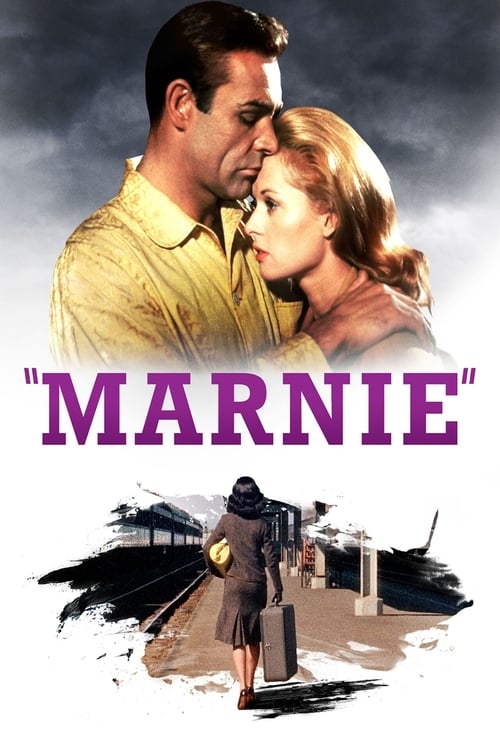
Marnie
1964 · Alfred Hitchcock
For when you want a dark, thorny classic to chew on — a film to watch closely and argue about, not comfort viewing. Reach for it when you're in the mood for old-Hollywood glamour with something genuinely disturbing underneath.
What it's about
Marnie is a poised, beautiful thief who takes a job, robs the safe, and vanishes into a new identity — until a wealthy new employer, Mark Rutland, recognizes her and, instead of turning her in, blackmails her into marriage. He's convinced he can dig out the buried trauma driving her compulsions; she's determined to keep the past sealed, and their marriage becomes a battle over who controls her mind.
The experience
Unsettling and deliberately strange — part romance, part interrogation, with sudden flares of color and panic that signal something buried trying to surface. It's slower and pricklier than a standard thriller, and it leaves you queasy about the 'cure' as much as the crime.
Performances
Tippi Hedren carries the film with a brittle, wounded intensity as a woman performing normalcy over constant fear, while Sean Connery uses his charm to genuinely discomfiting ends — a leading man whose rescue looks a lot like capture.
The craft
Hitchcock stages Marnie's compulsions with bold, almost expressionist devices — washes of red, dreamlike backdrops, a lush Bernard Herrmann-style romantic score set against very unromantic material. The artificiality is the point: the film looks like a glossy studio romance and behaves like a case study.
Why it matters
Dismissed by many on release, it has been steadily rehabilitated into one of Hitchcock's most debated late works — a film critics return to when arguing about what his cinema really says about men, women, and control.
Snapshot
A psychological thriller turned case study in compulsion, Marnie follows a serial thief who cycles through stolen identities until her new employer, Mark Rutland, unmasks and then blackmails her into marriage, convinced he can psychoanalyze her out of her kleptomania. More divisive on release than almost anything else in Hitchcock's mature career, the film has undergone a sustained critical rehabilitation since the 1970s — first through auteurist recovery, then through feminist psychoanalytic film theory — until it now stands as one of the director's most intellectually contested works. Its subject is control: the man's over the woman, the past over the present, and representation itself over the viewer's comfortable credulity.
Industry & production
Marnie was produced by Alfred Hitchcock for Universal Pictures and released in the United States in July 1964. The screenplay was written by Jay Presson Allen, adapting Winston Graham's 1961 novel of the same name. Allen had recently adapted Vladimir Nabokov's Lolita for stage, and Hitchcock valued her ability to write complex, damaged female psychology without sentimentality; she worked closely with the director through multiple drafts.
Tippi Hedren, whom Hitchcock had discovered and cast in The Birds (1963), was contracted for the lead. Hitchcock reportedly approached Grace Kelly — by then Princess of Monaco — about returning to the screen for the role, but that overture came to nothing; the story is often cited, though the precise terms of any conversation remain incompletely documented. Sean Connery, then in the midst of his early Bond years, was cast as Mark Rutland, a choice that introduced a more overtly sexualized and morally ambiguous male lead than many of Hitchcock's prior romantic protagonists.
The production was set largely at Universal's studio facilities in Universal City, with location shooting in Baltimore and at various Virginia horse-country estates for the fox-hunting sequences. The studio-bound nature of much of the film — including the notoriously artificial painted backdrops of the Baltimore dockside neighborhood — became a persistent critical flashpoint. Shooting took place in late 1963 and early 1964.
The relationship between Hitchcock and Hedren deteriorated severely during production. Hedren has stated publicly, including in her 2016 memoir, that Hitchcock made unwanted sexual advances and, when refused, subjected her to a punishing professional isolation. This biographical reality has become inseparable from the film's critical reception, particularly in feminist scholarship, lending the text's themes of male obsession and female entrapment an uncomfortable extradiegetic resonance.
Technology
Marnie was shot in Technicolor using Universal's standard mid-1960s production pipeline. The color processes enabled the film's central technical signature: the subjective red-tide effect, in which the frame washes to a saturated crimson whenever Marnie perceives red objects — flowers, a jockey's jacket, a spilled inkwell — triggering her panic response. This was achieved through in-camera filtration and optical printing rather than a single unified method, and the results vary in elegance across the film.
The extensive use of rear projection drew immediate critical notice. Process shots used for the horseback-riding sequences and the honeymoon-ship exterior are conspicuously artificial even by the conventions of the period. Some later defenders have argued that Hitchcock deliberately chose this artificiality as an expressionistic correlate of Marnie's unreliable interiority — the world rendered as constructed, unstable — though the evidence that this was a fully articulated aesthetic program rather than a budget-driven convenience remains contested. The painted backdrop of the dock visible at the end of the street in Bernice Edgar's neighborhood has been read along similar lines: a world that refuses to cohere into naturalistic depth.
Technique
Cinematography
Robert Burks, who had served as Hitchcock's director of photography on a nearly unbroken run from Strangers on a Train (1951) through The Birds, shot Marnie — his final collaboration with the director before his death in a house fire in 1968. Burks' work here is notably less lustrous than on Vertigo or North by Northwest, partly a function of the more confined studio environments, partly a tonal choice in service of the film's clinical unease. The opening sequence — Marnie from behind, a retrieved yellow handbag tucked under her arm, walking away from the camera down a railway platform — is one of Hitchcock's most deliberate withholding gestures, establishing the film's central problematic of female opacity before a face or identity is established. The camera's relationship to Hedren throughout is observational to the point of surveillance: long lenses, held two-shots that refuse comfortable identification, and framing choices that place Marnie within architectures of enclosure.
Editing
George Tomasini, who had edited every major Hitchcock production from Rear Window (1954) through The Birds, cut Marnie. Tomasini died in November 1964, shortly after the film's release, making it his last credit. His editing of the theft sequences — particularly the sustained Strutt office scene — deploys classic Hitchcockian suspense grammar: precise intercutting between Marnie's movements and the approaching cleaner, the sound of a mop handle against a bucket counterpointed against the image of Marnie immobilized at the safe, the tension held beyond comfortable duration. The flashback-fragment structure used to represent Marnie's traumatic memory introduces a more fractured temporal logic into the cutting, though Hitchcock and Tomasini do not pursue this into genuinely disorienting modernist territory.
Mise-en-scène / staging
Hitchcock's blocking and staging in Marnie frequently subordinates naturalism to psychological geometry. The recurring shot type of Marnie behind bars of shadow or within window frames underscores the film's incarceration motif without subtlety. The fox-hunting sequence, set against Virginia countryside and staged with evident pleasure, operates as a respite from the film's dominant interiority — its sunlit openness making the subsequent death of Marnie's horse Forio all the more brutal. The honeymoon rape sequence is staged with a clinical flatness that refuses both titillation and simple condemnation: Hitchcock holds on Mark's face reading Marnie's dissociation, implicating the spectator's own analytical gaze.
Sound
Bernard Herrmann composed the score, his penultimate collaboration with Hitchcock before their notorious rupture during Torn Curtain (1966). The Marnie score is among Herrmann's most romantically expansive, built around a main theme of sweeping strings whose lushness is disproportionate to the film's more constricted emotional register — a deliberate dissonance between what the music promises and what the narrative delivers. The score for the riding sequences recalls Herrmann's own work on Vertigo in its spiraling insistence. Herrmann also contributes to the texture of dread in the panic sequences through abrupt orchestral intrusions that function analogously to the red-tide images: involuntary, overwhelming, physiologically immediate.
Performance
Tippi Hedren's performance divides critics along lines that often reveal the critic's theoretical commitments as much as anything about the performance itself. She plays Marnie's multiple identities — the efficient secretary, the cool thief, the frightened daughter — with a deliberate smoothness that some read as skilled surface-maintenance and others as evidence of directorial over-control. Her breakdown sequences carry genuine distress. Sean Connery brings physical confidence and a legible ambivalence to Mark: his fascination with Marnie reads as genuinely diagnostic at moments and predatory at others, which is the performance's essential value. Diane Baker as Lil Mainwaring and Louise Latham as Bernice Edgar provide strong character support; Latham's Bernice, all southern Protestant repression, is the film's most quietly devastating performance.
Narrative & dramatic mode
Marnie operates through a hybrid of thriller mechanics and psychoanalytic case-study structure. The thriller plot — will Marnie be exposed? will she be caught? — is gradually displaced by an analytic drive: the real mystery is not what Marnie will do next but what happened to her. The film works backward, accumulating fragments of the primal scene (a childhood killing, a mother's secret) that the present-tense narrative will eventually decode. This teleology toward revelation and cure aligns it with the therapeutic narratives of 1940s Hollywood — Spellbound is the obvious antecedent — though Hitchcock's treatment is considerably less optimistic about cure as closure. The final revelation of Marnie's childhood trauma has been read by feminist critics as a deeply ambivalent ending: "understanding" achieved at the cost of Marnie's autonomous mystery, her opacity finally collapsed into patriarchal legibility.
Genre & cycle
Marnie belongs to the psychoanalytic thriller cycle that Hollywood developed from the early 1940s, drawing on the postwar prestige of Freudian psychiatry as dramatic machinery. Within Hitchcock's own filmography it sits alongside Spellbound (1945) and Vertigo (1958) as works that locate their suspense in the inaccessibility of a traumatized consciousness. As a late-cycle entry — by 1964 the explicitly Freudian thriller had largely exhausted its prestige register in mainstream Hollywood — Marnie has a slightly anachronistic quality that its critics noted as staleness and its defenders have reclaimed as deliberate archaism. The film also participates in the romantic thriller and the "woman's picture" tradition: its emotional center of gravity is the damaged woman's interiority rather than the investigative competence of the male lead. The fox-hunting sequences gesture toward the British country-house genre, a tonal incongruity that Hitchcock navigates without full integration.
Authorship & method
Marnie is among the most author-saturated films in the Hitchcock canon. The director's method by this period was highly controlling at the pre-production level: he storyboarded extensively and arrived on set with shots pre-designed, leaving limited improvisational latitude. Jay Presson Allen has described a collaborative screenplay process in which Hitchcock's interest was primarily in the structural and psychological architecture; dialogue was her domain. The result is a text dense with Hitchcockian signature motifs — the recurring blonde protagonist, the controlling male gaze, the psychoanalytic plot machinery, the use of rear projection to denaturalize space — but also, in Allen's contribution, a specificity about female psychology and class performance that distinguishes Marnie from Hitchcock's more schematic earlier heroines.
Robert Burks and Bernard Herrmann were by this point among Hitchcock's most trusted long-term collaborators, and their contributions to Marnie are integrated into its tonal register rather than standing apart from it. George Tomasini's editing enforces the rhythmic grammar that had characterized the thriller sequences in Rear Window and The Wrong Man. The film is thus in some respects the most complete expression of the Hitchcock unit's accumulated competencies — and simultaneously, in its roughness and artificial staging, evidence of a unit working against declining institutional support.
Movement / national cinema
Marnie is a Hollywood studio production, but its director was British-born and retained persistent formal and cultural affiliations with British filmmaking traditions. The film's English and Scottish locations (the Rutland estate interiors, Mark's world of gentleman capitalism) reflect Hitchcock's ongoing negotiation between American genre conventions and European art-cinema interiority. The film has no meaningful relationship to the British New Wave concurrent with its production, though it shares with films like Darling (1965) an interest in female performance and social masquerade. Its psychoanalytic framework is entirely American in its Hollywood Freudian variant; its emotional restraint and the artificiality of its visual style read as more European in sensibility.
Era / period
Marnie arrived at a moment of sharp transition in Hollywood. The Production Code was weakening: the film's rape scene — staged within a marriage but clearly presented as assault — and its frank treatment of sexual compulsion and childhood sexual exposure would have been impossible five years earlier. The film inhabits a threshold space between classical Hollywood's psychological melodrama and the more explicit treatment of sexuality and violence that would characterize the industry by the late 1960s. Thematically, it is of its early-1960s moment in its engagement with psychoanalytic ideas that were then culturally mainstream; by the time of its release, the emerging counter-culture and feminist movements were already beginning to subject such frameworks to critique, which partly explains why the film registered as dated to many reviewers even in 1964.
Themes
The film's central preoccupation is compulsion and its causes: why Marnie steals, why she freezes at the color red, why she cannot tolerate male touch. These are explicitly framed as symptoms with an underlying etiology, and the film's narrative machinery is devoted to their diagnosis. The psychoanalytic model it employs — trauma repressed in childhood surfaces as compulsive adult behavior, "cured" by recovered memory — is presented without irony, though the inadequacy of the cure as a narrative resolution has been extensively critiqued.
Running through the compulsion theme is the problem of control: Mark's belief that he can possess and repair Marnie maps onto broader structures of male authority over female subjectivity. The film does not endorse this unambiguously — Marnie's resistance to Mark is repeatedly staged as legitimate — but neither does it provide a structural critique or an alternative. The motif of performance and identity (Marnie's serial reinventions, her multiple names and social masks) connects to themes of female social precarity: the identities Marnie constructs are survival strategies.
Horses and riding function as the film's central symbol of Marnie's displaced desire — the one domain in which she exercises unambiguous agency and pleasure. The death of Forio, shot by Marnie herself after a riding accident, registers as the film's most emotionally unguarded sequence, more nakedly affecting than the human relationships.
Reception, canon & influence
Critical reception. Marnie received a largely hostile critical reception on release in 1964. American reviewers found it cold, implausible, and technically sloppy — the rear-projection criticism was near-universal, and many found Hedren's performance insufficient for the film's demands. The film performed below the commercial expectations Hitchcock's name and The Birds' success had established. In the United Kingdom the response was somewhat more sympathetic, with reviewers attuned to the director's formal preoccupations.
Influences on the film. The most direct source is Winston Graham's novel, which provided the plot's essential architecture, though Allen's screenplay significantly reshapes the novel's first-person narration into the more fractured, multiply focalized structure Hitchcock required. Hitchcock's own Spellbound (1945) is the obvious internal precursor, establishing the template of psychoanalytic revelation as thriller climax. Vertigo (1958) contributes the template of a man's obsessive remaking of a woman. The broader tradition of the Hollywood "woman's film" — particularly the 1940s cycle of female Gothic melodrama including Hitchcock's own Rebecca (1940) and Suspicion (1941) — informs the domestic entrapment plot. Freudian ideas about abreaction, repression, and the talking cure were culturally pervasive in mid-century America; Marnie deploys them in a relatively unmediated form.
Legacy and forward influence. Marnie's rehabilitation began in earnest with Robin Wood's sympathetic auteurist reassessment in the revised editions of Hitchcock's Films and accelerated dramatically with the rise of psychoanalytic feminist film theory in the 1970s. Laura Mulvey's landmark 1975 essay "Visual Pleasure and Narrative Cinema," while not focused exclusively on Marnie, provided a theoretical vocabulary — the male gaze, scopophilia, woman as spectacle and enigma — that critics immediately applied to the film. Tania Modleski's The Women Who Knew Too Much (1988) devoted sustained attention to Marnie, arguing for a reading in which the film's feminist ambivalence is located in its formal texture rather than its explicit ideology.
The film has influenced the thriller genre's treatment of traumatic memory and female interiority, contributing to a lineage that runs through the psychological thrillers of the 1980s and 1990s. Jonathan Demme's The Silence of the Lambs (1991) shares structural DNA in its construction of a male expert probing a damaged female psyche, though Demme's film significantly revises the power distribution. Todd Haynes, among contemporary filmmakers most explicitly indebted to the Hitchcock-Sirk axis of repression and surface, has cited the film's visual language of enclosure as a recurrent reference.
The Hitchcock-Hedren biographical controversy, widely publicized following Hedren's memoir and the 2012 HBO film The Girl, has added a further layer to the film's reception history — one that makes it difficult to discuss Marnie's themes of male obsession and coercion without acknowledging the production conditions that shadowed them. Whether this biographical context enriches or distorts the textual reading is itself a live critical question. What is not in dispute is that Marnie has become, over six decades, one of the most persistently generative films in the Hitchcock canon — not despite its flaws and roughness, but in significant part because of them.
A Deleuzian reading
A yellow handbag, tucked under one arm, and a woman walking away from us down a railway platform.
The full Deleuzian reading of Marnie →
Reception
A critical and box-office disappointment in 1964, widely dismissed as creaky late Hitchcock — until auteurist critics like Robin Wood mounted a passionate defense, and it's now routinely cited as one of his last great films.
How Marnie was received, from release to now →
Influences: the films it descends from and the films it influenced
- Rebecca (1940) — The opening-withholding device — Joan Fontaine's character denied a name while her past is systematically obscured — and shadow-bar enclosure staging within Manderley's interiors directly establish the formal grammar Hitchcock systematizes in Marnie.
- Now, Voyager (1942) — Codifies the woman's-picture psychoanalytic template — repressed woman, domineering-mother trauma, analyst-as-authority, backward revelation of the case history — and Bette Davis's surface-opacity performance register, both of which Hitchcock inherits wholesale and then ironizes.
- Spellbound (1945) — The first fully elaborated Hitchcock psychoanalytic case study, using backward revelation to unlock traumatic amnesia and deploying in-camera subjective color (the crimson gun-barrel tint) as a direct technical predecessor to Marnie's red-tide filtration; Miklós Rózsa's romantic-dissonant scoring also prefigures Herrmann's approach here.
- Leave Her to Heaven (1945) — Deploys Technicolor saturation as a diagnostic instrument for female pathology rather than spectacle — Gene Tierney's character color-coded through the lush palette as dangerously aberrant — establishing the grammar of color-as-psychology that Marnie's red-tide filtration directly extends.
- Secret Beyond the Door (1947) — Lang's explicitly Freudian thriller codifies the psychoanalytic-thriller genre's shadow-bar staging and backward-revelation structure — a wife systematically investigates her husband's traumatic primal scene — which Hitchcock inverts in Marnie so that the male analyst studies the female patient.
- Strangers on a Train (1951) — Robert Burks' debut as Hitchcock's DP establishes the shadow-bar enclosure visual syntax — geometric shadow grids and striped reflections trapping characters within the frame — that recurs throughout Marnie as an architectural figure for psychological entrapment.
- Vertigo (1958) — The identical production team — Burks' surveillance framing on long lenses, Tomasini's backward-revelation editing, Herrmann's romantic-dissonant score — first fully deploys the formal grammar Marnie extends; Scottie's psychoanalytic remaking of Judy directly prefigures Mark Rutland's case-study authority over Marnie.
- Psycho (1960) — Tomasini's suspense-intercutting grammar — cutting between Marion's movements and an encroaching threat to build tension through precision withholding — and Herrmann's dissonant scoring are transferred directly to Marnie's theft sequences, with the opening-withholding device also reprised.
- Suddenly, Last Summer (1959) — Descendant in the psychiatric melodrama of a buried childhood trauma forced into consciousness through superimposed flashback and incantatory interrogation as the curative climax.
- Klute (1971) — Pakula systematizes Hitchcock's surveillance-framing as the thriller's formal engine — wire recordings, long-lens trailing, the stalker's hidden observation — while literalizing Marnie's psychoanalytic case study by staging Bree Daniel's actual therapy sessions on screen; Jane Fonda's surface-opacity performance is the direct descendant of Hedren's register.
- Bad Timing (1980) — The most radical extension of Marnie's backward-revelation/psychoanalytic structure: a detective reconstructs a woman's sexual history through non-linear flashback-fragment editing while Art Garfunkel's analyst reads her body as institutional text; the clinical rape staging in the ambulance sequence is a direct formal citation of Marnie's most contested scene.
- Dressed to Kill (1980) — De Palma's systematic technical homage deploys Burks-style long-lens surveillance framing in the museum sequence, Pino Donaggio's Herrmann-derived romantic-dissonant scoring, the opening-withholding device (Angie Dickinson's identity and fate withheld), and an on-screen psychiatrist to literalize the psychoanalytic case study.
- Blue Velvet (1986) — Lynch extends Marnie's backward-revelation structure — surface normality peeled to expose a sexual trauma origin scene — and its color filtration grammar for subjective psychological states, while making the ethical ambiguity of the male surveillance-framing gaze explicit rather than leaving it as subtext.
- The Piano Teacher (2001) — Haneke extends Marnie's psychoanalytic case study structure and surface-opacity performance register (Isabelle Huppert's compulsion rendered as unreadable self-punishment) through clinical staging of sexual humiliation, but refuses the backward-revelation catharsis Hitchcock ultimately provides, leaving the case permanently open.
- The Collector (1965) — A contemporaneous male-obsession/female-captivity thriller whose collector's paternalistic rationalizations of love mirror Mark Rutland's analytical authority; Samantha Eggar's surface-opacity performance establishes the same register of female survival-intelligence navigating a captor's fantasy of cure.
- Repulsion (1965) — Polanski's contemporaneous psychoanalytic-thriller deploys expressionistic spatial and tonal distortion to render female trauma from the inside, with Catherine Deneuve's surface-opacity performance and flashback-fragment intrusions of sexual assault into present action working the same compulsion-as-symptom territory.
- The Birds (1963) — Hitchcock's immediate follow-up retains Robert Burks as director of photography and Tippi Hedren as lead, continuing the program of Technicolor restraint and the construction of a female star-persona through directorial control — the Brenner-house claustrophobia relocated into overt psychosexual architecture.
Similar films
- Psycho (1960) — influence & lineage
- Rebecca (1940) — influence & lineage
- Spellbound (1945) — influence & lineage
- Leave Her to Heaven (1945) — influence & lineage
- Vertigo (1958) — influence & lineage
- Strangers on a Train (1951) — influence & lineage
- Notorious (1946) — shared sensibility
- The Birds (1963) — shared sensibility