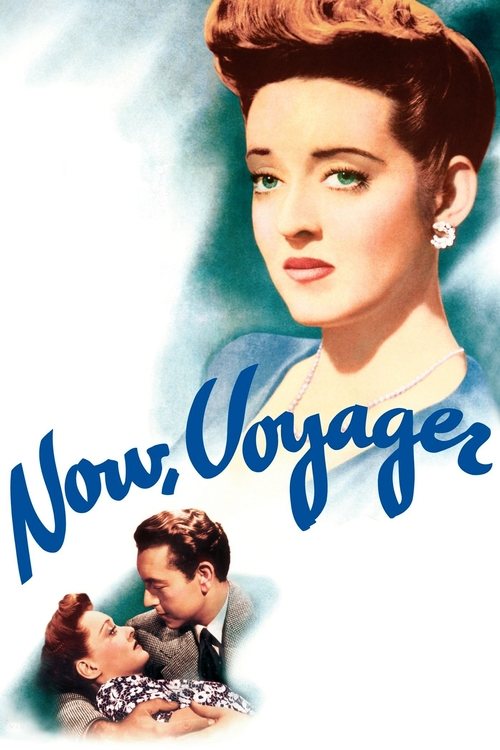
Now, Voyager
1942 · Irving Rapper
For a cozy night in when you want to fall in love and have a good cry — and come out feeling stronger, not just wrung out. Classic comfort viewing with real spine.
What it's about
A wealthy Boston spinster, crushed into invisibility by a domineering mother, suffers a breakdown — and finds in a psychiatrist's care the first person who has ever taken her side. Remade in body and nerve, she boards a cruise ship, where a charming, unhappily married man notices the woman no one else ever has. What she does with that awakening, back home under her mother's roof, is the real story.
The experience
Pure, unashamed emotional sweep: romantic, tearful, and surprisingly steely underneath, with a heroine who keeps choosing self-respect over the easy ending. It's the kind of melodrama that earns its swoons.
Performances
Bette Davis gives one of the great screen transformations, playing repression and blossoming with equal conviction; Claude Rains is all warmth and wit as the psychiatrist, Gladys Cooper is chilling as the mother, and Paul Henreid's two-cigarettes gesture became one of the most imitated moments in movies.
The craft
Warner Bros. prestige craftsmanship at full polish: lush black-and-white photography, Max Steiner's Oscar-winning score surging exactly when your heart does, and dialogue that produced one of the most quoted closing lines of the 1940s. It's studio-era glamour engineered to devastate.
Why it matters
The definitive 'woman's picture' of the studio era — a template for the makeover story and the romance of self-invention that Hollywood has been reworking ever since, and a peak of Bette Davis's stardom.
Snapshot
Now, Voyager is the definitive prestige "woman's picture" of Hollywood's studio era: a Warner Bros. melodrama in which a repressed, neurotic spinster is liberated first by psychiatric treatment and then by an impossible love, emerging into selfhood without ever claiming the conventional reward of marriage. Adapted from Olive Higgins Prouty's 1941 novel and built as a star vehicle for Bette Davis, the film fuses three durable popular fantasies — the ugly-duckling transformation, the shipboard romance, and the talking cure — into a single arc of self-actualization. Its closing exchange ("Oh, Jerry, don't let's ask for the moon. We have the stars.") and the image of Paul Henreid lighting two cigarettes at once became among the most quoted and imitated moments in 1940s American cinema. The title derives from Walt Whitman's Leaves of Grass ("Now, voyager, sail thou forth, to seek and find"), and the literary borrowing signals the film's ambition to treat a despised genre — the weepie — as a serious account of a woman's interior life.
Industry & production
The film was a Warner Bros. production overseen by Hal B. Wallis, one of the studio's most powerful producers, during the period when Warner had positioned Bette Davis as its premier dramatic star. By 1942 Davis was at the commercial and critical peak of her career, fresh from The Letter (1940), The Little Foxes (1941), and a string of vehicles that traded on her capacity to play difficult, intelligent, suffering women. Now, Voyager was conceived squarely within this star economy: the project's value lay in its showcase for Davis's range, here doubled into a single role — the hunched, eyebrow-heavy, defeated Charlotte of the early reels and the poised, transformed woman of the later ones.
The source was Prouty's novel, itself part of a multi-volume cycle about the Boston Brahmin Vale family; Prouty had earlier written Stella Dallas, another touchstone of the maternal-melodrama tradition. Warner's adaptation was assigned to Casey Robinson, the studio's leading specialist in literary and romantic material (he had also scripted Dark Victory, Kings Row, and Captain Blood). Robinson's compression of the novel — sharpening the three-act movement of breakdown, romance, and surrogate motherhood — is generally credited with giving the film its taut emotional architecture.
Casting reinforced the prestige frame. Paul Henreid, recently arrived from European productions and about to film Casablanca the same year, played Jerry Durrance; Claude Rains, a Warner mainstay, played the analyst Dr. Jaquith; and the British stage actress Gladys Cooper played the tyrannical mother. The film performed strongly on release and was nominated for three Academy Awards (Best Actress for Davis, Best Supporting Actress for Cooper, and Best Scoring), winning for Max Steiner's score. I do not have reliable verified box-office figures to cite, so I leave the commercial record at the level of its evident success and awards profile rather than inventing numbers.
Technology
Now, Voyager was made on standard 35mm black-and-white nitrate stock with the panchromatic emulsions and incandescent lighting typical of early-1940s studio production. There is no technological novelty to claim for it; its interest lies entirely in the refinement of mature studio craft rather than in any innovation of apparatus. The film is a product of the fully industrialized Warner Bros. plant — soundstages, process screens for the cruise and travel sequences, and the optical and rear-projection techniques that let a ship's railing or a Rio hillside be conjured without leaving Burbank. The shipboard and South American passages rely conspicuously on rear projection and studio construction, which the film's lighting and staging are designed to flatter rather than disguise.
Technique
Cinematography
Sol Polito's photography is central to the film's meaning, because the transformation of Charlotte Vale is in large part a transformation of how she is lit and framed. In the early Boston sequences Charlotte is photographed to disappear: shadowed, shot from unflattering angles, her face half-hidden behind heavy brows and dowdy clothes, often pushed to the edge of compositions dominated by her mother. After her treatment and her emergence as a glamorous traveler, Polito shifts to the soft, frontal, diffused "glamour" lighting reserved for stars — luminous close-ups that model Davis's face as an object of desire. The contrast is deliberate and legible: the camera enacts the cure. Polito, a frequent collaborator of Michael Curtiz and a fixture of the Warner look, brings the studio's characteristic high-contrast, deep-shadow vocabulary to the domestic interiors, lending the Vale mansion a near-Gothic oppressiveness.
Editing
Warren Low's cutting is classical and largely invisible, organized around the legibility of emotion and the rhythm of the star performance. The film's editing logic is built to deliver Davis's face at the decisive moments — holding on reactions, cutting to register the small shifts that mark Charlotte's growing autonomy. The famous cigarette ritual works as much through editing as through performance: the cut to the two glowing cigarettes, then to the exchange of looks, condenses an entire erotic transaction into a few shots. Transitions across the film's large geographic and temporal spans (Boston, the cruise, Rio, back to Boston, the sanatorium) are handled with the economy of montage and dissolve conventional to the period.
Mise-en-scène / staging
The film's spatial drama is the opposition between two enclosures: the Vale family mansion, a mausoleum of inherited Boston propriety presided over by the mother, and Dr. Jaquith's sanatorium "Cascade," coded as light, open, and curative. Charlotte's movement between worlds — and finally her return to the mansion on her own terms, reorganizing its space — charts her psychological progress. Staging repeatedly uses staircases, doorways, and thresholds to figure constraint and emergence; the mother's command of domestic space is the visual form of her tyranny. Orry-Kelly's costumes are load-bearing dramatic instruments: Charlotte's drab, ill-fitting early wardrobe and the celebrated unveiling of her transformed, fashionable self function as plot points, not decoration.
Sound
Beyond Steiner's score (discussed below), the film's sound design is conventional for its period — dialogue-forward, with ambient and effects work subordinated to speech and music. What distinguishes it is the integration of music and dialogue: Steiner's themes are timed to swell and recede around key lines, so that the score effectively narrates Charlotte's emotional states. The film's most quoted lines are staged in relative quiet so that the music can rise into the silence after them.
Performance
The film is, finally, a performance event. Bette Davis constructs Charlotte as two near-distinct beings — the physically contracted, stammering, defeated woman of the opening, and the upright, controlled, articulate woman she becomes — while making the second legible as a hard-won achievement of the first rather than a magical substitution. It is among the canonical demonstrations of her technique. Gladys Cooper's mother is a study in genteel cruelty, monstrous without melodramatic excess, which is why the performance earned its nomination. Claude Rains gives Dr. Jaquith a benign, pipe-smoking steadiness that humanizes the era's anxieties about psychiatry. Paul Henreid's Jerry is courtly and constrained, his decency the engine of the film's central renunciation. The ensemble's restraint is what keeps a potentially lurid premise in the register of serious drama.
Narrative & dramatic mode
The mode is melodrama in its precise sense: a drama of moral and emotional legibility in which interior states are externalized through performance, music, costume, and mise-en-scène, and in which the engine is not action but feeling and sacrifice. The structure is tripartite — breakdown and cure; romance and its impossibility; sublimation into surrogate motherhood — and its distinctive feature is the refusal of the marriage ending. Jerry is married and will remain so; Charlotte chooses instead to mother his neglected daughter Tina, transmuting forbidden romantic love into nurturance. The final renunciation is staged not as defeat but as a paradoxical fulfillment, which is what gives the film its peculiar emotional doubleness: it is at once a love story and a story about doing without love.
Genre & cycle
Now, Voyager sits at the center of the 1930s–40s "woman's picture," the cycle of melodramas addressed to female audiences and built around a suffering, choosing, or sacrificing heroine — Stella Dallas, Dark Victory, Mildred Pierce, Letter from an Unknown Woman. Within that cycle it belongs to the specific subset organized around maternal tyranny, female transformation, and renunciation. It also participates in the early-1940s vogue for psychoanalytic narrative in Hollywood — the "cure" film — that would shortly include Spellbound (1945). Its shipboard-romance and exotic-travel elements connect it to the romance picture more broadly, but its governing identity is the prestige weepie.
Authorship & method
Authorship here is corporate and collaborative in the studio manner, but with identifiable hands. Irving Rapper, a former dialogue director promoted to features at Warner, was a sympathetic, actor-centered craftsman rather than a stylist with a signature; his contribution was to serve the material and, above all, to manage and frame Davis's performance — a role for which his theatrical background suited him. (His later credits include The Corn Is Green and Rhapsody in Blue.) Casey Robinson's screenplay supplied the dramatic compression and the polished romantic dialogue. Sol Polito's cinematography and Orry-Kelly's costumes did much of the work of dramatizing transformation visually.
The most assertive authorial voice is arguably Max Steiner's. His Academy Award–winning score is a textbook of the leitmotif method he had helped import into Hollywood scoring: recurring themes attached to Charlotte and to the romance, deployed to underline and intensify emotion almost continuously. The love theme became a popular standard in its own right. Steiner's scoring is so dominant that many writers treat the music as a co-author of the film's meaning, narrating feeling where the dialogue stays reticent. As is often noted of star vehicles, Davis herself functioned as a kind of author of her own performance, and contemporary and later accounts credit her with strong views on the shaping of Charlotte; the precise division of creative authority among Davis, Rapper, Wallis, and Robinson is not something I can adjudicate with certainty from the documentary record.
Movement / national cinema
The film is a pure product of the classical Hollywood studio system at its zenith — not affiliated with any avant-garde or national art-cinema movement. It exemplifies the Warner Bros. house style of the early 1940s: efficient, dramatically dense, somewhat darker and more astringent than the MGM gloss, organized around strong contract stars and skilled craft departments. Its claim on film history is as an exemplary instance of mainstream American commercial filmmaking, not as a member of a movement.
Era / period
Now, Voyager was released in 1942, in the first year of full American involvement in the Second World War, and it bears the imprint of the home-front moment in oblique ways. Its sympathetic depiction of psychiatry registers a period of growing public interest in (and anxiety about) mental health, sharpened by wartime concerns. Its narrative of a woman who finds purpose and independence outside marriage resonates with the wartime expansion of women's social roles, even though the film's surface is wholly domestic and its conflicts are private. Produced under the Production Code, the film's central situation — sustained romantic love between a married man and a single woman — is managed through renunciation and sublimation, the Code-era solution that converts transgressive desire into socially sanctioned self-sacrifice.
Themes
The film's master theme is liberation from maternal tyranny — the mother as the internalized agent of repression, whose defeat is the precondition of selfhood. Around this cluster several others: psychoanalysis and the curative power of being seen and named; the relation between appearance and identity (transformation through clothes, lighting, and bearing as an outward sign of inner change); and, most distinctively, the sublimation of romantic love into care for a child. The Whitman epigraph frames the whole as a voyage of self-discovery. The recurring cigarette ritual operates as the film's central symbol of intimacy — a shared, repeatable gesture that stands in for the consummation the plot denies. The closing renunciation crystallizes the film's ambivalent ethic: maturity figured as the acceptance of partial fulfillment, "the stars" in place of "the moon."
Reception, canon & influence
On release the film was received as a high-quality star melodrama and confirmed Davis's standing; its three Oscar nominations and Steiner's win mark its contemporary prestige. In the decades after, Now, Voyager became one of the most critically generative films of its genre. Looking backward, it draws on the maternal-melodrama tradition codified by Prouty's own Stella Dallas, on the woman's-picture cycle Warner had been building around Davis (notably Dark Victory), and on the European-derived practice of leitmotif film scoring that Steiner brought to maturity. Its romantic-renunciation structure descends from a long line of stage and literary melodrama.
Looking forward, its influence is twofold. As popular culture, it bequeathed enduring iconography — the two-cigarette gesture and the "moon/stars" line have been endlessly quoted, parodied, and homaged. As an object of study, it became central to the feminist film criticism that reshaped film studies from the 1970s onward, which took the woman's picture seriously as a site where the construction of female subjectivity and desire could be read. It figures prominently in influential scholarship on the 1940s woman's film — for example in work associated with Mary Ann Doane's study of the genre and in Stanley Cavell's writing on what he called the melodrama of the unknown woman — where its renunciation plot and its treatment of female desire are read closely. (I cite these as representative of the critical tradition rather than offering specific quotations I cannot verify.) Through that scholarly afterlife as much as through its popular survival, Now, Voyager has come to stand as the exemplary case for the proposition that the despised "weepie" was, in fact, one of classical Hollywood's most sophisticated instruments for examining a woman's inner life.
A Deleuzian reading
A woman is photographed to vanish.
The full Deleuzian reading of Now, Voyager →
Reception
A huge box-office hit in 1942 but filed away by critics as a glossy 'women's picture' — decades later it's been reclaimed as one of Hollywood's great melodramas, a camp and queer-canon touchstone, and prime Bette Davis.
How Now, Voyager was received, from release to now →
Influences: the films it descends from and the films it influenced
- Stella Dallas (1937) — Adapted from the same novelist, Olive Higgins Prouty, it supplies the maternal-renunciation template — a woman surrendering what she loves for another's good — that Now, Voyager inherits and recasts as surrogate motherhood ('don't ask for the moon, we have the stars').
- The Silver Cord (1933) — A psychodrama of a possessive, devouring mother that establishes the smothering-matriarch type Gladys Cooper's Mrs. Vale descends from, dramatizing maternal tyranny as the cause of a child's arrested adulthood.
- Dark Victory (1939) — Warner's prototype Davis vehicle of affliction-and-transformation, scored by Max Steiner with near-continuous leitmotif underscoring — the immediate model for fusing Davis's interiority with wall-to-wall emotional music.
- Jezebel (1938) — Codifies Davis costume-as-plot: a single garment (the scandalous red ball gown) carries the dramatic reversal, the device Orry-Kelly extends across Charlotte's frumpy-to-glamorous wardrobe arc.
- The Letter (1940) — The Davis–Steiner–Warner chamber melodrama whose chiaroscuro and lattice-shadow lighting model the high-contrast glamour staging Sol Polito uses to register Charlotte's repressed inner life.
- Camille (1936) — The romantic-renunciation melodrama built on luminous glamour close-ups of a suffering, self-sacrificing heroine, ennobled by giving up her love — the renunciation-as-transcendence ending Now, Voyager echoes.
- King Kong (1933) — Where Steiner first systematized the Wagnerian leitmotif method in Hollywood — themes welded to characters and narrated emotion — the scoring grammar his Oscar-winning Now, Voyager score perfects.
- Gone with the Wind (1939) — Steiner's sweeping signature-theme approach, in which a single recurring melody becomes the film's emotional brand, set the template for the Now, Voyager love theme that escaped the film as a pop standard.
- Mildred Pierce (1945) — A Steiner-scored maternal woman's picture that, like Now, Voyager, organizes its drama around a mother–daughter pathology and dignifies the 'weepie' with prestige craft and a star at her dramatic peak.
- Letter from an Unknown Woman (1948) — The canonical 'melodrama of the unknown woman' (per Cavell), structuring unspoken female desire and self-sacrifice around a recurring romantic motif and staircase mise-en-scène — the same critical-feminist lineage Now, Voyager anchors.
- Brief Encounter (1945) — The renunciation of an affair narrated by continuous romantic music (Rachmaninoff) standing in for words a repressed heroine cannot speak — the same use of score-as-confession and restraint-as-emotion.
- All That Heaven Allows (1955) — Extends the woman's picture by dramatizing a widow's stifled desire through saturated, oppressive mise-en-scène and the pressure of grown children — the social-maternal entrapment Charlotte's story diagnoses, rendered through décor.
- Imitation of Life (1959) — The high-Technicolor maternal-melodrama apotheosis whose self-conscious excess weaponizes the genre's emotional manipulation, completing the woman's-picture trajectory that feminist criticism reads back through Now, Voyager.
- Far from Heaven (2002) — A scholarly reconstruction of the studio-era woman's picture — Sirkian color, Elmer Bernstein's leitmotif score, costume-driven characterization — that revives the exact craft apparatus Now, Voyager exemplifies.
- Carol (2015) — Revives the woman's-picture grammar of glove-and-glance, costume-as-desire, and the renunciation/reunion structure, treating suppressed female longing with the formal seriousness the genre earned through films like Now, Voyager.
- Marnie (1964) — Codifies the woman's-picture psychoanalytic template — repressed woman, domineering-mother trauma, analyst-as-authority, backward revelation of the case history — and Bette Davis's surface-opacity performance register, both of which Hitchcock inherits wholesale and then ironizes.
- The Proposition (1998) — Max Steiner's wall-to-wall romantic-orchestral underscoring is the emotional grammar Endelman's score directly descends from.
- Muriel's Wedding (1994) — Supplies the woman's-picture 'ugly duckling' transformation arc — a repressed, unglamorous heroine remade through spectacle — that Muriel's Toni-Collette metamorphosis inherits and then sours with irony.
- Desert Hearts (1985) — Precedent for the open, non-possessive ending — love affirmed without permanent union — that Deitch and Natalie Cooper rework into the film's train-window refusal of tragic closure.
- The Bridges of Madison County (1995) — The classical woman's-picture star vehicle built on contained yearning and a renunciation ethic ('don't ask for the moon'), the actressly restraint Streep updates.
- Spellbound (1945) — Names the talking cure explicitly: like Charlotte's reconstruction under Dr. Jaquith, it makes psychoanalysis the narrative engine that excavates a repression and rebuilds the protagonist — the 1940s psychoanalytic-melodrama vogue Now, Voyager helped open.
- Casablanca (1943) — Paul Henreid plays a nearly identical role — the cultivated married European who cannot have the woman he loves and chooses honorable renunciation — and Max Steiner applies the same leitmotif technique at Warner Bros. in the same production year, building a recurring romantic theme that undergoes harmonic variation to track the relationship's emotional arc, making the two films craft twins in their melodramatic scoring.
Similar films
- Letter from an Unknown Woman (1948) — influence & lineage
- Imitation of Life (1959) — influence & lineage
- Mildred Pierce (1945) — influence & lineage
- All About Eve (1950) — shared sensibility
- Leave Her to Heaven (1945) — shared sensibility
- Cries and Whispers (1972) — shared sensibility
- The Notebook (2004) — shared sensibility
- Titanic (1997) — shared sensibility