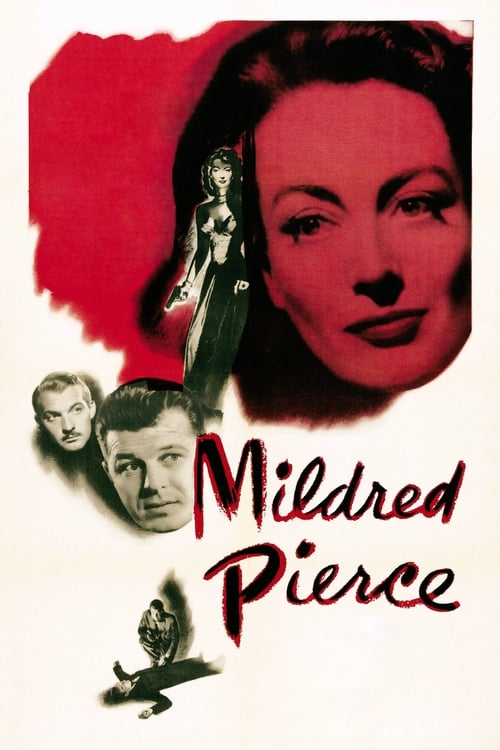
Mildred Pierce
1945 · Michael Curtiz
For a moody classic-Hollywood night when you want glamour with teeth — an old movie that still stings. It rewards you when you're in the mood for family drama at its most poisonous.
What it's about
A divorced mother in 1940s California works herself to the bone — first waiting tables, then building a restaurant business from nothing — all to give her daughter the life of luxury the girl demands and never thanks her for. The story unspools from a murder, told in flashback, as Mildred's climb through marriages, money, and sacrifice is laid out to explain how everything came apart.
The experience
Lush, shadowy, and quietly devastating — a melodrama with the nerves of a crime picture. You watch a woman give everything to someone incapable of gratitude, and the tension between sympathy and dread keeps ratcheting up.
Performances
Joan Crawford won the Best Actress Oscar in the role that rescued her career, playing Mildred with a steeliness that keeps cracking to show the wound underneath; Ann Blyth is chilling as the daughter whose contempt drives the whole tragedy.
The craft
Michael Curtiz fuses two genres — the women's melodrama and film noir — so the domestic scenes carry the same threat as the crime scenes, all in gorgeous black-and-white, venetian-blind shadows and rain-slicked beach houses. Adapted from James M. Cain's novel with a murder-mystery frame grafted on, and the structure works like a trap slowly closing.
Why it matters
A cornerstone of both noir and the classic 'women's picture,' endlessly studied for what it says about motherhood, money, and female ambition — and the film that made Crawford's comeback legendary.
Snapshot
Michael Curtiz's Mildred Pierce is a landmark Hollywood hybrid: a women's melodrama wearing the costume of film noir. Adapted from James M. Cain's 1941 domestic novel, the film grafts a murder mystery framing device onto a story of maternal sacrifice, class ambition, and spectacular self-destruction. Joan Crawford, in the role that rescued her career and won her the Academy Award for Best Actress, plays a divorced mother who builds a restaurant empire to satisfy a daughter incapable of gratitude. The film holds an uneasy, productive tension between sympathy for its protagonist and a cultural anxiety about female independence — that double bind has made it a perpetual object of feminist criticism and one of the richest texts in the classical Hollywood canon.
Industry & production
Warner Bros. produced Mildred Pierce under the stewardship of producer Jerry Wald, who had a gift for identifying commercially potent literary properties with transgressive undertones. Cain's novel, published in 1941, was a bestseller but presented adaptation challenges: unlike his earlier The Postman Always Rings Twice or Double Indemnity, it contained no crime at its structural center — only domestic ambition and erotic rivalry between mother and daughter. Wald's solution was to commission a murder mystery opening that would frame Mildred's entire story as a criminal investigation, importing the noir scaffolding that was proving commercially reliable at the studio.
Crawford's casting was itself an industry event. She had departed MGM in 1943 after years of diminishing returns and the informal "box office poison" stigma that had attached to her name in the late 1930s. Warner Bros. signed her, and Wald fought to cast her in the lead, believing her persona of driven, working-class dignity was exactly right for Mildred. The casting overcame internal resistance; other names reportedly circulated in early discussions, though the documentary record on specific alternatives is thin. The preparation Crawford brought to the role — including research visits to actual restaurant kitchens — became part of the film's promotional lore and prefigured the Method-adjacent preparation that would define prestige Hollywood acting in the following decade.
Ranald MacDougall received the screenplay credit, though earlier drafts had been worked on by Catherine Turney. The adaptation required substantial invention: the incest-adjacent eroticism of the novel's Mildred-Veda relationship had to be filtered through Production Code compliance, and the addition of Monty Beragon as murder victim restructured the narrative causality entirely.
Technology
Mildred Pierce is a studio-system product and does not mark technological ruptures. It was shot on the Warner Bros. lot with standing sets augmented for specific locations. The film uses the standard 35mm format of the period, with monaural optical sound. What is notable is how cinematographer Ernest Haller deploys available technology with precise dramatic intent: the arc lighting systems of the period gave him the deep chiaroscuro shadows that open the film, and the fog-filtered exterior location work in the rain-soaked murder prologue shows careful integration of controlled studio technique with location-inflected atmosphere.
Technique
Cinematography
Ernest Haller, ASC, brings a high-contrast noir grammar to material that is generically melodrama. The film's opening sequence — Monty Beragon shot in a beach house, stumbling forward, the blinds casting barred shadows — is among the most cited set-pieces of 1940s noir cinematography. Haller uses deep-focus selectively, staging domestic interiors with the kind of shallow-focus glamour lighting associated with the women's picture (Crawford in particular required and received exceptionally controlled key lighting throughout her career), then shifting registers for the noir passages. The contrast between warmly lit restaurant interiors, coded as Mildred's domain of competence, and the murky, shadow-saturated spaces of romantic transgression is sustained as a visual argument about where the protagonist is and is not in control.
Crawford's famous high-cheeked face receives the full Haller treatment: dramatic side lighting that sculpts the bone structure into something approaching architectural form. This was a deliberate collaboration between actor and cinematographer that continued across several projects.
Editing
David Weisbart edited the film, constructing the flashback architecture that is central to the narrative. The story is told almost entirely in retrospect — Mildred under interrogation recounts her history in a long analepsis — which requires the editing to establish and maintain two temporal registers: the interrogation room of the present and the rising action of the past. Weisbart's transitions between these layers are largely conventional by studio standards, relying on dissolves to signal temporal movement, but the cumulative effect of the structure is considerable: the audience possesses knowledge from the framing scenes that inflects every subsequent image of Mildred's ambition with dramatic irony.
Mise-en-scène / staging
Curtiz is a director whose virtues are often undervalued because he worked efficiently across so many genres. In Mildred Pierce he demonstrates a precise command of screen space as class indicator. The early domestic scenes in the Glendale house are staged in cramped, middle registers; as Mildred's restaurant chain expands, the depth of field in her professional spaces increases, the camera pulls back to reveal a world she has built. Veda's performance spaces — the piano, the cabaret stage — are lit and framed with a theatrical excess that signals her as a figure of dangerous spectacle. The staging of the film's climactic revelation, with characters arranged across the depth of a room in a configuration that clarifies moral geometry, is among Curtiz's most elegant spatial constructions.
Sound
Max Steiner's score is characteristic of the composer's Warner Bros. work: thematically rich, emotionally declarative, with identifiable leitmotifs attached to Mildred's love for Veda. Steiner received an Academy Award nomination for the score. The music operates as melodramatic affect amplifier, particularly in scenes of maternal anguish; it has been criticized by later commentators for reducing ambiguity, though within the conventions of the period it functions effectively. The sound design otherwise offers little to distinguish it from the studio norm.
Performance
Crawford's performance is the film's spine. She plays Mildred as a woman whose extraordinary competence in the material world is inseparable from a catastrophic emotional blindspot. The physicality is remarkable: Crawford makes Mildred's tiredness legible in her body across decades of story time, and the scenes of Mildred at work in the restaurant kitchen — physically demanding, unglamorous — have a documentary credibility unusual for a star of Crawford's magnitude. Ann Blyth as Veda delivers a performance of controlled venom that is arguably more technically accomplished than Crawford's, modulating between social performance and authentic malice with unsettling ease; she received a Best Supporting Actress nomination. Eve Arden, also nominated for Supporting Actress, plays Ida, Mildred's sardonic friend, with a comic timing and verbal wit that provides necessary tonal relief. Zachary Scott as Monty Beragon offers a portrait of decorative parasitism with minimal sympathy.
Narrative & dramatic mode
The film's narrative architecture is a double helix: the noir investigation coils around the melodrama of maternal sacrifice. The detective genre provides the question (who killed Beragon?) while the melodrama provides the emotional stakes (what did Mildred's love cost her?). These two modes are not perfectly synthesized — the murder mystery resolution is somewhat perfunctory, and the film's emotional truth lives in the domestic flashback material — but the hybrid structure gives each mode a charge it would lack alone. The noir framing transforms Mildred's ambition into something categorically suspect, subjecting her retrospective account to an interrogating gaze that the melodrama mode alone would not have provided. This is the film's ideological core, much analyzed in feminist criticism: the woman who acts, who builds, who sacrifices, is simultaneously the woman under investigation.
Genre & cycle
Mildred Pierce belongs to the cycle of 1940s Hollywood "women's pictures" that flourished during and immediately after the war years — films addressed to female audiences, centered on female protagonists navigating domestic and romantic crises. It also participates in the film noir cycle that extended roughly from 1941 (The Maltese Falcon) through the early 1950s, characterized by flashback structures, femme fatales, moral ambiguity, and a visual rhetoric of shadows and urban alienation. The film's distinction is that it inhabits both categories simultaneously, which was commercially shrewd and artistically generative. The femme fatale in Mildred Pierce is not the protagonist but her daughter — an inversion that complicates the noir formula by locating the destructive seductive power in a figure who is also the object of the protagonist's most self-destructive love.
The film participates in a specific Cain adaptation cycle: Double Indemnity (Billy Wilder, 1944) and The Postman Always Rings Twice (Tay Garnett, 1946) bracket it, all three drawing on the same author's preoccupation with desire, money, and violent consequence in a Southern California landscape.
Authorship & method
Michael Curtiz (born Manó Kaminer in Budapest, 1886) was one of the most prolific directors in Warner Bros. history, cycling through genres with professional fluency that his contemporaries and later auteurist critics sometimes mistook for impersonality. Mildred Pierce sits alongside Casablanca (1942) and Yankee Doodle Dandy (1942) as evidence that Curtiz's technical command and instinct for performance were not merely journeyman competence but a coherent if untheorized aesthetic. His Hungarian émigré background and training in the European theater and early cinema inform a theatrical sensibility about staging and spatial organization that is legible across his Warner work.
Ernest Haller had shot Jezebel (1938) and Gone with the Wind (1939) before Mildred Pierce, and his facility with female star lighting was a deliberate resource. Crawford's subsequent Warner films often requested him. Max Steiner was the studio's prestige composer, his prolific output across the period including Casablanca, Now, Voyager, and King Kong. Ranald MacDougall went on to further work in the melodrama-adjacent crime genre. Jerry Wald's producer role, and his instinct for the transformative framing device, deserves recognition as a structuring creative decision.
Movement / national cinema
Mildred Pierce is a product of the classical Hollywood studio system at its administrative peak, representing Warner Bros.' particular identity within that system: a studio associated with socially grounded, urban, genre-literate filmmaking. If it belongs to a "movement," that movement is the high-studio-system mode of the 1940s — a moment of industrial consolidation, formal refinement, and ideological complexity that the war and its immediate aftermath brought into focus. The film is thoroughly American in its preoccupations (class mobility, the self-made woman, the corruption of success) while drawing on émigré creative talent — Curtiz, Steiner — whose European formation contributed to Hollywood's visual and musical sophistication during the period.
Era / period
The film was produced and released in the final months of World War II, though its action is set across the preceding decade. The period resonates: Mildred Pierce is a film about a woman who enters the workforce out of economic necessity and achieves substantial professional success, released precisely as American cultural discourse was beginning to manage the postwar question of women returning from wartime employment to domestic life. Whether the film's ending — Mildred walking out of the police station into dawn with her first husband, effectively returning to the domestic from which she had departed — constitutes conservative reassurance or ironic pathos has been debated continuously in film scholarship.
Themes
The film's central theme is the perversion of maternal love into a mechanism of self-destruction. Mildred's devotion to Veda is not merely excessive but constitutively blind: she cannot perceive her daughter accurately because to do so would be to acknowledge that her entire project of sacrifice has been misdirected. Class aspiration is intertwined throughout: Veda despises the working origins her mother represents, and Mildred's tragedy is that she has funded the instrument of her own humiliation. The film thinks seriously about female labor — waitressing, restaurant ownership, the physical and organizational work of running a business — in terms unusual for Hollywood melodrama, and it does not punish Mildred for her ambition per se but for what her ambition serves. Sexuality operates as a secondary register: Mildred's affair with the parasitic, aristocratic Beragon is a form of class purchase, and Veda's usurpation of that relationship carries an Oedipal charge that Cain's novel renders more explicit and the film can only gesture toward.
Reception, canon & influence
Critical reception: Mildred Pierce was a major box-office success upon release and a critical validation of Crawford's Warner transition. The film received six Academy Award nominations: Best Picture, Best Actress (Crawford, winner), Best Supporting Actress (Blyth and Arden, both nominated), Best Screenplay, and Best Cinematography (black and white). Contemporary reviews emphasized the star performance and production quality. Joan Crawford's Oscar win, her only one, became an immediate legend; she was reportedly too ill to attend the ceremony and received the award in bed, photographed by press photographers in what became one of the iconic images of Hollywood's studio era — though whether her illness was diplomatic or genuine has been disputed in subsequent biography.
Influences on the film (backward): The most direct influence is Cain's source novel, which itself drew on a tradition of American naturalist fiction about class aspiration and its costs. The film's noir framework inherits from Double Indemnity (1944), itself a Cain adaptation, and from the broader atmospheric debt to German Expressionism that runs through the entire noir cycle via émigré cinematographers and directors. The "woman's picture" conventions the film mobilizes — the suffering mother, the ungrateful child, the romantic sacrifice — had been refined at Warner Bros. through films like Stella Dallas (1937) and Now, Voyager (1942).
Legacy and forward influence: Mildred Pierce became a foundational text in the feminist film criticism that emerged in the 1970s and 1980s. Work by Pam Cook, E. Ann Kaplan, and others used the film to examine how classical Hollywood managed and contained female desire and ambition — how the genre structure imposes punishment on the woman who exceeds her domestic role, and what visual and narrative strategies accomplish that containment. These readings made the film canonical in film studies curricula, where it has remained a touchstone for discussions of genre, gender, and ideology.
The film influenced a cycle of maternal melodramas and continued to shape the noir-inflected domestic thriller through the following decades. Todd Haynes' 2011 HBO miniseries adaptation, scripted by Todd Haynes from Cain's novel directly, stands as the most significant act of critical engagement with the film: by stripping away the murder mystery and producing a five-hour account closer to the novel's structure, Haynes implicitly argued that Curtiz's framing device, however effective cinematically, had imposed a punitive noir logic on material that was more ambiguous and more troubling without it. Kate Winslet's performance in the Haynes version won Emmy recognition and prompted renewed critical attention to Crawford's original. The two versions now exist in productive dialogue, each illuminating what the other chose to suppress.
A Deleuzian reading
Start with the blinds.
The full Deleuzian reading of Mildred Pierce →
Reception
A hit in 1945 that resurrected Joan Crawford's career after MGM dropped her, it was later adopted by feminist film scholars in the '70s and '80s as the key case study in what happens when the 'woman's picture' collides with film noir — and it's now firmly canon on both counts.
How Mildred Pierce was received, from release to now →
Influences: the films it descends from and the films it influenced
- Double Indemnity (1944) — Both films structure a Cain adaptation as a retrospective confession under interrogation, building dramatic irony into every image of the protagonist's past by placing the audience inside foreknowledge of the outcome before the analepsis begins.
- Stella Dallas (1937) — The women's-picture template Curtiz reworks: a working-class mother whose self-destruction is the price of elevating an ungrateful daughter across a class line, the narrative staging her sacrifice as simultaneously heroic and pathetic without resolving the contradiction.
- Jezebel (1938) — Ernest Haller's star-key-lighting vocabulary for a defiant female protagonist — sculpting the face through dramatic side-lighting while coding the social world through the warmth or coldness of surrounding fill — was developed here for Bette Davis and carried directly into his work on Crawford.
- Rebecca (1940) — The analeptic structure built around a female protagonist reconstructing her past under psychological pressure, combined with domestic staging where the architecture of each room is legible as a register of class aspiration or transgression, gives Curtiz a formal template for organizing Mildred's rise through space.
- Now, Voyager (1942) — Max Steiner's leitmotif system — recurring orchestral themes bound to specific characters and functioning as ironic commentary on the visible action — was refined across his Warner Bros. assignments, and the character-signature approach he perfected here was carried directly into his Mildred Pierce score.
- Laura (1944) — The noir investigation that retrospectively reconstructs a woman's identity through detective interrogation of witnesses, assembling a portrait from competing testimonies, directly precedes and informs the police-framing device through which Mildred's analepsis is licensed.
- Casablanca (1943) — Curtiz carries the flashback-as-confession-counterpoint structure and the stratified social interior — Pierce's restaurant as Rick's Café analog, with morally coded levels and dense ensemble crowd choreography — into the femme noir; Ernest Haller's expressionist lighting extends Casablanca's shadow grammar into the domestic and commercial spaces of postwar Los Angeles.
- The Little Foxes (1941) — Extends the strong-woman melodrama of women-and-money, organizing a star vehicle around a heroine's acquisitive drive and the corrosion of family by capital.
- The Reckless Moment (1949) — A mother who conceals a violent death to protect her daughter becomes trapped in a blackmail plot she cannot escape; the film inherits the Mildred Pierce structure of maternal sacrifice recast as criminal complicity, then extends it through Ophüls's tracking shot, which literalizes the protagonist's progressive loss of agency within domestic space.
- All About Eve (1950) — The flashback testimony structured for maximum dramatic irony — the audience's foreknowledge of the outcome charges every image of the protagonist's rise with the cost already known — is deployed at identical scale, and the ensemble generated multiple co-nominations in a single year, directly echoing Mildred Pierce's remarkable Academy recognition pattern.
- Sunset Boulevard (1950) — The noir confession-frame taken to its logical extreme: the narrator of the retrospective analepsis is already dead when the film begins, making the dramatic irony absolute and structurally total from the first image — the culmination of the framing-device tradition Wilder and Curtiz both drew from in 1944–45.
- The Bad and the Beautiful (1952) — Three witnesses each narrate retrospective flashbacks about a central figure, each accounting for a separate chapter of his career; the multi-testimony analepsis extended into a formal experiment in competing subjectivities, scaling up the indictment-through-retrospection structure that Mildred Pierce uses in its single interrogation frame.
- Imitation of Life (1959) — Sirk's melodrama explicitly inherits female labor and maternal sacrifice as its structural engine, staging a woman's commercial empire and the disintegration of her domestic world in direct thematic succession to Mildred Pierce; the mise-en-scène codes domestic and professional space as class indicator, extending Curtiz's staging principle into a fully ironic Sirkian register.
- Mildred Pierce (2011) — Haynes's miniseries is feminist-critical archaeology: it strips the Warner Bros. murder framing entirely to return to Cain's novel, restoring the incest-adjacent eroticism and the unmediated class analysis that Production Code compliance and genre hybridization required Curtiz to sublimate, using the costume and production design of the 1940s women's picture as deliberate citation rather than period decoration.
- Rashomon (1950) — The legal interrogation frame that introduces first-person flashback testimony as the mechanism for reconstructing a past crime — authority present at the outer frame, witnesses speaking directly to it — supplies Rashomon's courtyard-testimony structure where characters address the camera as if testifying to the viewer as judge.
- Mother (2009) — The melodrama architecture in which a mother's sacrificial overprotection generates the conditions for crime and moral catastrophe is the template Mother inherits and radicalizes: where Mildred enables the monster, the Mother is the monster, the complicity structural rather than inadvertent.
- Johnny Guitar (1954) — Forged Crawford's woman's-picture persona of armored, suffering ambition — the melodrama register Johnny Guitar transplants into the saloon and weaponizes as repressed hysteria.
- Alice Doesn't Live Here Anymore (1974) — Supplies the woman's-picture template of a mother forced to support herself and her child through diner/service labor, which Alice de-glamorizes and strips of noir fatalism.
- Sudden Fear (1952) — The picture that reinvented Crawford as a noir-melodrama lead built around female subjectivity and flashback structure — the star-persona engine Sudden Fear restages as suspense.
- Insiang (1976) — Its mother-daughter melodrama built on sexual rivalry over the same man prefigures the Insiang-Tonya-Dado triangle, where a mother's lover becomes the axis of maternal betrayal.
- Leave Her to Heaven (1945) — Released the same year, the film runs the femme-fatale inversion in parallel: the woman whose destructive force is not sexual predation but possessive devotion, coded as criminal pathology, hybridizing the women's picture and the crime film by the same generic logic Curtiz applies to different surface materials.
- The Postman Always Rings Twice (1946) — The parallel node in the Cain adaptation cycle: another story of sexual transgression and domestic crime narrated in retrospect by a condemned protagonist, using the same Production Code displacement of erotic content into noir violence that Wald and MacDougall employed when adapting Cain's non-criminal original.
- Humoresque (1946) — Crawford and Haller reteam immediately after Mildred Pierce for another Warner Bros. noir-melodrama hybrid; Haller's star-key-lighting protocol for Crawford's face is continuous across both films, and the transgressive desires of a wealthy woman are again displaced into a male performance world that encodes her destruction.
- Possessed (1947) — Joan Crawford opens under clinical interrogation and the film unfolds as a psychiatric flashback; the double-temporal structure of testimony plus analepsis is virtually identical to Mildred Pierce, the star-key-lighting protocol for Crawford's face sustained at the same studio just two years later.
- Volver (2006) — Supplies Volver's core mechanism: a working mother absorbs and conceals a killing to shield her daughter, the melodrama structured around a homicide that maternal love quietly buries.
Similar films
- Laura (1944) — influence & lineage
- The Postman Always Rings Twice (1946) — influence & lineage
- Leave Her to Heaven (1945) — influence & lineage
- Imitation of Life (1959) — influence & lineage
- All About Eve (1950) — influence & lineage
- Double Indemnity (1944) — influence & lineage
- Sunset Boulevard (1950) — influence & lineage
- Rebecca (1940) — influence & lineage