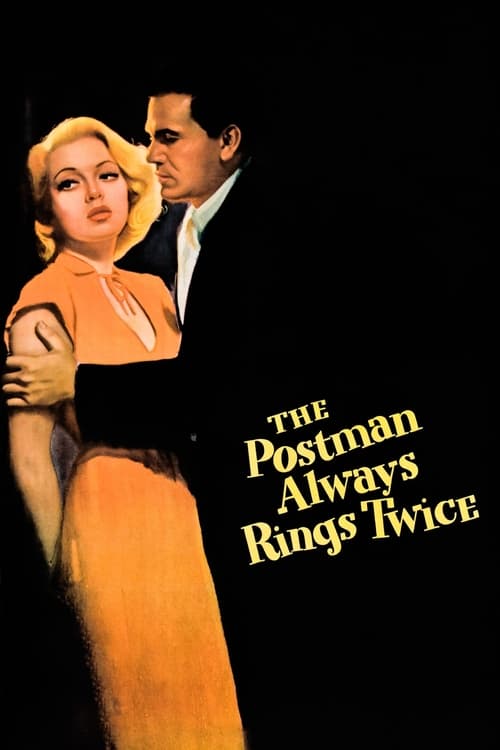
The Postman Always Rings Twice
1946 · Tay Garnett
For a moody black-and-white night when you're craving crime, desire, and doom in classic Hollywood style — when you want to watch two people make every wrong choice and be unable to look away.
What it's about
A drifter named Frank stops at a roadside diner and never quite leaves — because of Cora, the restless young wife of the much older man who owns it. Their attraction turns into an affair, and the affair curdles into a plan to get rid of her husband. What follows is the slow tightening of a trap the lovers built for themselves.
The experience
Sultry and fatalistic — the heat between the leads is immediate, and the movie rides it straight into dread, guilt, and paranoia. It's a taut, doom-laden watch that keeps twisting even after you think the worst has happened.
Performances
Lana Turner, famously dressed all in white, is one of the definitive femme fatales — glamorous, hungry, and unreadable — and John Garfield matches her with a raw, restless masculinity that makes their chemistry combustible.
The craft
Adapted from James M. Cain's notorious novel — long considered too sordid to film — it distills the story into lean, shadowed studio filmmaking where a look across a diner counter carries more charge than most love scenes. The way it smuggles so much lust and menace past 1946 censorship is a craft achievement in itself.
Why it matters
A cornerstone of film noir and the canonical screen version of Cain's novel, it helped define the femme fatale and the lovers-undone-by-their-own-crime story for generations of thrillers.
Snapshot
Tay Garnett's The Postman Always Rings Twice is the canonical Hollywood adaptation of James M. Cain's 1934 novel, a lean tale of adultery, murder, and the slow strangulation of two lovers by their own crime. Produced at MGM and released in 1946, it pairs Lana Turner — sheathed in a famous wardrobe of white — as Cora Smith, the restless wife of a roadside diner owner, with John Garfield as Frank Chambers, the drifter who wanders into the Twin Oaks and never quite leaves. The film arrived more than a decade after Cain's novel had been deemed too sordid for the screen, and its production history is in large part the story of how the Production Code's grip loosened just enough, in the changed moral climate of the immediate postwar years, to allow one of the most notorious of American crime novels onto the screen with its central transgressions intact. It is a foundational film noir, an essential entry in the cycle of films adapted from Cain (alongside Double Indemnity and Mildred Pierce), and the picture that recast Turner from glamour star to dramatic actress. Its reputation rests on its frankness about sexual desire as the engine of murder, on Turner and Garfield's chemistry, and on a sun-bleached visual scheme that broke with the rain-slicked shadow play usually associated with noir.
Industry & production
The film was a Metro-Goldwyn-Mayer production, and that studio pedigree matters to how it looks and feels. MGM was the glossiest and most decorous of the major studios, the home of star glamour rather than gutter realism, and Postman bears the marks of that house style even as its subject matter strained against it. The picture was produced by Carey Wilson, a longtime MGM contract producer. The screenplay is credited to Harry Ruskin and Niven Busch, the latter a novelist (Duel in the Sun) with a feel for American hardboiled material.
The central fact of the production is its long gestation. Cain's novel appeared in 1934 and was immediately recognized as both a sensation and a problem: its matter-of-fact treatment of lust and homicide made it, under the newly enforced Production Code of that same year, effectively unfilmable in Hollywood. MGM is reported to have held the rights for years while the property sat dormant. In the interim the material reached the screen abroad — most famously in Luchino Visconti's unauthorized Italian adaptation Ossessione (1943) and earlier in the French Le Dernier Tournant (1939) — so that the American "first" adaptation was in fact preceded internationally. The success of other Cain adaptations in the early-to-mid 1940s, particularly Billy Wilder's Double Indemnity (1944) and Michael Curtiz's Mildred Pierce (1945), demonstrated that the Code could accommodate adultery-and-murder narratives if they were framed with sufficient moral retribution, and this commercial proof of concept cleared the way for MGM to finally proceed.
The casting of Lana Turner was a calculated act of star management. By 1946 Turner was an established MGM glamour commodity, and the role of Cora — a sexually frank, ambitious, fundamentally sympathetic murderess — represented a deliberate elevation of her dramatic standing. The decision to costume her largely in white is the production's single most discussed design choice (treated below). John Garfield, on loan or in the orbit of his Warner Bros. associations, brought a proletarian intensity honed in Group Theatre–derived performance and Warners social-realist pictures; his everyman ruggedness was essential to making Frank a credible drifter rather than a matinee idol.
Technology
Postman was made with the standard professional apparatus of mid-1940s Hollywood: 35mm black-and-white photography, the Academy ratio, studio sound recording, and a mix of soundstage interiors and location or backlot exteriors standing in for the California highway country where Cain set the story. There is no notable technological novelty to claim here — the film is not a site of equipment innovation, and to assert otherwise would be invention. What is worth registering is the aesthetic use of conventional black-and-white technology against type: where much noir of the period exploited fast films and low-key lighting for nocturnal murk, Postman deploys the same monochrome stock for a bright, high-key, sun-struck California, an inversion discussed under Cinematography.
Technique
Cinematography
The director of photography was Sidney Wagner, an MGM cameraman, working in black and white. The film's most distinctive visual decision is its rejection of the shadowed, expressionist register that "film noir" usually connotes. Much of Postman takes place in daylight, in and around the white-painted Twin Oaks diner and gas station on an open stretch of highway. The lighting tends toward high-key brightness; Turner's pale costumes, the whitewashed roadside buildings, and the glare of California sun create a noir of exposure rather than concealment — a world where guilt has nowhere to hide and the heat seems to press the characters toward their crime. This "sunlit noir" or "California noir" strategy aligns the film with Double Indemnity's suburban daylight and anticipates a strain of the cycle that locates menace in bright, ordinary American spaces rather than rain-slicked urban canyons. Turner's first appearance — a celebrated entrance in which the camera discovers her by way of a dropped lipstick rolling across the floor, then tilts up her white-clad figure — is the most cited single image, a piece of pure cinematic objectification that establishes Cora as both desire-object and narrative catalyst.
Editing
The editing, credited to George White, serves the film's economical, forward-driving narrative. Cain's novel is short and propulsive, and the adaptation preserves that momentum, cutting cleanly through the stages of seduction, the failed first murder attempt, the successful second, the trial, and the ironic aftermath. The film's structure is essentially classical and linear, framed by Frank's narration, and the cutting supports legibility and pace rather than calling attention to itself. The set pieces — particularly the staged car "accident" that kills the husband — are constructed through editing to maintain tension and to manage what the Code would and would not permit to be shown.
Mise-en-scène / staging
The Twin Oaks diner is the film's controlling space, a single roadside location that concentrates the drama: the husband Nick's domain, Cora's prison, and the stage on which Frank intrudes. The whiteness of the setting and of Turner's wardrobe is the key staging conceit. The decision to dress a murderess in white reads as both a Production Code negotiation — softening and "purifying" the character's image to make her sympathetic and the material acceptable — and a piece of bitter irony, the visual innocence at war with the moral fact. The geography of the diner, the highway, and the surrounding hills is used to underline the characters' entrapment: they are always trying to leave, and the road that should mean escape keeps delivering them back to the scene of their guilt.
Sound
The score was composed by George Bassman. The film's sound design is conventional for studio production of the period, supporting the drama without experimental ambition. The title's own motif — the "postman" who "always rings twice," a phrase that appears as Cain's metaphor for the inescapability of fate (the second ring being the punishment one cannot avoid) — is thematic rather than literal, and the film carries that fatalism in its tone more than in any specific sonic device.
Performance
The film lives on its two leads. Lana Turner's Cora is the performance that redefined her range: she modulates between hard ambition, genuine longing, sensual heat, and frightened vulnerability, making Cora neither a simple femme fatale nor a victim but a woman whose desire for security and respectability curdles into homicide. John Garfield's Frank supplies the restless, sweating physicality of a man governed by appetite; his naturalistic, slightly coiled playing grounds the melodrama. The supporting work is anchored by Cecil Kellaway as Nick Smith, the older husband whose decency and obliviousness make his murder both easier and more damning, and by Hume Cronyn as the slippery defense attorney Arthur Keats, whose cynical legal maneuvering during the trial sequence provides the film's most acid commentary on justice as a game. Leon Ames appears as the district attorney. Cronyn's and Kellaway's contributions are frequently singled out as giving the picture its moral and tonal texture beyond the central romance.
Narrative & dramatic mode
The film operates in the mode of fatalistic crime melodrama, structured as a confession. Frank's retrospective narration frames the action, lending it the doomed, backward-looking quality characteristic of noir storytelling — we understand from early on that this will end badly. The dramatic engine is Cain's pitiless irony: the lovers commit murder successfully and escape legal punishment for it, only to be destroyed by chance, mutual suspicion, and a second, accidental death that the law reads as the murder they actually got away with. The "two rings" of the title encode this structure — fate calls twice, and the second summons is the one that collects. The mode is tragic in a debased, modern key: there is no nobility in the fall, only the grinding mechanism of desire, crime, guilt, and cosmic bad luck.
Genre & cycle
Postman belongs squarely to the film noir cycle of the 1940s and, more specifically, to the subset of noirs adapted from James M. Cain and built around the adultery-murder-insurance/inheritance triangle. It is the third major Cain adaptation of the decade, following Double Indemnity (1944) and Mildred Pierce (1945), and it shares with the first the template of a sexually magnetic woman and a vulnerable man conspiring to kill an inconvenient husband. Within noir's typology it is a definitive instance of the "femme fatale and patsy" narrative, though Cora is a more sympathetic and three-dimensional figure than the pure predator of some noir mythology. It also belongs to a thematically coherent group of films about the lethal underside of the American dream of upward mobility and domestic security.
Authorship & method
Tay Garnett was a capable, versatile studio craftsman rather than a celebrated auteur, and Postman is generally regarded as the high point of his career. His method here is one of disciplined classical storytelling: he subordinates style to the propulsion of Cain's plot and to the showcasing of his stars, trusting the material's frankness and his actors' chemistry to carry the film. The key collaborators define the work as much as the director: cinematographer Sidney Wagner, whose bright monochrome scheme gives the film its distinctive sunlit fatalism; composer George Bassman; editor George White; and screenwriters Harry Ruskin and Niven Busch, who performed the delicate task of preserving Cain's story under Production Code constraint. The decisive "authorship," in a sense, belongs jointly to Cain — whose terse, hardboiled source supplies the structure, irony, and moral vision — and to the MGM star-making apparatus that built the film around Lana Turner.
Movement / national cinema
This is a Hollywood studio film, an American product of the classical era at its most industrially refined, and it is a load-bearing entry in the loose movement later christened film noir by French critics. Noir was not a self-conscious movement at the time of production but a retrospective category, and Postman is one of the films that helped define it. The international dimension of the Cain material is significant: the novel's prior adaptations in France (Le Dernier Tournant, 1939) and Italy (Visconti's Ossessione, 1943, a foundational text of Italian neorealism) mean that this most American of stories had already become a node of transnational cinema before MGM's version, and that Visconti's engagement with it links the same source to an entirely different national movement.
Era / period
The 1946 release date situates the film precisely in the immediate postwar moment, and that timing is not incidental. The loosening that allowed the long-shelved novel to be filmed reflects a broader shift in American mass culture toward greater frankness about sex and violence, and the noir cycle's darkening of the national mood is often read in relation to postwar anxiety, returning-veteran dislocation, and the strain on domestic life. Postman's story of restless desire and the deadly pursuit of security through illicit means resonated with a country recalibrating after the war. It is a film of its precise moment in the long negotiation between Hollywood and the Production Code, arriving just as that machinery had found it could metabolize adult crime material if it administered a final dose of retribution.
Themes
The governing theme is the fatal inseparability of desire and destruction: sexual passion and the longing for a better life drive Cora and Frank to murder, and the same forces — jealousy, suspicion, guilt — then consume them. Closely bound to this is the theme of inescapable fate, encoded in the title's metaphor: punishment is the postman who rings a second time, and there is no not answering the door. The film is also about class and the American dream's dark conversion — Cora's crime is fundamentally an attempt to escape servitude and claim ownership, respectability, and security, and the picture is unsparing about how that aspiration curdles into homicide. Justice is treated with corrosive irony: the legal system, embodied in Cronyn's cynical attorney and the dueling prosecutors, is shown as a game of leverage and gamesmanship rather than a moral instrument, and the lovers are ultimately punished not for the murder they committed but by the random cruelty of fate. Underlying it all is a deterministic, almost naturalist vision of human beings as creatures driven by appetite toward a doom they half-see and cannot avoid.
Reception, canon & influence
On release the film was a commercial success and a significant event in Lana Turner's career, widely credited with establishing her as a dramatic actress rather than merely a glamour star; the role of Cora became one of the defining performances of her career. Contemporary attention focused on the frankness of the material and on the heat of the Turner-Garfield pairing. Over time the film has been firmly canonized as a major film noir and as one of the essential Cain adaptations, regularly discussed alongside Double Indemnity and Mildred Pierce in histories of the cycle.
The influences on the film run backward to James M. Cain's 1934 novel above all — its structure, irony, and hardboiled moral vision — and to the immediately preceding Cain films that proved such material commercially viable, especially Double Indemnity. The Code negotiations of the era shaped its every choice. Its prior international adaptations (Le Dernier Tournant, Ossessione) form a parallel rather than a direct influence on the MGM version, but they belong to the same lineage of the source.
The film's legacy runs forward in several directions. It cemented the noir template of the conspiring lovers and the doomed crime of passion, and its "sunlit," bright-key approach contributed to a strand of the cycle that found menace in daylight and ordinary American spaces. The story itself proved durable: it was remade in 1981 by Bob Rafelson, with Jack Nicholson and Jessica Lange and a screenplay by David Mamet, a more sexually explicit version freed from Code constraint that explicitly measured itself against the 1946 film, confirming the latter's status as the canonical version against which all others are read. Lana Turner's white-clad Cora became an enduring image in the iconography of noir, and the film remains a fixture in the study and teaching of the genre — both as a superb example of classical Hollywood craft applied to transgressive material and as a case study in how the Production Code shaped, constrained, and was ultimately outmaneuvered by, the adult crime film of the 1940s.
A Deleuzian reading
A tube of lipstick rolls across the floor of a roadside diner.
The full Deleuzian reading of The Postman Always Rings Twice →
Reception
A box-office hit in 1946 that some critics found tame next to Cain's scandalous novel, it's since settled in as one of the defining film noirs — and the definitive screen version of the story, outlasting its starrier 1981 remake in most fans' esteem.
How The Postman Always Rings Twice was received, from release to now →
Influences: the films it descends from and the films it influenced
- Le Dernier Tournant (1939) — The first screen adaptation of Cain's novel, it established the visual rhetoric of staging the murder conspiracy inside a single roadside diner/garage location that the MGM film inherits as its claustrophobic stage.
- Double Indemnity (1944) — The immediately preceding Cain adaptation that proved the template Garnett copies wholesale: retrospective voiceover-confession framing the doomed crime, plus the conspiring-lovers murder plot driven by an insurance/inheritance motive.
- The Maltese Falcon (1941) — Codified the noir femme fatale whose erotic chemistry with the male lead is itself the engine of plot — the Cora/Frank dynamic descends from Brigid O'Shaughnessy's weaponized desirability.
- Scarlet Street (1945) — Extends the working-man-plus-faithless-woman-plus-murder triangle, retaining the Production-Code compromise Lang fought — punishment arrives, but the film mimics his study of desire dismantling an unremarkable man.
- Out of the Past (1947) — Extends the voiceover-confession fatalism and the deadly-couple-on-the-run structure, with a femme fatale whose white-bright introduction echoes Cora's calculated wardrobe entrance.
- They Live by Night (1948) — Carries forward the doomed-lovers-as-criminal-couple template Postman cemented, treating the romance itself as the tragic mechanism that drives them toward death.
- Gun Crazy (1950) — Pushes the conspiring-lovers crime-of-passion formula to its sexual-violent extreme, the femme fatale's physical magnetism explicitly motivating the male partner's escalating crimes.
- Sunset Boulevard (1950) — Inherits and intensifies the retrospective voiceover-confession device, the dead-man-narrating frame making explicit the fatalism Postman delivers through Frank's death-row narration.
- The Postman Always Rings Twice (1981) — The explicit remake that measures itself against the 1946 version, restoring the sexual frankness the Code suppressed while preserving the single-location diner staging and Cain's confession structure.
- Body Heat (1981) — A neo-noir that revives Postman's sunlit-noir cinematography — sweltering daylight menace — fused with the white-clad femme fatale luring a weak man into a spouse-murder conspiracy.
- The Last Seduction (1994) — Updates the Cora archetype of the femme fatale who manipulates a besotted male accomplice into killing the husband, foregrounding her erotic control as the plot's driving force.
- Blood Simple (1985) — The Cain source novel's specific plot mechanics — a married woman, her lover, a murder scheme that survives its first execution only to destroy all parties through incompetence and mutual misreading — are the skeletal structure Blood Simple repurposes, keeping the Texas roadhouse setting and adultery triangle while stripping the legal procedural aftermath.
- The Man Who Wasn't There (2001) — The other canonical Cain adaptation supplying the adulterous triangle and the murder scheme that destroys its conspirators, the structural source the Coens hollow out into passivity.
- The Prowler (1951) — Cain's blueprint of a striving outsider and a discontented wife plotting the husband's death, then being destroyed by the ironic legal-fatal aftermath, models The Prowler's working-class adultery-murder and its downward spiral toward accidental self-incrimination.
- Criss Cross (1949) — Fixes the Cain triangle's casting logic — drifter, restless wife, brutish possessor — and the practice of staging the adulterous conspiracy in blunt daylight interiors so that the fatalism reads as social fact rather than expressionist mood.
- The Breaking Point (1950) — Set Garfield's daylight-noir register — the doomed drifter played in flat California sun rather than expressionist shadow, with the actor's clipped, defensive underplaying supplying the fatalism the lighting refuses to.
- Ossessione (1943) — A parallel adaptation of the same Cain source whose sweaty, body-fixated handling of the lovers prefigures Garnett's objectifying camera, though it pursues neorealist location grit rather than MGM gloss.
- Mildred Pierce (1945) — The third major-studio Cain adaptation of the cycle, sharing the project of laundering Cain's hardboiled irony through a glamorous female star vehicle under Production Code constraint.
- Laura (1944) — Shares the 'bright-key' strand of noir, finding menace in high-key, well-lit upscale interiors rather than expressionist shadow, anticipating Wagner's sunlit monochrome scheme.
- The Killers (1946) — A contemporary noir built, like Postman, on a hardboiled author's terse structure and on a fatalistic flashback architecture in which the protagonist's doom is announced before it is explained.
- The Asphalt Jungle (1950) — Shares the noir fatalism in which a meticulously plotted criminal scheme is undone by human appetite, the doom feeling structurally preordained rather than accidental.
- In a Lonely Place (1950) — Extends the Garfield-style naturalistic male lead drawn from theatrical Method acting, building noir tension out of intimate two-character performance rather than plot mechanics.
- Bound (1996) — Supplies the adulterous-couple-plots-to-kill-the-proprietor engine and the sweaty erotic charge between conspirators that Bound reroutes through Corky and Violet.
Similar films
- The Postman Always Rings Twice (1981) — influence & lineage
- Double Indemnity (1944) — influence & lineage
- Obsession (1943) — influence & lineage
- Out of the Past (1947) — influence & lineage
- Body Heat (1981) — influence & lineage
- Laura (1944) — influence & lineage
- Mildred Pierce (1945) — influence & lineage
- The Maltese Falcon (1941) — influence & lineage
All the films related to The Postman Always Rings Twice →