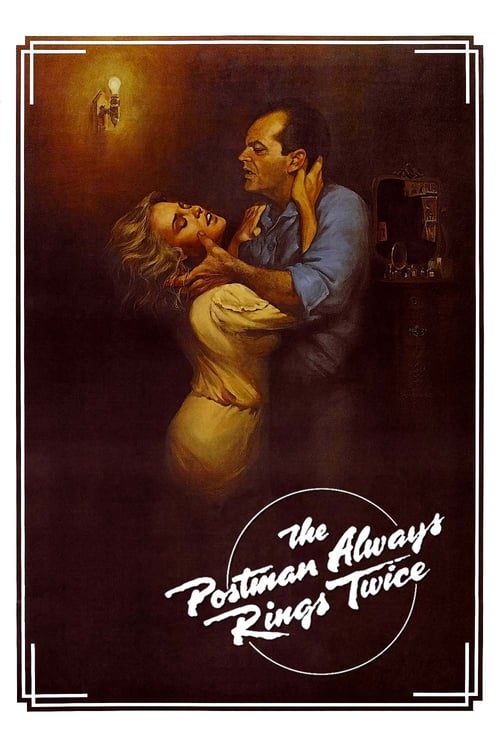
The Postman Always Rings Twice
1981 · Bob Rafelson
For a late night when you want something adult, carnal, and doomed — a crime story about people you understand and can't root for. More brooding than thrilling; come for the atmosphere and the moral wreckage.
What it's about
In Depression-era rural California, a drifter named Frank washes up at a roadside lunch wagon run by a genial Greek proprietor and his restless young wife, Cora. Frank and Cora fall into an affair that's immediate, physical, and reckless — and it hardens into a plan to get the husband out of the way for good. It's James M. Cain's classic pulp story of lust and murder, told this time without the old Hollywood censors looking over its shoulder.
The experience
Slow-burning, sweaty, and fatalistic — the heat between the leads is real, but the film keeps its eyes cold, watching desire curdle into something desperate. It leaves you with the grim aftertaste good noir is supposed to leave.
Performances
Jack Nicholson and Jessica Lange generate genuinely dangerous chemistry — Nicholson all hunger and bad instincts, Lange giving Cora a restlessness and intelligence that makes the whole doomed scheme believable.
The craft
David Mamet's first produced screenplay strips Cain's pulp down to appetite and economics, and Sven Nykvist — Ingmar Bergman's longtime cinematographer — shoots the Depression-era roadside world in beautiful, unglamorous natural light. It's a lurid story made with art-film patience.
Why it matters
The definitive uncensored take on a novel Hollywood had famously sanitized in 1946, and a landmark of the early-'80s neo-noir revival — notorious on release for its raw eroticism.
Snapshot
Bob Rafelson's The Postman Always Rings Twice is a Depression-era neo-noir that returns to James M. Cain's 1934 novel with a frankness the Production Code had forbidden the famous 1946 MGM version. Jack Nicholson plays Frank Chambers, a rootless drifter who wanders into a roadside lunch wagon somewhere in rural California; Jessica Lange is Cora, the restless wife of the genial Greek proprietor Nick Papadakis (John Colicos). Their affair is immediate and carnal, and it curdles into a conspiracy to murder Nick. Working from a screenplay by David Mamet—his first produced script—and photographed by Ingmar Bergman's longtime cinematographer Sven Nykvist, Rafelson made a film that treats Cain's lurid pulp as a study in appetite, class entrapment, and the grinding economics of the 1930s. The result is colder and more deliberate than its melodramatic source, prized by some critics for its texture and atmosphere and faulted by others for muffling the story's fatalistic heat. It stands as a key late entry in the 1970s–80s neo-noir revival and as a transitional work for Lange, whose performance here preceded her dual breakthrough year of Frances and Tootsie in 1982.
Industry & production
The film was a Lorimar production, distributed in the United States by Paramount Pictures, and released in 1981. It emerged from the same independent-minded, director-driven sensibility that had defined Rafelson's earlier career: he had been a principal of BBS Productions, the company behind Easy Rider, Five Easy Pieces, and The Last Picture Show, and Postman extended his association with Nicholson, with whom he had made Five Easy Pieces (1970) and The King of Marvin Gardens (1972). Nicholson, by 1981 a major star, was both lead and a driving creative force; his involvement was central to the project's viability.
The decision to remake a celebrated 1946 studio picture—Tay Garnett's version with Lana Turner and John Garfield—was framed less as a remake than as a more faithful return to Cain. The 1946 film had been constrained by the Hollywood Production Code, which dictated that the sexual frankness and moral squalor of the novel be sublimated; by 1981, with the ratings system long in place, the filmmakers could restore the eroticism and grime that Cain had written. Hiring David Mamet, then known primarily as a playwright (American Buffalo, Sexual Perversity in Chicago), signaled an intent to treat the material as serious literary adaptation rather than genre product. The casting of Lange, still establishing herself after King Kong (1976), opposite Nicholson was a significant gamble that paid off in her favor. The supporting cast included Anjelica Huston—then Nicholson's longtime partner—in a small but memorable role.
Technology
Postman was shot on 35mm color film stock, the industry standard, with no notable technological novelty; its interest lies in how conventional tools were deployed for a period-naturalist effect rather than in any innovation. Working in color to evoke a 1930s world, Nykvist and Rafelson pursued a muted, earthy palette and available-light naturalism rather than the high-contrast monochrome associated with classic noir. The film relies on practical period production design and location work to ground its world; specific technical particulars of camera packages and lab processes are not well documented in the readily available record, and I will not invent them.
Technique
Cinematography
Sven Nykvist's photography is the film's most distinctive technical signature. Renowned for his decades of work with Ingmar Bergman, Nykvist brought a soft, naturalistic lighting style—favoring diffused daylight, dim interiors lit as if by the available bulbs and windows of a Depression roadhouse, and a restrained, often desaturated palette. The visual approach deliberately resists the chiaroscuro shadow-play of 1940s noir; instead it renders the lunch-wagon world as dusty, sun-bleached, and physically tangible. This naturalism throws the eroticism into relief: the bodies and the cramped, sweaty interiors feel concrete rather than stylized. The collaboration is notable simply as an event—one of America's most idiosyncratic auteurs paired with Europe's most celebrated cinematographer of interiority—and the images carry a gravity and tactility unusual for genre material of this kind.
Editing
The film was edited by Graeme Clifford, who had cut Robert Altman's Images and Nicolas Roeg's Don't Look Now and who would direct Lange in Frances the following year. The cutting is measured and patient, favoring duration and the build of tension over the propulsive momentum a thriller might conventionally seek. The pacing is one of the qualities critics divided over: admirers found it brooding and atmospheric, detractors found it slack. The celebrated sexual encounters are constructed as sustained, physical set-pieces rather than elided, a choice that depends on editing that holds rather than cuts away.
Mise-en-scène / staging
The production design renders a tightly circumscribed world: the lunch wagon and gas station, the kitchen, the back rooms, the dusty roads. This confinement is dramatically purposeful—Cora is trapped by the business, the marriage, and the era's narrow horizons for a woman of her class. The most discussed sequence is the first consummation in the kitchen, staged amid flour and the working surfaces of the diner, raw and graphic by the standards of mainstream 1981 cinema and an emphatic repudiation of the 1946 film's coded restraint. Throughout, Rafelson stages the drama in cramped, functional spaces that emphasize the characters' entrapment within an economy and a geography that offer no exit.
Sound
Michael Small composed the score. Small was among the most respected film composers of the 1970s, associated with the paranoia cycle (Klute, The Parallax View, Marathon Man), and his work here serves the film's brooding register rather than underlining melodrama. Beyond the score, the film leans on the ambient texture of its world—the roadhouse, traffic, the rural quiet. Detailed accounts of the sound design are thin in the available record.
Performance
The performances are the film's center of gravity. Nicholson plays Frank as coarse, opportunistic, and physically present—less the doomed romantic of Garfield's 1946 reading than a hungry, unreflective drifter. Lange's Cora is the revelation: ambitious, sensual, and frustrated, a woman whose desire for the murder is bound up with her wish to escape both her husband and the dead-end life the diner represents. The role demanded an unguarded physical and emotional exposure, and Lange's work here is frequently cited as the moment her dramatic seriousness became undeniable, setting up her acclaimed 1982. John Colicos lends Nick Papadakis a warmth and decency that make the betrayal genuinely ugly rather than merely convenient. Anjelica Huston appears in a smaller role.
Narrative & dramatic mode
The film is built on Cain's classic noir engine: sexual obsession driving two people to murder, followed by the slow disintegration of their bond under guilt, suspicion, and circumstance. Mamet's adaptation strips the story toward its elemental drives—lust, money, escape—and his characteristically terse, oblique dialogue replaces the novel's hardboiled first-person narration. Significantly, the 1981 film discards the framing device that anchors both the novel and the 1946 version, in which Frank narrates from death row; this changes the story's moral architecture, removing the explicit machinery of cosmic retribution that the title itself gestures toward (the "postman" who always rings twice being fate, or death, arriving for its due). The dramatic mode is fatalistic and naturalist: these are people moved by appetite and economic desperation more than by villainy, and the tragedy is that their one transgressive act traps rather than frees them. The film's ending diverges from the tidy ironic justice of the earlier version, closing on a bleaker, more abrupt note.
Genre & cycle
Postman belongs to the neo-noir revival that ran from the late 1960s through the 1980s, in which New Hollywood filmmakers returned to the templates of 1940s crime melodrama and reworked them with the permissiveness, ambiguity, and revisionism of the post-Code era. It is often discussed alongside Chinatown (1974)—Nicholson's defining noir, and a Robert Towne–Roman Polanski period reconstruction—and Lawrence Kasdan's Body Heat, released the same year, 1981, which transposed essentially the same Cain-derived "lovers murder the husband" plot to contemporary Florida. That two James M. Cain–inflected erotic thrillers appeared in 1981 marks the moment the cycle reached full, sexually explicit maturity. Postman is the more austere and period-bound of the two, less a glossy entertainment than a literary-naturalist excavation of the genre's roots.
Authorship & method
The film is a convergence of strong, distinct authorial signatures. Rafelson, as director, brought the New Hollywood preoccupations of his earlier films—drift, restlessness, men who cannot settle, the texture of American place—to genre material, and his sensibility favors mood, behavior, and milieu over plot mechanics. David Mamet, in his screenwriting debut, contributed a spare, elliptical literary intelligence that would soon define a major writing-directing career; Postman inaugurated his long engagement with confidence games, betrayal, and male appetite. Sven Nykvist's cinematography imported a European art-cinema gravity and naturalism. Michael Small's score supplied the brooding, anxious undertow he had perfected in the previous decade's political thrillers. Graeme Clifford's editing gave the film its patient, atmospheric rhythm. The production design realized a credible Depression world. The film is best understood as the meeting point of these collaborators—an American genre property refracted through an unusually literary and European-inflected set of hands.
Movement / national cinema
The film sits within American New Hollywood, specifically its later, more genre-revisionist phase, and within the broader neo-noir movement. Rafelson's pedigree connects it to the BBS lineage that had reshaped American film in the early 1970s. At the same time, the Nykvist collaboration threads a strand of European art cinema—Bergmanesque naturalism—through an emphatically American story, making the film a small case study in the cross-pollination between New Hollywood and the European masters its directors admired. Cain's novel itself sits at the headwaters of an international lineage: it had previously been adapted in France as Le Dernier Tournant (1939) and, unofficially and famously, by Luchino Visconti in Italy as Ossessione (1943), a founding work of neorealism. The 1981 film is thus one node in a genuinely transnational adaptation history.
Era / period
Set in the 1930s, the film foregrounds the Depression as a material condition rather than mere backdrop. The economic desperation that drives Cora's longing for security and Frank's rootless wandering is the soil from which the crime grows; the roadside diner, the cars, the transient labor, and the closed horizons are all period-specific and dramatically load-bearing. As a 1981 production, the film also reflects its own moment—the post-Code permissiveness that allowed Cain's sexuality onto the screen, and the New Hollywood generation's confidence in treating pulp genre as the stuff of serious authorship. It arrived at the tail end of that generation's ascendancy, as the blockbuster era was reshaping the industry around it.
Themes
The film's governing themes are sexual obsession and its entanglement with money and class. Desire here is inseparable from the wish to escape—Cora's affair is also a bid for a different life, and the murder is an economic act as much as a passional one. Entrapment runs throughout: in marriage, in the diner, in the Depression's narrowing of options, and finally in the crime itself, which binds the lovers in mutual suspicion rather than liberating them. Fate and retribution are encoded in the very title, though the 1981 version handles this more obliquely than its predecessors by dropping the death-row frame. Class and ethnicity inflect the drama through Nick, the immigrant Greek proprietor whose decency and ambition the lovers destroy. And beneath it all runs Rafelson's recurring American theme of rootlessness—the drifter who cannot stay, the restlessness that finds in violence a temporary, ruinous form of motion.
Reception, canon & influence
Critical reception in 1981 was mixed-to-respectful rather than rapturous. The film drew admiration for Nykvist's photography, its grimy period atmosphere, and especially for Lange's performance, while a recurring line of criticism held that, despite its sexual frankness, the film was curiously cold or inert—that it had restored Cain's explicitness without fully capturing the fatalistic momentum and pulp heat that made the story burn. Comparisons to the 1946 version and to the same year's Body Heat were ubiquitous, often to Postman's disadvantage as entertainment even when it was credited as the more serious adaptation. (I am avoiding attributing specific quotations or box-office figures, which I cannot verify with confidence.)
The influences on the film are clear and acknowledged: Cain's 1934 novel above all, the shadow of the 1946 Garnett–Turner–Garfield film against which it defined itself, and the broader noir tradition revived by Chinatown and the New Hollywood crime cycle; Nykvist's presence imported the naturalism of European art cinema. Its legacy forward is more diffuse. The film's most durable consequence was for Jessica Lange, for whom it functioned as a serious-actress proving ground immediately before Frances and Tootsie. It contributed to the 1980s erotic-thriller current that Body Heat did most to launch and that would flourish later in the decade. As a Mamet debut, it marks the beginning of a major screenwriting and directing career. The 1981 Postman has not displaced the 1946 film in popular memory, and it remains the more admired-than-loved of the two—valued today chiefly as a Rafelson–Nicholson collaboration, a Nykvist showcase, and a Lange landmark, a handsome and intelligent adaptation whose reputation rests more on its craft and its cast than on the heat its story promises.
A Deleuzian reading
There is flour on the counter.
The full Deleuzian reading of The Postman Always Rings Twice →
Reception
In 1981 it landed to mixed reviews and middling box office, endlessly unfavorably compared to the 1946 Lana Turner classic; it's since been reappraised as a key early-80s neo-noir, with Jessica Lange's performance in particular now widely regarded as the film's ace.
How The Postman Always Rings Twice was received, from release to now →
Influences: the films it descends from and the films it influenced
- Ossessione (1943) — The first Cain adaptation established the sweaty, naturalistic neorealist treatment of the roadside-diner triangle that Rafelson's grimy Depression milieu deliberately echoes over the 1946 version's studio gloss.
- The Postman Always Rings Twice (1946) — The prior Hollywood adaptation the 1981 film defines itself against, restoring the sexual explicitness and fatalistic carnality the Hays Code forced Garnett to sublimate into white-clad iconography.
- Double Indemnity (1944) — The other foundational Cain adaptation, supplying the template of doomed lovers conspiring to murder a husband, whose insurance-and-betrayal fatalism underwrites Postman's structure.
- Five Easy Pieces (1970) — Rafelson's prior film with Nicholson built the restless-drifter persona and the privileging of behavior, milieu and class friction over plot mechanics that he carries directly into Frank Chambers.
- The King of Marvin Gardens (1972) — Rafelson's mood-driven study of American place and men who cannot settle established the atmospheric, milieu-first directorial method applied here to genre material.
- Chinatown (1974) — The New Hollywood period-noir revival that made serious, art-cinema-inflected revisiting of 1930s crime material commercially viable and set the template for prestige neo-noir.
- Persona (1966) — Sven Nykvist's naturalistic close-up lighting of the human face, developed here, is the European art-cinema gravity he imports wholesale into Postman's photography.
- Cries and Whispers (1972) — Nykvist's available-light, desaturated-yet-textured color naturalism from this film is the exact cinematographic sensibility he brings to Postman's confined Depression interiors.
- Klute (1971) — Michael Small's brooding, anxious paranoid-thriller scoring method, perfected across the 1970s, supplies the same uneasy undertow he composes for Postman.
- Blood Simple (1984) — A Cain-flavored neo-noir of adultery and botched murder in a sweaty American backwater, extending the naturalistic, fatalistic-betrayal lineage into independent filmmaking.
- House of Games (1987) — Mamet's directing debut grows directly out of the screenwriting career Postman inaugurated, extending his signature engagement with confidence games, betrayal and male appetite.
- Black Widow (1987) — Rafelson returns to noir and lethal sexual obsession, reworking the predatory-eros-and-class material of Postman within the matured erotic-thriller idiom.
- Fatal Attraction (1987) — A mainstream culmination of the erotic-thriller current Postman helped seed, foregrounding sexual obsession-as-doom for a glossy commercial register.
- The Last Seduction (1994) — Late neo-noir that distills the femme-fatale-driven conspiracy-to-murder-the-husband structure Cain originated and Postman revived, pushing the fatalistic-naturalism into 1990s cynicism.
- Body Heat (1981) — Released the same year and built from the same Cain-derived doomed-adultery-and-murder DNA, it is Postman's twin in launching the 1980s erotic-thriller cycle, but with pulp heat foregrounded.
- Frances (1982) — Directed by Postman's own editor and built around Jessica Lange's proving-ground intensity, it extends the serious-actress register Postman first opened for her.
Similar films
- The Postman Always Rings Twice (1946) — influence & lineage
- Obsession (1943) — influence & lineage
- Chinatown (1974) — influence & lineage
- Double Indemnity (1944) — influence & lineage
- Body Heat (1981) — influence & lineage
- Fatal Attraction (1987) — influence & lineage
- Five Easy Pieces (1970) — influence & lineage
- Pulp Fiction (1994) — shared sensibility