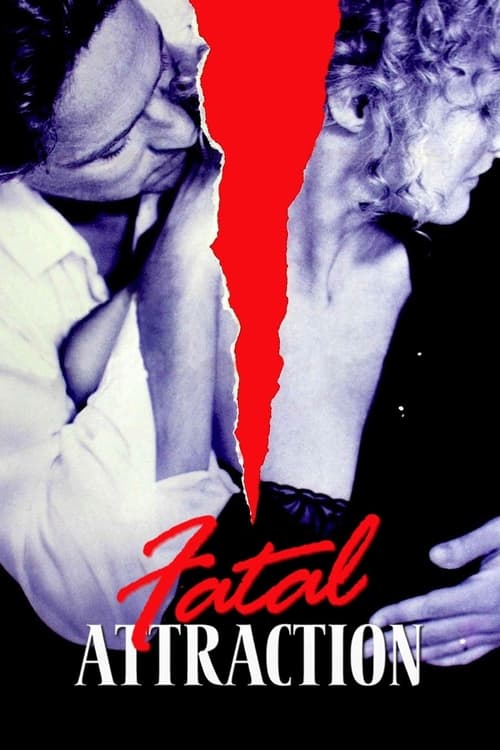
Fatal Attraction
1987 · Adrian Lyne
For when you're craving a grown-up thriller with real dread — date-night tension with an edge, or a solo watch when you want your pulse up. Not a comfort film; that's the point.
What it's about
A married Manhattan lawyer has a weekend fling while his wife is away, and assumes that's the end of it. The other woman doesn't. What begins as awkward phone calls curdles into obsession, and Dan Gallagher watches a private mistake creep toward everything he loves — his marriage, his daughter, his home.
The experience
A slow tightening of the screws — glossy, adult, and genuinely nerve-shredding by the end. It's the rare thriller that doubles as a squirm-inducing moral drama: you're scared and implicated at the same time.
Performances
Glenn Close is astonishing — she makes Alex wounded, magnetic, and terrifying all at once, refusing to play a simple villain. Michael Douglas is perfectly cast as a man watching his comfortable life come apart, and Anne Archer brings quiet steel as his wife.
The craft
Adrian Lyne directs with sleek, sensual precision, building menace out of ordinary domestic spaces — kitchens, bathtubs, phone lines — until home itself feels unsafe. The editing ratchets the last act into one of the most effective suspense climaxes of its decade.
Why it matters
A colossal hit that defined the erotic thriller for a generation, sparked national arguments about infidelity and how the film treats its 'other woman,' and added 'bunny boiler' to the language.
Snapshot
Fatal Attraction is the film that turned a private moral lapse into a national parable. A successful Manhattan attorney, Dan Gallagher (Michael Douglas), has a weekend affair with an editor, Alex Forrest (Glenn Close), while his wife and daughter are away; when he tries to end it, Alex refuses to be discarded, escalating from wounded reproach to surveillance, self-harm, and finally lethal violence against his family. Released by Paramount in the autumn of 1987, Adrian Lyne's film became one of the defining commercial and cultural events of its decade — a glossy, expertly tooled suspense melodrama that audiences argued about on the way out of the theater. It crystallized the late-1980s erotic thriller, gave the language the phrase "bunny boiler," and became a lightning rod in debates about marriage, working women, and feminist backlash. Beneath the marketing slickness is a genuinely accomplished piece of genre filmmaking, anchored by Close's fearless, deliberately unsympathetic performance and by a structure that converts adultery-guilt into home-invasion terror.
Industry & production
The project originated not as a Hollywood pitch but as a British short. Writer James Dearden had made a forty-five-minute film for British television, Diversion (1980), about a married man's weekend fling and its unsettling aftermath. The producing team of Stanley Jaffe and Sherry Lansing — Lansing had recently left her post as president of 20th Century Fox to produce independently — saw in the material the bones of a mainstream thriller and developed it with Dearden into a feature for Paramount. The Jaffe-Lansing partnership would go on to specialize in exactly this register of adult, issue-adjacent commercial drama.
Casting proved consequential. Michael Douglas, then transitioning from television and producing into leading-man stardom (and, the same year, winning acclaim as Gordon Gekko in Wall Street), took the role of an everyman whose appeal depends on his ordinariness rather than heroism. Glenn Close, established as a refined, maternal screen presence from The World According to Garp, The Big Chill, and The Natural, campaigned against type for Alex; the casting against her image is part of why the performance lands. Anne Archer played Beth, the wife, in a role the film progressively elevates from background figure to avenging center.
The production's most documented episode is the ending. As originally shot, the film followed Dearden's conception: Alex, broken and abandoned, takes her own life by cutting her throat while Puccini's Madame Butterfly plays, having arranged matters so that Dan would be implicated in her death — a tragic, operatic resolution in which she is at once victim and instrument of his ruin. Test-screening audiences reportedly rejected this; they wanted Alex punished and the family vindicated. Paramount and the producers ordered a new climax, the now-famous bathroom sequence in which Alex attacks Beth and is shot. The reshoot reframed the film from tragedy of a discarded woman to thriller of a threatened household. Glenn Close is widely reported to have resisted the change, believing it betrayed the psychology she had built; she ultimately performed it. The episode is one of the most cited cases in studies of how preview testing reshapes American movies.
The film was a major commercial success — among the largest hits of 1987 and, by most accounts, the year's top-grossing release worldwide. It earned six Academy Award nominations, including Best Picture, Best Director (Lyne), Best Actress (Close), Best Supporting Actress (Archer), Best Adapted Screenplay (Dearden), and Best Film Editing; it won none, in a year dominated at the ceremony by The Last Emperor.
Technology
Fatal Attraction is, technically, a conventional late-1980s 35mm studio production, and its sophistication lies in deployment rather than novelty. There are no special-effects set pieces; the "technology" of the film is the high-finish apparatus of commercial cinematography that Lyne and his peers had imported from advertising — fast lenses, controlled practical lighting, atmospheric haze, and a polished image surface. The reshot ending, requiring the recall of cast and the rebuilding of the Gallagher bathroom set months after principal photography, is the production's notable logistical fact rather than any technical innovation. The film belongs to the analog studio tradition at a moment just before digital tools entered post-production.
Technique
Cinematography
Howard Atherton's photography gives the film its seductive, treacherous gloss. The visual scheme draws a sharp contrast between worlds: the warm, lamp-lit, slightly disordered intimacy of Alex's downtown loft — all rain on windows, candlelight, and a sweaty, close-pressed sensuality — against the cooler, ordered domesticity of the Gallaghers' apartment and, later, their country house. Atherton works extensively with practical sources and low-key lighting, and Lyne's advertising sensibility shows in the tactile rendering of surfaces: wet streets, steam, white sheets, the famous kitchen-sink encounter. As the film tips into thriller, the palette and framing tighten, the loft's romantic chiaroscuro curdling into something menacing, so that the same stylistic language that sold the affair now sells the dread.
Editing
Cut by Michael Kahn and Peter E. Berger, the film was Oscar-nominated for its editing, and the nomination is earned in the back half. The escalation is paced as a tightening screw — Alex's intrusions arrive at quickening intervals — and the climactic bathroom sequence is a model of suspense construction, exploiting the false reassurance of a drowned body that rises again, a shock beat assembled in the cutting room as much as on set. The editing also bears the scar of the reshoot: the film's two halves shift register, from relationship drama to horror-inflected thriller, and the cutting works to make that tonal pivot feel like escalation rather than rupture.
Mise-en-scène / staging
Lyne stages the film as a contrast of domesticities. Production design opposes Alex's stark white loft, isolated in a meatpacking-district industrial zone, against the soft clutter of the Gallagher home; the eventual move to a suburban house literalizes Dan's flight toward family sanctuary and makes the final invasion a violation of that refuge. Recurring objects carry meaning — the white dress, the kitchen knife, the bathtub, and most notoriously the child's pet rabbit, whose fate gives the staging its single most infamous image. The Gallagher daughter and the family dog are positioned as stakes, the apparatus of normal life weaponized by the plot.
Sound
Maurice Jarre's score is restrained where the genre might invite excess, but the film's defining sonic element is borrowed: Puccini's Madame Butterfly. Alex plays the opera, and its presence supplies an interpretive key — she aligns herself with Cio-Cio-San, the woman who gives everything to a man who treats the union as temporary and is destroyed by his desertion. In the original ending the Butterfly motif culminated in her operatic suicide; even in the released version the music marks Alex as a figure of tragic abandonment, complicating the thriller's later effort to render her simply monstrous.
Performance
The film is a showcase for three performances. Michael Douglas plays Dan as deliberately unexceptional — weak, evasive, recognizably ordinary — which makes the audience's complicity uncomfortable; he is neither blameless nor a villain. Glenn Close's Alex is the film's engine and its conscience: she charts a continuous descent from charming and self-possessed through desperate to deranged, and crucially she keeps visible the wound beneath the menace, so that even the most lurid moments retain a residue of genuine grief. Anne Archer's Beth grows from sympathetic background wife into the figure who finally fires the gun, and her Oscar-nominated work supplies the emotional ballast the climax requires.
Narrative & dramatic mode
The film operates as a moral cautionary tale grafted onto a suspense thriller. Its first movement is the classic structure of transgression: temptation, indulgence, the attempt to return to normal life. Its second movement converts consequence into persecution — the discarded lover as relentless antagonist — so that a story about guilt becomes a story about survival. The dramatic mode is melodrama in the strict sense: heightened emotion, clear moral stakes, a domestic order threatened and (in the released cut) restored. The reshot ending matters precisely because it changes the mode: Dearden's original is tragedy, in which the affair destroys two people and the moral is about the cost of betrayal; the studio ending is thriller-melodrama, in which evil is externalized in Alex and expelled by the wife's gun, allowing the family — and the guilty husband — to be saved.
Genre & cycle
Fatal Attraction is a foundational text of the late-1980s/early-1990s erotic thriller, the cycle in which sexual desire and lethal danger are fused and a transgressive woman threatens a bourgeois man's life. It looks back to the woman's-revenge and "other woman" traditions and to film noir's fatal femmes, and it looks forward to a wave of imitators. Its most direct descendant is Basic Instinct (1992), which reunites Douglas and Lansing and pushes the formula toward explicit provocation; the cycle also includes lower-budget "from hell" thrillers — the nanny, the tenant, the roommate — that transplant Fatal Attraction's template of the intimate intruder into other domestic relationships. The film effectively standardized a genre grammar that the early 1990s would mass-produce.
Authorship & method
Adrian Lyne is the film's controlling sensibility. A Briton who, like Ridley Scott, Tony Scott, Alan Parker, and Hugh Hudson, came up through British television commercials, Lyne brought to features an advertising-honed command of surface, atmosphere, and eroticized image. His earlier Flashdance (1983) and 9½ Weeks (1986) had already marked him as a director preoccupied with desire and its photogenic textures, and his later Indecent Proposal (1993), Lolita (1997), and Unfaithful (2002) confirm infidelity and transgressive sexuality as his career-long subject. Fatal Attraction is in this sense thoroughly authored, even as it was reshaped by the studio.
His key collaborators define the result as much as he does. James Dearden supplied the source and screenplay, and his original conception — visible in the discarded ending — represents a road not taken, a more tragic film submerged inside the commercial one. Cinematographer Howard Atherton built the seductive-then-sinister look. Editors Michael Kahn and Peter E. Berger engineered the suspense and smoothed the reshoot's seam. Composer Maurice Jarre, and Puccini behind him, set the emotional register. And producers Jaffe and Lansing exercised the decisive authorship of the marketplace: the choice to test the film and change its ending is itself an authorial act, one that determined how millions would understand the story.
Movement / national cinema
The film belongs to mainstream American studio cinema, but it carries the imprint of the British "ad-men" diaspora that reshaped Hollywood's commercial look in the 1980s. Lyne, his compatriots, and their shared commercials background constitute a loose stylistic movement — high-gloss, image-forward, emotionally direct filmmaking — distinct from both the auteur-driven New Hollywood of the 1970s and the franchise spectacle that was rising alongside it. Fatal Attraction is one of that tendency's signature achievements: a European-trained eye applied to an utterly American anxiety.
Era / period
The film is inseparable from its moment. It arrives at the height of Reagan-era family-values discourse and amid acute anxiety about sexually transmitted disease in the early years of the AIDS crisis, when the cost of a casual encounter could be coded as catastrophic. It also lands in the middle of a cultural argument about working women and feminism: Susan Faludi's Backlash (1991) would later read Alex Forrest as an emblem of how popular culture pathologized the single, independent, professionally ambitious woman, punishing her for existing outside marriage. The film's terror depends on a yuppie ideal of the dual-income family and the renovated apartment and the country house — the very prosperity of the late-1980s professional class — and on the dread that it might be taken away.
Themes
At its core the film concerns the consequences of betrayal and the fragility of the family as an institution. It dramatizes male guilt and evasion — Dan's wish to enjoy transgression without paying for it — and the refusal of the wronged woman to be erased. It is preoccupied with possession and obsession: Alex's demand to be acknowledged ("I won't be ignored," in the film's most quoted register) reads alternately as madness and as a legitimate, if monstrous, protest against being treated as disposable. The Madame Butterfly motif frames the affair as a tragedy of abandonment. And the film stages an anxiety about female autonomy: Alex is independent, sexual, and unmarried, and the narrative ultimately requires that she be destroyed and the domestic order — wife, daughter, restored husband — reinstated. Whether the film endorses that restoration or merely delivers it under audience pressure is the central interpretive question its production history forces.
Reception, canon & influence
Fatal Attraction was both a commercial phenomenon and a cultural flashpoint. It drew large, vocal audiences — reports of viewers shouting at the screen during the climax are part of its lore — and provoked extensive commentary in the press about marriage, fidelity, and the war between the sexes. Critically it was respected as a superior example of its kind, and the Academy's six nominations registered industry esteem even as it went home empty-handed. Close's performance has endured as the consensus high point, frequently cited among the great screen portrayals of a "villain" who exceeds the category.
Its influences run backward to the fatal women of film noir, to Clouzot's Les Diaboliques (whose drowned-body-that-rises shock the climax echoes), to Play Misty for Me (1971), Clint Eastwood's earlier thriller of an obsessive spurned lover, and to the long melodramatic tradition of the abandoned woman, with Puccini as its explicit operatic ancestor. Its forward legacy is large. It established the commercial template for the erotic thriller and the "intruder in the home" subgenre that flourished into the 1990s; it made Lansing and Douglas the presiding figures of the cycle, leading directly to Basic Instinct. It entered everyday language: "bunny boiler" became shorthand for a vengeful, obsessive ex, a sign of how thoroughly the film penetrated popular consciousness — though it is worth noting how that phrase reduces Close's complex characterization to a single grotesque image. The film has remained a fixture of feminist film criticism precisely because it is so legible as backlash, and its contested ending is a standard teaching case in discussions of authorship, preview testing, and the economics of the Hollywood resolution. A 2023 streaming-television series reprised the premise for a new era, evidence of the property's continuing recognition. More than thirty years on, Fatal Attraction persists less as a film people merely admire than as one they keep arguing with — which may be the surest measure of its hold.
A Deleuzian reading
Alex Forrest's loft sits where they butcher animals.
The full Deleuzian reading of Fatal Attraction →
Reception
A monster hit in 1987 — the year's biggest box-office phenomenon and a six-time Oscar nominee — it was read then as a cautionary tale about the 'other woman'; now the reappraisal runs the opposite way, with Alex Forrest widely reclaimed as the wronged party and the film discussed as a time capsule of 80s backlash politics.
How Fatal Attraction was received, from release to now →
Influences: the films it descends from and the films it influenced
- Les Diaboliques (1955) — The bathtub climax lifts Clouzot's drowned-body-that-rises shock — the presumed-dead antagonist surging back to life from water as the final jolt.
- Play Misty for Me (1971) — Supplies the exact structural template: a casual sexual encounter curdles into a spurned woman's escalating, knife-wielding home invasion of the man's domestic life.
- Psycho (1960) — Establishes the bathroom as primary kill-site and the suspense grammar of weaponizing ordinary domestic objects, both reprised in the climactic struggle.
- Repulsion (1965) — Models the apartment-as-psyche, rendering a woman's sexual derangement through claustrophobic close-quarters staging that Lyne echoes in Alex's spiraling interiors.
- Double Indemnity (1944) — Atherton's seductive-then-sinister low-key chiaroscuro and the lethal-desire femme fatale descend directly from this noir lighting and archetype.
- Madame Butterfly (1974 film of the opera) (1974) — Provides the abandoned-woman operatic register; Alex's obsessive playing of Puccini is the film's explicit musical-leitmotif citation of the betrayed lover who destroys herself.
- The Postman Always Rings Twice (1981) — A mainstream culmination of the erotic-thriller current Postman helped seed, foregrounding sexual obsession-as-doom for a glossy commercial register.
- Cape Fear (1962) — Relocates the obsessive, legally-untouchable stalker into the suburban nuclear family, extending the family-under-siege thriller Cape Fear founded.
- Body Heat (1981) — Extends the glossy erotic-thriller cycle Body Heat seeded — desire filmed as overheated atmosphere tipping into deadly consequence — into the marquee studio version of the form.
- The 4th Man (1983) — Mainstreams the glossy, eroticized femme-fatale-as-lethal-threat thriller whose arthouse success The 4th Man helped seed in the US market.
- Basic Instinct (1992) — The direct commercial heir of the Douglas/Lansing erotic-thriller template, again pairing Michael Douglas with a lethal woman and a weaponized domestic object (the ice pick).
- The Hand That Rocks the Cradle (1992) — Codifies the 'intruder in the home' subgenre this film launched — a vengeful woman infiltrating and detonating an intact nuclear family from within its own house.
- Single White Female (1992) — Extends the obsessive-intruder formula into the shared apartment, building suspense from a fixated woman's invasion of domestic space and identity.
- Sleeping with the Enemy (1991) — Inherits the domestic-thriller staging of the home as battleground, mining terror from familiar household objects and rooms turned threatening.
- Disclosure (1994) — Reworks the Michael Douglas gender-backlash erotic thriller, again framing a transgressive woman as predatory threat to a man's family and career.
- Unfaithful (2002) — Lyne reprises his own template of glossy infidelity tipping into domestic violence, with weaponized household objects and the suspense-of-the-cover-up structure.
- Cape Fear (1991) — Carries forward the intact-family-besieged-by-an-avenging-outsider structure, with the climax again relocating the threat into the family's own domestic sanctuary.
- Gone Girl (2014) — Inverts the 'bunny boiler' discourse this film spawned, self-consciously weaponizing the vengeful-woman melodrama and its feminist-backlash framing as deliberate narrative critique.
- Babygirl (2024) — Codifies the corporate-affair-as-thriller template with a punishing moral structure that Babygirl deliberately inverts by refusing to destroy its transgressor.
- The Housemaid (2025) — Defines the glossy domestic-erotic-thriller surface in which aspirational bourgeois interiors are invaded, and the adversarial woman becomes the agent of sexual and class disorder.
- Lolita (1997) — Supplied both Howard Atherton and the working grammar Atherton reuses here — long lenses wide open so the frame holds one face in focus inside a soft luminous surround, practical-source backlight through curtains and blinds, and a slow escalation structure in which each domestic interior is restaged later as a trap.
- 9½ Weeks (1986) — Lyne's own immediately prior film perfects the eroticized, advertising-honed surface — atmospheric backlight, fetishized texture — that he carries straight into this thriller.
- The Hunger (1983) — A fellow British-admen-diaspora debut applying the same glossy commercial-trained aesthetic of smoke, gauze, and high-fashion eroticism to genre horror-thriller material.
- Jagged Edge (1985) — Contemporary erotic-thriller that casts Glenn Close as the sexually-entangled lead, the immediate precedent for her against-type pivot into the genre.
- Leave Her to Heaven (1945) — Direct heir to the erotic-obsession domestic-thriller cycle of the beautiful, fixated partner who destroys a family from within, Ellen's jealousy modernized into stalking.
Similar films
- Basic Instinct (1992) — influence & lineage
- Double Indemnity (1944) — influence & lineage
- Gone Girl (2014) — influence & lineage
- Possession (1981) — shared sensibility
- Body Heat (1981) — shared sensibility
- Dressed to Kill (1980) — shared sensibility
- Rear Window (1954) — shared sensibility
- Body Double (1984) — shared sensibility
All the films related to Fatal Attraction →