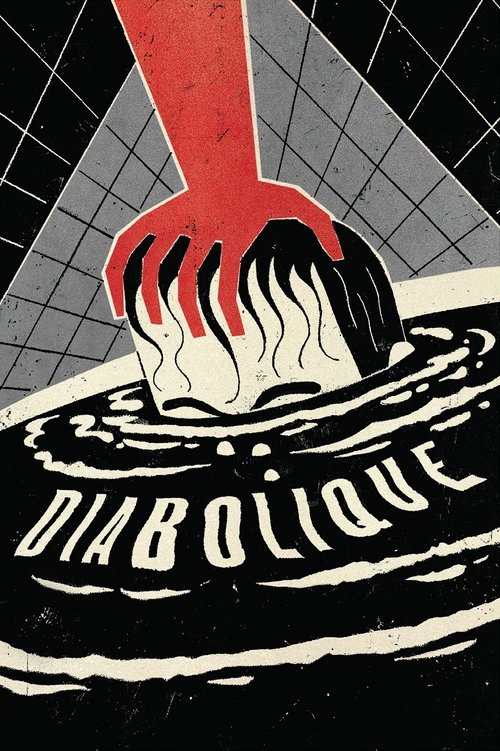
Diabolique
1955 · Henri-Georges Clouzot
When you're craving a real scare of the creeping kind — no monsters, just mounting wrongness — and you want a twist you genuinely won't see coming. Best watched knowing as little as possible; the film itself ends by begging you not to spoil it.
What it's about
At a run-down boys' boarding school, the tyrannical headmaster torments both his fragile wife and his mistress — until the two women join forces to drown him and stage it as an accident. The plan seems to work. Then his body vanishes from where they left it, and small, impossible signs begin to suggest the dead man isn't finished with them.
The experience
A slow strangulation of the nerves — clammy, quiet, and mercilessly controlled, ratcheting from guilt to dread to one of the most famous finales in thriller history. Even seventy years on, the last stretch can make an audience gasp.
Performances
Simone Signoret is superb as the cool, watchful mistress, playing off Véra Clouzot's trembling, guilt-sick wife — the film runs on the friction between one woman's nerve and the other's unraveling. Paul Meurisse makes the headmaster hateful enough that you sign on to the murder immediately.
The craft
Clouzot directs in grubby, unglamorous black and white — drained swimming pools, dim corridors, institutional decay — and builds terror from ordinary objects: a wicker hamper, a suit at the cleaners, a photograph. The plotting is watchmaker-precise, every detail planted to pay off, and the near-total absence of music makes the silences do the frightening.
Why it matters
It beat Hitchcock to the novel and then influenced him anyway — its shock construction and 'don't reveal the ending' campaign paved the way for the twist-thriller as we know it, and it's been imitated and remade ever since.
Snapshot
Les Diaboliques is the film that taught the postwar thriller how to lie to its audience and make the lie feel like a gift. Adapted from Pierre Boileau and Thomas Narcejac's novel Celle qui n'était plus, it strands two women — the frail, devout wife Christina and the brittle, watchful mistress Nicole — in a conspiracy to drown the man who torments them both, the petty tyrant Michel Delassalle, headmaster of a decaying provincial boarding school. The murder is the film's first act, not its climax. What follows is a slow strangulation of nerves: a corpse that will not stay where it was put, a drained swimming pool, a photograph, a pair of footprints, until the body's reappearance detonates a final reversal that has become one of cinema's most imitated. Clouzot caps it with a closing card begging audiences not to spoil the ending for those who haven't seen it — a piece of showmanship that also names the film's governing ethic: complicity. Les Diaboliques implicates the viewer in its own deception and treats dread as a matter of plumbing, damp corridors, and bad institutional food rather than the supernatural.
Industry & production
The film emerged at the peak of Clouzot's commercial and critical authority. He had just won the Grand Prize at Cannes with Le Salaire de la peur (The Wages of Fear, 1953), and Les Diaboliques was produced through his own production setup — Vera Films, named for his wife Véra Clouzot, in association with Filmsonor. The acquisition of the source novel has become industry legend: Clouzot is widely reported to have secured the rights to the Boileau-Narcejac book just ahead of Alfred Hitchcock, who is said to have been pursuing it himself. Boileau and Narcejac subsequently wrote D'entre les morts with Hitchcock in mind; he adapted it as Vertigo (1958). The exact margins of that race are the stuff of anecdote and should be treated as well-established lore rather than documented contract history, but the rivalry is real enough that the two films are permanently linked.
Production was a French studio-and-location affair shot in black and white in the standard Académie ratio. The school setting — a shabby, underfunded internat — was central to the film's economy of means; Clouzot extracted atmosphere from genuinely unglamorous interiors, peeling paint, and provincial dreariness rather than from built spectacle. Clouzot's reputation as a despotic perfectionist, already established on Wages of Fear, shadows the production: accounts from collaborators, Simone Signoret among them, describe a director who courted real exhaustion and discomfort from his cast in pursuit of authenticity. The film was a substantial success on release and won the Prix Louis Delluc; it also drew international attention, including in the United States, where it helped build Clouzot's reputation abroad as a French answer to Hitchcock.
Technology
Les Diaboliques is not a film of technical innovation, and it would misrepresent it to claim otherwise. It uses orthodox mid-1950s tools — black-and-white stock, conventional studio lighting, the Académie frame — and its power comes from how austerely those tools are deployed. The most consequential "technological" choice is a negative one: the near-total absence of a musical score. Where contemporary thrillers leaned on orchestration to cue fear, Clouzot largely strips music away, leaving diegetic sound — dripping water, footsteps, a flushing toilet, the hum of an empty building — to carry tension. This is an aesthetic decision realized through restraint rather than apparatus, and it is the film's defining "technical" signature.
Technique
Cinematography
Armand Thirard, who had also shot The Wages of Fear, photographs the film in a deglamorized, high-contrast monochrome that treats the boarding school as a place of perpetual damp. The visual scheme is functional and grim: flat institutional light in the schoolrooms, deep shadow in corridors and the headmaster's lodgings, and a clammy texture to surfaces — water, tile, wet pavement — that keeps the body and its disposal physically present in the mind. The framing favors entrapment, boxing the women within doorways and windows, and reserves its most famous compositional shock for the climactic bathroom, where the long-feared corpse rises. Thirard's restraint matters: the camera rarely shows off, which makes its few aggressive moves and the late horror imagery land with disproportionate force.
Editing
Madeleine Gug's cutting governs the film's signature tempo — a deliberate, almost punishing slowness that converts waiting into suspense. Les Diaboliques is built on duration: the protracted drowning, the transport and concealment of the body, the agonizing days during which the corpse fails to surface. The editing withholds, letting scenes run past the point of comfort so that the eventual jolts feel earned rather than manufactured. The final sequence depends entirely on rhythmic control, releasing its reversal in stages so the audience's understanding collapses at the same pace as Christina's.
Mise-en-scène / staging
The school is the film's master device. Clouzot stages cruelty and decay as institutional facts: spoiled fish served at dinner, a drained and dredged swimming pool, cramped lodgings, the constant low-grade humiliation of underpaid teachers and neglected boys. The pool — a body of water that ought to give up the body but doesn't — is the central staging conceit, an empty rectangle that mocks the women's expectations. Clouzot composes the headmaster's apartment and the school's public spaces as overlapping prisons, and uses the boarding-school routine (bells, supervision, collective meals) as a clock against which the conspiracy's unraveling is measured.
Sound
Sound is where Les Diaboliques is genuinely radical. By refusing a conventional score for long stretches, Clouzot makes the audience listen to the building. Water is the recurring motif — dripping, running, the bath — and the soundtrack's quiet turns ordinary noises into threats. The much-discussed bathroom climax is as much a sound event as an image, and the typewriter, footsteps, and silences throughout do the work a musical cue would do in a lesser thriller. The discipline is total: tension is produced by what is heard in the absence of reassurance.
Performance
The film rests on three performances. Véra Clouzot plays Christina as a genuinely fragile figure — pious, heart-weakened, increasingly unstrung — and the role's cardiac vulnerability acquires a grim resonance given that the actress herself suffered from a heart condition and died young in 1960. Simone Signoret's Nicole is the counterweight: cool, hard, sunglasses-and-cigarette modern, holding the audience's trust precisely so it can be betrayed. Paul Meurisse makes Michel a study in mundane sadism, a man whose cruelty is bureaucratic and intimate rather than theatrical. Charles Vanel, as the rumpled, persistent retired detective Fichet, supplies the film's only warmth and its investigative engine, a deliberately shabby figure who sees more than he admits.
Narrative & dramatic mode
The film's dramatic mode is the inversion of the detective story. It is structured as a "perfect crime" thriller that almost immediately curdles into something closer to horror, then resolves as a sting. By committing the murder early and withholding the body, Clouzot relocates suspense from whodunit to what is happening — a register of mounting unreality in which the protagonists, and the audience, lose their grip on whether the dead man is truly dead. Crucially, the film aligns the viewer with the conspirators rather than the law, so the dread is the dread of being found out, then the more vertiginous dread that the crime may not have worked at all. The closing reversal recontextualizes everything that came before, a structural twist that depends on the audience having accepted a false point of view as reliable.
Genre & cycle
Les Diaboliques sits at the hinge of several genres: the French policier, the psychological thriller, and — in its final movement — outright horror. It belongs to the Boileau-Narcejac cycle of literary suspense built on identity, deception, and the dead-who-aren't, a strain that runs directly into Hitchcock's Vertigo and into later twist-driven cinema. Within French production of the 1950s it represents the high-craft commercial thriller, distinct from both Hollywood noir and the about-to-arrive New Wave. Its lasting genre legacy is the "horror-thriller of the unstable real," in which domestic and institutional spaces become sites of terror.
Authorship & method
Les Diaboliques is unmistakably a Clouzot film, and Clouzot's authorship is inseparable from his method. A meticulous, controlling director with a documented reputation for cruelty toward his collaborators, he built suspense through accumulation, physical detail, and a misanthropic eye for human weakness — qualities that earned him the "French Hitchcock" tag while remaining distinctly his own, bleaker and more disgusted with his characters. He co-wrote the screenplay (with collaborators including Jérôme Géronimi), adapting and crucially altering the source: where Boileau-Narcejac's novel centers on a man and his mistress conspiring against the man's wife, Clouzot reconfigured the triangle so that two women conspire against the husband, a change that reshapes the film's sexual and emotional dynamics.
His key collaborators recur across his work. Cinematographer Armand Thirard and the production team carried over from The Wages of Fear, giving the two films a shared austerity. Editor Madeleine Gug shaped the film's crucial sense of duration. The most distinctive authorial-collaborative choice is again the renunciation of a scoring composer's services for most of the film. And Véra Clouzot's presence — as star and as the namesake of the production company — makes the film a personal as well as a professional project for the director.
Movement / national cinema
The film is a landmark of the French "tradition of quality" — the polished, screenwriter-driven studio cinema that the young critics of Cahiers du cinéma would soon attack. Clouzot was a frequent target of that polemic, cast as the establishment against which the New Wave defined itself. Yet Les Diaboliques complicates the caricature: its formal control, its location-grounded realism, and its refusal of consolation make it more than a well-made commercial product, and it has been retrospectively absorbed into the canon of French cinema as one of the era's enduring achievements. It stands as evidence that the pre-New-Wave French industry could produce work of genuine darkness and rigor.
Era / period
Made a decade after the Occupation, Les Diaboliques carries the period's deglamorized texture — postwar austerity, institutional shabbiness, a society of small economies and smaller cruelties. The boarding school is a microcosm of a France of limited means and grinding routine, and the film's morality is appropriately bleak: no character is innocent, and authority (in the person of the headmaster) is contemptible. Coming just before the rupture of 1959–60, it belongs to the last confident phase of the classical French studio thriller.
Themes
The film's central themes are complicity and abuse. The marriage and the affair are both structured by Michel's domination, and the women's alliance is born of shared subjugation — a solidarity that the ending exposes as itself a trap. Religion threads through Christina's characterization, setting her piety and physical frailty against Nicole's worldly hardness. Water recurs as a motif of concealment and revelation, the medium that should hide the crime and instead refuses to. Above all the film is about perception and trust: the terror of not knowing whether what you see is real, and the moral cost of a deception that the film extends from its characters to its audience. Institutional cruelty — the school as a machine for petty tyranny — frames the personal cruelties as part of a larger order.
Reception, canon & influence
Les Diaboliques was both a popular success and a critical landmark, winning the Prix Louis Delluc and consolidating Clouzot's international standing. Influences on the film run primarily through its literary source — the Boileau-Narcejac school of identity-and-deception suspense — and through the broader traditions of the French policier and the well-made studio thriller; the inevitable Hitchcock comparison is more a matter of parallel sensibility and the shared scramble for Boileau-Narcejac material than of direct borrowing.
Its influence forward is enormous and well documented in outline. The film is repeatedly cited as a decisive precedent for Hitchcock's Psycho (1960) — in its willingness to kill structure and expectation, its bathroom horror, and its manipulation of audience allegiance — and the rights rivalry fed directly into Vertigo. More broadly, Les Diaboliques established the template for the modern twist thriller and the "is the body really dead" subgenre, influencing the Italian giallo, the psychological horror of unstable domestic space, and decades of films built on a late, perception-shattering reversal. It was remade in Hollywood in 1996 as Diabolique, a version generally regarded as a pale shadow of the original, which itself testifies to the durability of Clouzot's design. Its closing plea against spoilers anticipated the marketing of suspense as a contract with the audience, a strategy Hitchcock would make famous. Today the film is firmly canonical — a fixture in histories of the thriller and of French cinema — admired precisely for achieving terror through restraint, patience, and a cold understanding of how trust can be weaponized.
A Deleuzian reading
Start with the swimming pool.
The full Deleuzian reading of Diabolique →
Reception
A sensation on release — it won the Prix Louis Delluc and became an international hit that had audiences sworn to secrecy — and its reputation has never really dipped; it's gone from thriller-of-the-moment to permanent fixture of the suspense canon.
How Diabolique was received, from release to now →
Influences: the films it descends from and the films it influenced
- Le Corbeau (1943) — Clouzot's own template for misanthropic suspense set in a decaying provincial institution, weaponizing communal suspicion through patient accumulation of mundane detail rather than shocks — the method Diabolique inherits wholesale.
- The Wages of Fear (1953) — The same production team — Armand Thirard's high-contrast monochrome and Madeleine Gug's editing — carried over, establishing the duration-as-suspense rhythm where the camera simply waits, stretching real time until ordinary action becomes unbearable.
- Gaslight (1944) — Codified the methodical psychological erosion of a fragile wife by an intimate, turning domestic trust into a slow-acting weapon — the engine of Nicole and Christina's campaign against Christina's own perceptions.
- M (1931) — Built dread out of procedural patience and high-contrast monochrome in banal civic spaces, proving the policier could generate horror through method and waiting rather than spectacle.
- Le Jour se lève (1939) — Poetic-realist entrapment framing and tradition-of-quality studio austerity — characters boxed by architecture and shadow — that Clouzot adopts to make the boarding school feel like a closing trap.
- The Spiral Staircase (1946) — Chiaroscuro woman-in-peril suspense staged inside a large decaying house, using the institutional interior itself as the source of menace, prefiguring Diabolique's school-as-prison.
- Shadow of a Doubt (1943) — Mundane sadism hidden behind a domestic everyman, with suspense built on the audience knowing the killer's banality before the victim does — Clouzot sharpens this into Paul Meurisse's cold cruelty.
- Sudden Fear (1952) — Carries forward the imperiled-woman-turned-conspirator structure and the meticulously timed suspense set-piece built around physical evidence, escalating Sudden Fear's accelerating-cut climax method.
- Vertigo (1958) — Born of the same scramble for Boileau-Narcejac source material, it shares the central conceit of a staged death and an identity-deception plot weaponizing a survivor's grief and unreliable perception.
- Psycho (1960) — Directly descends in its early-murder structural inversion, its bathroom horror, its manipulation of audience allegiance, and its closing no-late-admittance plea that turned spoiler-protection into a marketing contract.
- Eyes Without a Face (1960) — Extends the French strain of restrained, clinical horror set in a decaying institutional house, achieving terror through austerity and the drained, antiseptic image rather than gore.
- What Ever Happened to Baby Jane? (1962) — Two women locked in mutual psychological abuse inside a rotting house, sustaining dread through mundane domestic sadism and high-contrast monochrome — Diabolique's complicity-and-abuse dynamic transplanted.
- Carnival of Souls (1962) — Builds an entire film on an unreliable POV and a perception-shattering reversal about whether the protagonist is already dead — the 'is the body really dead' subgenre Clouzot launched.
- Blood and Black Lace (1964) — Founding giallo that inherits Diabolique's late perception-shattering reversal and its taste for elaborately staged, water-and-tile set-piece killings drawn out for duration.
- Repulsion (1965) — Extends the unstable-domestic-space horror with entrapment framing and amplified diegetic sound — dripping water, ticking — used to dramatize a woman's disintegrating perception in place of score.
- Don't Look Now (1973) — Inherits the drowning/water motif and the closing perception-shattering reversal that retroactively reframes everything the grieving protagonist (and audience) believed they saw.
- The Sixth Sense (1999) — Modern apotheosis of the twist-as-audience-contract and the retroactive POV reframe — its marketing of secrecy is the direct heir of Diabolique's anti-spoiler closing plea.
- The Others (2001) — Combines slow institutional-house dread, score-restraint, and an are-they-already-dead reversal — an explicit late descendant of Clouzot's design for terror through patience and withheld information.
- Inside Man (2006) — Clouzot's inverted-locked-room puzzle — the audience discovers the criminals were operating from inside the victim's position all along, inverting the apparent power geometry — supplies Inside Man's epistemological trap: Russell's presence inside the vault from the opening is withheld until the film permits the false architecture to collapse.
- Rosemary's Baby (1968) — Clouzot's slow-build institutional conspiracy thriller — horror accruing through the accumulation of small wrong details rather than set-piece shocks, the audience's uncertainty calibrated scene by scene — is the direct methodological predecessor to Polanski's pacing architecture; Polanski has cited Clouzot explicitly.
- Dial M for Murder (1954) — The nearest contemporary European peer; Clouzot adapts a theatrical crime source using the inverted-mystery structure, maps the crime in precise spatial diagrams of a confined institutional space, and builds its climax on the logic of contingency defeating a perfect plan — the exact structural logic Dial M enacts with Tony Wendice's unraveling scheme.
- Strangers on a Train (1951) — Clouzot's murder conspiracy uses the same sinister-festive inversion — a school's domestic routine as backdrop to a plotted killing — and sustained parallel-cutting between the conspirators' dread and the institution's normalcy that Hitchcock deploys between Bruno's fairground mission and Guy's tennis match; the definitive contemporaneous French parallel to Strangers in the psychological-thriller genre.
- The Invisible Guest (2017) — Models the chamber-scale thriller whose final act reveals an impersonation and a staged death engineered by a hidden accomplice, mirroring Paulo's substitution-of-identity endgame.
Similar films
- Psycho (1960) — influence & lineage · same viewing thread
- Repulsion (1965) — influence & lineage · often watched together
- Le Corbeau (1943) — influence & lineage
- Eyes Without a Face (1960) — influence & lineage
- The Wages of Fear (1953) — influence & lineage
- Rebecca (1940) — same viewing thread · often watched together
- Vertigo (1958) — influence & lineage · same viewing thread
- Strangers on a Train (1951) — same viewing thread
All the films related to Diabolique →
Watch it with: curated runs of related films
- The Golden Age of Suspense — A run of immaculate mid-century crime pictures — Hitchcock plus his sharpest rivals — where guilt, obsession, and dangerous romance are staged in gorgeous black-and-white; watch them close together and the shared DNA of the perfect-murder plot lights up.