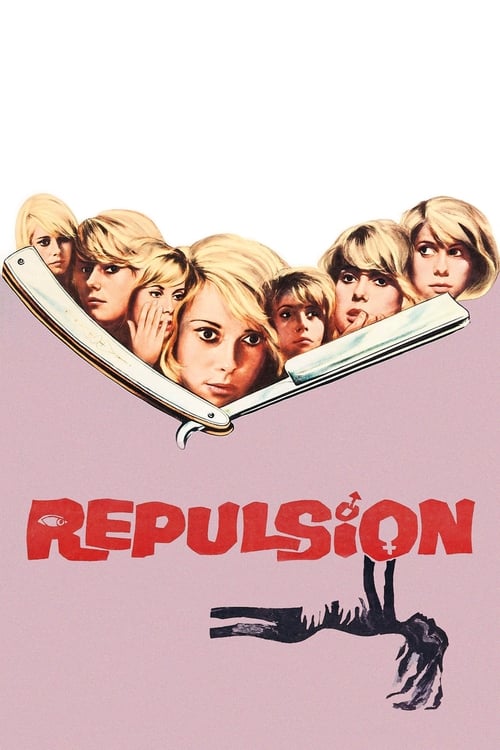
Repulsion
1965 · Roman Polanski
For when you want a real, serious scare that gets under your skin rather than at your throat — a challenge, not a comfort watch. Best alone, late, with the lights low, if you dare.
What it's about
A young Belgian manicurist named Carol lives with her sister in a London flat, beautiful and withdrawn, flinching from the men who pursue her. When her sister leaves for a holiday in Italy, Carol is alone with the apartment — and the apartment starts to change. Cracks appear, sounds grow teeth, and her private dread of male attention curdles into full hallucination.
The experience
Slow, airless, and genuinely frightening — the film traps you inside one mind as it comes apart, so ordinary things (a wall, a razor, a ringing phone) become unbearable. It builds by accumulation rather than jump scares, and it leaves a residue of unease that outlasts the runtime.
Performances
Catherine Deneuve is extraordinary in a nearly wordless role, playing terror and blankness at once — she makes catatonia magnetic, and the whole film rests on her face.
The craft
Polanski turns a single flat into a horror landscape: black-and-white photography that makes skin look like wax, sound design where dripping taps and ticking clocks become weapons, and walls that literally give way. The camera stays claustrophobically close, so you can never step outside Carol's perception. It rewards a dark room and good speakers — the silences are doing half the work.
Why it matters
The first of Polanski's celebrated apartment horrors and a template for decades of psychological horror that locates the monster inside the protagonist. It proved a horror film could be an art film without losing any of its power to disturb.
Snapshot
Roman Polanski's Repulsion is a black-and-white psychological horror film produced in Britain by Compton Films and shot largely on a purpose-built interior set. Its subject is the complete mental dissolution of Carol Ledoux (Catherine Deneuve), a Belgian manicurist in London who, left alone in her sister's flat, retreats entirely into a private world of erotic terror and violent hallucination. The film operates almost without conventional plot mechanics: it is less a narrative than a sustained phenomenological descent, charting the textures and rhythms of a collapsing consciousness from inside. At ninety-five minutes, spare and mercilessly focused, Repulsion remains one of cinema's most unsparing portraits of psychic disintegration. It was Polanski's first English-language film and the first entry in what critics later grouped as his informal Apartment Trilogy.
Industry & production
Polanski arrived in London in 1964 following the international success of Knife in the Water (1962), his Polish-language debut feature, which had earned an Academy Award nomination for Best Foreign Language Film and secured him a foothold in European co-production circles. He was recruited by British producers Michael Klinger and Tony Tenser of Compton Films, a company that typically operated in the low-budget exploitation sector — soft-core "nudies" and genre programmers. Klinger and Tenser wanted a prestige horror property that could travel internationally; Polanski and his regular writing collaborator Gérard Brach delivered a script far more austere and art-cinema-inflected than their backers may have anticipated.
The budget was modest by any standard, though precise figures in the public record are unreliable and are not reproduced here. The constraints forced a concentration of resources: rather than location-shooting across London, production designer Seamus Flannery constructed a faithful replica of the South Kensington flat interior at Twickenham Studios. This decision turned out to be enabling rather than limiting, allowing the space to be architecturally manipulated in ways that exteriors could not accommodate. The production occupied a single main location — that flat — and a handful of street exteriors, which gave the film its suffocating unity of place.
Polanski and Brach had collaborated since meeting in Paris, developing a shared sensibility around claustrophobia, sexual menace, and the vulnerability of the isolated individual. Their script for Repulsion pointedly refused to supply Carol with a clinical diagnosis or an explanatory backstory; the traumatic past is glimpsed only obliquely, most famously in the film's closing shot.
Technology
Polanski shot Repulsion in black-and-white at a moment when color was rapidly becoming the commercial default in British cinema. The choice was deliberate and aesthetically load-bearing: color would have normalized the flat's domestic surfaces, whereas high-contrast monochrome allowed the cinematography to drift toward the expressionist without losing the baseline register of gritty London realism. The black-and-white also aligned the film with the European art-cinema tradition Polanski was drawing from, signaling seriousness of purpose against the lurid Eastmancolor of contemporary Hammer productions.
The film made significant use of wide-angle and ultra-wide-angle lenses, which distort spatial relationships and produce a characteristic barrel curvature at the edges of the frame. These lenses are deployed not as neutral tools but as instruments of subjectivity: the apartment walls seem to lean inward, corridors lengthen impossibly, and Carol herself is periodically dwarfed by the geometry around her. The set for the flat was engineered to accommodate this: walls could be shifted outward between setups, physically expanding the space so that as Carol's hallucinations intensify, the rooms that contain her appear to have grotesquely grown. This practical solution to the problem of staging madness — architectural rather than optical — gave the film's visual grammar an uncanny groundedness; the viewer's unease is not the product of trick photography alone but of a real space that has been made, in production terms, actually wrong.
The practical effects for the hallucination sequences — hands erupting from corridor walls to clutch at Carol, the surface of the walls themselves fracturing along spreading crack lines — were achieved through set construction and timed mechanical rigs rather than optical printing, lending them a tactile physicality that would have been harder to sustain in a more polished visual register.
Technique
Cinematography
Gilbert Taylor, who would later shoot Star Wars (1977) and Dr. Strangelove (1964) among many others, brings to Repulsion a rigorous control of tonal range that turns the flat's décor — peeling wallpaper, stained porcelain, the reflective surfaces of beauty-salon equipment — into a landscape of latent threat. Taylor's use of available-light-style setups, even when working on a studio set, roots the film's visual world in the tradition of British social-realist cinematography while his wide-angle choices systematically violate that tradition's codes of observational neutrality. His compositions frequently place Deneuve in spatial relationships that make the human figure seem assailed by its environment: door frames that bisect her, mirrors that multiply her, ceilings that appear to press downward. The film's opening shot — an extreme close-up on the surface of an eye, which slowly pulls back to reveal Carol staring vacantly into the middle distance at the beauty salon where she works — establishes from its first frames that the film's visual investigation is inward, epidermally intimate, and suspicious of the boundary between surface and depth.
Editing
Alastair McIntyre's editing maintains a slow, deliberate rhythm that tracks Carol's withdrawal from normal time. The early sequences, when Helen and her lover Michael are still in the flat and London life pulses around Carol, are cut with a conventional pace that tightens and fragments as her isolation deepens. Transitions between Carol's objective reality and her hallucinations are made with increasing abruptness — sometimes a hard cut, sometimes an almost imperceptible dissolve — so that the film eventually relinquishes any stable grammar for distinguishing what is real. The editing of the two murder sequences is specifically notable: the killing of Carol's persistent admirer Colin is staged and cut as both banal and vertiginously sudden, stripping the act of the grandeur horror convention would usually supply.
Mise-en-scène / staging
The flat becomes the film's central protagonist through a system of object accumulation that functions as a materialist diagram of psychic breakdown. The peeled, uncooked rabbit that Carol leaves on a plate — Helen brought it home to cook before her departure — is left to rot in real time across the film, acquiring progressively more insistent screen presence as Carol's hygiene and domestic management collapse around it. The unwashed dishes, the running tap, the mold accruing on vegetables, the crack that appears in the wall and spreads in branching lines through the plaster: Flannery's production design and Polanski's staging treat the apartment as a body that decays in synchrony with its occupant's mind. The landlord's sexual advance near the film's climax is staged partly as reality, partly as Carol's violent projection, partly as the culmination of everything the space has been building toward — the collapse of the distinction between the violated body and the violated domestic interior.
Sound
The film's sound design is among the most inventive elements of its construction. Polanski and sound editor (the specific credited personnel are not reliably documented in accessible sources) deploy silence as an active presence: long passages without music or ambient sound, broken by isolated sounds — a clock's tick, a dripping faucet, the distant clang of a convent bell — that are amplified to an almost unbearable prominence. This technique, common to the psychological horror of European art cinema but applied here with exceptional precision, makes ordinary domestic sound strange and threatening. The scratch of a needle across a record, the creaking of floorboards, become tactile intrusions from outside. Chico Hamilton's score — sparse, jazz-inflected, built from unsettled percussion and dissonant brass gestures — appears intermittently rather than continuously, and the moments when it intrudes feel like auditory hallucinations in their own right. The film's use of diegetic sound is throughout a form of psychological portraiture.
Performance
Deneuve's performance is constructed almost entirely through absence and restraint. Carol speaks very little; her face registers disturbance through microexpressions, involuntary flinches, the unfocused gaze of someone whose attention has relocated entirely inward. Deneuve was twenty-one at the time of filming, already established in France through her work with Jacques Demy (The Umbrellas of Cherbourg, 1964), but Repulsion demanded a register entirely unlike the warmth of that work. Her beauty is used throughout as a provocation to the men around her and simultaneously as a kind of armor that the film gradually strips away: by the film's final stages, she is barely a social subject at all. The decision to give Carol no monologue, no scene of coherent self-expression, no therapeutic confessor, means that Deneuve must carry the film's entire phenomenological project through physical performance alone, which she does with extraordinary precision.
Narrative & dramatic mode
Repulsion has a three-part structure that the film does not mark explicitly but that is legible in retrospect. In the first part, Carol exists under the pressures of shared domestic life and the London social world — the beauty salon, her would-be boyfriend Colin, her sister Helen's relationship with the married Michael. In the second, Helen and Michael depart for Italy and Carol is left alone, the flat contracting around her as her hallucinations multiply: an intruder who rapes her in the night, hands that emerge from corridor walls to touch her body. In the third, the hallucinations have become violent acts: Carol kills Colin when he breaks down the door to check on her, then kills the landlord when he makes a sexual advance. The film ends not with police procedure or psychological resolution but with a pan across a family photograph — and a final, long zoom into the image of young Carol and an older male figure whose gaze, trained on the child, implies an abuse that the film has strategically withheld. The dossier of Carol's violence is retrospectively reframed as consequence rather than cause.
This mode — in which psychological revelation is deferred to a single, ambiguous visual disclosure at the end — owes a debt to Hitchcock but refuses Hitchcock's explanatory tidiness. The family photograph does not explain Carol; it deepens her opacity while making her sympathies newly, retroactively available.
Genre & cycle
Repulsion belongs to the tradition of what critics have variously termed psychological horror, art-horror, and the "apartment film" — a loose grouping of works in which a confined domestic space becomes the site and agent of psychological disintegration. The film sits in productive tension with the dominant British horror of its moment (the Hammer cycle, with its Gothic settings and exteriorised monsters) and represents something closer to the continental European psychological thriller. It also connects to a specifically 1960s interest in female hysteria and breakdown: the same moment produced Bergman's Persona (1966), Cassavetes's A Woman Under the Influence (1974, though made later), and Varda's work. Whether Repulsion belongs to this feminist lineage or exploits the same materials it critiques has been a point of ongoing scholarly contestation.
Authorship & method
Polanski's authorship in Repulsion is legible partly through his consistency with the preoccupations that structure his broader career: the siege of interiority by external and internal menace, the apartment as psychic container, sexual violence and its distortion of the victim's relationship to space and body. His method on set was meticulous to the point of exhaustion; collaborators from this period describe a director who prepared obsessively and controlled minutely, rehearsing setups at length before rolling. Gérard Brach's contribution to the screenplay was structural and tonal — Brach, a reclusive figure, brought to their collaborations a sensitivity to psychological isolation that complemented Polanski's more visceral instincts. Gilbert Taylor's cinematographic contribution was substantial; the visual philosophy of the film — its commitment to wide-angle distortion, its tonal range, its treatment of the face — required an operator of unusual technical fluency and willingness to depart from commercial norms. Chico Hamilton's jazz score, meanwhile, brought a specifically American musical idiom that estranges the film's London setting, placing it in no fully coherent national context.
Movement / national cinema
Repulsion occupies an unusual position in the national cinema landscape. It is a British-produced, English-language film with a French star, a Polish director, a French co-writer, and a London setting explored through a visual tradition closer to Central European expressionism than to either Free Cinema social realism or Hammer genre. In this sense it belongs to the genuinely international art cinema of the 1960s more than to any specifically British school — and Polanski, who moved between Poland, France, Britain, and the United States across his career, has never been assimilable to a single national tradition. The film's London is less a social world than a sensory environment: streets, tube stations, and beauty salons register as stimuli impinging on Carol's nervous system rather than as legible social terrain. This bracketing of the sociological in favour of the phenomenological distinguishes Repulsion sharply from the British New Wave contemporaries with whom it shares some surface concerns.
Era / period
The mid-1960s context inflects Repulsion in ways the film itself does not make explicit. London's social transformation — the loosening of sexual mores, the visibility of women working and living independently, the changing codes around male-female relations — forms a pressure system around Carol that the film declines to interpret sociologically but that gives the male characters (Colin, Michael, the landlord) their particular texture of entitlement. The film arrives in the same years as second-wave feminism's emergence as a political force, though it predates most of the theoretical apparatus through which that movement would analyze images of women and hysteria. Its afterlife in feminist film theory — in Barbara Creed's work on the monstrous-feminine, in analyses of the male gaze and its relationship to female breakdown — belongs to a later critical moment responding to conditions the film was already registering.
Themes
The film's governing themes are the colonization of female interior space by male sexual aggression, the inseparability of the psychic and the architectural, and the impossibility of stable epistemological ground — for Carol and, by extension, for the viewer. Repulsion refuses to settle the question of what is real within Carol's experience: the night-time rapist who returns again and again may be hallucination, may be a figure from memory, may be a projection of desire and terror that Carol herself cannot disentangle. The film's treatment of androphobia is not pathologising in a clinical sense; it shows the male characters as uniformly intrusive, incapable of reading refusal, entitled to access to Carol's body and domestic space in ways that retroactively (given the final photograph) make her responses legible as proportion rather than excess. The rotting domestic interior — the rabbit, the mold, the cracking walls — figures the body's insistence on its own materiality in the face of Carol's attempt to withdraw from embodiment entirely. Beauty itself is a theme: Carol works on other women's hands, making them presentable, while her own existence grows progressively more squalid.
Reception, canon & influence
Critical reception: Repulsion won the Silver Bear — Special Jury Prize at the Berlin International Film Festival in 1965, a recognition that signaled its immediate critical standing as art cinema rather than genre exploitation. Reviews in the British and American press were largely admiring and, in some cases, disturbed — a response the film actively solicits. The film was controversial for its unflinching staging of sexual violence and its refusal to provide the viewer with the moral clarity that horror genre convention typically supplied. In subsequent decades it entered the canon firmly: it appears consistently on scholarly lists of significant horror films and of significant films of the 1960s more broadly, and Deneuve's performance is cited as one of the defining screen performances of its decade.
Influences on the film (backward): The most legible antecedent is Hitchcock — specifically Psycho (1960), which had established that horror could be pursued through the subjectivity of a psychologically disturbed protagonist without surrendering either formal rigor or commercial viability. Polanski absorbed the Hitchcockian lesson about point-of-view as a structuring device while rejecting the explanatory epilogue that Hitchcock included in Psycho (the psychiatrist's scene) and that Polanski specifically found artistically dishonest. European art cinema — Bergman's exploration of female psychology, Antonioni's treatment of alienated modernism, Buñuel's surrealist domestic horror — is also audible throughout. The Kafka of The Metamorphosis, with its transformation of domestic space into a site of irreversible biological and psychological alteration, is a structural reference the film does not cite but clearly inhabits.
Legacy (forward): Repulsion's forward influence is pervasive in the subgenre it effectively founded: psychological horror in which a confined space and a disintegrating female consciousness become mutually transforming. Polanski's own subsequent entries in the Apartment Trilogy — Rosemary's Baby (1968) and The Tenant (1976) — develop and vary the template directly. More broadly, the film can be traced in the lineage of works that use domestic space as psychic diagram: David Lynch's Eraserhead (1977) shares its tactile expressionism and its insistence on sound as psychological event; Darren Aronofsky's Black Swan (2010) and mother! (2017) both owe substantial formal debts to the film's strategy of making the environment corporealise the protagonist's breakdown. Jennifer Kent's The Babadook (2014) and Ari Aster's Hereditary (2018) both work within a tradition of grief-and-madness domestic horror that Repulsion helped establish. Deneuve's performance has been specifically cited by directors and actors as a model for the physically restrained, almost pre-verbal rendering of psychological extremity. The film's practice of implicating the viewer in the gaze that threatens its protagonist — forcing a scopophilic relationship with Carol's body while also making the male scopophiles in the diegesis objects of horror — was a provocation that feminist film theory took up extensively, and that contemporary horror continues to negotiate.
A Deleuzian reading
A skinned rabbit sits on a plate in a South Kensington flat.
The full Deleuzian reading of Repulsion →
Reception
A hit from the start — it won the Silver Bear at Berlin in 1965 and gave Polanski his English-language breakthrough — and it's only grown, now canonized as the first panel of his 'Apartment Trilogy' and a foundational text of psychological horror.
How Repulsion was received, from release to now →
Influences: the films it descends from and the films it influenced
- Psycho (1960) — Polanski adopts Hitchcock's technique of pairing extreme close-up editing with amplified diegetic sound—drain water, buzzing flies—to generate horror from the textures of the mundane rather than from supernatural spectacle.
- The Cabinet of Dr. Caligari (1920) — The expressionist tradition of engineering set architecture to externalize pathological subjectivity—walls that lean, corridors that narrow—is the genealogical root of Repulsion's expandable flat and its distorted wide-angle geometry.
- Peeping Tom (1960) — Powell's British psychological horror establishes the precedent of inhabiting a pathological consciousness through sustained subjective camera without omniscient corrective narration, refusing to explain the protagonist's inner life from outside.
- Through a Glass Darkly (1961) — Bergman's island-confined study of a woman's schizophrenic breakdown pursues the same phenomenological method—no clinical diagnosis, no explanatory backstory—that Polanski and Brach adopt for Carol's dissolution.
- Diabolique (1955) — Clouzot charges domestic plumbing and bathroom architecture with maximum dread through amplified diegetic sound, establishing the grammar of apartment-as-horror-geography that Repulsion inherits and intensifies.
- The Haunting (1963) — Davis Boulton's wide-angle black-and-white lenses make the interior architecture appear to curve and press inward under its own weight, a direct formal precursor to Gilbert Taylor's lens choices in Repulsion's flat sequences.
- Eyes Without a Face (1960) — Polanski deploys architectural confinement and silence as primary horror texture in the same register as Franju: Deneuve's apartment contracts around her psychological disintegration as Génessier's clinic contracts around Christiane, and both films use near-silence and ambient sound rather than underscore to produce dread, treating music as an intrusion rather than a support.
- The Trial (1962) — Inherits the wide-angle interior that elastically warps around a paranoid protagonist, the apartment itself becoming an accusing, distorting antagonist.
- Knife in the Water (1962) — Extends Polanski's confined-space psychological menace into a single apartment, distilling the trapped-character method this debut established.
- The Innocents (1961) — Pushes the subjective-female-collapse device further, making the environment (an apartment) a literal projection of a disintegrating mind, extending Clayton's ambiguity of perception into full hallucination.
- The Wind (1928) — A woman's madness and disintegration are staged through interiors that seem to distort and physically assault her, the same fusion of enclosed space with a mind coming apart.
- Él (1953) — Builds a paranoid interior world through subjectivized audio and apartment-as-psyche distortion, extending Él's method of locating us inside the deluded perceiver.
- Rosemary's Baby (1968) — Polanski extends Repulsion's apartment-film grammar into color: strategic object accumulation signaling psychic erosion, female perceptual unreliability sustained without narrative correction, and amplified diegetic domestic sound in a New York Dakota apartment.
- The Tenant (1976) — The third panel of the informal apartment trilogy applies the expandable-set strategy—rooms that distort as the protagonist's grip on reality loosens—and the same phenomenological descent structure to a male occupant taking over a previous tenant's identity.
- Jeanne Dielman, 23 Commerce Quay, 1080 Brussels (1975) — Akerman's hyper-amplification of diegetic domestic sound—running water, chopping, the click of a light switch—and her method of using object displacement to index a woman's deterioration in apartment space is a direct formal extension of Repulsion's staging logic.
- Possession (1981) — Żuławski uses ultra-wide-angle lenses and extreme physical performance—Isabelle Adjani's subway breakdown—to stage psychic dissolution in Berlin apartment corridors, while practical body-horror rigs recall Repulsion's hands-through-walls construction.
- The Shining (1980) — Kubrick engineers the Overlook Hotel's impossible spatial geometry—rooms that could not architecturally coexist, corridors that reverse direction—as a practical correlative of psychological unraveling, extending Repulsion's expandable-set strategy to a different genre scale.
- Black Swan (2010) — Aronofsky adopts Repulsion's editing grammar for the reality-hallucination boundary—identical setups with different outcomes cutting seamlessly—and the strategy of tracing psychic dissolution through mounting physical symptoms performed with extreme bodily restraint.
- Under the Skin (2013) — Glazer uses near-wordless physical restraint in Scarlett Johansson's performance and a hypersensitive amplified diegetic sound design to defamiliarize the female body and its environment, extending Repulsion's phenomenological mode outside the psychological-horror apparatus.
- Die My Love (2025) — The template for staging a woman's psychosexual disintegration inside a single apartment, using spatial distortion, swelling textures, and amplified ambient sound to externalize a subjective unraveling — the explicitly acknowledged blueprint for the film's domestic-horror grammar.
- Twelve Monkeys (1995) — Polanski's use of extreme wide-angle lenses to make interior walls curve inward and ceilings press down — externalizing psychological disintegration through architectural distortion — is the direct technical precedent for Roger Pratt's expressionist treatment of the Baltimore psychiatric hospital.
- Taxi Driver (1976) — Scorsese adopted Polanski's technique of externalizing psychological deterioration through the transformation of inhabited space — the way a room warps to reflect its occupant's inner state — transposing it from Carole's apartment walls to Travis's cab windshield and the streets he drives.
- Klute (1971) — Polanski stages a single woman's apartment as a contested psychological space where male presences accumulate at the edges and doorways hold threatening shadow; the strategy of making domestic interiors legible as sites of power rather than safety is Klute's direct inheritance.
- Frenzy (1972) — Polanski demonstrated that graphic sexual violence could be staged in static, unflinching medium shot within a British social-realist visual register without intercutting evasions—the formal and geographic precedent for Hitchcock's static-take treatment of Brenda's rape-murder in Rusk's flat.
- Persona (1966) — Bergman's near-simultaneous deployment of extreme close-up on the female face as the primary unit of psychological investigation—in black-and-white, in confined space—runs as a parallel formal project to Repulsion's epidermally intimate visual grammar.
- Seconds (1966) — James Wong Howe's ultra-wide-angle cinematography systematically deforms the geometry of rooms and corridors to register the protagonist's psychological disorientation, the same lens strategy Gilbert Taylor employs inside Repulsion's engineered flat.
- Marnie (1964) — Polanski's contemporaneous psychoanalytic-thriller deploys expressionistic spatial and tonal distortion to render female trauma from the inside, with Catherine Deneuve's surface-opacity performance and flashback-fragment intrusions of sexual assault into present action working the same compulsion-as-symptom territory.
- Woman in the Dunes (1964) — Polanski's extreme close-ups of deteriorating tactile surfaces — cracking walls, rotting flesh, the heroine's hands — as the visual language of psychological dissolution directly parallels Segawa's macro photography of sand grains: both films make disintegration apprehensible through texture rather than performance.
- Shock Corridor (1963) — Confines a descent into madness to one theatrically compressed set, rendering the unraveling mind through in-camera surrealist distortion rather than optical effects.
- Chess of the Wind (1976) — Claustrophobic single-interior psychological gothic in which an enclosed domestic space curdles into madness and murder, the confinement-to-derangement arc Chess shares.
- The Father (2020) — Renders a deteriorating mind from the inside by treating a single apartment as an unstable subjective space whose walls and dimensions morph as the protagonist decompensates.
- The Headless Woman (2008) — Ancestor for anchoring the entire film to one woman's unreliable, dissociating consciousness and using off-screen and warped sound to externalize a mind coming apart from the inside.
- The Criminal Life of Archibaldo de la Cruz (1955) — Renders a subjective descent into repressed sexual mania in which ordinary objects turn menacing, paralleling the fetish-object-in-realism device.
- Bunny Lake Is Missing (1965) — A subjective London monochrome study of a mind coming apart, the camera bound to a disturbed perception so the viewer cannot separate reality from delusion.
- Carnival of Souls (1962) — Stages a woman's dissociation inside real rooms using sound and glass rather than optics — the tolling bell, the buzzing intercom, faces appearing in mirrors and wardrobe panels — and rests on a lead performance that gives the audience no interior access.
Similar films
- The Tenant (1976) — influence & lineage · same viewing thread · often watched together
- The Shining (1980) — influence & lineage · same viewing thread · often watched together
- Rosemary's Baby (1968) — influence & lineage · same viewing thread
- Possession (1981) — influence & lineage · often watched together
- The Cabinet of Dr. Caligari (1920) — influence & lineage · often watched together
- Diabolique (1955) — influence & lineage · often watched together
- Psycho (1960) — influence & lineage · often watched together
- Persona (1966) — influence & lineage · often watched together
All the films related to Repulsion →
Watch it with: curated runs of related films
- The Walls Are Closing In — Watch these when you want horror that comes from inside the house — a mind or a family cracking apart in rooms that slowly turn hostile.