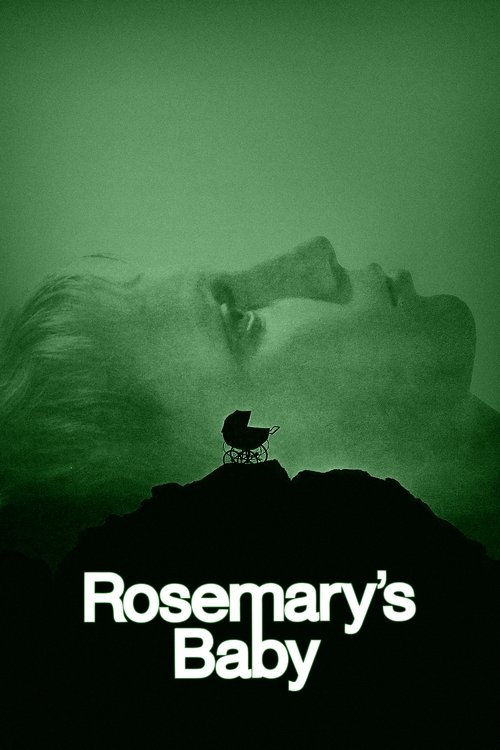
Rosemary's Baby
1968 · Roman Polanski
When you're craving real horror that gets under your skin rather than at your throat — a slow-burn, grown-up scare for a night when you want to feel paranoia done perfectly. Challenge, not comfort: it's the kind of unsettling that lingers into the next morning.
What it's about
A young married couple — Rosemary, hopeful and trusting, and Guy, a struggling actor hungry for his break — move into a grand old New York apartment building with a whispered-about past. The elderly neighbors are aggressively friendly, Guy's career suddenly turns, and when Rosemary becomes pregnant, everyone around her seems a little too invested in her baby. She begins to suspect that the people closest to her are not on her side.
The experience
Creeping, daylight dread — almost nothing jumps out at you, yet the unease builds scene by scene until ordinary things (a chalky drink, a kindly smile, a locked closet) feel radioactive. It's the horror of not being believed, and it leaves you rattled long after quieter films would have faded.
Performances
Mia Farrow is devastating as Rosemary — fragile, luminous, and increasingly desperate, she makes you feel every stage of a woman being gaslit by her whole world. Ruth Gordon is unforgettable as the meddling neighbor, weaponizing nosy-old-lady charm into something genuinely sinister.
The craft
Polanski shoots evil in bright, banal Manhattan light — casseroles, wallpaper, neighborly chit-chat — so the menace has nowhere obvious to hide and is therefore everywhere. The apartment itself becomes a trap you learn room by room, and a fragile lullaby theme haunts the whole picture. Precision-built: every scene plays fair while quietly tightening the noose.
Why it matters
It kicked off the era of prestige supernatural horror — proof that a studio horror film could be an A-list, adult event — and its portrait of a woman's fears dismissed by doctors, husband, and neighbors has only grown more pointed with time.
Snapshot
Roman Polanski's American debut is the film that domesticated evil — installing it not in a Gothic castle or a fog-drenched moor but in a high-ceilinged Manhattan apartment, behind casseroles and neighborly smiles. Adapted faithfully from Ira Levin's bestselling 1967 novel, Rosemary's Baby follows a young wife whose anxieties about pregnancy, isolation, and a husband's creeping indifference curdle into something irreversible. The horror the film pioneers is predominantly social: Rosemary Woodhouse is not menaced by a monster from outside but betrayed by every institution designed to protect her — medicine, marriage, neighborliness, the Church itself. One of the most profitable films Paramount released in the decade, it inaugurated the cycle of prestige supernatural horror that would define American genre cinema into the 1970s and arguably beyond.
Industry & production
Producer William Castle purchased the rights to Levin's novel before publication, intending to direct the adaptation himself. Castle was the reigning king of gimmick horror — The Tingler (1959), House on Haunted Hill (1959) — but Paramount's head of production Robert Evans saw an opportunity to make something classier, and negotiated Castle into a producing role only. Evans brought in Polanski, whose European arthouse credentials (Repulsion, Cul-de-sac) signaled he could handle psychological material without recourse to cheap shock. Castle received his screen credit and a small cameo — he appears, visibly frustrated, checking his watch outside a phone booth — and reportedly struggled throughout production to reconcile himself to the arrangement.
Paramount greenlighted a relatively modest budget that various sources place in the low single-digit millions. Polanski was given unusual control for an outsider director, including sole adaptation credit, which was both creatively efficient and commercially shrewd: his screenplay follows Levin's novel so precisely that it reads like a page-for-page transcription, preserving the book's slow-boil tension and leaving almost nothing on the cutting-room floor. Mia Farrow was cast over Evans's initial resistance; her casting proved definitive, her frail, wide-eyed presence transforming the film's central figure from literary construct into icon. John Cassavetes, himself an auteur filmmaker of considerable independent reputation, played Guy Woodhouse, Rosemary's actor husband. The decision to cast a director in the role of a performer who sells out his integrity was, at minimum, resonant.
The film's primary exterior and lobby location is the Dakota, the landmark cooperative apartment building on Central Park West, called the Bramford in the film. Polanski and his production team dressed and lit the interiors on studio sets in Los Angeles to match the Dakota's distinctive architecture and the period-specific New York décor.
Technology
Rosemary's Baby was shot on 35mm in Technicolor with Panavision cameras, in a spherical format rather than the anamorphic scope ratio then common in prestige productions. The choice of a more intimate aspect ratio reinforces the film's domestic claustrophobia — the frame never gestures toward spectacle. Cinematographer William Fraker relied heavily on available-light and soft-light setups to give the apartment interiors a natural, untheatrical glow that made the uncanny difficult to locate. There are no expressionist shadows announcing menace; the evil is lit like a dinner party. Color grading (achieved through photochemical processing) keeps the palette warm and slightly muted — the orange-browns and olive greens of late-1960s Manhattan interiors rendered faithfully enough to function as period documentary detail.
Technique
Cinematography
William Fraker's camera strategies are the technical engine of the film's paranoia. Wide-angle lenses distort peripheral space without calling attention to themselves, so rooms feel subtly wrong without looking obviously manipulated. Polanski and Fraker frequently place Rosemary at the edge of the frame or shoot her through doorways and across thresholds, fragmenting the space she should inhabit fully. The camera rarely expresses her subjectivity through flamboyant movement; instead it maintains an almost clinical distance, observing her as the other characters do — which is to say, with an objectifying patience that mirrors the film's thematic argument about who controls her body.
The dream-rape sequence is the film's most technically elaborate passage and its most deliberate stylistic rupture: quick edits, a drifting superimposition structure, and disorienting scale shifts distinguish it from the film's otherwise steady-handed realism. The sequence functions as a controlled release valve — the one moment where the film's buried expressionism surfaces — before the style snaps back to matter-of-fact normalcy. The final shot, Rosemary peering into the black-draped bassinet and then, after a beat of horror, reaching toward the infant within it, achieves its effect through duration alone: no cut, no score sting, just the slow transformation of her face.
Editing
Sam O'Steen, who had cut The Graduate for Mike Nichols the year before, edited the film. O'Steen's contribution is largely invisible in the best sense: the pacing is calibrated to build dread through accumulation rather than shock cutting, and the transitions between Rosemary's present tense and the subjective dream passages are handled with enough ambiguity to sustain the film's central epistemological uncertainty. O'Steen's restraint is itself a rhetorical choice — a horror film that barely feels edited is one in which the audience cannot locate the manipulation.
Mise-en-scène / staging
Polanski's theatrical background and his meticulous pre-planning on set give the staging a quality of almost suffocating control. Actors are frequently blocked in arrangements that place Rosemary physically lower or more peripheral than the characters who surround her — Minnie and Roman Castevet loom over her at the dinner table; Dr. Saperstein occupies the commanding chair while she sits; even Guy's presence tends to crowd her. The Castevets' apartment, adjacent to the Woodhouses', is styled with a baroque clutter that contrasts with Rosemary's more austere taste — a mise-en-scène argument that the older neighbors represent not comfort but encroachment. The use of the apartment's internal geography — which rooms connect, which doors are kept shut, where sound travels — turns the set into a diagram of surveillance and control.
Sound
Krzysztof Komeda's score is one of the landmark achievements of horror film music. A Polish jazz composer and Polanski's frequent collaborator (he scored Knife in the Water, Repulsion, and Cul-de-sac), Komeda wrote a lullaby — hummed and sung by Mia Farrow over the opening aerial sequence — that is simultaneously tender and deeply unsettling, its major-key innocence curling toward something unresolved. The score uses chamber arrangements and a vocal performance that refuses to anchor itself in either comfort or dread, floating in the gap between them. Komeda died in April 1969 following injuries sustained in an accident, making Rosemary's Baby among his final completed scores. Beyond the lullaby, Komeda deploys silence and ambient New York sound design with as much deliberation as any composed cue; the film understands that what the audience fills in is more frightening than what it is given.
Performance
Mia Farrow's performance is one of the extraordinary feats of the period. Playing roughly every scene — including a radical mid-film haircutting scene that functions as a visual declaration of her character's fracturing — in registers that must simultaneously convince us of Rosemary's sanity and her possible delusion, Farrow does nothing that announces itself as acting. Her weight loss over the shoot, partly the result of a simultaneous stressful personal situation, became part of the character's physical transformation, the body's deterioration made visible and ambiguous — suffering or gestation? Ruth Gordon's Minnie Castevet is the film's other great performance: a theatrical grotesque precisely calibrated not to tip into parody, a smothering maternal figure whose intrusions are plausibly benign until they suddenly are not. Gordon won the Academy Award for Best Supporting Actress. John Cassavetes was reportedly difficult and resistant to Polanski's direction, and his performance has a genuine opacity — Guy's self-interested callousness is never quite readable as ordinary actorly villainy, which serves the film's needs perfectly.
Narrative & dramatic mode
The film's great structural gambit is that it maintains, for most of its running time, what might be called the Jamesian governess problem: we are confined to the consciousness of a protagonist who may be unreliable. Every sinister event Rosemary perceives has a plausible mundane explanation, and the film never quite tips its hand until the final sequence. This is unusual for supernatural horror, which generally offers the audience a privileged view; here the audience knows only what Rosemary knows, and Rosemary can be discredited. The narrative mode is therefore closer to the paranoid thriller than to conventional horror — Hitchcock's influence is audible throughout — with the added weight of a sustained feminist argument: Rosemary's dismissal as hysterical, overwrought, ungrateful, and irrational by every male character in the film maps precisely onto documented patterns of medical gaslighting.
The ending refuses catharsis. Rosemary does not escape; she does not destroy the child; she reaches toward it. The film closes on a woman absorbing the full scope of her violation and, in the same gesture, continuing. It is one of the more disturbing endings in American commercial cinema.
Genre & cycle
Rosemary's Baby effectively invented the template for prestige supernatural horror — the A-picture production values, the literary source, the credentialed director, the horror-of-the-everyday aesthetic — that The Exorcist (1973) and The Omen (1976) would subsequently inhabit and amplify. Before Polanski's film, supernatural horror had been largely confined to low-budget exploitation and the Hammer cycle in Britain. Rosemary's Baby demonstrated that the genre could sustain serious directorial ambition and attract mainstream audiences simultaneously.
The film also belongs to a distinct subgenre that might be called conspiracy-of-the-ordinary: the horror that emerges not from external invasion but from the discovery that one's own community — neighbors, doctors, husbands — has been complicit from the beginning. This subgenre would be revitalized in the twenty-first century in ways that explicitly acknowledge Polanski's blueprint.
Authorship & method
Polanski's adaptation method was demonstrably close-reading: he retained not just the plot but Levin's chapter structure as a rough scene-breakdown guide. The result is a script with an unusually even architecture, no passages of dead air, and dialogue that earns its exposition through character. Polanski's broader method on set was control — meticulous storyboarding, exacting blocking — offset by genuine engagement with actors whom he trusted at the moment of performance. His background in the Polish Film School, where rigorous cinematic literacy was the baseline expectation, gave him a framework for thinking about every technical decision as meaningful, not merely functional.
William Fraker's cinematography and Komeda's score are indispensable co-authorships; the film's visual and sonic textures are not decorative but argumentative, doing rhetorical work that the script leaves implicit.
Movement / national cinema
Rosemary's Baby sits at a productive intersection of movements. Polanski came to Hollywood trailing the credentials of the Polish Film School — the tradition that produced Wajda, Munk, and the early Polanski of Knife in the Water (1962) — and brought with him European art cinema's interest in psychological interiority, oppressive environments, and formal precision. The film was made during the opening phase of what is now called the New Hollywood or Hollywood Renaissance, a period in which the major studios, battered by box-office failures and audience fragmentation, began hiring younger directors with unconventional sensibilities. Rosemary's Baby was a flagship exhibit of this new arrangement: a genre film made with the discipline of European cinema, backed by studio money, and aimed squarely at mainstream audiences. That it worked — critically and commercially — helped validate the model that would enable The Godfather, Chinatown, and Taxi Driver in the years that followed.
Era / period
The film appeared in 1968, a year of extraordinary social violence: the assassinations of Martin Luther King Jr. and Robert F. Kennedy, the riots at the Democratic National Convention, the ongoing catastrophe of Vietnam. The cultural atmosphere was one of institutional betrayal — the feeling that the people and structures society trusted to be protective were themselves corrupt or indifferent. Rosemary's Baby's central situation — a woman surrounded by authorities who reassure her while working against her — is legible as a horror-genre encoding of that wider experience. The film also arrives at the cusp of second-wave feminism's public emergence, and its sustained portrait of a woman controlled through medicine, marriage, and affective manipulation gave feminist critics immediate and generative material. It was not made as a political film in any programmatic sense, but it is one of the period's most accurately political artifacts.
Themes
The film's thematic architecture is dense without being schematic. The violation of bodily autonomy — enacted by the devil but enabled by Rosemary's husband, her doctor, and her neighbors — is its load-bearing concern. Guy Woodhouse sells his wife's body for career advancement, an arrangement that externalizes the implicit social compact Rosemary has unknowingly entered. The medicalization and dismissal of female pain is rendered with uncomfortable precision: Dr. Saperstein's insistence that Rosemary ignore her suffering, trust his judgment, and accept a treatment regime she has not chosen is presented in the same register as the film's other naturalistic scenes.
The theme of community-as-trap is equally sustained. The Castevets are neighbors — the form that sociability takes in apartment life — and their intrusions are coded as excessive hospitality, the most culturally difficult force to refuse. Ambition is the film's hidden engine: it is Guy's desire for success, not Minnie's scheming, that makes the conspiracy possible, which implicates the ordinary American hunger for advancement as the real enabling condition of evil.
Reception, canon & influence
Rosemary's Baby was a substantial commercial success on release, and critical reception was strongly positive; Polanski received an Academy Award nomination for Best Adapted Screenplay, and Ruth Gordon's win for Best Supporting Actress brought the film additional mainstream visibility. Over subsequent decades it has been absorbed into the canon of American horror with little resistance — it appears on virtually every critical listing of the form's essential works and has been selected for preservation by the National Film Registry.
Influences on the film (backward): Polanski's own Repulsion (1965) is the most direct precursor — both films trap a woman in an apartment and trace her psychological deterioration, and both decline to fully adjudicate between subjective and objective horror. Val Lewton's RKO productions of the 1940s (Cat People, I Walked with a Zombie) established the model of horror in which the monster is glimpsed only obliquely and the audience's imagination does the real work; Rosemary's Baby inherits this principle. Hitchcock's Vertigo (1958) and Rear Window (1954) are present in the film's formal interest in restricted viewpoint and its portrait of a woman observed and controlled. Henri-Georges Clouzot's Diabolique (1955) — another film about a woman who may or may not be going mad, in a building full of conspirators — provides an additional French template.
Legacy (forward): The film's direct progeny in supernatural horror includes The Exorcist (1973) and The Omen (1976), both of which adopt its structure of respectable production values, genuine literary sources, and suburban-domestic settings for satanic threat. Don't Look Now (1973) shares its interest in grief, urban space, and the fragility of the couple. More recent debts are substantial: Jordan Peele has cited Rosemary's Baby as a formative influence on Get Out (2017), which transposes its paranoid architecture — the protagonist surrounded by smiling people who are complicit in something monstrous — onto American racial dynamics. Ari Aster's Hereditary (2018) and Midsommar (2019) inherit its interest in community-as-cult and the horror of the ordinary face. The film's specific contribution to the vocabulary of domestic horror — the apartment building as organism, the neighbor as predator, the husband as collaborator — has proven inexhaustible.
A Deleuzian reading
A neighbor presses a charm into your hand.
The full Deleuzian reading of Rosemary's Baby →
Reception
A massive hit and critical success on release in 1968 — Ruth Gordon won the Oscar for it — so there's no reappraisal arc, just steady ascent: it's now enshrined as the film that made Satanic horror prestige cinema, paving the way for The Exorcist and The Omen.
How Rosemary's Baby was received, from release to now →
Influences: the films it descends from and the films it influenced
- Repulsion (1965) — Polanski's own preceding film established the apartment-as-horror-architecture blueprint: wide-angle lenses distorting domestic space without calling attention to themselves, a female protagonist's subjectivity rendered through spatial claustrophobia rather than explicit supernatural event.
- Rebecca (1940) — Hitchcock codified the formula of a young woman navigating a domestic space where every institutional figure — husband, household staff, doctor — is complicit in a conspiracy she cannot name; Polanski transplants this exact architecture from Gothic manor to Manhattan apartment.
- Gaslight (1944) — Cukor's film established the domestic-manipulation grammar Rosemary's Baby inherits: a husband who systematically erodes his wife's grip on reality through social conspiracy, using the household itself — its objects, its witnesses — as the instrument of her destruction.
- Psycho (1960) — Hitchcock established that horror could be rooted in the banal and institutional rather than the Gothic; his objectifying camera strategy for Marion — watching her as a specimen — directly precedes Fraker's clinical distance from Rosemary, who is observed rather than identified with.
- The Innocents (1961) — Freddie Francis's cinematography for Clayton — soft, naturalistic light that renders supernatural intrusion without expressionist shadow — is the direct technical precedent for Fraker's approach of making the uncanny indistinguishable from the quotidian domestic.
- Les Diaboliques (1955) — Clouzot's slow-build institutional conspiracy thriller — horror accruing through the accumulation of small wrong details rather than set-piece shocks, the audience's uncertainty calibrated scene by scene — is the direct methodological predecessor to Polanski's pacing architecture; Polanski has cited Clouzot explicitly.
- The Birds (1963) — Polanski's staging of the Dakota apartment as domestic fortress — windows mapped as vulnerabilities, neighboring spaces as sites of breach, the floorplan weaponized against its inhabitant — directly extends The Birds' method of converting household architecture into a threat diagram through mise-en-scène alone, without monster-movie explication.
- Knife in the Water (1962) — Continues the Polanski–Komeda director-composer partnership begun here and the slow-build confinement-paranoia of a closed domestic space.
- Bunny Lake Is Missing (1965) — Extends the gaslit-parent structure — a mother whose maternal reality and instincts are systematically denied by a conspiring, respectable establishment.
- Cul-de-sac (1966) — Carries the withheld-arrival structure forward intact — a film organized around an agent who never properly appears — with Komeda's ironic-lyrical idiom again supplying the tonal distance between what is heard and what is shown.
- The Exorcist (1973) — Friedkin directly extends the possession-horror formula Polanski invented: the maternal body as site of Satanic invasion, institutional medicine and clergy as failed protectors, realist cinematography — Owen Roizman borrowing Fraker's naturalistic interior light — sustaining horror inside a credible everyday.
- The Tenant (1976) — Polanski's own return to the formula: the Parisian apartment building as conspiratorial social body, wide-angle lens distortion of corridor and threshold spaces, a protagonist's identity progressively colonized by the apartment's previous occupant — a direct continuation and inversion of the Bramford's spatial grammar.
- The Omen (1976) — Donner extends the satanic-child formula Polanski invented, adding an institutional-conspiracy dimension — government, Church, hospital all complicit in suppressing the truth about the child's nature — while retaining the unwitting parent in the domestic space as the horror's primary vehicle.
- Eraserhead (1977) — Lynch adopts Polanski's structural device of the subjective rupture embedded in otherwise clinical realism — the apartment block, anxiety of impending parenthood rendered as horror — and extends the dream-sequence grammar into a sustained hypnagogic register that refuses to snap back to normalcy.
- The Shining (1980) — Kubrick amplifies Polanski's wide-angle domestic distortion into a Steadicam system: the Overlook is the Bramford at scale, and Jack's trajectory — charming husband whose thwarted ambition poisons the family space — is a direct extension of Guy Woodhouse's betrayal, now made explicit rather than withheld.
- Audition (1999) — Miike inherits Polanski's slow-build methodology: an extended realist first half in which nothing is visibly wrong accumulates dread through misdirection and small tonal dissonances, with horror erupting from domestic and romantic intimacy rather than from an external threat — the structural architecture is Polanski's.
- The Witch (2015) — Eggers inherits the isolated-family-as-conspiracy-vessel structure: a female protagonist surrounded by those who claim to protect her while participating in her destruction, Satanic agency operating through domestic intimacy, and the horror of institutional betrayal — here Puritan religion replacing medicine and marriage — as the primary engine.
- Get Out (2017) — Peele transposes the Levin/Polanski formula — protagonist enters a domestic space where every institutional and social figure is complicit in a conspiracy targeting his body — while preserving the specific mechanism of friendly ordinary surfaces masking total betrayal, and the protagonist's inability to be believed by those outside.
- Hereditary (2018) — Aster directly inherits the Polanski template: the family unit as vessel for Satanic conspiracy, grief and maternal terror as dual horror engines, slow-build domestic accumulation before revelation, a cult whose members infiltrate every supposed protector, and the final image of the protagonist confronting the bassinet's contents rewritten at scale.
- Die My Love (2025) — Recodes maternal anxiety and ordinary domestic ritual into creeping paranoid dread within the home, the second Polanski apartment film Ramsay cites as a tonal model for pregnancy/motherhood as horror.
- Alien (1979) — Establishes body-horror through parasitic violation as a genre grammar: the protagonist's bodily autonomy is overridden by institutional forces who treat her body as a vehicle for something else — the structural template for the chestburster sequence and Alien's corporate-complicity plot.
- Chinatown (1974) — Sam O'Steen cut both films for Polanski and repeats his technique of maintaining spatial clarity while systematically withholding narrative coherence — the viewer sees everything the protagonist sees but cannot interpret it correctly until too late — making the editorial method as much a formal inheritance as the screenplay structure.
- Don't Look Now (1973) — Roeg adopts the cross-cutting structure of Polanski's dream-rape sequence — interleaving subjective and objective registers with sustained temporal ambiguity — as a full editing grammar, applying it to grief-horror in an architectural location (Venice) that mirrors the Bramford's function as a space that withholds its true nature.
- Angel Heart (1987) — Establishes the slow-build Satanic conspiracy whose dread emerges from the protagonist's dawning, too-late comprehension — Angel Heart inherits its method of staging damnation as a banal social network closing around an oblivious victim rather than as overt monstrosity.
- If I Had Legs I'd Kick You (2025) — Locates terror in ordinary domestic caregiving by restricting the audience to the mother's paranoid, partial knowledge — the maternal-horror withholding strategy.
- The Conjuring: The Devil Made Me Do It (2021) — Foundational ancestor of the Satanic-cult horror the film's 1981 curse-and-coven plot descends from — evil as an organized human conspiracy of Satanists rather than a free-floating haunting, enabling the culpability theme.
- Blink Twice (2024) — The foundational paranoid thriller of a woman whose account of reality is smoothly denied by charming, powerful men — gaslighting elevated into the film's central formal engine.
Similar films
- The Tenant (1976) — influence & lineage · same viewing thread
- Repulsion (1965) — influence & lineage · same viewing thread
- The Shining (1980) — influence & lineage · same viewing thread
- The Exorcist (1973) — influence & lineage · same viewing thread
- Gaslight (1944) — influence & lineage
- Psycho (1960) — influence & lineage
- Don't Look Now (1973) — influence & lineage
- The Innocents (1961) — influence & lineage · same viewing thread
All the films related to Rosemary's Baby →
Watch it with: curated runs of related films
- The Walls Are Closing In — Watch these when you want horror that comes from inside the house — a mind or a family cracking apart in rooms that slowly turn hostile.