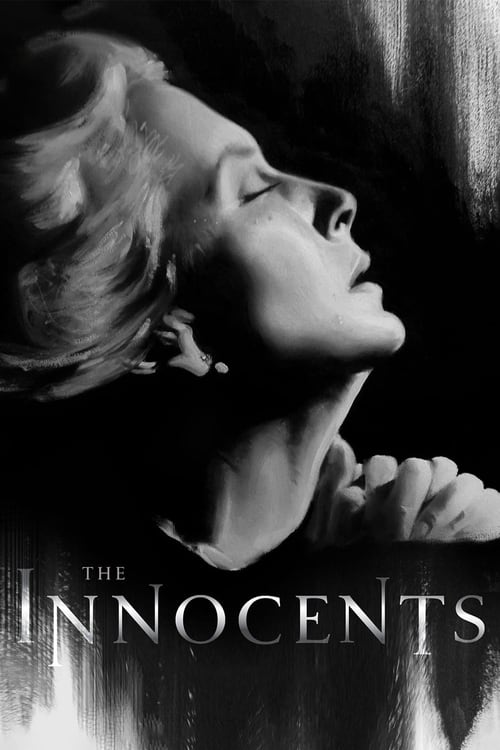
The Innocents
1961 · Jack Clayton
For a late night when you want to be properly unsettled, not jolted — a scare that works on your mind instead of your reflexes. Watch it alone with the lights off and let it get under your skin.
What it's about
A young governess arrives at a grand Victorian country house in Essex to care for two orphaned children, and gradually becomes convinced the grounds are haunted — and that the dead have designs on her charges. Whether the ghosts are real or hers alone is the question the film never lets you settle. It's drawn from Henry James's 'The Turn of the Screw.'
The experience
Slow-burning dread rather than shocks: the fear seeps in through candlelight, silence, and the unnerving poise of two beautiful children. It leaves you genuinely unsure what you saw, which is exactly why it lingers.
Performances
Deborah Kerr gives one of the great horror performances, playing conviction and delusion in the same breath — her certainty is the scariest thing in the film. The two child actors are eerie precisely because they're so composed.
The craft
Freddie Francis's black-and-white CinemaScope photography is the real spectre: deep-focus frames where faces float in pools of candlelight and the edges dissolve into engineered darkness, so something always seems to wait just out of sight. A screenplay polished by Truman Capote keeps every scene readable two ways, and the nursery rhyme drifting through the sound design works like an infection. Demands a dark room and patience — and rewards both.
Why it matters
Still the high-water mark of the ambiguous ghost story, the film generations of horror directors measure their haunted houses against.
The finest screen adaptation of Henry James's 'The Turn of the Screw,' and still the high-water mark of the ambiguous ghost story. Jack Clayton — fresh from Room at the Top and Britain's kitchen-sink vanguard — turned instead to Victorian gothic, with Deborah Kerr as the governess whose conviction that her young charges are being corrupted by the dead may be perception or projection; a screenplay polished by Truman Capote keeps both readings alive in every scene. The film's real spectre is Freddie Francis's CinemaScope photography: deep-focus compositions lit by candelabra, faces isolated in pools of light while the wide frame's edges sink into engineered darkness, so that something always seems to wait just beyond legibility. The children's nursery rhyme 'O Willow Waly' drifts through the sound design like an infection. Truffaut admired it; The Others and The Haunting of Hill House are unthinkable without it. Few horror films have trusted daylight so completely — some of its most unnerving apparitions stand in full sun, across a pond, perfectly still.
A Deleuzian reading
Across the pond, in full sun, a woman is standing.
The full Deleuzian reading of The Innocents →
Reception
Respectfully received but no sensation in 1961, it's since climbed to near-universal 'greatest ghost film ever made' status — a slow canonization sealed by decades of horror directors citing it and a Criterion-era critical embrace.
How The Innocents was received, from release to now →
Influences: the films it descends from and the films it influenced
- Cat People (1942) — Establishes the Lewton principle of horror by suggestion — the terror is never shown, only implied in shadow, off-screen space and the viewer's dread, the same restraint Clayton uses so we can never confirm a ghost is present.
- The Uninvited (1944) — The first Hollywood haunted-house film to treat its ghosts as a genuine ambiguous phenomenon rather than a hoax, pairing candlelit gothic atmosphere with a sober, adult tone that Clayton inherits wholesale.
- Vampyr (1932) — Diffuse, soft-focus photography and dream-logic staging make the frame itself feel haunted and perception untrustworthy — the precedent for Freddie Francis's misted daylight-horror and Miss Giddens's collapsing certainty.
- Rebecca (1940) — Filters an oppressive gothic estate entirely through a repressed, sexually anxious woman's subjectivity, the governess-in-a-haunted-house template of point-of-view dread that The Innocents refines.
- Les Diaboliques (1955) — Nerve-shredding ambiguity built on withheld information and a drowned/water motif, proving horror could work as an adult psychological thriller where the audience is deliberately kept off-balance about what is real.
- Sons and Lovers (1960) — Freddie Francis's Oscar-winning black-and-white CinemaScope deep-focus here is the direct technical rehearsal for The Innocents — extreme depth across the wide frame with detail held from foreground candle to distant doorway.
- Room at the Top (1959) — Clayton's own debut established his exacting, performance-first direction of interior emotional repression, the actor's-face discipline he brings to Deborah Kerr's unraveling.
- The Bad Seed (1956) — Codifies the 'corrupted child' whose angelic surface masks something monstrous, the corruption-of-innocence horror that Miles and Flora inherit and complicate.
- The Ghost and Mrs. Muir (1947) — Extends the craft of the ghost-occupied house rendered through deep-focus low-key chiaroscuro, where lighting and empty rooms conjure a presence the camera never fully shows.
- Great Expectations (1946) — Freddie Francis lights a decaying English great house from candle and window motivation only, holding true blacks at the edges of the CinemaScope frame, and stages the house as a preserved wound in explicitly Satis House terms.
- The Heiress (1949) — The other landmark James adaptation: Freddie Francis holds candle-practical foreground faces and deep-background apparitions in one CinemaScope plane with masked edges, extending Wyler's principle that a wide, sharp, held frame can carry dread without a single cut to explain it.
- The Fallen Idol (1948) — Freddie Francis's deep-focus scope frames hold a child sharp in the foreground while an ambiguous adult figure stands at depth, and offscreen sound (whispers, a music box) is the filter through which sexual knowledge is implied but never confirmed.
- The Haunting (1963) — Directly extends The Innocents' show-nothing method — wide-angle distortion of architecture, sound design and a susceptible woman's narration carry all the terror, with no ghost ever visualized.
- Repulsion (1965) — Pushes the subjective-female-collapse device further, making the environment (an apartment) a literal projection of a disintegrating mind, extending Clayton's ambiguity of perception into full hallucination.
- Don't Look Now (1973) — Weaponizes editing itself against the viewer — cross-cut premonitions and misread glimpses make perception unreliable in the same grief-and-dread register as Miss Giddens's visions.
- The Shining (1980) — Manifests its ghosts in flat, bright light and sustains the madness-versus-haunting ambiguity around a caretaker and imperilled child, the daylight-horror and unresolved-perception inheritance from Clayton.
- The Others (2001) — The most direct descendant: a governess, two children, candlelit deep-focus gothic interiors and an ambiguous-ghost structure lifted almost point-for-point from The Innocents' scheme.
- The Orphanage (2007) — Restrained atmosphere-over-shock ghost story turning a haunted house and threatened children into grief made spectral, prizing suggestion and candlelit dread in Clayton's lineage.
- Crimson Peak (2015) — Revives Victorian-gothic candlelight and widescreen deep-focus composition, foregrounding pools of light in darkness as the governing visual grammar Freddie Francis pioneered here.
- Rosemary's Baby (1968) — Freddie Francis's cinematography for Clayton — soft, naturalistic light that renders supernatural intrusion without expressionist shadow — is the direct technical precedent for Fraker's approach of making the uncanny indistinguishable from the quotidian domestic.
- The Exorcist (1973) — Clayton established placing a child at the center of supernatural dread within a naturalistic procedural-doubt narrative (a rational investigator confronting the inexplicable), while Freddie Francis's cold, hard cinematography refuses gothic warmth for clinical observation — the direct structural and visual precursor to Father Karras's skeptic-to-believer arc.
- The Remains of the Day (1993) — Low-key naturalist photography and a governess's repressed propriety inside an English country house, subtext made visible through what the camera and performance decline to state.
- Picnic at Hanging Rock (1975) — Freddie Francis's gauze-diffused widescreen and the reading of repressed sexuality as the true haunting prefigure both Boyd's veil and the film's ambiguous, never-confirmed supernatural.
- The Go-Between (1971) — A child as the limited, unreliable witness to adult sexuality, realized through deep-focus architectural compositions and a heavy, oppressive period world — the child's-eye-on-corruption craft the film inherits.
- The Pumpkin Eater (1964) — Clayton again anatomizes a woman's fracturing psyche in crisp black-and-white, using elliptical editing and close performance work to keep the line between reality and breakdown deliberately porous.
- The Nightcomers (1971) — A literal prequel dramatizing Quint and Miss Jessel's living affair, engaging the same Henry James source to explain the corruption The Innocents leaves spectral.
- The Age of Innocence (1993) — A meticulous, repression-soaked adaptation of period prose where desire is rendered through suppressed gesture and atmospheric craft rather than statement — the same theory of acting-as-withholding.
- Night of the Demon (1957) — Freddie Francis's black-and-white CinemaScope, deep-focus center with the frame edges vignetted into darkness, sustains an unresolvable question of whether the apparition exists — the widescreen-monochrome case for ambiguity that Ted Scaife's photography had argued a few years earlier.
Similar films
- The Shining (1980) — influence & lineage · same viewing thread
- Vampyr (1932) — influence & lineage · often watched together
- Rebecca (1940) — influence & lineage · often watched together
- The Others (2001) — influence & lineage
- Repulsion (1965) — influence & lineage · same viewing thread · often watched together
- Crimson Peak (2015) — influence & lineage
- The Exorcist (1973) — same viewing thread
- Diabolique (1955) — influence & lineage · often watched together
All the films related to The Innocents →
Watch it with: curated runs of related films
- The Walls Are Closing In — Watch these when you want horror that comes from inside the house — a mind or a family cracking apart in rooms that slowly turn hostile.