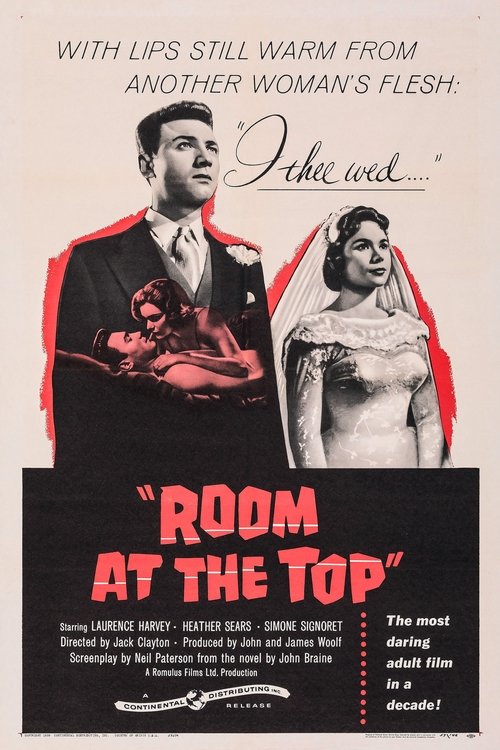
Room at the Top
1958 · Jack Clayton
For when you're in the mood for ambition and consequences — a love-triangle drama with teeth, best on a night when you want to be gripped and left with something to argue about after.
What it's about
Joe Lampton, an accountant from a poor background, arrives in a prosperous Yorkshire town determined to climb — and sets his sights on the daughter of the local factory owner. The complication is Alice, an unhappily married older Frenchwoman he actually falls for. Ambition, class resentment, and real desire pull him in three directions at once.
The experience
Smoldering and adult, with a hard edge of bitterness under the romance. You watch a man calculate his way toward everything he wants while the film quietly asks what it will cost him — it's absorbing, sexy for its era, and increasingly uncomfortable.
Performances
Simone Signoret is the reason to watch: her Alice is warm, weary, and devastatingly real, a performance that won her the Academy Award. Laurence Harvey makes Joe's charm and coldness feel like two sides of the same hunger.
The craft
Jack Clayton directs with a frankness about sex and class that was startling for late-1950s Britain, and the script gives its characters real appetite and real cruelty. The moody black-and-white photography makes the town itself — mills below, big houses on the hill — a map of exactly what Joe is climbing.
Why it matters
Conventionally credited with breaking the dam in postwar British cinema: after this, class anger and adult desire became fair game on British screens, opening the door for the entire New Wave that followed.
Snapshot
Room at the Top is the film that is conventionally credited with breaking the dam in postwar British cinema — the picture after which the frank treatment of class resentment and sexual desire became thinkable on British screens. Adapted from John Braine's bestselling 1957 novel, it follows Joe Lampton (Laurence Harvey), a clerk of working-class origins newly arrived in a Yorkshire town, who calculates his way toward marriage with the daughter of a local industrialist while conducting an affair with Alice Aisgill (Simone Signoret), an unhappily married Frenchwoman a decade his senior. The film's importance is twofold: as a social document, it dramatized the "Angry Young Man" sensibility that had already surfaced in literature and on the stage, transferring it to a mass medium; as an industrial event, it tested and shifted the boundaries of British screen censorship, earning the then-new "X" certificate from the BBFC for its adult sexual content. It is usually treated as the threshold work standing just before the British New Wave proper, and Signoret's performance won her the Academy Award for Best Actress. Whatever its later reputation as a transitional rather than a fully achieved masterpiece, it remains a hinge film around which a great deal of British cinema history is organized.
Industry & production
The film was produced by the brothers James and John Woolf through Romulus Films, the independent company they had built in the early 1950s and which had a track record of literate, mid-budget productions with international ambitions. Romulus's involvement is significant: the Woolfs operated outside the orthodoxies of the larger Rank and ABPC combines, and the project's relatively modest budget gave it room to be franker than a more cautious studio production might have allowed. John Braine's novel had been a commercial sensation, and acquiring it positioned the Woolfs to capitalize on a literary phenomenon already associated with a generational shift in British writing.
The decisive industrial fact about the production is its relationship to censorship. The BBFC granted the film an "X" certificate, restricting it to adult audiences, and the picture became one of the early demonstrations that the X category could carry a serious, award-worthy film rather than only horror or exploitation. The candor about Joe and Alice's affair — and about sex as an instrument of ambition — was unusual for British cinema of the period, and the film's commercial success helped establish that adult subject matter was viable at the box office. (Precise budget and grosses I would not want to assert from memory; the surviving record on Romulus's internal finances is thin, and I will not invent figures.) The casting of Signoret, an established star of French cinema, gave the production continental prestige and a star whose association with frank European sexuality the film exploited deliberately. Laurence Harvey, Lithuanian-born and South African–raised, was a rising leading man whose somewhat external, calculating screen presence proved unexpectedly apt for Joe Lampton.
Technology
Room at the Top was shot in black-and-white, in the standard Academy-ratio register of late-1950s British production, and there is nothing technologically avant-garde about its means. Its significance lies elsewhere — in subject and tone rather than in apparatus. That said, the choice of monochrome and the willingness to shoot substantial material in real Yorkshire locations (the production used Bradford and Halifax and the surrounding West Riding industrial landscape) connect the film to a broader late-1950s tendency, enabled by more portable equipment and faster film stocks, toward location realism and away from the wholly studio-bound look of earlier British features. The film sits at the technological cusp where documentary-derived location shooting was becoming a marker of seriousness in fiction filmmaking, a tendency the Free Cinema documentarists were articulating in the same years and which the New Wave features would carry further.
Technique
Cinematography
The photography is by Freddie Francis, who would shortly become one of the defining cameramen of the British New Wave (and later an Oscar-winning cinematographer and a director in his own right). Francis's monochrome here is expressive without being showy: the Yorkshire townscape of soot-darkened stone, mills, and gray skies is rendered as a tangible social fact, the physical correlative of the class barriers Joe is trying to climb. The contrast between the cramped, dim interiors associated with Joe's origins and the brighter, more spacious world of the Brown family registers the film's central opposition between deprivation and money. Francis lights Signoret with particular care — her face becomes the film's emotional barometer — and the location work lends the romance between Joe and Alice a worn, weathered authenticity that the studio could not have manufactured.
Editing
Ralph Kemplen edited the film. The cutting is broadly classical and at the service of performance and narrative clarity rather than calling attention to itself; the film advances through scenes of conversation, calculation, and confrontation built in a measured, legible rhythm. The most discussed editorial-dramatic decision concerns the film's catastrophe and its aftermath, where the management of offscreen event and reaction carries the tragedy. I would not overstate Kemplen's stylistic signature here; the editing's achievement is its discipline and its tact in handling the film's most painful turns.
Mise-en-scène / staging
The film's staging is organized almost entirely around the geography of class. Spaces are coded by money: the genteel drawing rooms of the Brown circle, the amateur-dramatics milieu where Joe meets both women, the pubs and rented rooms, the contrast between the industrial valley and the comfortable houses above it. The title itself is spatial — "room at the top" — and the production design literalizes the metaphor of ascent. Joe is repeatedly framed as an outsider looking in, a man reading the furniture of a class he wishes to join. The amateur theatrical that brings the principals together is a characteristic touch: it is in this slightly pretentious, aspirational social space that the working-class striver and the trapped older woman find each other.
Sound
The score is by Mario Nascimbene, the Italian composer whose work ranged across European and international productions of the period. The musical treatment underscores the romance and the tragedy without, by the standards of the time, excessive sentimentality. The film's soundscape otherwise leans on its locations and on the flat Yorkshire speech that marks Joe's origins and that he is partly trying to leave behind — accent and idiom function as social signifiers throughout. I would not claim detailed knowledge of the sound recording practice on the production; the relevant point is that regional voice is treated as meaningful rather than as comic local color.
Performance
Performance is where the film's reputation most securely rests. Simone Signoret's Alice Aisgill is the heart of the picture: she gives the affair a lived-in maturity, a mixture of warmth, irony, and resignation that makes Alice the film's moral and emotional center and makes Joe's ultimate choice register as a betrayal of something genuinely precious. The performance won her the Academy Award for Best Actress — a notable instance of a French star being honored for an English-language British film. Laurence Harvey's Joe is a more divisive piece of work, and deliberately so: his slightly cold, self-regarding quality has been read both as a limitation and as exactly right for a character whose ambition has hollowed out his capacity for feeling. Hermione Baddeley, as Elspeth, was nominated for the Academy Award for Best Supporting Actress for a performance of famously brief screen time — often cited as among the shortest performances ever to receive a nomination, though I would flag that the precise running time figures repeated for it should be treated with some caution. Heather Sears as Susan Brown, Donald Wolfit as her industrialist father, and Donald Houston in support fill out a strong ensemble.
Narrative & dramatic mode
The film operates in the mode of social tragedy crossed with the realist novel of ambition — a recognizably nineteenth-century shape (the provincial arriviste, the older woman, the marriage of advancement) transposed to postwar England. Its dramatic engine is Joe's double pursuit: Susan Brown as the route to money and status, Alice as the object of real, complicated love. The two lines are structurally incompatible, and the narrative tightens toward the moment Joe must choose. Crucially, the film does not let him off the hook. The achievement of his ambition is staged as a hollow victory shadowed by the destruction of the one authentic relationship he had. This insistence that "success" is itself the tragedy — that getting the room at the top is a form of damnation — gives the film a moral seriousness that distinguishes it from a simpler rise-and-fall melodrama.
Genre & cycle
Room at the Top belongs to, and helped inaugurate, the cycle of British films associated with the "Angry Young Man" and with what came to be called kitchen-sink realism. It is usually positioned as a direct precursor to the British New Wave features that followed over 1959–1963 — Look Back in Anger, Saturday Night and Sunday Morning, The Loneliness of the Long Distance Runner, A Taste of Honey, This Sporting Life — films drawn likewise from contemporary novels and plays and concerned with working-class and provincial life, class frustration, and sexual frankness. Some historians distinguish Room at the Top from the New Wave proper on the grounds that its style remains more conventionally glossy and star-driven, and that its protagonist is an upwardly mobile striver rather than a rooted working-class figure. The distinction is useful: the film is the cycle's announcement and commercial proof-of-concept more than its stylistic exemplar.
Authorship & method
The film is the feature debut of Jack Clayton as director, after a long apprenticeship in the British industry and an Oscar-winning short, The Bespoke Overcoat (1955). Clayton's authorship is characteristically literary and tasteful: across his subsequent career (The Innocents, The Pumpkin Eater, The Great Gatsby, The Lonely Passion of Judith Hearne) he showed a recurring attraction to adaptations of difficult prose and to studies of repression, desire, and disillusion, often centered on a vivid central female performance. Room at the Top already displays the Clayton signature: restraint, attention to actors, and an unwillingness to sentimentalize. His key collaborators here are foundational figures: cinematographer Freddie Francis, editor Ralph Kemplen, and composer Mario Nascimbene. The screenplay is by Neil Paterson, adapting Braine's novel; Paterson's script won the Academy Award for Best Adapted Screenplay, and its compression of the novel into a taut tragic arc is central to the film's success. The producers James and John Woolf should be counted among the authors of the project in the fuller sense, having chosen the property, secured the censorship terms, and assembled the international cast.
Movement / national cinema
The film is a landmark of British national cinema and is bound up with two adjacent movements: the literary "Angry Young Men" (Braine, Osborne, Sillitoe, Amis and others) and the Free Cinema documentary group whose practitioners — Lindsay Anderson, Karel Reisz, Tony Richardson — would shortly move into fiction and define the New Wave. Room at the Top is the commercial bridge between these currents and the feature mainstream. It demonstrated that the regional, class-conscious, sexually candid material of the new writing could succeed as popular cinema, clearing a path that the Woodfall Films productions and others would follow. Its place is therefore less as a member of a movement than as the gate through which the movement passed into wide release.
Era / period
The film is a document of late-1950s Britain: a society still marked by class rigidities but increasingly aware of postwar affluence, consumer aspiration, and shifting moral codes. Joe Lampton is a creature of his moment — a war veteran's generation, educated enough to resent his station, ambitious enough to game it. The film captures the friction between the persistence of an entrenched provincial elite and the pressure of upwardly mobile newcomers, and it does so at the precise juncture when British public culture was beginning to permit franker depictions of sex and class anger. It belongs to the brief window before the fuller social liberalization of the 1960s, and part of its historical charge is that it registers that change arriving.
Themes
The governing theme is ambition and its costs — the proposition that to climb the class ladder one must amputate part of oneself. Closely bound to this is the theme of sex as transaction: Joe weaponizes desire, and the film anatomizes the difference between love (Alice) and advancement (Susan). Class is the pervasive subject — its barriers, its humiliations, its seductions — treated with an unusual lack of consolation. A further theme is the entrapment of women within marriage and respectability, embodied in Alice, whose tragedy exposes the limited room available to a woman of feeling in this society. Finally, the film is about self-knowledge and bad faith: Joe gets what he wanted and understands, too late and too dimly, what it cost. The title's irony — the "room at the top" as both goal and prison — encapsulates the whole.
Reception, canon & influence
On release the film was a major critical and commercial success and a significant awards presence. At the Academy Awards it won Best Actress for Simone Signoret and Best Adapted Screenplay for Neil Paterson, and was nominated in further categories including Best Picture, Best Director for Clayton, and Best Supporting Actress for Hermione Baddeley. It was similarly honored by the British Academy. (I am confident of these principal awards; for any secondary nominations or specific vote counts I would defer to the formal record rather than assert details from memory.)
Looking backward, the film's influences are primarily literary and theatrical: Braine's novel and the broader Angry Young Man movement, the social-realist tradition of the English novel of ambition, and the contemporaneous Free Cinema impulse toward authentic location and class subject matter. The casting of Signoret imported the prestige and frankness of European art cinema.
Looking forward, the film's legacy is its role as the icebreaker of the British New Wave. By proving that adult, class-conscious material could win audiences, awards, and the X certificate without disgrace, it helped make possible the Woodfall films and the whole kitchen-sink cycle. Its frankness contributed to the gradual liberalization of British screen content. Braine's character returned in the sequel Life at the Top (1965), with Harvey reprising Joe, and later in television, evidence of the property's cultural durability. In the longer historical assessment, Room at the Top is sometimes judged more important than it is great — a transitional film whose style is more conventional than the works it enabled — but its position in the canon as the threshold of a major movement in national cinema is secure, and Signoret's Alice remains one of the enduring performances of the British screen.
A Deleuzian reading
Joe Lampton stands in a room that isn't his and prices it.
The full Deleuzian reading of Room at the Top →
Reception
A scandalous sensation in 1959 — its frankness about sex and class earned it an X certificate and huge box office — and it's now credited as the film that kicked off the British New Wave, even if the kitchen-sink films it enabled (Saturday Night and Sunday Morning, This Sporting Life) tend to overshadow it in memory.
How Room at the Top was received, from release to now →
Influences: the films it descends from and the films it influenced
- Brief Encounter (1945) — Supplies the template of tasteful, emotionally repressed British adult melodrama about a doomed adulterous affair, whose literate understatement Clayton inherits for the Joe–Alice relationship.
- Casque d'Or (1952) — Forged Simone Signoret's screen persona as the mature, sexually frank older woman; Clayton cast her precisely to import that Becker-built emblem of continental candor into Alice.
- Le Jour se lève (1939) — Provides the French poetic-realist model of the working-class man trapped by class and desire into fatalistic social tragedy, the doom-structure underwriting Joe Lampton's arc.
- Bicycle Thieves (1948) — Italian neorealism's practice of real streets and ordinary working-class lives legitimized social-realist subject matter and location shooting for the British filmmakers Room drew on.
- On the Waterfront (1954) — Proved that location-shot, class-conscious drama built on raw performance could sweep the Oscars and the box office — the commercial precedent the Woolf producers banked on.
- Marty (1955) — Oscar-winning proof that unglamorous romance among ordinary working people was viable prestige cinema, clearing a path for adult class material to win awards.
- The Bespoke Overcoat (1955) — Clayton's own Oscar-winning short, the apprenticeship in literary adaptation and actor-centered restraint he carried directly into his debut feature.
- Momma Don't Allow (1956) — Free Cinema's handheld location documentation of working-class youth at leisure supplied the authenticity impulse Room channeled from documentary into fiction.
- Look Back in Anger (1959) — The first Woodfall feature, transposing Osborne's Angry Young Man to screen through the commercial door Room's success had just opened.
- Saturday Night and Sunday Morning (1960) — Extends Room's class-geography location realism and sexually candid working-class anti-hero, with Finney's Arthur Seaton as Joe Lampton's more unrepentant heir.
- A Taste of Honey (1961) — Woodfall location shooting in industrial Salford with full regional dialect, pushing the kitchen-sink frankness that Room had made commercially safe.
- A Kind of Loving (1962) — A northern class-geography study of ambition and a trapped marriage built on Room's social-tragic arc of desire colliding with provincial respectability.
- This Sporting Life (1963) — A working-class tragedy of brutal social climbing and a doomed affair with an older woman, with Rachel Roberts's widow echoing Signoret's Alice.
- The Innocents (1961) — Clayton reunites with cinematographer Freddie Francis, extending their black-and-white study of repressed desire into widescreen gothic.
- Life at the Top (1965) — The direct sequel, with Laurence Harvey reprising Joe Lampton, continuing the character's social-climbing disillusion a decade on.
- Darling (1965) — Clayton's narrative of a ruthless social climber trading sex for status is the British template Darling rewrites with a woman as its ambitious, self-destroying arriviste.
- Billy Liar (1963) — Founded British kitchen-sink realism: provincial class ambition, location shooting, and a young man trapped by the horizons of his Northern town.
- Alfie (1966) — Established the British New Wave template Alfie inherits — the sexually predatory working-class male climber whose conquests are charted as a ledger of self-advancement rather than romance.
- The L-Shaped Room (1962) — Repeats Room's exact casting strategy of importing a French star — Leslie Caron — to bring continental sexual frankness to a boarding-house class drama.
Similar films
- Look Back in Anger (1959) — influence & lineage
- Brief Encounter (1945) — influence & lineage
- A Taste of Honey (1961) — influence & lineage
- Daybreak (1939) — influence & lineage
- Closer (2004) — same viewing thread
- Damage (1992) — same viewing thread
- A Place in the Sun (1951) — shared sensibility
- Billy Liar (1963) — shared sensibility
All the films related to Room at the Top →
Watch it with: curated runs of related films
- Love as a Wrecking Ball — Watch these when you want desire pushed all the way to self-destruction — affairs and infatuations that leave nothing standing.