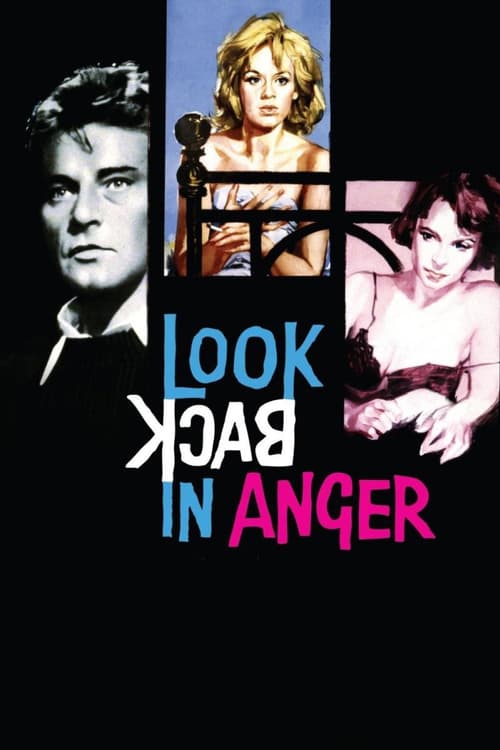
Look Back in Anger
1959 · Tony Richardson
For when you're in the mood for something fierce and confrontational rather than soothing — a film to argue with. Best met on a night you want raw feeling and razor dialogue, not escape.
What it's about
Jimmy Porter is a university graduate stuck running a market sweet stall in a drab English town, playing jazz trumpet at night and raging at everything — the class system that educated him and then shut him out, the country, and above all his gentle, upper-middle-class wife, who absorbs his fury in their cramped flat. When her friend moves in, the household's tensions twist into a triangle. Adapted from the play that detonated under British theater in 1956.
The experience
Talky, bruising, and electric — less a plot than a sustained storm of eloquent anger, with scenes that feel like being trapped in the room during someone else's marriage. It's uncomfortable by design, and Burton's voice makes even the cruelty compulsive.
Performances
Richard Burton is ferocious as Jimmy Porter — a torrent of articulate rage that defined a new kind of British screen antihero and shows exactly why his voice became legendary.
The craft
Richardson opens the stage play out into real markets and wet streets, shot in stark black and white that grounds the theatrical fireworks in grubby postwar England. The jazz-trumpet motif gives the anger a sound, and the dialogue still crackles more than sixty years on.
Why it matters
The founding film of the British New Wave and the screen arrival of the 'Angry Young Men' — it opened the door for a decade of working-class realism in British cinema. The educated, embittered young man raging at the system became an archetype here.
Snapshot
Tony Richardson's adaptation of John Osborne's incendiary 1956 Royal Court play is the foundational text of the British New Wave and the first major document of what the press had already labeled the "Angry Young Men" movement. Richard Burton's portrayal of Jimmy Porter — raging market-stall holder, jazz trumpeter, and failed idealist — introduced a new archetype into British screen culture: the educated working-class man whose intelligence has given him the vocabulary to indict the class system but no leverage to escape it. The film is simultaneously a record of an epochal theatrical event and an autonomous cinematic statement, shaped by the overlapping energies of kitchen-sink realism, Free Cinema documentary practice, and the particular fury of post-Suez England.
Industry & production
The film was the inaugural feature of Woodfall Film Productions, the company Richardson co-founded with Osborne and the producer Harry Saltzman in 1958. Woodfall's formation was itself a political act: dissatisfied with the cautious, studio-bound conventions of the British film industry, Richardson and Osborne sought creative control over the material they owned and the stories they wanted to tell. The deal with Associated British Pictures and Warner Bros. for distribution gave Woodfall sufficient independence to cast unconventionally and insist on location work. The budget was modest by mainstream standards, reflecting both commercial caution around difficult material and a deliberate aesthetic preference for constraint.
Richardson had directed the original Royal Court stage production of Look Back in Anger in 1956, so his relationship to the text was intimate; he had already shaped the play's first definitive interpretation. Mary Ure, who originated the role of Alison Porter on the London stage, crossed over into the film, bringing with her a physical and emotional memory of the character's passivity and concealed suffering. Richard Burton, however, was a replacement for the stage's original Jimmy Porter, Kenneth Haigh — a commercially motivated but artistically defensible substitution. Burton brought an operatic vocal power and a film-star charisma that simultaneously amplified the character's magnetism and, for some critics, smoothed over the more intractable edges of Osborne's conception. Claire Bloom, cast as Helena Charles, and Edith Evans in a supporting role added further theatrical prestige to what the industry regarded as a risky venture.
The screenplay was entrusted to Nigel Kneale, best known at the time for his Quatermass television serials — an unusual but ultimately astute choice. Kneale understood the grammar of dramatic adaptation and approached the task of opening up Osborne's claustrophobic attic flat with structural discipline, adding exterior locations without inflating the material into a social-realist panorama.
Technology
The film was shot in black and white, a choice that carried both economic and aesthetic logic. Black and white stock remained cheaper and technically more flexible for location work in the late 1950s, particularly in low-light interiors and overcast British exteriors. The tonal range of monochrome also reinforced the film's mood: the gray midlands light and the cramped squalor of the Porters' flat are inseparable from the visual argument Richardson and his collaborators were making about English life. The cinematography was by Oswald Morris, BSC, who had established himself as one of the most technically adventurous operators in British cinema, having worked with John Huston on Moulin Rouge (1952) and Moby Dick (1956). Morris's sensitivity to available and near-available light suited the production's semi-documentary ambitions.
Synchronized location sound, still a logistical challenge in this period, was used selectively. The film did not attempt the full acoustic naturalism that later British New Wave films would pursue, but neither does it retreat into the obviously looped studio sound typical of mainstream British production.
Technique
Cinematography
Morris's visual approach is calibrated to reinforce social and psychological constriction. The attic flat is shot at close quarters, with walls pressing in and ceilings low in frame, giving physical form to Jimmy Porter's entrapment. The frame rarely opens into the kind of expressive wide-angle landscape that, say, Karel Reisz would deploy in Saturday Night and Sunday Morning the following year. Light sources are motivated — desk lamps, windows, the glow of the ironing board's heat — and Morris avoids the expressive lighting schemes of studio melodrama in favour of something more quotidian. When the film moves outside — to the market stall, to street scenes, to the theatrical and jazz-club spaces Jimmy inhabits — there is a visible relaxation in the framing, a breathing room that underlines how stifling the domestic space has been. The location work in the English Midlands, however brief, registers the industrial landscape as social fact rather than picturesque backdrop.
Editing
The editing proceeds at a pace governed by the spoken word; Look Back in Anger is, fundamentally, a film of monologue and dialogue, and the cut serves the rhythm of speech rather than action. Richardson does not attempt to disguise the theatrical source through kinetic editing, and the film is richer for it: the long takes of Burton in full rhetorical flight have a cumulative pressure that rapid cutting would defuse. The structural problem of any Osborne adaptation — how to sustain two hours of almost exclusively verbal aggression without the audience's exhaustion becoming indistinguishable from Jimmy's own fatigue — is managed partly by performance energy and partly by the restraint of the editorial hand.
Mise-en-scène / staging
The staging throughout the flat sequences reflects the theatrical origin of the material while never lapsing into the fixed frontality of filmed theater. Richardson blocks his actors in the constrained geometry of the attic rooms with evident awareness of the spatial limits — characters cross, avoid each other, and cluster at the margins of the frame in ways that feel physically determined by the actual apartment rather than studio-constructed mise-en-scène. The ironing board, a famous symbolic object from the play, occupies its proper central position in the domestic space; Alison's ironing while Jimmy harangues her is given its full iconographic weight. The moments when the film moves into public spaces — the jazz club, the outdoor market — are handled with a newsreel looseness that contrasts productively with the formality of the interior staging.
Sound
The soundtrack deploys jazz — specifically the trumpet — as Jimmy Porter's emotional register and as a structural motif. Jimmy's trumpet playing is not merely characterization; it represents an aspiration toward expression that exceeds language, a non-verbal outlet for a man who has turned speech itself into a weapon. The score otherwise reflects the contemporary British tendency toward understated orchestral accompaniment, avoiding the expressionist flourishes of Hollywood scoring. Ambient sound in the exterior sequences is used to anchor the film in the observable world: market noise, street traffic, the acoustic texture of a provincial English town.
Performance
Burton's performance is the film's central event and its central problem. He commands every scene he enters, which is appropriate, since Jimmy Porter's domination of psychic space is the play's subject. But Burton's natural grandeur — the voice that could fill the Old Vic, the bone structure of a matinee idol — tilts Jimmy slightly toward the heroic when Osborne's original conception was more deliberately uncomfortable. What Burton captures absolutely is the man's restless, devouring intelligence and the exhausting neediness beneath the aggression. Mary Ure, working with character she knew from the inside, gives Alison a more interior performance: her suffering is communicated through stillness and a kind of watchful withdrawal rather than reactive emotion, which makes the character's resilience legible even when the text frames her primarily as a target. Claire Bloom's Helena is handled with a precision that acknowledges the character's function as a dark mirror to Alison — she yields to Jimmy with a frankness that Alison cannot manage — without collapsing her into mere plot mechanism.
Narrative & dramatic mode
The film inherits and largely respects the play's unusual dramatic structure, which proceeds not through conventional plot escalation but through the accumulation of tirade, domestic crisis, and painful stasis. Jimmy Porter's monologues are not speeches in the theatrical sense of set-pieces that advance action; they are performances of consciousness, maps of a mind simultaneously too large for its circumstances and disabled by its own bitterness. The narrative frame — Jimmy's marriage deteriorating, Alison's pregnancy and miscarriage, Helena's arrival and departure, the final fragile reconciliation — is thin enough to be almost vestigial; what Osborne and Richardson are dramatizing is a condition rather than a story. The dramatic mode is essentially tragicomic — the comedy of Jimmy's operatic self-pity coexists with the genuine pathos of Alison's suffering — and Richardson's direction holds both registers without forcing resolution between them.
Genre & cycle
Look Back in Anger belongs to the kitchen-sink drama cycle that transformed British theater and cinema in the late 1950s and early 1960s. The term, borrowed from a phrase used critically about the social-realist painters of the period, designated work that insisted on the unglamorous material texture of working-class and lower-middle-class life: cramped flats, Sunday papers, ironing boards, fried food, the particular dreariness of provincial English Sundays. The film sits at the head of a cycle that would include Room at the Top (Jack Clayton, 1959), Saturday Night and Sunday Morning (Karel Reisz, 1960), The Entertainer (Richardson, 1960), A Taste of Honey (Richardson, 1961), The Loneliness of the Long Distance Runner (Richardson, 1962), This Sporting Life (Lindsay Anderson, 1963), and Billy Liar (John Schlesinger, 1963). The cycle shares an investment in male protagonists defined by social frustration, in sexual relations as a displaced arena for class conflict, and in landscape — industrial, provincial, semi-urban — as social argument.
Authorship & method
Richardson's authority over the material was established in the theater and consolidates in the film. His directorial method at this stage of his career combined a theater director's discipline with narrative text and actors with an instinct for the spatial freedoms that cinema, even on modest budgets, could offer. He was not, at this point, the formally inventive stylist he would become with Tom Jones (1963); the visual language of Look Back in Anger is subordinated to the words and performances rather than competing with them. This restraint was a considered choice appropriate to the material: Jimmy Porter's monologues require a camera that listens rather than editorialises.
Oswald Morris's contribution as cinematographer was to translate the production's ambitions into technically workable images under the conditions of location shooting and modest budgets. Nigel Kneale's screenplay made the essential structural decision of the adaptation: to honor the play's verbal texture by not domesticating it into conventional screen narrative while opening the physical world enough to establish the social geography Jimmy inhabits. Harry Saltzman's producorial role was partly protective, insulating Woodfall's creative decisions from distributor interference — a function he would also perform on the early Bond films before his partnership with Cubby Broccoli formalized.
Movement / national cinema
Look Back in Anger is the inaugural feature of what would come to be called the British New Wave, though the term was applied retrospectively and somewhat loosely by analogy with the French nouvelle vague then emerging simultaneously. The British movement was more directly rooted in social realism and had a closer relationship to the theatrical revolution of the Royal Court than to any equivalent French cultural institution. Its precursors were the Free Cinema documentary shorts that Richardson, Lindsay Anderson, and Karel Reisz had produced in the mid-1950s — Momma Don't Allow (Richardson/Reisz, 1956), O Dreamland (Anderson, 1953), Every Day Except Christmas (Anderson, 1957) — which established the aesthetic commitment to observing the unacknowledged lives of working-class Britain with respect and without condescension. Woodfall Film Productions became the institutional center of the movement, producing not only Richardson's films but functioning as the structural model for the independent production ethos that defined the wave's industrial as well as creative identity.
Era / period
The film was made in the immediate aftermath of the Suez Crisis of 1956, which had exposed the limits of British imperial power and precipitated a widespread cultural reckoning with national identity, decline, and self-delusion. Jimmy Porter's rage, though not explicitly political in the programmatic sense, is historically saturated: his contempt for the middle classes who have accommodated themselves to diminished national horizons, his nostalgia for a heroic era he simultaneously mocks, his feeling of having arrived too late for anything worth fighting for — all of this is legible as a cultural response to the post-war settlement and its discontents. The welfare state had delivered secondary and university education to a generation of working-class and lower-middle-class men who now possessed the analytical tools to diagnose their own exclusion from the institutions that culture and political power inhabited. Jimmy Porter is the screen embodiment of this social formation.
Themes
Class is the organizing structural theme: Jimmy Porter's identity is constituted by his position on the border between classes, educated out of the working class without being admitted to the middle class, contemptuous of both. The domestic space of the film is simultaneously a love story and a class battlefield, with the women — Alison from the officer class, Helena from a marginally different social register — serving as proxy for institutions and privileges Jimmy cannot attack directly. Gender is thus inextricably entangled with class: the play and film have been subject to sustained feminist critique for their framing of women's suffering as the site on which male frustration is worked out, and for the way Alison's subordination is aestheticized.
The decline of empire and the failure of idealism — Jimmy's explicit lament that there are no brave causes left — constitutes a second major thematic strand. His rage has no adequate political object; it disperses into domestic violence, verbal cruelty, and intermittent tenderness. The generation's dilemma, as Osborne saw it, was being equipped with a critique without a program — intelligent enough to identify what was wrong, lacking the collective instruments to change it.
Reception, canon & influence
Critical reception at release was generally strong, though divided on whether the film's theatrical origins represented a limitation. Richardson's earlier stage production had made the play's reputation; the film was understood as a consolidation rather than a revelation. Mary Ure received an Academy Award nomination for Best Supporting Actress — one of the earliest signs of American critical recognition for the British New Wave cycle — though she did not win. Burton's performance generated substantial attention as evidence of his screen potential, even from reviewers who found the material oppressive. Some British critics expressed reservations about the translation to film, arguing that the monologue-heavy text was inadequately cinematic, though these objections were largely superseded by the film's subsequent canonical status.
Influences on the film run through several distinct channels. Theatrically, the Royal Court under George Devine had created the institutional context for Osborne's work, and the influence of Bertolt Brecht — in the estrangement of sympathy from the protagonist, in the resistance to easy catharsis — is visible in the dramatic structure, if not in any formal Brechtian device. Cinematically, the Italian neorealists, particularly De Sica and early Visconti, informed the British realist commitment to authentic location and non-glamourised working-class life. The French poetic realist tradition, and specifically the films of Marcel Carné, provided another model for the conjunction of social determinism and romantic fatalism. The Free Cinema documentaries that Richardson himself had helped produce were the most immediate formal precursors.
Legacy and forward influence is substantial and well-documented. Look Back in Anger established the institutional, aesthetic, and thematic template for the British New Wave features that followed through the early 1960s. The Woodfall model — independent production company, theatrical adaptation, location shooting, class-conscious subject matter — was replicated and varied across the cycle. More broadly, the Angry Young Man figure, with his mixture of class resentment, sexual aggression, verbal brilliance, and political incoherence, became a persistent archetype in British culture, recurring in different registers through figures as various as Mick Jagger's stage persona, the protagonist of Kingsley Amis's Lucky Jim (who shares DNA with Jimmy Porter without the theatrical fury), and onward into the post-punk era. The film's influence on performance culture — particularly the legitimization of regional accents and working-class physicality in serious dramatic work — was significant and lasting, enabling the careers that would follow through the New Wave cycle and beyond. In documentary terms, the film's insistence that provincial English life was fit subject for serious cinema without apology or exoticization is perhaps its most durable contribution.
A Deleuzian reading
Sunday afternoon in the attic.
The full Deleuzian reading of Look Back in Anger →
Reception
The play was the 1956 earthquake that coined the 'angry young man', but the film landed with a thud — a box-office disappointment that many found stagey. Now it's respected less as a great film than as the starting gun of the British New Wave, the first shot from Woodfall Films.
How Look Back in Anger was received, from release to now →
Influences: the films it descends from and the films it influenced
- Le Jour se Lève (1939) — Carné seals his protagonist inside a single attic room for the entire film, externalizing class fate through physical architecture — the locked space as social determinism made literal; Richardson inherits this single-domestic-interior-as-trap grammar for the flat, where the ironing board, the gas stove, and the low ceiling perform the same enclosure.
- Bicycle Thieves (1948) — De Sica's commitment to unglamourised working-class Roman locations shot without studio light — the street as anti-spectacle — establishes the neorealist precedent the dossier explicitly cites; Richardson's Midlands interiors apply the same principle: authentic place as moral argument against the prettified poverty of older British social cinema.
- La Terra Trema (1948) — Visconti's use of nonprofessional performers in real Sicilian fishing-community locations, with a social-determinism structure that refuses consolation and treats the working-class body as both subject and formal material, provides the other neorealist pole the dossier names; the refusal to exoticize or elevate the community directly shapes the Woodfall commitment to unbeautified Northern English life.
- O Dreamland (1953) — Anderson's Free Cinema short records a Margate funfair in available light without voiceover or editorial sympathy, establishing the anti-commentary observational stance toward working-class leisure that Richardson adopts; the silent-camera patience — watching without explaining — is the documentary method *Look Back* converts into its fiction-film grammar of simply holding on Burton's face during monologues.
- Momma Don't Allow (1956) — Richardson's own Free Cinema documentary, shot in a North London jazz club in available 16mm light: the sonic material (live jazz trumpet, working-class youth dancing) and low-light handheld grammar he will transpose directly into *Look Back*'s visual and sound register; the film is literally the laboratory for the jazz-trumpet motif and available-light cinematography that Oswald Morris inherits.
- A Streetcar Named Desire (1951) — Kazan translates Williams's stage play by preserving the monologue-accumulation structure within a single compressed domestic space while Brando's method physicality — sexuality, rage, and self-pity in equal measure, staged against domestic furniture — directly anticipates Burton's mode; the ironing board and bed as performance arenas for male operatic presence are the transatlantic inheritance.
- Room at the Top (1959) — Shot the same year in Northern English locations with available-light cinematography, *Room at the Top* defines the other pole of the Angry Young Man formation: Harvey's Joe Lampton pursues upward mobility where Porter rages in stasis, but both films construct class resentment through a physically overwhelming male performance in a provincially shot environment; Clayton and Richardson are reading from the same production grammar simultaneously.
- Saturday Night and Sunday Morning (1960) — Reisz applies the Woodfall production model Richardson had established: Nottingham locations, available-light photography by Freddie Francis, a working-class male protagonist (Finney's Arthur Seaton) whose class resentment is expressed through physical rather than rhetorical aggression; Reisz co-directed *Momma Don't Allow* with Richardson and the institutional continuity is as much craft as context.
- A Taste of Honey (1961) — Richardson carries the spatial-constriction staging and Salford location-realism from *Look Back* forward with Walter Lassally's available-light cinematography, now filtering working-class domestic entrapment through a female protagonist; the single-room grammar and the constrained-geometry staging inherited from the Osborne adaptation are reproduced with a different gender politics but the same architectural vocabulary.
- The Loneliness of the Long Distance Runner (1962) — Richardson converts the monologue-as-interior-resistance device from speech into internal voiceover — Porter's verbal onslaught becomes the runner's private running commentary — while Woodfall's institutional continuity, Walter Lassally's cinematography, and the spatial constriction (Borstal replacing the flat) carry the same formal grammar into a more overtly politicized class-revolt structure.
- This Sporting Life (1963) — Richard Harris's operatically overwhelming physical performance — sexual aggression and inarticulate emotional violence in a Northern domestic interior — directly inherits the mode Burton established for Jimmy Porter; Karel Reisz produced, maintaining the Free Cinema institutional lineage, and Denys Coop's available-light rugby-field and boarding-house cinematography extends Richardson's location grammar.
- Who's Afraid of Virginia Woolf? (1966) — Burton carries his Jimmy Porter operatic-presence method directly into George — the same combination of verbal brilliance, performative self-destruction, and domestic fury staged within a single interior — while Nichols preserves Albee's theatrical monologue-accumulation structure intact; the film is the American reception and extension of the mode Richardson established, with Burton himself as the biographical transmission vector.
- Kes (1969) — Loach internalizes Richardson's available-light spatial grammar and Free Cinema's observational documentary mode into fiction — the working-class child's institutional and geographic constriction extends the kitchen-sink claustrophobia into the post-New Wave generation; the refusal to exoticize or sentimentalize Barnsley, and the non-professional performance textures, are direct descendants of the Woodfall-Free Cinema commitment.
- The Spy Who Came In from the Cold (1965) — Oswald Morris shot this kitchen-sink landmark in unglamorous high-contrast monochrome on actual locations, establishing an anti-picturesque visual grammar — resistant to beauty, hostile to glamour — that he and Ritt translated directly into espionage fiction.
- Naked (1993) — Establishes the articulate working-class male whose verbal aggression erupts as sustained dialectical tirade — Jimmy Porter's rhetorical assault is the direct template for Johnny's monologic torrents.
- A Kind of Loving (1962) — Brought the 'angry young man' stage idiom to film via faithful adaptation of new working-class writing, modeling the Waterhouse–Hall practice of translating literary interiority into observed behavior.
- Educating Rita (1983) — Osborne's British theatrical realism stages articulate class rage as dense verbal duels — the dialogic register and accent-as-class friction Russell writes in.
- The Entertainer (1960) — Richardson adapts a second Osborne play at Woodfall with Olivier's Archie Rice extending the monologue-accumulation and tragicomic structure into music-hall performance; the formal method is identical — a verbally brilliant, self-destroying male performer dominating domestic and stage space through set-piece speeches — while the music-hall context allows the jazz-and-decline sonic register to become explicit.
- Billy Liar (1963) — Schlesinger's protagonist in a Northern English domestic trap uses compulsive verbal fantasy-construction — the monologue turned inward as daydream — as the only available class-escape mechanism, exactly analogous to Porter's speeches; the film's spatial grammar (Bradford locations, a small house, the geography of departure that never quite happens) is the tragicomic counterpart to *Look Back*'s tragic one.
Similar films
- The Loneliness of the Long Distance Runner (1962) — influence & lineage
- Who's Afraid of Virginia Woolf? (1966) — influence & lineage
- A Taste of Honey (1961) — influence & lineage
- Billy Liar (1963) — influence & lineage
- This Sporting Life (1963) — influence & lineage
- Room at the Top (1958) — shared sensibility
- The Spy Who Came In from the Cold (1965) — shared sensibility
- Brighton Rock (1948) — shared sensibility
All the films related to Look Back in Anger →