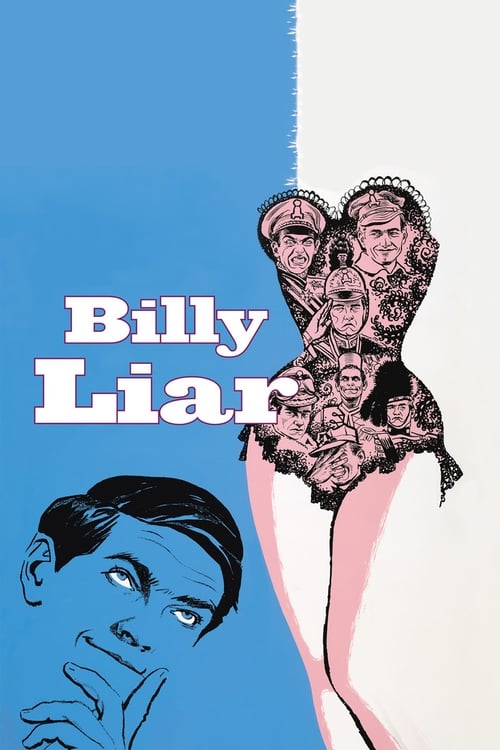
Billy Liar
1963 · John Schlesinger
For when you're feeling stuck in a rut and want a film that gets it — one that makes you laugh at a dreamer's schemes and then quietly asks whether you'd board the train yourself. Comfort viewing with a sting.
What it's about
Billy Fisher is a young clerk in a Yorkshire undertaker's office who copes with his dead-end job and suffocating family by living inside elaborate daydreams — chief among them an imaginary country called Ambrosia, where he rules as hero and dictator. His compulsive lying has tangled him up with too many people, including more than one fiancée, and the walls are closing in. Then a free-spirited girl named Liz breezes back into town, offering him a real shot at the escape he's always fantasized about.
The experience
Funny and buoyant on the surface, with fantasy sequences that burst out of drab northern streets like fireworks — but underneath runs a quiet, growing ache, because you can see the gap between what Billy dreams and what Billy does. It ends up somewhere unexpectedly tender and sad without ever losing its wit.
Performances
Tom Courtenay makes Billy irresistible and exasperating in the same breath, a fantasist you root for even as he sabotages himself. Julie Christie, in the role that made her a star, blows through the film like fresh air — a few scenes of pure, casual freedom that tell you everything Billy is missing.
The craft
John Schlesinger cuts between grimy Bradford reality and Billy's widescreen fantasies with a snap that still feels playful and modern — machine-gun daydreams erupting mid-conversation, whole imaginary parades in a walk down the street. The black-and-white location shooting captures a northern England mid-demolition, old terraces coming down as new tower blocks rise, so the whole town seems caught between eras just like Billy.
Why it matters
A hinge film for British cinema — it took the gritty working-class realism of the era and injected fantasy and lightness, pointing the way toward the more freewheeling British films of the mid-sixties. It launched Julie Christie and set up Schlesinger's run of defining sixties pictures.
Snapshot
Billy Liar is John Schlesinger's second feature, a tragicomedy about a young Yorkshire clerk who lives so fully inside his own fantasies that he cannot act on the one real chance of escape life offers him. Adapted from Keith Waterhouse's 1959 novel and the hit stage play Waterhouse wrote with Willis Hall, the film sits at the hinge of British cinema's transition out of the "kitchen sink" New Wave and toward the brighter, more mobile mode that Schlesinger himself would help inaugurate with Darling (1965). Tom Courtenay plays Billy Fisher, undertaker's clerk, compulsive liar, and self-appointed dictator of an imaginary country called Ambrosia; Julie Christie, in the role that made her a star, plays Liz, the free-moving girl who embodies the freedom Billy claims to want and ultimately refuses. The film's lasting reputation rests on two things: its decisive late-night ending, in which Billy lets the London train leave without him, and its fusion of documentary-grounded provincial realism with frankly stylized daydream sequences — a combination that made it both a summation of the realist cycle and a quiet departure from it.
Industry & production
Billy Liar was produced by Joseph Janni, the Italian-born British producer whose partnership with Schlesinger was one of the most productive of the era; Janni had backed Schlesinger's debut A Kind of Loving (1962) and would go on to produce Darling and Far from the Madding Crowd. The project came to the screen with an unusually strong pedigree of prior success: Waterhouse's novel had been a critical event, and the stage adaptation had been a substantial West End hit, with Albert Finney originating the role of Billy and Tom Courtenay later taking it over — a lineage that gave Courtenay an authority in the part by the time of filming. Waterhouse and Hall adapted their own material for the screen, which helps account for the film's confident handling of structure and dialogue.
The picture belongs to the wave of relatively low-budget, locally rooted British films that flowed from the commercial breakthrough of Room at the Top (1959) and Saturday Night and Sunday Morning (1960). It was distributed through the Anglo-Amalgamated / Warner-Pathé channels that handled much of this product. Precise budget and box-office figures for the film are not securely documented in the popular record, and I will not invent them; what is clear is that the film performed well enough critically and commercially to consolidate Schlesinger's standing and to launch Christie, whom Schlesinger immediately cast as the lead in Darling.
Technology
The most consequential technological choice was the decision to shoot in black-and-white anamorphic widescreen (CinemaScope-type 2.35:1 format). This is worth dwelling on, because it runs against the grain of the realist cycle, whose films were typically shot in the Academy-ish 1.66/1.85 ratios that suited cramped interiors. Schlesinger and his cinematographer Denys Coop turned the wide frame into an expressive instrument rather than a spectacle format: the elongated horizontal image surrounds Billy with the clutter of family rooms and the rubble of a town being demolished, so that the very width that promises scope instead emphasizes how penned-in he is. The film remained in black-and-white at a moment when color was increasingly the prestige norm, a choice consistent with the documentary lineage of the New Wave and with the film's gray Northern settings. Otherwise the production used conventional studio-and-location methods of early-1960s British filmmaking, combining sound-stage interiors with location shooting in the industrial North.
Technique
Cinematography
Denys Coop, who had also photographed A Kind of Loving and Lindsay Anderson's This Sporting Life (1963), gives Billy Liar a textured monochrome look that moves fluidly between two registers. The "real" world of the Fisher household and the undertaker's office is shot with the observational sobriety of the realist school; the town exteriors capture a Yorkshire caught mid-transformation, terraced streets being cleared for new flats, supermarkets, and dual carriageways. Against this, the Ambrosia fantasy inserts are staged with a deliberately grander, more theatrical visual rhetoric — military reviews, balcony oratory, machine-gunning of Billy's enemies — so that the cutting between modes carries much of the film's comedy and pathos. The single most celebrated cinematographic passage is Liz's walk through the town: Christie striding, swinging a bag, the camera moving with her, an image of liberated motion that crystallized a new kind of screen presence and is frequently cited as a harbinger of the "Swinging London" cinema to come.
Editing
The film's editing is its structural signature. The cuts into and out of Billy's daydreams must be timed to land as both joke and revelation, and the film uses them to externalize a consciousness rather than merely to decorate it — a strategy that distinguishes Billy Liar from straight realism. Roger Cherrill is credited with the editing; the rhythm alternates the loose, scene-driven pace of the domestic and workplace material with the sharper, punctuating interruptions of fantasy. The cumulative effect is to make Billy's inner life feel continuous with, and finally inseparable from, his evasions in the real one.
Mise-en-scène / staging
Staging repeatedly contrasts confinement and openness. The Fisher home — dominated by Wilfred Pickles's exasperated father, Mona Washbourne's anxious mother, and Ethel Griffies's querulous grandmother — is a space of overlapping, talking-past-each-other domesticity. The undertaker's office, with its calendars, petty cash, and unposted promotional matter (the source of one of Billy's worst tangles), is the trap of provincial respectability made concrete. Against these enclosures the film sets the demolition sites and the open road to the station, and finally the railway platform itself, where the choice between staying and leaving is given literal spatial form.
Sound
Richard Rodney Bennett's score is jazz-inflected and brisk, lending the comedy buoyancy and giving the fantasy sequences their mock-heroic lift (martial flourishes for Ambrosia). Dialogue carries enormous weight: Waterhouse and Hall's Northern idiom, the family's overlapping complaints, and Billy's fluent self-mythologizing are central to characterization. The contrast between the everyday speech of the household and the inflated rhetoric Billy supplies for his imaginary nation is one of the film's running sound-design ideas.
Performance
Courtenay's Billy is the film's engine — a performance that holds sympathy and exasperation in balance, charming and maddening, never letting the audience forget that his lies wound real people (notably his two simultaneous fiancées, played by Helen Fraser and Gwendolyn Watts, who share a single engagement ring). The supporting playing is rich in character-actor detail: Pickles, Washbourne, and Griffies as the family; Finlay Currie and Leonard Rossiter among the undertaking firm; Rodney Bewes as Billy's friend Arthur. But the performance that altered film history is Julie Christie's Liz. Appearing in relatively little screen time, she projects an unforced modernity and physical freedom that reads as the future arriving inside a film otherwise rooted in the receding present.
Narrative & dramatic mode
The film's dramatic mode is comedy shading into something closer to melancholy realism — a Walter Mitty story with consequences. Its organizing device is the counterpoint between Billy's fantasy life and his accumulating real-world failures: petty theft of company funds, undelivered work, parallel engagements, grandiose claims of a scriptwriting job in London. The narrative is structured as a single decisive day building toward the night train, and its power lies in withholding the conventional payoff. Where the romantic-escape plot promises that Billy will leave with Liz, the film instead has him step off the train at the last moment and walk home — choosing the safety of fantasy over the risk of freedom. The ending is studied because it refuses both tragedy and uplift: Billy is not destroyed, merely returned, marching his imaginary Ambrosian army down a suburban street.
Genre & cycle
Billy Liar belongs to the British New Wave cycle of social-realist adaptations from contemporary novels and plays — the "kitchen sink" films associated with provincial settings, working- and lower-middle-class protagonists, and frank treatment of class and sex. Yet it is a self-aware, even valedictory entry in that cycle, because it laces realism with comedy and fantasy in a way that the earlier, sterner films (Saturday Night and Sunday Morning, A Taste of Honey, This Sporting Life) largely avoided. It can also be placed in the older tradition of the daydreamer-comedy, and it is frequently read as a generational portrait, the dilemma of a young man poised between a dying industrial provincialism and an unrealized metropolitan modernity.
Authorship & method
The film is a meeting of several strong authorial hands. John Schlesinger, having come from television documentary (his BBC short Terminus preceded his features), brought an observational eye and an interest in social texture, but also — increasingly across his career — a fascination with self-deception and performance that runs from Billy through Darling's Diana Scott to Midnight Cowboy's drifters. Billy Liar is in many ways the film where Schlesinger discovered his subject: people who narrate flattering versions of themselves. Keith Waterhouse and Willis Hall, adapting their own novel and play, supplied a screenplay of unusual structural assurance and dialogue density; their collaboration was among the most durable writing partnerships in British screen and stage work of the period. Cinematographer Denys Coop anchored the film in the visual idiom of the realist movement while accommodating its fantasy excursions. Composer Richard Rodney Bennett, then early in a major career spanning concert music and film, gave the picture its jaunty, ironic musical voice. Editor Roger Cherrill realized the central fantasy/reality counterpoint at the level of cutting. The result is genuinely collaborative authorship, with Schlesinger as the organizing sensibility.
Movement / national cinema
The film is a landmark of British national cinema's early-1960s renewal, when a generation of directors (Tony Richardson, Karel Reisz, Lindsay Anderson, Schlesinger) and the literary "Angry Young Men" reshaped what British films could depict. It is bound up with the Free Cinema documentary background of several of these figures and with the broader cultural shift that gave the provincial North a new centrality in British art. Crucially, Billy Liar also marks the movement's pivot: Liz's London-ward energy and Christie's persona point directly toward the "Swinging London" cinema of the mid-decade, making the film a bridge between two phases of the same national-cinema story.
Era / period
Made and set in the early 1960s, the film is acutely a document of its moment. Its backdrop of slum clearance and redevelopment registers the physical remaking of industrial Britain; its preoccupation with London as the promised land of opportunity registers the centralizing pull of the metropolis on provincial youth; and its sexual comedy registers the loosening, still-anxious mores of the pre-permissive early decade. The film captures a culture in transition — the old working-class respectability embodied by Billy's family giving way to a mobility and self-invention that Billy can imagine but cannot enact.
Themes
The governing theme is the gap between imagination and action — fantasy as both a survival mechanism and a prison. Billy's lies and daydreams protect him from a stifling environment, but they also disable him; the very faculty that lets him escape in his head prevents him from escaping in fact. Around this core cluster several others: class and aspiration (the longing to rise and leave); the suffocations and loyalties of family; the conflict between provincial stasis and metropolitan possibility; masculinity and evasion, especially in Billy's tangled, dishonest dealings with women; and the broader generational predicament of postwar British youth offered new horizons they are not yet equipped to seize. The final image — Billy at home, commanding phantom troops — fixes the theme: he has chosen the kingdom he controls over the world he cannot.
Reception, canon & influence
Billy Liar was well received critically on release and has grown in stature as one of the defining British films of its generation, regularly appearing in surveys and polls of important British cinema (including British Film Institute listings), and routinely singled out both for its formal daring within the realist tradition and for introducing Julie Christie. Tom Courtenay's performance cemented his arrival as a leading figure of the new British acting generation alongside Finney and others. I will not attribute specific contemporary review quotations or awards here without the documentary record in front of me, but the broad pattern — strong notices, durable canonical standing, star-making impact for Christie — is well established.
Influences on the film (backward): the immediate sources are Waterhouse's novel and the Waterhouse–Hall stage play; behind them lies the daydreamer-comedy tradition exemplified by James Thurber's "The Secret Life of Walter Mitty," to which the film is frequently compared. Stylistically it stands on the shoulders of the British New Wave realist films of 1959–1962, whose location-based, class-conscious idiom it inherits and then complicates with fantasy.
Legacy (forward): the film's most direct line of influence runs through Schlesinger's own Darling, which carried Christie and the metropolitan energy of Liz into a full Swinging-London portrait. More broadly, Billy Liar's blend of grounded realism with externalized fantasy anticipated later British works built on the same tension — its DNA is visible in the imaginative-escape cinema that culminates in something like Terry Gilliam's Brazil, and in the British tradition of socially observant comedy-drama. The property itself proved durable across media: it was adapted into a stage musical, Billy (1974), and into a 1970s British television sitcom, extending the character's life well beyond the film. Within film history, Billy Liar is now read less as a simple kitchen-sink entry than as the movement's self-aware turning point — the film in which postwar British realism looked at its own dreamer and let the train leave without him.
A Deleuzian reading
Halfway through a dull morning, Billy Fisher machine-guns his entire family.
The full Deleuzian reading of Billy Liar →
Reception
A hit with critics on release as one of the smarter British New Wave entries, it's since climbed even higher — now regularly cited as the moment kitchen-sink realism learned to dream, and one of the most affectionately remembered British films of the 60s.
How Billy Liar was received, from release to now →
Influences: the films it descends from and the films it influenced
- The Secret Life of Walter Mitty (1947) — Established the daydreamer-comedy structure of a meek man escaping drab life into self-aggrandizing heroic fantasy vignettes that interrupt the mundane — the exact reverie engine driving Billy's fantasies of ruling 'Ambrosia.'
- Sherlock Jr. (1924) — Pioneered the cinematic daydreamer who bodily enters his fantasy via match-cut transitions between drab reality and imagined heroics — the editing conceit behind Billy's machine-gunning massacre reveries.
- Wild Strawberries (1957) — Normalized interleaving lived scenes with subjective dream and memory at the cut, without optical dissolves to flag them — the unmarked fantasy/reality editing Roger Cherrill deploys throughout.
- Room at the Top (1959) — Founded British kitchen-sink realism: provincial class ambition, location shooting, and a young man trapped by the horizons of his Northern town.
- Saturday Night and Sunday Morning (1960) — Set the template of the rebellious working-class antihero amid industrial location realism (Finney) that Courtenay's Billy both inherits and ironizes into fantasy.
- A Taste of Honey (1961) — Walter Lassally's documentary-flavored location photography of grimy Northern townscapes codified the British New Wave visual idiom Denys Coop works within.
- The Loneliness of the Long Distance Runner (1962) — Gave Tom Courtenay his screen-defining debut as a fantasizing working-class rebel and intercut present action with imagined/remembered states, directly prefiguring Billy's structure.
- A Kind of Loving (1962) — Schlesinger's debut feature, shot by Denys Coop, established the Northern realist grammar he then complicates with externalized fantasy in Billy Liar a year later.
- Darling (1965) — Schlesinger carries Julie Christie and Liz's metropolitan restlessness directly into a full Swinging-London portrait of a self-mythologizing woman.
- Morgan: A Suitable Case for Treatment (1966) — Externalizes a man's gorilla-and-revolutionary fantasy life intruding on social reality — the most direct British heir to Billy's imagination-versus-action cutting.
- Midnight Cowboy (1969) — Schlesinger again cuts a drifter's flattering fantasies and memories against squalid reality, extending his abiding subject of people who narrate flattering versions of themselves.
- Brazil (1985) — Builds an entire film on a clerk escaping bureaucratic drabness into soaring winged-flight fantasies — the maximalist culmination of Billy's imaginative-escape device.
- Trainspotting (1996) — Energizes British working-class realism with surreal fantasy interludes and ironic voiceover, the modern inheritor of grounded realism spliced with externalized inner life.
- Amélie (2001) — Stages a daydreamer's whimsical inner imaginings as formally playful interludes erupting within an otherwise grounded milieu, extending the fantasy-counterpoint tradition.
- Alfie (1966) — Provided the fantasist working-class male protagonist whose self-narrated inner world the camera privileges, a subjectivity Alfie externalizes into literal address.
- Precious: Based on the Novel 'Push' by Sapphire (2009) — Codified the kitchen-sink-realism-plus-daydream template: a trapped working-class protagonist's grim milieu is punctured by lush fantasy interludes, the exact reality/fantasy cross-cutting Daniels uses for Precious's red-carpet escapes.
- Nine to Five (1980) — Cuts fantasy-daydream inserts into a drudge's naturalistic routine to dramatize revenge and escape — the structural device Nine to Five reuses for its three interpolated wish-fulfillment fantasies.
- 8½ (1963) — Released the same year, it dissolves the boundary between a man's fantasies, memories and real life through fluid editing — the international counterpart to Billy's fantasy counterpoint.
- A Hard Day's Night (1964) — Shares the kinetic, score-driven editing energy and jaunty irony of the moment British realism turned playful and pop, akin to Bennett's jazz-inflected scoring of Billy.
- This Sporting Life (1963) — Again photographed by Denys Coop, the film uses the same Bradford location grammar — handheld exterior shooting counterpointed against interior confinement — as a formal analog for the protagonist's inability to escape class determination.
- Look Back in Anger (1959) — Schlesinger's protagonist in a Northern English domestic trap uses compulsive verbal fantasy-construction — the monologue turned inward as daydream — as the only available class-escape mechanism, exactly analogous to Porter's speeches; the film's spatial grammar (Bradford locations, a small house, the geography of departure that never quite happens) is the tragicomic counterpart to *Look Back*'s tragic one.
Similar films
- Darling (1965) — influence & lineage
- The Loneliness of the Long Distance Runner (1962) — influence & lineage
- Brazil (1985) — influence & lineage
- A Kind of Loving (1962) — influence & lineage
- A Taste of Honey (1961) — influence & lineage
- The Apartment (1960) — shared sensibility
- Room at the Top (1958) — shared sensibility
- Brief Encounter (1945) — shared sensibility
All the films related to Billy Liar →