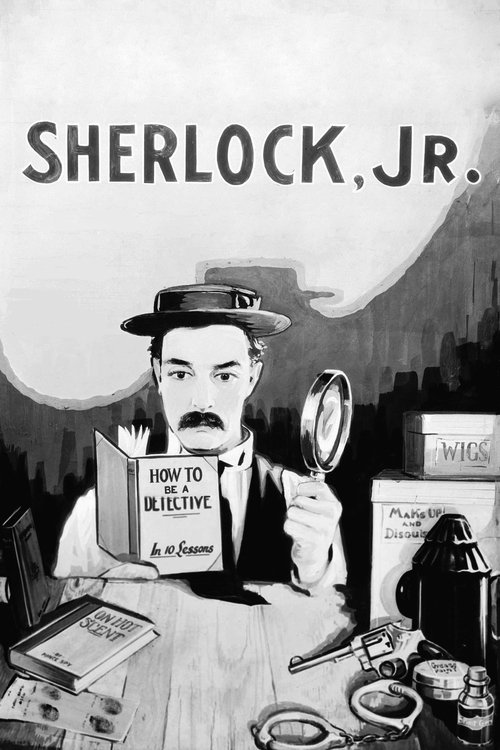
Sherlock Jr.
1924 · Buster Keaton
For when you're curious about silent film but want the fun, fast gateway drug — or when you just need something short, dazzling, and guaranteed to delight. Zero homework required.
What it's about
A small-town movie projectionist with detective daydreams gets framed by a rival for stealing his girlfriend's father's pocketwatch. Banished and brooding, he falls asleep at his projector — and walks straight down the theater aisle and into the screen, where he becomes the dapper super-sleuth of his dreams. What follows is part mystery spoof, part chase picture, and part magic trick about the movies themselves.
The experience
Forty-five minutes of pure astonishment — silent comedy at maximum velocity, where the laughs keep tripping over your disbelief that any of this was physically possible. It's playful, precise, and somehow still jaw-dropping a century on.
Performances
Buster Keaton, deadpan and impossibly athletic, performs every stunt himself — including one so dangerous he fractured his neck without realizing it. His stillness amid chaos is the whole comic engine.
The craft
The film-within-a-film sequence — Keaton stranded as the movie cuts around him, backgrounds changing under his feet with surveyor-grade precision — was decades ahead of any vocabulary for such effects. Every gag is engineered like clockwork, from an impossible pool game to a chase ridden on the handlebars of a driverless motorcycle.
Why it matters
One of the foundational texts of visual comedy and screen illusion, endlessly studied and stolen from — the moment cinema first dreamed, on camera, about entering itself.
Buster Keaton's 45-minute marvel about a movie-theater projectionist who, framed for a theft and dreaming at his post, walks down the aisle and steps directly into the screen — where the film keeps cutting around him, stranding him on rocks, in traffic, atop a lion's den, each background change matched with surveyor-grade precision decades before anyone had a word for such effects. It is cinema thinking about itself with total playfulness: the fantasy of entering the movies, staged by the one performer athletic and exacting enough to make it physical. The second half becomes pure velocity — a pool game of impossible geometry, a chase ridden on the handlebars of a driverless motorcycle — every gag engineered, rehearsed, and performed by Keaton himself without trickery he considered cheating. During the water-tower stunt he fractured his neck and simply kept shooting; a doctor found the healed break years later. A commercial disappointment in 1924, it now reads as prophecy, echoed everywhere from Godard's provocations to The Purple Rose of Cairo. The stone face never once asks for our astonishment, which is exactly why it earns it.
A Deleuzian reading
He has fallen asleep in the projection booth.
The full Deleuzian reading of Sherlock Jr. →
Reception
In 1924 it was reviewed as a middling Keaton programmer and did unremarkable business; today it's routinely called one of the greatest films of the silent era, a fixture of Sight & Sound polls and film-school syllabi.
How Sherlock Jr. was received, from release to now →
Influences: the films it descends from and the films it influenced
- A Trip to the Moon (1902) — Establishes the substitution splice and stop-trick — the in-camera edit-as-magic that Keaton weaponizes into gags, where a single cut swaps the world around a stationary figure.
- Dream of a Rarebit Fiend (1906) — Houses trick photography inside a sleeper's dream frame, the exact narrative armature Keaton borrows: the projectionist dozes off and his dream becomes a stage for lock-off composite effects.
- The Butcher Boy (1917) — Arbuckle personally mentored Keaton here, teaching him camera mechanics and single-take gag construction — the mastery of how the lens sees that Sherlock Jr.'s seamless mattes absolutely require.
- The Playhouse (1921) — Keaton's own earlier short perfects multiple-exposure matte work (playing every role in one frame with a masked lens), the invisible-composite discipline he scales up into the dream-screen sequence.
- The General (1926) — Extends Keaton's precision-geometry staging to a moving train, engineering gags with surveyor's exactitude so bodies and machines intersect on frame-perfect trajectories.
- Hellzapoppin' (1941) — Directly inherits the porous film frame — characters argue with the projectionist and the film slips out of its sprockets mid-scene, extending Keaton's gag of a movie that malfunctions around its viewer.
- Singin' in the Rain (1952) — Fuses cinema-about-moviemaking with virtuosic physical comedy staged in unbroken takes, carrying Keaton's principle that the body's precise choreography, not the cut, sells the gag.
- Les Carabiniers (1963) — The naive soldier who lunges at and tries to climb into the movie screen is a direct Godardian quotation of Keaton's projectionist walking into the projected image.
- Playtime (1967) — Adopts Keaton's locked, distant camera and precision-geometry wide staging, letting gags play out in deep architectural space where the audience must hunt the frame for the comedy.
- The Purple Rose of Cairo (1985) — Explicitly inverts Sherlock Jr. — a character steps OUT of the screen into the audience rather than in — working the same permeable membrane between projected fiction and the watching world.
- Police Story (1985) — Carries the real-injury physical-stunt-comedy lineage Keaton pioneered — Chan performs his own bone-breaking set-pieces in long takes and openly names Keaton as his model.
- Last Action Hero (1993) — Restages the screen-entry as blockbuster spectacle: a boy passes through the movie screen into the film's diegesis, the projectionist's dream-crossing scaled to magic-ticket effects.
- The Science of Sleep (2006) — Renders dream logic through handmade, in-camera practical trickery rather than optical or digital compositing, keeping faith with Keaton's lock-off, do-it-for-real effects tradition.
- Hugo (2011) — A cinema-about-itself that reveres early trick-film craft (Méliès's substitution effects), closing the loop on the same self-reflexive love of the projection apparatus Keaton dramatized.
- Toy Story (1995) — Source of the silent-slapstick comic timing and full-body physical gag construction Lasseter cites — gags staged in unbroken space with the body's weight as the punchline.
- Billy Liar (1963) — Pioneered the cinematic daydreamer who bodily enters his fantasy via match-cut transitions between drab reality and imagined heroics — the editing conceit behind Billy's machine-gunning massacre reveries.
- Safety Last! (1923) — Builds thrill-comedy from real architectural stunts and precise sightline illusions (the clock-hang), the same marriage of genuine physical danger and camera-calibrated geometry Keaton pursues with his own real-injury set-pieces.
- Man with a Movie Camera (1929) — Shares the self-reflexive apparatus: a film that foregrounds its own projection, editing, and screen, turning the mechanics of cinema into the subject the way Keaton's projectionist literalizes the act of watching.
- Mission: Impossible - Fallout (2018) — Originates the body-on-the-line ethic of the performer executing genuinely dangerous stunts in-frame, the lineage Cruise consciously revives as physical author of his own action.
- City Lights (1931) — Keaton's contemporaneous mastery of gag built through editing and exact bodily mechanics represents the parallel pole of silent visual storytelling, sharing City Lights' faith that the cut and the body, not the title card, carry meaning.
- Steamboat Bill, Jr. (1928) — Executes life-threatening real stunts like the water-tower fall with total facial stillness, subordinating cutting to the unbroken physical event exactly as the cyclone gag does.
Similar films
- PlayTime (1967) — influence & lineage · same viewing thread · often watched together
- The General (1926) — influence & lineage
- Pee-wee's Big Adventure (1985) — same viewing thread
- Minions & Monsters (2026) — same viewing thread
- Monsieur Hulot's Holiday (1953) — same viewing thread
- Singin' in the Rain (1952) — influence & lineage · often watched together
- Man with a Movie Camera (1929) — influence & lineage · often watched together
- City Lights (1931) — often watched together
All the films related to Sherlock Jr. →
Watch it with: curated runs of related films
- Sight Gags and Soft Hearts — Watch these when you want comedy built from movement, timing, and architecture rather than punchlines — a gentle soul politely adrift in a bustling, beautifully machined world.