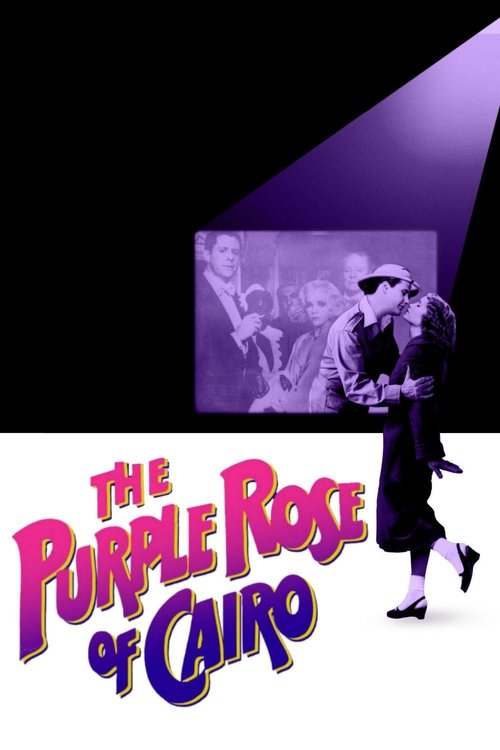
The Purple Rose of Cairo
1985 · Woody Allen
For when you want something short, sweet, and smarter than it needs to be — a love letter to going to the movies that's also honest about what movies can't fix. Cozy on the surface, with a lingering bittersweet finish.
What it's about
During the Great Depression, a New Jersey waitress with a bleak marriage and a vanishing job escapes into the movie theater, watching the same romantic adventure picture over and over. Then the film's dashing hero notices her from the screen — and steps down out of the black-and-white movie and into her life, throwing the theater, the studio, and her own heart into chaos.
The experience
Light on its feet and genuinely funny, but with an ache running underneath — it's a comedy about escapism that quietly understands why people need to escape. It charms you for eighty minutes and then lands somewhere unexpectedly tender and sad.
Performances
Mia Farrow is quietly heartbreaking as Cecilia, all fragile hope and movie-fed wonder, and Jeff Daniels has a ball in a tricky double role that asks him to be both an impossibly perfect screen hero and something more complicated.
The craft
The film-within-a-film is executed with loving precision — the black-and-white picture Cecilia adores is a pitch-perfect pastiche of 1930s studio escapism, and the interplay between that world and her drab color reality is the movie's engine. At a lean 82 minutes, there isn't a wasted scene.
Why it matters
Widely considered one of Woody Allen's finest films — and one he himself has singled out — it became a touchstone for stories about the border between the movies and the lives of the people who love them.
Snapshot
The Purple Rose of Cairo is Woody Allen's Depression-era fable about a battered New Jersey waitress, Cecilia (Mia Farrow), whose devotion to the movies is so complete that a character steps down off the screen to court her. Tom Baxter (Jeff Daniels), the "poet-adventurer" of a fictional 1930s RKO-style picture also called The Purple Rose of Cairo, walks out of the black-and-white world of the film-within-the-film into Cecilia's grubby color reality, throwing both the movie theater and the movie's own narrative into chaos. Running a lean 82 minutes, it is at once a slapstick comedy of metaphysical malfunction and a genuinely melancholy essay on the consolations and cruelties of fantasy. Allen has repeatedly named it among his own favorites of his films — a rare public endorsement from a director habitually dismissive of his own work — and it is widely regarded as one of the most fully achieved of his mid-1980s pictures, the group that also includes Zelig (1983), Broadway Danny Rose (1984), and Hannah and Her Sisters (1986). Its central conceit — the porous membrane between screen and spectator — has made it a touchstone in academic film theory, endlessly cited in discussions of spectatorship, reflexivity, and the ontology of the moving image.
Industry & production
The film was produced by Robert Greenhut for Orion Pictures, the distributor that handled most of Allen's output during the 1980s and gave him the near-total creative autonomy — final cut, casting control, freedom from studio interference — that defined his working method in this period. Budgets on Allen's films of this era were modest by Hollywood standards, and Purple Rose was no exception; it was a small, carefully controlled production rather than a major studio tentpole. Its most consequential production event is well documented: Michael Keaton was originally cast as Tom Baxter and shot for a period before Allen replaced him with Jeff Daniels, having concluded that Keaton read as too contemporary for the 1930s idiom the part required. This is one of the better-known casting reversals in Allen's career and is corroborated across multiple accounts, including Allen's own later remarks.
The picture was shot largely in and around New York and New Jersey, with production design by Stuart Wurtzel evoking the threadbare textures of the Great Depression. Commercially, the film performed modestly in the United States — as was typical for Allen's work, which reliably found a larger and more enthusiastic audience in Europe than at home. Specific North American gross figures are a matter of record but I will not cite a precise number here rather than risk misstating it. What is clear is that the film's reputation has always rested on critical and cultural standing rather than box-office performance.
Technology
Technologically, the film's defining challenge was optical: the seamless integration of a character crossing between a projected black-and-white "film" and the "real" color world. Made in 1985, before digital compositing, the picture achieved its screen-to-audience transgressions through traditional means — carefully matched staging, in-camera setups, rear projection, and optical/matte work executed photochemically. The film-within-the-film was shot in black and white to establish the ontological divide, so that Tom Baxter's emergence into Cecilia's color reality is registered immediately by the eye. The technical accomplishment is less about any single novel apparatus than about the disciplined, unshowy orchestration of period-appropriate techniques to sell an impossible premise. Where the exact mechanics of specific shots are concerned — which crossings were rear projection versus optical printing versus split staging — the granular production record available to me is thin, and I will not reconstruct it speculatively.
Technique
Cinematography
The film was photographed by Gordon Willis, Allen's most important cinematographic collaborator, who shot the majority of his films from Annie Hall (1977) through The Purple Rose of Cairo. Willis — nicknamed "the Prince of Darkness" for his low-key, underexposed work on the Godfather films — brings a controlled, painterly sensibility to the picture's two visual registers. The "real" world of Depression New Jersey is rendered in muted, desaturated color, its diners and rooming houses drab and cold; the film-within-the-film is a glossy, high-key black-and-white pastiche of 1930s studio glamour, all crisp whites and Art Deco sheen. The contrast is the whole point: Willis makes the fantasy literally more luminous than the life, so that Cecilia's longing is embedded in the image itself. Purple Rose marked effectively the end of the Allen–Willis partnership, closing one of the signal director-cinematographer collaborations of the New Hollywood generation.
Editing
The film was edited by Susan E. Morse, who cut virtually all of Allen's films across the late 1970s, 1980s, and into the 1990s. The editorial task here is unusually delicate: the comedy depends on precise timing between the screen characters (who freeze, argue, and address the audience when their plot stalls) and the theater patrons and the on-the-loose Tom. Morse's cutting sustains the illusion that two levels of reality are reacting to each other in real time, and the film's brisk 82-minute economy reflects the trim, unindulgent construction characteristic of her work with Allen.
Mise-en-scène / staging
Staging is central to the film's meaning. The proscenium of the movie screen becomes a literal threshold, and Allen repeatedly frames the theater so that the audience, the screen, and the space between them are legible in a single geography. When the stranded characters within the film-within-the-film turn to bicker with the paying customers, the composition must hold both planes at once. Stuart Wurtzel's production design differentiates the worlds not only by color but by texture and abundance — the film-within-the-film's nightclubs and penthouses overflowing with elegance, Cecilia's world pinched and worn. The staging consistently dramatizes the gap between the two.
Sound
The soundscape leans on period-appropriate popular song of the 1930s to evoke the Depression era and the escapist glamour of the movies, a scoring approach — curated vintage recordings rather than an original orchestral score — that Allen favored throughout his career. Dialogue is foregrounded in the classic Allen manner, and the film's verbal comedy (the marooned screen characters philosophizing about their predicament) depends on clean, theatrical clarity of speech.
Performance
The performances are the film's emotional engine. Mia Farrow, in one of the central collaborations of her long partnership with Allen, plays Cecilia with an open, unguarded vulnerability — no irony, no self-protection — that keeps the film's clever premise anchored in real pathos. Jeff Daniels does remarkable double duty, playing both the guileless, gallant fictional Tom Baxter, who has no concept of a world that does not obey a script, and Gil Shepherd, the vain, anxious real-life actor who played Tom and now arrives to reclaim his runaway creation. Danny Aiello appears as Cecilia's brutish husband. The film asks Daniels to make two versions of the same face read as opposite kinds of men — one incapable of dishonesty, the other capable of little else — and the contrast carries the movie's argument about fantasy and reality.
Narrative & dramatic mode
The film's dramatic mode is metafiction rendered as farce and, finally, as tragedy. Its governing device is the rupture of the diegetic boundary: a character becomes aware of, and then escapes, his own fiction. This generates two intertwined lines of comedy — the practical chaos of a film that cannot continue because its leading man has left the screen (the remaining characters stall, complain, and negotiate with the audience), and the romantic triangle among Cecilia, the perfect-but-unreal Tom, and the real-but-faithless Gil. Allen structures the film around a cruel symmetry: Cecilia must choose between a man who is ideal but fictional and a man who is real but false. The resolution refuses consolation. The famous final image — Cecilia, abandoned by both, returning alone to the theater and losing herself in Fred Astaire and Ginger Rogers dancing "Cheek to Cheek" in Top Hat — is one of the most quietly devastating endings in Allen's body of work, an argument that the movies will not save us and that we will keep going back anyway.
Genre & cycle
Nominally a fantasy-comedy-romance, the film belongs to the reflexive strain of Allen's mid-1980s work in which he tested formal conceits about media and reality: Zelig (1983) with its faux-documentary "human chameleon," Broadway Danny Rose (1984) with its nested storytelling, and Purple Rose with its screen-crossing character. It also participates in a longer lineage of self-aware films about filmgoing and about characters aware of their fictionality — a tradition that reaches back to Buster Keaton's Sherlock Jr. (1924), in which a projectionist dreams himself into the movie on the screen, an antecedent frequently and rightly invoked in discussions of Purple Rose. Within Allen's own filmography it is the purest expression of his recurring theme of illusion versus reality.
Authorship & method
The Purple Rose of Cairo is a signature Allen auteur work: he wrote and directed it, though — pointedly — he does not appear in it, one of several films of the period in which he stayed behind the camera to serve a concept that did not require his on-screen persona. The film crystallizes his abiding preoccupations: the seductions and betrayals of fantasy, the smallness of ordinary life, the way art both rescues and lies to us.
The authorship is, as always with Allen, collaborative in its craft. Gordon Willis (cinematography) supplied the two-tiered visual scheme that makes the premise legible; this was the last of their films together. Susan E. Morse (editor) sustained the film's cross-plane comic timing and its lean shape. Producer Robert Greenhut and production designer Stuart Wurtzel built the Depression-era world. Allen did not employ a conventional composer, instead scoring the film with period recordings in his customary fashion. The recurring creative partnership with Mia Farrow, who starred in a long run of his films through the 1980s and into the early 1990s, is inseparable from the movie's tenderness.
Movement / national cinema
The film sits within American independent-minded auteur cinema of the post–New Hollywood 1980s — work made inside the industry but with the autonomy and personal signature associated with European art cinema, an autonomy Orion's arrangement with Allen made possible. Allen's sensibility was always self-consciously indebted to European models — Bergman, Fellini — and Purple Rose, with its philosophical melancholy folded into comedy, is legible as an American refraction of that art-cinema tradition. Fittingly, the film was embraced more warmly in Europe than in the United States; it competed at the Cannes Film Festival and won the BAFTA for Best Film, and Allen's original screenplay was recognized with major writing honors on both sides of the Atlantic. (I state these awards at the level the record firmly supports and avoid attaching specific vote tallies or category minutiae I cannot verify.)
Era / period
The film is doubly period. Diegetically it is set during the Great Depression of the 1930s, and the economic desperation is not decorative — it is the precondition of Cecilia's need for the movies. Her poverty, her abusive and unemployed husband, the ever-present threat of losing even her waitressing job: these make the cinema not a diversion but a survival mechanism, which is what gives the film its thesis about escapism real weight. Made in 1985, the film also belongs to a mid-1980s moment of American cinema newly fascinated by its own history and machinery, and Allen's affectionate recreation of the 1930s studio product — the clipped mid-Atlantic diction, the penthouse-and-nightclub milieu, the "poet-adventurer" archetype — functions as both homage and gentle satire of Golden Age Hollywood.
Themes
The film's master theme is the relationship between fantasy and reality, and specifically the double edge of escapism: the movies console the powerless and, in the same gesture, set them up for disappointment by making real life look unbearable by comparison. Tom Baxter is fantasy made flesh — perfect, faithful, incapable of cruelty — precisely because he is not real; the moment fantasy must compete with reality, it cannot survive. A second theme is the unreliability of the real: Gil Shepherd, the flesh-and-blood man, proves less trustworthy than the fictional one, so that Cecilia's "correct" choice of reality over illusion is punished. Underlying both is a meditation on spectatorship itself — on what we ask of the movies and what they can and cannot give back. The ending, with Cecilia's tearstained face slowly warming as she watches Astaire and Rogers, stages the theme without a word: the screen offers no rescue, only the temporary grace of looking, and that, the film suggests, is both not enough and all we have.
Reception, canon & influence
Critically, The Purple Rose of Cairo was warmly received on release and its standing has only grown; it is routinely ranked among Allen's finest films and is frequently singled out for the audacity of its concept married to the sincerity of its feeling. Its major honors — the BAFTA for Best Film, recognition at Cannes, and leading screenplay awards for Allen — mark it as one of the most acclaimed pictures of his career.
Influences on the film (backward): The most direct and universally cited antecedent is Buster Keaton's Sherlock Jr. (1924), which first dramatized a spectator crossing into the screen. More broadly the film draws on the reflexive tradition of stories about characters aware of their fictionality (the Pirandellian lineage of Six Characters in Search of an Author is often invoked) and on Allen's deep affection for 1930s Hollywood studio filmmaking, whose glamour and idiom it lovingly reconstructs. Allen's European art-cinema models — Bergman above all — inform its willingness to let comedy end in unresolved sorrow.
Legacy (forward): The film has become a permanent fixture in film-theoretical writing on spectatorship, reflexivity, and the ontology of cinema — a ready-made illustration of the fantasy of the screen made porous, cited across decades of academic and critical work. It stands as a key reference point whenever later films toy with characters escaping or entering their own fictions, and it is regularly discussed alongside the broader tradition of metacinema. Within Allen's own oeuvre it is the definitive statement of his illusion-versus-reality theme, a film he has held up as among his best, and its final shot endures as one of the most eloquent images ever made about why we go to the movies at all.
A Deleuzian reading
The brightest thing in this movie is a rectangle of light in a half-empty matinee.
The full Deleuzian reading of The Purple Rose of Cairo →
Reception
A critical darling on release in 1985 — it won the BAFTA for Best Film and the César for Best Foreign Film despite modest box office — and its stock has only risen since, now routinely ranked among Woody Allen's two or three best.
How The Purple Rose of Cairo was received, from release to now →
How to watch The Purple Rose of Cairo: what to notice on a first viewing
- Notice the movie world is brighter than the real one. Willis shoots Cecilia's Depression New Jersey in muted, cold color and the film-within-the-film in glossy, high-key black-and-white, all crisp whites and Art Deco sheen. The fantasy is made literally more luminous than her actual life.
- Watch how the theater frames screen, seats, and space between. Allen composes the auditorium so the audience, the screen, and the gap between them stay visible together in a single geography, not cut apart. The composition turns the movie house into a single working machine you can see whole.
- Watch Jeff Daniels play two different men with one face. He plays both the guileless fictional Tom Baxter and the vain actor Gil Shepherd who portrayed him, using the same features to read as opposite kinds of people. One actor's face is doing the work of the film's entire argument about honesty.
- Listen for vintage 1930s recordings instead of a score. Allen skips original orchestral music entirely and scores the film with curated period songs, keeping dialogue foregrounded and theatrically clear throughout. The period songs place you inside the era's own soundtrack rather than a modern commentary on it.
- Watch Farrow's face while she watches the screen. Cecilia plays Tom Baxter's admirer with open, unguarded vulnerability, no irony or self-protection, which is exactly what lets a character notice her back. Her unguarded watching is what makes the whole premise believable in the first place.
The whole guide to watching The Purple Rose of Cairo, with the keys for a rewatch →
Influences: the films it descends from and the films it influenced
- Sherlock Jr. (1924) — Supplies the founding gag Allen inverts—Keaton's projectionist walks INTO the projected movie, where Allen has the fictional character walk OUT—both treating the screen surface as a physically permeable threshold.
- The White Sheik (1952) — Dramatizes a naive fan's romantic collision with a serialized fantasy hero, deflating the fictional idol against drab reality—Fellini being an explicitly acknowledged model for that fantasy-versus-life confrontation.
- 8½ (1963) — Establishes the reflexive grammar of treating filmmaking's artifice as its own subject, the Fellini mode Allen had already absorbed in Stardust Memories and extends here into the ontology of the finished movie.
- Persona (1966) — Makes the film's own membrane visible (the strip burning, the image rupturing) and lets the drama end in unresolved sorrow—Bergman's acknowledged influence on treating the screen as a fragile, breakable illusion.
- Sullivan's Travels (1941) — Argues, through a director's Depression-era descent among the poor, that escapist Hollywood comedy is a genuine lifeline for the downtrodden—the exact thesis Allen's final movie-house shot enacts.
- Hellzapoppin' (1941) — Pioneers the reflexive-comedy grammar of characters arguing with the projectionist and the film literally breaking down, the fourth-wall-demolition idiom Allen refines into a controlled dramatic device.
- Top Hat (1935) — Provides the RKO Astaire-Rogers art-deco glamour idiom that Gordon Willis and designer Stuart Wurtzel reconstruct as the pristine black-and-white film-within-the-film.
- Play It Again, Sam (1972) — Exact inversion of the premise: the screen figure crosses out of the projection into the spectator's world, and Allen withholds the consoling third-act resolution Sam grants.
- Last Action Hero (1993) — A magic movie ticket lets a boy and his on-screen hero cross between film and reality in both directions, scaling the Sherlock Jr./Purple Rose threshold-crossing device up to blockbuster spectacle.
- Pleasantville (1998) — Pulls viewers into a black-and-white period broadcast and uses a two-tone monochrome-versus-color scheme to mark the fiction/reality divide, echoing Willis's two-tiered visual system for the same purpose.
- The Truman Show (1998) — Extends the spectatorship-and-porous-screen inquiry to a man who unknowingly lives inside a produced fiction, inverting Purple Rose's terms so the fiction is the real world and escape means exiting it.
- Stranger than Fiction (2006) — Builds on the Pirandellian premise Allen invokes—a character who becomes aware he is a fictional creation subject to an offstage author's will—and confronts him with his own narrator.
- The Artist (2011) — Makes loving formal reconstruction of a vanished Hollywood idiom—silent/early-sound style—the entire texture of the film, the period-homage craft Purple Rose applies to its 1930s picture-within.
- Being John Malkovich (1999) — Allen's deadpan bureaucratic literalism about portal-crossing — the mechanics of transit between worlds treated as mundane fact requiring practical management by the characters left behind — establishes the genre grammar BJM inherits and extends from fictional-character-to-human-consciousness as destination.
- Cinema Paradiso (1988) — Allen stages the small-town cinema auditorium as a space of bidirectional desire where the spectator's gaze becomes the dramatic subject; Tornatore extends this reflexive booth-screen staging to include the projection apparatus itself, making the projectionist the relay between spectator desire and screen image — the third term Allen left offscreen.
- Galaxy Quest (1999) — Pioneers the formal conceit of a fiction literally crossing into reality, the metafictional literalization Galaxy Quest stages when the show's episodes turn out to be real 'historical documents.'
- Adaptation. (2002) — Establishes the permeable membrane between a fiction and its makers/subjects, with characters crossing into one another's reality.
- Falling in Love Like in Movies (2023) — A monochrome film-within-a-film whose character steps off the screen, dramatizing life-imitating-art and the yearning to author a happier ending than reality allows.
- Basic Sanitation, the Movie (2007) — Metacinema comedy that collides cinema's manufactured fictions with material poverty, using the movies-as-escape premise to sharpen an economic point.
- Joni's Promise (2005) — Cornerstone of the metacinema romance that makes the audience's love of the screen the literal engine of plot, the self-reflexive move Joni's cinephile conceit extends.
- Zelig (1983) — Allen's immediately prior film uses photochemical compositing to fuse a fictional character seamlessly into period footage—the same Depression-era metafictional experiment in blending invented figures with a reconstructed past.
- Stardust Memories (1980) — Allen's Fellini-derived film about a filmmaker besieged by his own fans and creations, the reflexive blurring of maker and fiction that Purple Rose distills into the actor/character split.
- Midnight in Paris (2011) — Allen's own later return to the fantasy-versus-reality and golden-age-homage engine, where a nostalgic escape into an idealized past both consoles and deceives exactly as the movie screen does here.
- Kiss of the Spider Woman (1985) — A same-year film built on cinema as refuge, in which a prisoner survives by retelling a glamorous fictional movie that bleeds into and reshapes his grim reality.
- Lisbela and the Prisoner (2003) — Metafiction ancestor: the screen-versus-life boundary as a comic engine, dramatizing moviegoing as an escapist faith in happy endings — the belief that organizes Leléu's cinephile hope.
Similar films
- 8½ (1963) — influence & lineage
- Zelig (1983) — influence & lineage
- Casablanca (1943) — shared sensibility
- Cinema Paradiso (1988) — shared sensibility
- Breakfast at Tiffany's (1961) — shared sensibility
- Play It Again, Sam (1972) — shared sensibility
- The Color Purple (1985) — shared sensibility
- Mildred Pierce (1945) — shared sensibility