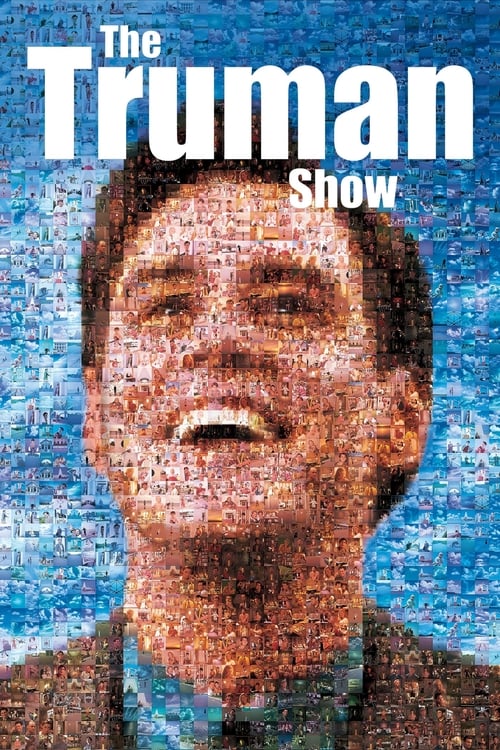
The Truman Show
1998 · Peter Weir
For when you want a crowd-pleaser with a brain — warm enough for a group night, sneaky enough to chew on for days. One of those rare films that works equally as comfort viewing and as a conversation starter.
What it's about
Truman Burbank is a cheerful insurance salesman in a postcard-perfect seaside town, and everything about his life is fake: his wife, his friends, his job, the sky. He's the unwitting star of a reality show broadcast to the world since birth, and the film follows the small glitches — a falling stage light, a too-convenient traffic jam — that start to crack his contentment and feed a suspicion he can't name.
The experience
It plays as a bright, funny fable that keeps turning quietly heartbreaking, and the tension of watching a man wake up to his own life is real edge-of-seat stuff. You laugh, you root for him hard, and you leave thinking about your own cameras.
Performances
Jim Carrey channels his rubber-faced energy into something poignant — the manic cheer becomes the performance of a man performing happiness without knowing it, and the cracks in it are devastating. Ed Harris brings unsettling tenderness to the showman who built the cage.
The craft
Peter Weir directs Andrew Niccol's original script with total control of tone, keeping satire, thriller, and fairy tale in balance. The too-perfect pastel town is a production-design coup — everything looks just artificial enough — and the film often frames Truman through hidden-camera angles, making you complicit in the watching.
Why it matters
Its premise escaped the film and entered everyday language — 'Truman Show' is now shorthand for the feeling your life is staged — and it eerily anticipated the reality-TV and surveillance culture that arrived right after it.
Snapshot
The Truman Show is the rare high-concept studio picture whose premise has outlived the film itself and entered ordinary language: "Truman Show" has become shorthand for the dawning suspicion that one's life is staged, even a clinical descriptor for a recognized delusional pattern. Directed by the Australian émigré Peter Weir from an original screenplay by Andrew Niccol, the film follows Truman Burbank (Jim Carrey), an affable insurance salesman in the immaculate island town of Seahaven who does not know that he was legally adopted by a corporation at birth, that every person in his life is an actor, and that his every waking moment has been broadcast live to a global audience since before he could walk. The film tracks the slow erosion of Truman's manufactured contentment as small malfunctions in the apparatus — a falling studio light, a rainfall that follows only him, his "dead" father reappearing as an extra — accumulate into the unbearable knowledge that the world is a set. Released in June 1998, it arrived a year before reality television's true commercial explosion and is routinely cited as having anticipated a media culture that did not yet exist. It is at once a satire of surveillance and spectacle, a fable about free will and the courage of departure, and a showcase that recast Carrey, then the era's reigning rubber-faced comic, as a dramatic actor of unexpected restraint.
Industry & production
The film was produced by Scott Rudin Productions and distributed by Paramount Pictures. Niccol's screenplay circulated in Hollywood as a coveted and much-reworked property; the writer, who would direct his own Gattaca (1997) in the interim, had conceived a darker, more paranoid, science-fiction-inflected version set in a New York-like city. Studio development pushed the material toward a brighter, more allegorical register, and Weir — attached after the project moved through other hands — was instrumental in relocating the tone from dystopian thriller to luminous fable. The much-repeated figure that the script went through numerous drafts reflects a genuinely protracted development, though precise draft counts vary between accounts and should be treated as approximate.
Casting was the production's pivotal commercial gamble. Jim Carrey, fresh off the blockbuster successes of Ace Ventura, The Mask, and Dumb and Dumber, commanded a top-tier comic salary and represented both the film's financing engine and its largest creative risk: audiences had not seen him in a contained dramatic role. Weir reportedly waited for Carrey's availability, accepting scheduling delay to secure him. The supporting cast — Laura Linney as Truman's relentlessly product-placing wife Meryl, Noah Emmerich as his best friend Marlon, and Ed Harris as Christof, the show's creator-director — was assembled around him. Harris was a replacement; the role of Christof had been cast earlier with another actor (Dennis Hopper is the name most often cited as having departed the production), and Harris joined after shooting had begun, ultimately earning the film's strongest acting notices.
The production's most consequential asset was its principal location: the planned community of Seaside, Florida, an early and influential example of New Urbanist town design, whose pastel cottages, white picket fences, and engineered walkability gave Seahaven its uncanny, too-perfect coherence without extensive set construction. The choice was an act of found design — a real town that already looked like a utopian backlot. The film was a substantial commercial success and a strong critical one, and it positioned both Weir and Carrey for awards-season attention.
Technology
The Truman Show is a film about a technological apparatus, and much of its production ingenuity went toward depicting that apparatus convincingly. The conceit required the audience to see two registers at once: the "broadcast" — the polished feed of Truman's life — and the "control," the godlike vantage of Christof's hidden cameras dispersed throughout Seahaven. The filmmakers built this distinction partly through optics. Many shots are framed to suggest concealment: views through dashboards, mirrors, buttons, and pinholes, often with a faint circular vignette evoking a hidden lens. The film made deliberate use of varied lenses and camera placements to differentiate the surveillance gaze from conventional narrative coverage.
In terms of its place in the broader technological history of cinema, the film sits at the tail end of the photochemical era, before digital intermediates and digital capture became standard; its world-building is achieved through production design, in-camera framing, and relatively restrained optical and matte work rather than the heavy CGI that would dominate the following decade. The film's true subject — a 24-hour live, multi-camera global broadcast of a single human life — was technologically speculative in 1998 but has since been substantially realized through streaming, livestreaming, lifecasting, and social-media self-surveillance, which is a large part of why the film is read as prophetic.
Technique
Cinematography
The cinematography, by Peter Biziou (an Oscar winner for Mississippi Burning), is central to the film's meaning. Seahaven is rendered in a heightened, almost candied palette — clean blues, buttery sunlight, lawns of an impossible green — that communicates artificial perfection before any line of dialogue explains it. The image is bright, balanced, and reassuringly composed, the look of an advertisement or a sitcom, so that the world's wrongness registers aesthetically before it registers narratively.
Crucially, Biziou and Weir built a visual grammar of surveillance into the coverage. Recurring devices include the iris or vignette framing that implies we are watching through a concealed camera; symmetrical, slightly stagey compositions; and unexpected angles — from inside appliances, from above, from behind objects — that have no conventional narrative "operator" and therefore feel automated, inhuman, watched. The film cuts between this "hidden camera" idiom and a cleaner mode for the control-room and Christof material, training the viewer to feel the difference between being inside Truman's broadcast and standing outside it. The result is a film whose form continually reminds you that every beautiful image is also an act of capture.
Editing
Edited by William M. Anderson and Lee Smith — Smith a long-standing Weir collaborator — the film orchestrates a structural counterpoint between the diegetic levels: Truman's lived experience, the broadcast as consumed by its in-world audience (bartenders, bathtub viewers, security guards who watch devotedly), and the control room from which Christof directs. The editing must let us inhabit Truman's subjectivity closely enough to share his mounting dread while periodically pulling back to the spectators, a move that implicates the film's own audience in the act of watching. The pacing is patient in its first act, accumulating small anomalies, then tightens as Truman's investigation and attempted escape accelerate toward the climactic voyage across the studio "sea."
Mise-en-scène / staging
This is the film's richest technical dimension, because the diegesis is itself a designed set. Production designer Dennis Gassner (a frequent Coen brothers collaborator) and the location of Seaside combine to make Seahaven a closed, legible, faintly oppressive utopia — a town built for visibility, with sightlines and symmetries that serve the hidden cameras. The mise-en-scène is saturated with staged "naturalness": neighbors who greet Truman on identical cues, a wife who turns domestic moments into commercials by brandishing branded products directly outward, background extras who circle the block on a loop. Weir choreographs this artificiality so that the audience can read the seams a beat before Truman does. The recurring physical metaphors — the lighthouse, the bridge Truman cannot cross because of an implanted fear of water, the great painted-sky dome of the studio, and the final staircase and exit door set into the horizon — are staged with deliberate, allegorical clarity.
Sound
The film's sound design exploits the gap between Truman's world as he hears it and the apparatus behind it — most memorably in the moment when Truman's car radio accidentally picks up the crew's coordinating chatter, the production's voice bleeding through into the fiction. Such breaches of the sonic membrane are the aural equivalent of the falling studio light: leaks in a sealed world. The score, discussed below, functions both as conventional film music and, self-reflexively, as the music Christof's production lays over its broadcast.
Performance
Carrey's performance is the film's load-bearing achievement. He calibrates his enormous comic energy into something poignant: the over-bright morning greeting ("Good morning, and in case I don't see ya, good afternoon, good evening, and good night") is at first pure sitcom cheer and gradually curdles into the rote ritual of a captive. As Truman's suspicion grows, Carrey lets the manic surface crack to reveal fear, grief, and finally resolve, without abandoning the character's fundamental sweetness. Ed Harris's Christof is the necessary counterweight — controlled, paternal, self-justifying, a creator who genuinely believes his benevolent imprisonment is a gift. Laura Linney's Meryl is a sharp study in performed wifeliness, her smile perpetually angled toward an unseen camera, and Noah Emmerich grounds the betrayal of friendship in something that still feels like love.
Narrative & dramatic mode
The film operates as allegory and fable more than as realist drama or hard science fiction. Its structure is a gradual epistemological awakening: a man who possesses everything except the truth slowly assembles the evidence of his own captivity and chooses uncertain freedom over comfortable illusion. The dramatic engine is dramatic irony in its purest form — the audience knows from the first frame what Truman spends the film discovering — which converts the viewer into a knowing spectator, the very role the film means to critique. The arc is classically shaped (innocence, disturbance, investigation, escape, departure) and resolves on one of the most quietly triumphant exits in American cinema: Truman bowing to his audience and stepping through a door into darkness, choosing the unknown world over the perfected one.
Genre & cycle
Generically the film is a hybrid: a satire with the warmth of a fable, a comedy that turns on existential dread, a media critique housed in a feel-good escape narrative. It belongs to a late-1990s cluster of films preoccupied with constructed or false realities — most often grouped with Pleasantville (also 1998), Dark City (1998), eXistenZ (1999), and above all The Matrix (1999) — a cycle expressing millennial anxiety about simulation, mediation, and the authenticity of experience. Within that cycle, The Truman Show is distinctive for locating the false reality not in technology-as-virtuality but in media-as-spectacle: Truman's prison is not a computer simulation but a television show, which makes the film a satire of entertainment culture as much as a metaphysical parable.
Authorship & method
The dossier's authorship turns on a productive tension between writer and director. Andrew Niccol's screenplay supplied the conceptual architecture and the cold, idea-driven precision that also marks Gattaca and his later S1m0ne and In Time — a body of work obsessed with engineered lives and manufactured identity. Peter Weir, by contrast, brought the humanism and the gift for uncanny atmosphere that runs through his filmography from Picnic at Hanging Rock and The Last Wave through Witness and Dead Poets Society — a recurring fascination with ordinary people confronting worlds whose rules they do not understand, and with the thin membrane between the rational and the numinous. Weir's decisive contribution was tonal: he warmed and brightened Niccol's conception, trusting allegorical clarity and sentiment where the script had leaned toward paranoia. The collaboration with cinematographer Peter Biziou and production designer Dennis Gassner produced the film's signature look, while composers Burkhard Dallwitz and Philip Glass supplied a score that is itself doubly authored — Glass's characteristically pulsing minimalism (some cues drawn from his existing work) folded together with Dallwitz's original music to create something that reads simultaneously as film score and as the diegetic soundtrack Christof's production would lay over its hero's life. The score won a Golden Globe.
Movement / national cinema
The film is an American studio production, but its sensibility is inseparable from Weir's formation in the Australian New Wave of the 1970s, the movement that produced Picnic at Hanging Rock (1975) and The Last Wave (1977). That tradition's preoccupation with landscape as something withholding and uncanny, and with protagonists estranged from a reality that will not quite cohere, is fully legible in Seahaven's beautiful wrongness. Weir belongs to a generation of Australian directors — alongside Gillian Armstrong, Fred Schepisi, and Bruce Beresford — who carried a distinctly antipodean eye into Hollywood; The Truman Show can be read as the most fully realized transplant of the Australian New Wave's uncanny into American genre filmmaking.
Era / period
The Truman Show is a quintessential fin-de-siècle American film, a product of pre-millennial anxiety about media saturation, surveillance, and the vanishing line between authentic and performed life. It arrived at a hinge moment: after the daytime-talk and tabloid-TV culture of the early-to-mid 1990s but before Big Brother (which premiered in 1999) and Survivor (2000) made the 24-hour observation of ordinary people a global commercial format. It also predates the consumer internet's maturation into a platform for voluntary self-broadcast. The film thus occupies the last moment when its premise could still be received as satire and speculation rather than documentary, which is the source of its enduring "prophetic" reputation.
Themes
The film's central theme is the conflict between comfortable illusion and difficult truth — the question of whether a perfectly pleasant unfreedom is worth the terror of an authentic, uncertain life. Around this core cluster several others: surveillance and the society of the spectacle, with the in-world audience standing as a mirror for the cinema audience and, increasingly, for the self-surveilling subjects of social media; the manufacture of reality and the commodification of a human life (Truman is literally corporate property, monetized through relentless product placement); paternalism and control, embodied in Christof, a creator-god who justifies captivity as love; and the ethics of watching, the film's implicit indictment of the passive spectator who weeps for Truman yet never switches off the broadcast. Truman's fear of water — implanted to keep him on the island — makes courage itself a theme: liberation requires confronting an engineered phobia, crossing the very threshold designed to contain him. The final exit dramatizes free will as a leap into the unknown, a secular act of faith.
Reception, canon & influence
The film was widely and warmly reviewed, praised especially for Carrey's revelatory dramatic turn and for the elegance with which it married a gimmick-proof high concept to genuine feeling. It earned three Academy Award nominations — Best Director for Weir, Best Supporting Actor for Ed Harris, and Best Original Screenplay for Niccol — though, notably, no nomination for Carrey, an omission widely discussed at the time as a snub. (It did not win in those categories; readers should consult the official record for the specific competing winners.) Harris and the score were recognized at the Golden Globes.
Looking backward, the film's influences are literary and philosophical as much as cinematic: the dystopian and solipsistic traditions of Huxley and Orwell; Plato's allegory of the cave, which the closing image of Truman ascending toward a painted sky and a hidden door almost literally enacts; Philip K. Dick's recurring fictions of counterfeit worlds; and the long satirical lineage of media critique running through A Face in the Crowd (1957) and Network (1976). It is sometimes noted alongside earlier screen treatments of staged or televised lives, and a number of antecedents and possible inspirations have been proposed in the critical literature; where specific claims of direct borrowing are contested, they are best treated as resonance rather than documented influence.
Looking forward, the film's legacy is unusually large for a single picture. It anticipated, and is perpetually invoked to interpret, the rise of reality television and the livestreaming and lifecasting cultures that followed. It lent its name to "Truman Show delusion," a term clinicians have used for patients who believe they are being filmed for a broadcast — a striking instance of a film shaping the very pathology it imagined. It belongs permanently to the millennial "false reality" canon alongside The Matrix, and it cemented the template of the comic star's dramatic pivot that Carrey would extend in Man on the Moon and Eternal Sunshine of the Spotless Mind. More than a quarter-century on, The Truman Show reads less as satire than as a description, and its central image — a man discovering the edge of his world and choosing to walk through it — remains one of American cinema's most resonant parables of freedom.
A Deleuzian reading
A studio light falls out of a cloudless blue sky and smashes on the cul-de-sac.
The full Deleuzian reading of The Truman Show →
Reception
A critical and commercial hit in 1998 that felt like sharp media satire; it's since been reappraised as flat-out prophetic, with every reality-TV boom, surveillance debate, and influencer era making it look more prescient than anyone guessed.
How The Truman Show was received, from release to now →
Influences: the films it descends from and the films it influenced
- A Face in the Crowd (1957) — Established the template of television as a manufacturing apparatus that fabricates an ordinary man into a managed broadcast commodity, the media-critique satire Niccol's script inherits.
- Network (1976) — Pioneered the spectacle of a control-room priesthood cynically packaging real human breakdown as programming, the off-screen producer-as-god dynamic Christof literalizes.
- Picnic at Hanging Rock (1975) — Weir's own source for the uncanny daylit dread — a sunlit, over-bright pastoral that conceals a membrane into the inexplicable, the heightened-palette unease he carries forward.
- The Last Wave (1977) — Weir's recurring blueprint of an ordinary man discovering his rational world is governed by hidden rules he was never told, the epistemological-awakening structure restaged in Seahaven.
- Sherlock Jr. (1924) — First dramatized a protagonist trapped inside and at the mercy of a constructed cinematic apparatus, the self-reflexive 'character versus the medium framing him' device.
- Seconds (1966) — Modeled the paranoid reveal that an entire life and the people in it are a covertly staged corporate production surrounding one unwitting subject.
- Koyaanisqatsi (1982) — The benchmark use of Philip Glass's pulsing minimalist cells as structural narration rather than underscore — the doubly-authored, score-as-commentary approach the Glass/Dallwitz music extends.
- It's a Wonderful Life (1946) — Built the idealized small-town Americana of total benevolent surveillance — a life secretly watched and curated from above — that Gassner's designed-utopia set both quotes and inverts.
- Willy Wonka & the Chocolate Factory (1971) — Weir extends Wonka's totalized manufactured-world architecture into allegory, and Christof's irresolvable contradiction — loving father and commercial exploiter simultaneously — directly inherits the structural tension the Quaker Oats co-financing embedded in the 1971 film between genuine creative vision and brand-vehicle instrumentalization.
- Rear Window (1954) — A purpose-built theatrical environment housing an entire life, surveilled through embedded fixed cameras whose grid replaces Jeff's single telephoto; Weir inverts Rear Window's reflexive spectatorship by making the observed man rather than the observing protagonist the narrative subject, completing the film's implicit argument that the audience's pleasurable complicity in watching is itself the ethical problem.
- Being There (1979) — Weir takes Ashby's television-as-total-consciousness staging logic to its formal extreme: where Chance watches television to learn to be human, Truman IS the broadcast without knowing it — extending Ashby's insight that TV constructs perceived reality into the film's own structural and architectural premise.
- Ace in the Hole (1951) — Realizes Ace's prophecy of a human life curated as mass entertainment for a paying, watching public — the spectacle architecture and crowd-as-spectator made total.
- The Matrix (1999) — Co-anchors the millennial false-reality canon, extending the epistemological-awakening arc of a man realizing his entire perceived world is a constructed broadcast he must exit.
- EDtv (1999) — Directly extends the life-as-24/7-broadcast premise, the diegetic-leak gag of an ordinary person's intimate moments rendered as continuous televised content.
- Man on the Moon (1999) — Continues Carrey's comic-star dramatic pivot, again built on the blur between authentic self and managed performance staged for an audience that may be in on it.
- Eternal Sunshine of the Spotless Mind (2004) — Carries Carrey's dramatic-restraint mode forward — the muted, melancholic underplaying first unlocked here, now anchoring another reality-instability narrative.
- The Hours (2002) — Adopts the Glass pulsing-minimalist score as the film's primary emotional architecture, scaling the diegetic-counterpoint scoring method into a structural through-line.
- Free Guy (2021) — Reworks the core image into a constructed-world citizen who discovers he is an unwitting performer inside someone else's broadcast spectacle and walks toward its boundary.
- Atropia (2025) — A full-scale constructed village operated as a total performed environment, anchoring the set-within-a-set / world-as-theater architecture.
- The Adjustment Bureau (2011) — An unseen control apparatus stage-managing one ordinary man's entire path from a behind-the-scenes booth, nudging events to keep him on plan.
- The Hunger Games (2012) — Pioneers the performance-within-performance dramaturgy of a constructed world watched en masse, with an unseen director-controller engineering reveals — the template for the arena's surveilled, authored reality.
- The Hunger Games: Catching Fire (2013) — Builds the control-room of designers who manipulate environment — storms, hazards, scripted events — over a live feed, the exact dramaturgy of the Gamemakers' booth steering the arena.
- Dream Scenario (2023) — The involuntary everyman elevated into mass spectacle, framed in bright clinical suburban flatness that curdles into unease — a direct model for the protagonist's relation to fame.
- Good Bye, Lenin! (2003) — The engineered reality-bubble whose upkeep becomes the plot mechanism — a single person kept inside a fabricated world that must be continuously stage-managed.
- The Game (1997) — Sustains the same dramatic-irony engine of an unwitting protagonist whose entire environment is a covertly engineered production calibrated against him in real time.
- Gattaca (1997) — Niccol's adjacent work supplies the cold, idea-driven precision and heightened, controlled-palette vision of an engineered life inside a manufactured-identity system.
- Pleasantville (1998) — Shares the designed-utopia Americana set and a rigorously controlled, heightened palette deployed as the visual signature of a manufactured, too-perfect world awaiting rupture.
- Dark City (1998) — Parallel false-reality-cycle entry in which a hidden architect physically rebuilds a sealed set-world nightly, and the hero's awakening is the discovery of its outer edge.
- Being John Malkovich (1999) — Production designer Dennis Gassner builds Seahaven as a physical environment where curved architecture encodes surveillance and limits authentic movement — the dome as built constriction — directly paralleling BJM's seventh-and-a-half floor as a space that inscribes diminishment into performers' bodies through practical construction rather than digital addition.
- Enemy of the State (1998) — Released the same year, Weir constructs total surveillance as spatial and editorial architecture—the panopticon rendered as a diegetic world whose geography is determined entirely by camera placement and broadcast-control montage—developing the panopticon-proscenium staging as pure ontological condition rather than political threat, the thematic mirror image to Scott's institutional critique.
- Liar Liar (1997) — Built the same year as a frame for a single irreplaceable Carrey, but inverts the vehicle's transparency, exposing rather than hiding the apparatus constructed around the star.
- Lord of War (2005) — The defining Niccol gap between a polished, constructed surface and the human truth it conceals — here the staged 'world' is the arms economy's salesmanship rather than a TV set.
- Barbie (2023) — Shares the engineered sun-drenched idyll as an unknowing enclosure whose protagonist gradually detects the artifice and walks out through its literal edge into the real.
- Spider-Man: Far From Home (2019) — Shares the illusion-as-fully-manufactured-world craft — an entire fabricated environment sustained by a hidden crew and a director-figure at a control desk — which Mysterio miniaturizes into portable drone-projected dioramas.
Similar films
- Eternal Sunshine of the Spotless Mind (2004) — influence & lineage · same viewing thread
- Dark City (1998) — influence & lineage · same viewing thread
- Vanilla Sky (2001) — same viewing thread · often watched together
- Dream Scenario (2023) — same viewing thread
- Sherlock Jr. (1924) — influence & lineage · often watched together
- The Big Lebowski (1998) — often watched together
- Minority Report (2002) — often watched together
- The Conversation (1974) — often watched together
All the films related to The Truman Show →
Watch it with: curated runs of related films
- Waking Up Inside the Illusion — Watch these in a run when you want the same jolt over and over — an ordinary man realizing the calm reality around him was built, dreamed, or erased, and clawing his way toward waking up.