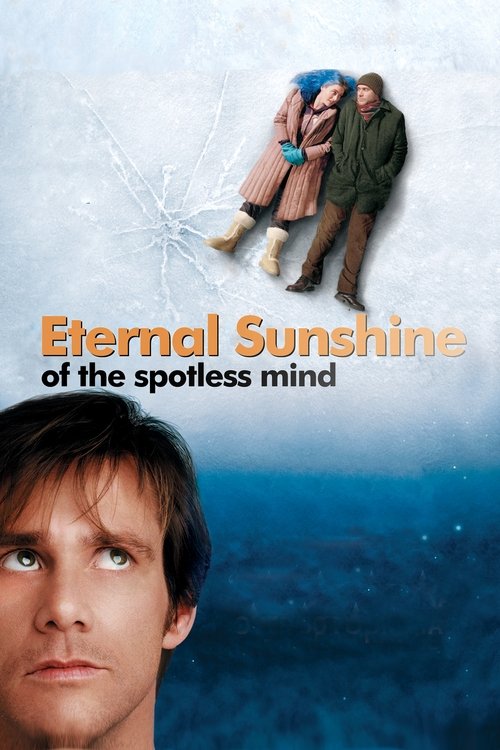
Eternal Sunshine of the Spotless Mind
2004 · Michel Gondry
The ultimate breakup movie, and a perfect pick when you want romance with a brain — something to chew on for days. Watch it fresh off a heartbreak at your own risk, or with someone you're falling for.
What it's about
Joel is a shy, heartbroken man who learns his ex-girlfriend Clementine paid a small clinic to erase him from her memory entirely. Out of spite he books the same procedure — but as technicians work through his sleeping mind, deleting their relationship memory by memory, he changes his mind mid-erasure and starts trying to hide her in corners of his head where they can't reach.
The experience
Funny, sad, and strange in equal measure — it plays like a dream you're losing as you have it. The inventiveness keeps you delighted while the love story quietly wrecks you, and the ending lands somewhere rueful and hopeful at once.
Performances
Jim Carrey, cast radically against type, gives his most restrained and moving performance as the mumbling, inward Joel; Kate Winslet flips the script as the impulsive, blue-haired Clementine — magnetic and maddening and completely human.
The craft
Charlie Kaufman's ingenious screenplay runs a love story backward through a collapsing mind, and Michel Gondry realizes it with handmade, in-camera magic — sets that vanish mid-scene, faces that blur, rooms that shrink — rather than digital effects, which gives the dream logic a tactile, homemade wonder. Jon Brion's wistful score ties it together.
Why it matters
Won the Original Screenplay Oscar and became a generational touchstone — the film people reach for when they argue that high-concept science fiction can be, above all, about the heart. It cemented Kaufman as the era's most original screenwriter.
Snapshot
Eternal Sunshine of the Spotless Mind is a science-fiction romance built on a single speculative premise — that a memory-erasure service could surgically remove a person from one's mind — and turned, against the grain of that premise, into one of the most emotionally durable American films of its decade. Joel Barish (Jim Carrey) discovers that his former girlfriend Clementine Kruczynski (Kate Winslet) has had him erased by the firm Lacuna, Inc.; in retaliatory grief he books the same procedure, only to fight, from inside his own collapsing memory, to keep the woman he is in the act of forgetting. Directed by Michel Gondry from a screenplay by Charlie Kaufman (story by Kaufman, Gondry, and Pierre Bismuth), the film married Kaufman's recursive, idea-driven scriptwriting to Gondry's handmade, in-camera surrealism. It won the Academy Award for Best Original Screenplay and earned Winslet a Best Actress nomination. Its title comes from Alexander Pope's "Eloisa to Abelard" — "How happy is the blameless vestal's lot! / The world forgetting, by the world forgot. / Eternal sunshine of the spotless mind!" — a literary anchor that signals the film's true subject: not technology, but the wish to be unburdened of love and the cost of getting that wish.
Industry & production
The film was produced by Anonymous Content and This Is That Productions, with Steve Golin and Anthony Bregman among the producers, and released in the United States in March 2004 by Focus Features, the specialty arm of Universal that had become a key distributor of director-driven work in the early 2000s. It belongs to a particular early-2000s ecosystem in which Kaufman's scripts — Being John Malkovich (1999), Adaptation (2002), Human Nature (2001), the last also directed by Gondry — were treated as bankable auteur properties precisely because of their strangeness. The casting of Jim Carrey, then one of the highest-paid comic stars in Hollywood, in a recessive dramatic role was central to the film's commercial logic: it placed a major box-office name inside an experimental structure. The supporting ensemble — Kirsten Dunst, Mark Ruffalo, Elijah Wood, and Tom Wilkinson as the Lacuna staff — gave the production further marquee weight. I do not have reliable budget or grosses to cite with precision, so I will not invent figures; the film is generally understood to have been a modest commercial performer that became far more influential than its theatrical run alone would suggest, with its reputation consolidating through home video, awards, and sustained critical revisiting.
Technology
The film's relationship to technology is deliberately, pointedly low. The Lacuna procedure is presented through deglamorized, almost shabby apparatus: a consumer-grade headset, a clunky desktop computer, technicians who drink and flirt while operating it, a home visit conducted by van. This is science fiction whose futurism has been stripped to a domestic, near-present register — a choice that keeps the speculative element from overwhelming the emotional one. On the production side, the film is notable for its near-total commitment to practical, in-camera technique rather than digital effects. Gondry, whose background was in music videos and commercials, favored physical solutions — forced perspective, oversized and undersized sets, hidden cuts, lighting changes within the shot, sleight-of-hand staging — to render the disintegration of memory. Where many 2004 films would have reached for compositing and CGI, Eternal Sunshine dissolves a beach house, vanishes faces and book text, and shrinks Joel to childhood scale largely through things that happened in front of the lens. The technology depicted is cheap and the technology used is analog; both choices serve the film's argument that memory is intimate, fragile, and bodily rather than clean and machine-like.
Technique
Cinematography
Ellen Kuras, a frequent Gondry collaborator, shot the film, working extensively with handheld camera and available or naturalistic light to give the present-tense scenes a raw, documentary immediacy and the memory scenes a fluid instability. The look is wintry and grained — Montauk in the cold, the Long Island Rail Road, snow and beach in off-season desolation — rather than polished. Within memories, Kuras and Gondry let lighting and focus shift mid-shot as recollection decays, so that the image itself participates in forgetting. The camera tends to stay close and mobile around the actors, reinforcing subjectivity; we are rarely given a stable, omniscient vantage. Kuras's work here is widely regarded as among the most expressive cinematography of its period for the way it binds technique to interiority.
Editing
Editing, by Valdís Óskarsdóttir, is the film's structural engine and arguably its single most important formal achievement. The narrative is told largely from inside Joel's mind as the erasure runs backward through his relationship, and the cutting must constantly negotiate two times at once — the procedure happening "now" and the memories being consumed. Óskarsdóttir's editing makes the seams between memory, dream, and waking deliberately porous, letting a character or object carry across a cut into a different space, and orchestrating the bleed-through by which Joel begins smuggling Clementine into memories where she does not belong. The film's famous disorientation — and its eventual emotional clarity — is achieved at the cut. Óskarsdóttir's contribution was recognized within the international editing community as a landmark of associative, non-linear construction.
Mise-en-scène / staging
Gondry's staging is the film's signature. Memory collapse is rendered through physical transformation of the set and the actor's relation to it: lights go out in sequence as a memory is deleted, a bookstore loses its signage and titles, a house comes apart, rain falls indoors, Joel and Clementine appear as giants or as a child beneath a kitchen table. Much of this depends on long takes and choreographed practical effects so that the unreality feels handmade and continuous rather than seamless and synthetic. The staging consistently externalizes psychology — the environment is a diagram of Joel's mind — yet it remains tactile, even childlike, which keeps the emotion warm rather than clinical.
Sound
Jon Brion's score is integral to the film's tone, combining fragile piano and chamber textures with a slightly mechanical, music-box quality that suits both the romance and the procedure. The film's soundtrack also leans on source music — most memorably Beck's cover of the Korgis' "Everybody's Got to Learn Sometime," which closes the film and crystallizes its bittersweet resignation. Sound design works alongside the editing to manage the slippage between layers of reality, with dialogue and ambient cues sometimes carrying across cuts to bind disparate spaces. I will not overstate technical sound-mixing detail I cannot verify, but the music's role in the film's identity is well established.
Performance
The performances invert the actors' public images and that inversion is part of the film's meaning. Carrey, restrained and inward, plays Joel as a withholding, depressive man, suppressing the elastic physicality that made him famous; the rare flickers of his comic energy land harder for being rationed. Winslet, conversely, plays against her then-prevailing period-drama image as the impulsive, blue-haired, talkative Clementine, who explicitly warns Joel — and the audience — not to make her into an idea of salvation: "I'm just a fucked-up girl who's looking for my own peace of mind." The two performances refuse the romantic-comedy template of complementary perfection and instead dramatize incompatibility, irritation, and need. The supporting players — Dunst's Mary, Ruffalo's Stan, Wood's Patrick, Wilkinson's Dr. Mierzwiak — supply a parallel, lower-key story of memory, betrayal, and repetition among the Lacuna staff.
Narrative & dramatic mode
The dramatic mode is interior and recursive: the bulk of the film takes place inside a mind during a procedure, structured as a reverse chronology of a relationship intercut with a present-tense frame. Kaufman's screenplay uses science fiction as a delivery system for a fundamentally classical romantic question — would you do it all again knowing it ends badly? — and answers it through form. The film withholds its own orientation for a considerable stretch; the early Montauk sequences are only retrospectively legible as occurring after the events we later see erased, so that the narrative loops back on itself and the "beginning" is also an ending. This structure converts the act of watching into an experience analogous to remembering: piecing, doubting, revising. The dramatic engine is not "will the technology fail?" but "what is a relationship worth once you can see, in advance, every reason it will hurt?"
Genre & cycle
The film sits at the intersection of three genres named in its own billing — science fiction, drama, romance — but it is most precisely a science-fiction film in the "soft," philosophical tradition that uses a single conceit to interrogate consciousness and identity rather than to build a world. It belongs to an early-2000s cycle of mind-bending, puzzle-structured American films — alongside works like Memento (2000), Donnie Darko (2001), and the broader Kaufman corpus — in which fractured chronology and subjective unreliability became a mainstream art-cinema mode. Within romance, it is part of an anti-romantic-comedy counter-tradition that treats love as difficult and recurring rather than redemptive and final. Its specific innovation in the cycle is to make the puzzle emotional: the formal complexity is in service of feeling, not of a twist.
Authorship & method
Authorship here is genuinely shared and productively tense. Charlie Kaufman is the conceptual and verbal author — the recursive structure, the philosophical premise, the refusal of easy catharsis are his signatures, continuous with Being John Malkovich and Adaptation. Michel Gondry is the visual and tonal author — the handmade surrealism, the warmth, the in-camera magic drawn from his music-video practice. The original story credit shared by Kaufman, Gondry, and the artist Pierre Bismuth points to the film's conceptual origins outside conventional screenwriting. The key collaborators complete the method: cinematographer Ellen Kuras translating interiority into light and movement; editor Valdís Óskarsdóttir constructing the associative architecture; composer Jon Brion supplying the fragile, mechanical-tender musical voice. The film is a strong case study in how a Kaufman script could be radically different in two directors' hands — Spike Jonze's Kaufman films are colder and more deadpan; Gondry's is more tactile and tender — which suggests the realized film is as much Gondry's and his craft collaborators' as it is the screenplay's.
Movement / national cinema
This is an American independent-adjacent studio-specialty film, a product of the Focus Features / Anonymous Content milieu, but its sensibility is cross-pollinated by European and music-video aesthetics. Gondry is French, and his approach descends partly from a European tradition of cinematic surrealism and bricolage rather than from Hollywood realism; editor Óskarsdóttir is Icelandic. The film thus reads less as the expression of a national cinema than as a transnational, auteur-driven art film operating inside the American specialty-distribution system of the early 2000s — the same ecosystem that supported directors like Spike Jonze, Wes Anderson, and Alexander Payne (whose Sideways Focus also released that year).
Era / period
Made and released in 2004, the film is firmly of its moment in two ways. Formally, it crowns the early-2000s vogue for non-linear, subjective "puzzle" storytelling in American cinema. Technologically and tonally, it registers a pre-smartphone, early-digital anxiety about memory, records, and self-curation — Lacuna mails out the erased objects, keeps paper files, makes house calls — that now reads as poignantly analog. It arrives just before the social-media era would make the externalization and deletion of personal history an everyday consumer reality, which has only sharpened the film's prescience: a culture that increasingly treats memory as something storable, shareable, and erasable found, in this film, an early and humane interrogation of that fantasy.
Themes
The governing theme is memory and its inseparability from identity and love: the film argues that to erase pain is also to erase the self that was shaped by it, and that the same flaws which doomed a relationship are the conditions of having loved at all. Its second theme is repetition and fate — the closing recognition, when Joel and Clementine hear the recordings of their own prior contempt and choose to continue anyway, reframes love not as a problem to be solved but as a cycle one consents to with open eyes; their final exchange ("Okay" / "Okay") is an acceptance of recurrence. Related concerns include the ethics of forgetting (the Lacuna subplot, in which the technicians abuse the procedure, shows memory-erasure as a tool of manipulation and self-deception); the impossibility of unmediated escape from grief; and, via the Pope epigraph, the ancient human wish for oblivion as relief — granted here, and shown to be a loss. The film is unusual in refusing both cynicism and sentimentality: it neither promises that love conquers all nor that forgetting heals.
Reception, canon & influence
Critically, the film was strongly received on release and its reputation has only grown; it is now routinely cited among the defining American films of the 2000s and among the best science-fiction and romance films of its era, and it has appeared on numerous "best of the decade/century" critics' lists. Its most concrete institutional honor is the Academy Award for Best Original Screenplay (Kaufman, Gondry, and Bismuth), with a Best Actress nomination for Winslet; I will not enumerate further awards I cannot verify precisely.
Influences on the film run backward to several traditions: Kaufman's recursive, self-interrogating screenwriting and the philosophy-of-mind questions it dramatizes; the literary Romanticism of the Pope source and the long lineage of stories about forgetting and lost love; the surrealist and trick-film heritage that Gondry channels through his music-video practice, with its lineage reaching back to early in-camera illusion; and the memory-and-subjectivity concerns of art cinema (the film is frequently discussed alongside Resnais's preoccupation with memory and time, and alongside La Jetée and Solaris in the science-fiction-of-memory tradition, though such comparisons are interpretive rather than documented sources). Its near-contemporary Memento helped normalize the audience appetite for reverse and fractured chronology it exploits.
Forward, the film's legacy is substantial. It became a touchstone for a generation of "elevated" or emotionally serious genre filmmaking that uses a speculative conceit to examine relationships and consciousness — a lineage visible in later science-fiction romances and in television that foregrounds memory, simulation, and the deletion of the self (the memory-and-identity strain of anthology science fiction owes it a clear debt). It is regularly invoked as the model for how to make formally radical structure serve mainstream emotional impact, and as the high-water mark for both Carrey's dramatic capacity and Gondry's handmade aesthetic. Perhaps its most lasting cultural afterlife is conceptual: "having someone erased" has entered common reference as shorthand for the wish — and the folly — of curating away a painful past, which is the clearest measure of a film that turned a gimmick premise into a durable idea about how love and memory are, finally, the same material.
A Deleuzian reading
Start with the bookstore.
The full Deleuzian reading of Eternal Sunshine of the Spotless Mind →
Reception
Acclaimed on release in 2004 (it won Charlie Kaufman the Best Original Screenplay Oscar) but only a modest box-office performer, it has since climbed to consensus best-of-the-century status — a fixture near the top of polls like the BBC's 2016 ranking of the 21st century's greatest films.
How Eternal Sunshine of the Spotless Mind was received, from release to now →
Influences: the films it descends from and the films it influenced
- La Jetée (1962) — Builds a science-fiction love story entirely as the involuntary return of one fixed memory-image, the romance-as-memory-recall template Eternal Sunshine literalizes through erasure.
- Hiroshima mon amour (1959) — Pioneers associative editing that cuts mid-scene from present lovers to resurfacing memory without flagging the jump — the non-linear associative grammar Valdís Óskarsdóttir's cutting inherits.
- Last Year at Marienbad (1961) — Stages a romance through contradicting, repeating recollections so the viewer can't verify what happened, the unreliable-subjectivity-plus-repetition device the film reuses inside a collapsing memory.
- Solaris (1972) — Uses a sci-fi conceit to materialize a dead lover out of memory, treating love and remembrance as the same substance — the conceptual core of the erasure premise.
- 8½ (1963) — Builds physical sets where remembered and imagined figures invade the present action, the externalized-psychology staging Gondry deploys when Joel's memories crumble around him.
- Persona (1966) — Dissolves identity through in-camera optical effects on faces, making subjective disintegration a formal device rather than dialogue.
- Being John Malkovich (1999) — Establishes Kaufman's method of literalizing a neuroscience-of-self conceit as a concrete, rule-bound mechanism the characters physically navigate.
- Adaptation (2002) — Demonstrates Kaufman's recursive, self-interrogating screenplay architecture that bends chronology around a single consciousness — the structural signature carried into Eternal Sunshine.
- Memento (2000) — Normalized mainstream appetite for reverse and fractured chronology driven by memory loss, the audience literacy Eternal Sunshine's structure exploits.
- Annie Hall (1977) — Reconstructs a romance non-linearly from memory with the present-day narrator physically walking through and addressing his own remembered scenes — Joel-inside-his-memories made decades earlier.
- The Vanishing Lady (1896) — Origin of the in-camera substitution (stop) trick — the handmade practical-illusion heritage Gondry channels from his music-video work into the film's in-shot transformations.
- Three Colors: Blue (1993) — Gondry and editor Valdís Óskarsdóttir use complete fades to black within scenes as punctuation for the mind going dark during erasure — adopting Witta's micro-blackout as an editorial unit representing interior will — and render involuntary memory intrusions as sudden chromatic ruptures across cuts.
- Her (2013) — Uses a speculative technology (an AI OS) and warm handheld naturalistic light to examine love and consciousness with emotional seriousness — the 'elevated' sci-fi romance mode Eternal Sunshine modeled.
- (500) Days of Summer (2009) — Edits a relationship by emotional association rather than chronology, shuffling across the timeline — directly inheriting the non-linear associative cutting of memory.
- Inception (2010) — Builds externalized psychology as navigable, collapsing architecture the characters move through, scaling up the crumbling-memory spaces Joel flees inside.
- The Entire History of You (2011) — Anthology sci-fi TV foregrounding recordable, deletable memory and the curated self — the memory-and-identity strain that owes Eternal Sunshine a clear structural debt.
- Everything Everywhere All at Once (2022) — The lo-fi in-camera and practical VFX method of externalizing subjective mental states—degrading environments, objects erased in real time—provides the template for EEAAO's universe-switching as tangible perceptual experience rather than CGI spectacle.
- Finding Dory (2016) — Modeled the subjective, dissolving associative flashback — recollection triggered by sensory cue and shading into the present tense — that Axel Geddes shapes into Dory's memory editing.
- Dream Scenario (2023) — Anchors a high-concept premise to a passive, sad-sack ordinary man, using the conceit as a vehicle for unflattering self-examination rather than wonder.
- The Worst Person in the World (2021) — Gondry's in-camera practical effects—reality reshaped around a character's emotional state without CGI—are the direct method behind the frozen-Oslo sequence's held extras.
- Falling in Love Like in Movies (2023) — Reconstructs a lost love through collapsing, nonlinear memory-spaces, modeling grief-driven revision of a relationship's narrative.
- The Secret Life of Walter Mitty (2013) — In-camera, practical-effect transitions that fold a character's interior mental world seamlessly into surrounding physical space rather than segregating it as effects work.
- All the Bright Places (2020) — Reworks the depressive-man/vivid-woman dyad so the seemingly quirky partner carries her own damage, undercutting the muse fantasy that the anti-manic-pixie construction depends on.
- Palm Springs (2020) — Models the sci-fi conceit as a delivery system for adult, unsentimental romance rather than spectacle — the tonal register Andy Siara's script inherits, folding a genre premise around two damaged people's ambivalence.
- The Science of Sleep (2006) — Externalizes a dreamer's psychology through tactile, handmade in-camera practical effects rather than CGI — Gondry extending the same craft on his own.
- Synecdoche, New York (2008) — Kaufman directing his own recursive structure as a literal externalized-psychology set, a life-sized model of a consciousness, extending the screenwriting signature alone.
- Anomalisa (2015) — Renders externalized psychology through handmade stop-motion puppetry, fusing Kaufman's recursive interiority with a tactile, in-camera craft aesthetic akin to Gondry's.
- 2046 (2004) — Non-linear reverse-chronological reconstruction of a romantic relationship through fragments rather than continuity, with an SF conceit — memory erasure — embedding a fiction-within-fiction; elliptical editing withholds the moments of consummation and accumulates emotional weight through repetition rather than narrative momentum.
- Punch-Drunk Love (2002) — Both films integrate hand-crafted non-photographic sequences — Anderson's Jeremy Blake digital paint-fields, Gondry's analog memory distortions — into photochemical live-action to externalize interiority, refusing naturalistic subjectivity as a means of rendering romantic experience.
- Sorry to Bother You (2018) — Template for the in-camera, craft-fair surrealism Riley cites — practical effects and analog visual trickery used to render interior/conceptual states physically rather than digitally.
- Code 46 (2003) — Fuses a memory-erasure technology with a fractured, retrospectively scrambled romance edited as subjective recollection — the same memory-wipe-meets-love structure Code 46 runs the year before.
- Paprika (2006) — Builds mind-space through in-camera sets that dissolve and rearrange mid-scene, a live-action analog to Paprika's dream architecture that mutates around the dreamer.
- Us and Them (2018) — Reconstructs a dissolved relationship through fragmented, subjective memory in which the palette and vividness of scenes track emotional presence — the same memory-as-editing principle behind the inverted nostalgia grade.
- Lost in Starlight (2025) — Edits memory as it degrades and collapses, using in-camera analog trickery to visualize grief being processed rather than narrated.
- Blink Twice (2024) — Establishes memory erasure rendered through elliptical, fragmented editing that makes the audience reconstruct suppressed events — the memory-as-power editing logic Kravitz adopts.
- Sore: A Wife from the Future (2025) — Reconstructs a relationship through the loss and recovery of memory, dramatizing love as something re-accessed by touch and recollection — the mechanic Sore's memory-restoring-touch echoes.
Similar films
- Her (2013) — influence & lineage
- Memento (2000) — influence & lineage
- Synecdoche, New York (2008) — influence & lineage
- Solaris (1972) — influence & lineage
- Inception (2010) — influence & lineage
- Last Year at Marienbad (1961) — influence & lineage
- 8½ (1963) — influence & lineage
- (500) Days of Summer (2009) — influence & lineage
All the films related to Eternal Sunshine of the Spotless Mind →
Watch it with: curated runs of related films
- Waking Up Inside the Illusion — Watch these in a run when you want the same jolt over and over — an ordinary man realizing the calm reality around him was built, dreamed, or erased, and clawing his way toward waking up.
Film essays and courses that include it
- Out of Order: A Century of Fractured Time
- The Ache of Distance: Cinema's Language of Longing
- The Architecture of Forgetting
- Hold Everything: The Art of the Maximalist Genre-Collapse Comedy
- Being John Malkovich: A Viewer's Guide
- The Crystal and the Trap
- The Screen That Thinks
- The Machine That Remembers
- The Seven-and-a-Half Floor of the Self