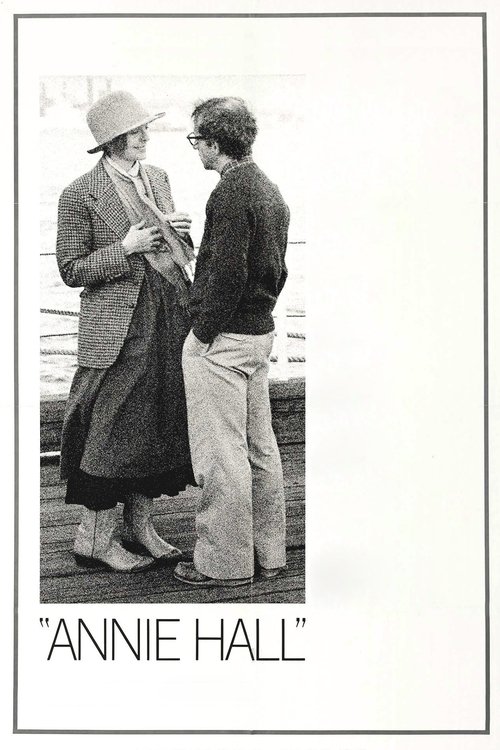
Annie Hall
1977 · Woody Allen
For when you're nursing a breakup or overthinking a relationship and want to laugh at the mess instead of crying about it — smart comfort for the romantically bruised.
What it's about
Alvy Singer, a neurotic New York stand-up comedian, looks back on his love affair with Annie Hall — a scattered, endearing aspiring singer from the Midwest — trying to figure out where it all went wrong. The film jumps freely through their romance: the tennis-court meet-cute, the lobster panic, the therapy sessions, the slow drift apart, with Alvy talking straight to the camera and even dragging strangers into his arguments. It's a comedy about love told by a man who can't stop analyzing it.
The experience
Fast, talky, and dense with jokes that double as confessions — wistful and laugh-out-loud funny at once. It feels like a brilliant friend telling you about their breakup and being honest for the first time.
Performances
Diane Keaton's Annie is one of the most beloved characters in American comedy — the stammering 'la-di-da' charm, the menswear, the growing confidence that outpaces Alvy — a performance so distinctive it changed how women dressed.
The craft
The film throws out linear storytelling entirely: fourth-wall breaks, split screens, subtitled inner thoughts, animated detours, and scenes where the adult Alvy stands inside his own childhood memories. Every trick serves the feeling of a mind restlessly replaying a lost love, and the screenplay is quoted to this day.
Why it matters
It remade the romantic comedy as something formally daring and emotionally honest, swept the top Academy Awards over the year's blockbusters, and marked the moment its director graduated from gag-man to major American filmmaker.
Snapshot
Annie Hall is the film with which Woody Allen transformed himself from a maker of broad, gag-driven comedies into one of the major American filmmakers of his generation, and with which the romantic comedy itself acquired a new emotional and formal sophistication. Structured as the rueful reminiscence of Alvy Singer (Allen), a New York stand-up comedian and incorrigible neurotic, the film reconstructs his love affair with Annie Hall (Diane Keaton) — a tentative, aspiring nightclub singer from the Midwest whose "la-di-da" charm, growing self-possession, and eventual independence Alvy can neither sustain nor relinquish. Rather than narrate this romance in linear order, the film fractures it into a mosaic of memory, fantasy, direct address, and analytic digression, opening with Alvy speaking straight to camera to tell us the affair is already over and then circling back through its rise and dissolution. The result is at once a comedy of ideas about love, anxiety, sex, death, and the cultural divide between New York and Los Angeles, and a genuinely melancholy account of why two people who love each other cannot stay together. Awarded the Academy Award for Best Picture over Star Wars and securing Oscars for Allen's direction and screenplay and for Keaton's performance, Annie Hall remains both a canonical American comedy and the template for the modern, bittersweet, talk-driven relationship film.
Industry & production
Annie Hall was produced under Allen's long-standing arrangement with his managers-turned-producers Charles H. Joffe and Jack Rollins, and distributed by United Artists, the studio that had given Allen an unusual degree of creative autonomy across his early career. By 1977 Allen had delivered a run of commercially reliable comedies — Bananas (1971), Everything You Always Wanted to Know About Sex (1972), Sleeper (1973), and Love and Death (1975) — that had earned him the latitude to attempt something more personal and formally adventurous. The latitude was real: Allen worked with comparatively modest budgets, final cut, and minimal studio interference, conditions that made the film's experimentation possible.
The screenplay was written by Allen with Marshall Brickman, his frequent collaborator, and the two would share the Academy Award for Best Original Screenplay. The genesis of the film is among the better-documented production stories in American comedy, in large part because of the candor of Allen's editor, Ralph Rosenblum, who described it in his memoir When the Shooting Stops. As shot, the picture was a sprawling, surreal, stream-of-consciousness portrait of Alvy Singer's mind — reportedly carrying the working title Anhedonia, the clinical term for the inability to experience pleasure — and included a murder-mystery strand and a far wider array of fantasy sequences than survive in the finished film. The romance between Alvy and Annie was only one thread among many. In the editing room Allen and Rosenblum recognized that this thread was the film's living center, and the picture was radically restructured around it, with much of the surrounding material discarded. (The unused murder-mystery impulse would resurface years later in Manhattan Murder Mystery.) This act of discovery-in-the-edit is central to understanding the film and is treated more fully below.
Casting drew on Allen's established stock company and personal circle. Diane Keaton — whose own birth name was Diane Hall and whose nickname was Annie — had appeared in Allen's Play It Again, Sam, Sleeper, and Love and Death, and the role was written for and around her. The supporting cast included Tony Roberts as Alvy's friend Rob, Carol Kane as Alvy's first wife, the singer-songwriter Paul Simon as a slick Los Angeles record producer, Shelley Duvall, Colleen Dewhurst as Annie's mother, and Christopher Walken in a memorably unsettling cameo as Annie's brother Duane. The film is also notable for very early screen appearances by Jeff Goldblum and Sigourney Weaver.
Technology
Annie Hall is a 35mm photochemical production that makes no claim to technological novelty, and its innovations are wholly those of form and craft rather than apparatus. Its visual style depends on a commitment to location shooting in New York City under naturalistic light, and on a deliberate restraint that runs counter to the busier comic filmmaking of its day. What is striking about the film technically is its renunciation of technical flourish: long-held master shots, a largely static or slowly reframing camera, and a willingness to play extended dialogue scenes without coverage. Where the film does deploy "tricks" — split screen, on-screen subtitles, an animated sequence, characters addressing the camera — these are achieved through conventional, well-established techniques rather than any new technology, and they are motivated by the film's psychological and essayistic ambitions. It would be invention to credit the film with technical innovation in the engineering sense; its modernity is one of grammar and structure.
Technique
Cinematography
Annie Hall marks the first of eight collaborations between Woody Allen and the cinematographer Gordon Willis, the photographer celebrated for the shadowed, controlled images of The Godfather and known by the sobriquet "the Prince of Darkness." Willis brought to Allen's comedy an unexpected discipline and beauty. The film favors muted, autumnal New York tones and a composition strategy built around long takes and full-figure framing, frequently allowing actors to drift out of frame or to speak from offscreen while the camera holds on an empty doorway or a listening face. This refusal of conventional shot-reverse-shot coverage — letting a scene play in a single sustained two-shot, as in Alvy and Annie's first awkward conversation on her terrace — lends the comedy a theatrical, observational quality and an emotional realism uncommon in the genre. Willis's restraint also throws the film's overt stylization into relief: when the image splits, animates, or admits a direct look at the lens, it registers as a deliberate rupture against an otherwise sober visual baseline.
Editing
Editing is, more than for almost any comparable comedy, the decisive creative act of Annie Hall. The film as conceived and shot did not exist until Allen and Ralph Rosenblum found it in the cutting room. Confronted with a long, diffuse assembly, they extracted the love story from the surrounding material, reordered the picture as a nonlinear flow of memory and association, and devised the framing device of Alvy's direct-address monologue — which both opens the film and supplies the connective logic for its leaps in time. The editing is the mechanism of the film's wit and its melancholy alike: scenes are juxtaposed for ironic counterpoint, fantasy and reality are cut together without warning, and the relationship's chronology is reassembled the way memory actually works, by emotional rather than calendrical sequence. The much-cited result is a film whose form is inseparable from its content — a movie about a man trying to understand a failed love by replaying and rearranging it.
Mise-en-scène / staging
Allen's staging exploits the gap between surface and interior, repeatedly externalizing inner life. The famous rooftop scene plays Alvy and Annie's nervous first flirtation while subtitles reveal their actual anxious thoughts beneath the small talk. A split screen sets Alvy's overbearing Jewish family dinner against Annie's restrained WASP one, the two tables eventually conversing across the divide. Alvy steps out of a cinema queue to summon the media theorist Marshall McLuhan — in person — to demolish a pontificating bore; he walks through scenes of his own childhood as an adult observer; his anxieties are literalized as an animated sequence casting Annie as the wicked queen from Disney's Snow White. Costume is itself a form of staging: Keaton's mannish, layered wardrobe — vest, necktie, baggy trousers, floppy hat — credited to designer Ruth Morley but drawing heavily on Keaton's own taste, became one of the most influential looks in film history, the "Annie Hall" style. The film's geography is staged as a moral contrast, the cluttered, intellectual, anxious vitality of Manhattan set against a sunlit, vacuous Los Angeles that Alvy regards with comic horror.
Sound
Annie Hall eschews an original orchestral score in favor of source music and popular standards, a choice that became a hallmark of Allen's mature style. Most memorably, Keaton's Annie performs in a nightclub, singing standards including "It Had to Be You" and "Seems Like Old Times," the songs charting her growth from timid amateur to a poised performer who will ultimately outgrow Alvy. The film's sonic texture is otherwise dominated by talk — overlapping, neurotic, joke-laden, analytic — delivered in long takes that prioritize the rhythm of conversation. Sound is also a vehicle for the film's reflexivity, as when Alvy's voice-over commentary, his direct addresses, and the remembered or imagined voices of others interleave with the diegetic world.
Performance
The film rests on the chemistry between its two leads. Allen plays a refined version of the comic persona he had been developing for years — the verbose, hypochondriacal, death-obsessed, culturally voracious New York Jewish intellectual — but here invests it with a vulnerability and self-criticism that deepen the caricature into character. Diane Keaton's Annie is the film's great performance and its emotional heart: her halting verbal style ("la-di-da"), her blend of insecurity and burgeoning confidence, and her gradual emergence into an independent woman who no longer needs Alvy give the film its arc and its pathos. Keaton's work won her the Academy Award for Best Actress and made the character an enduring cultural figure. The supporting playing is sharp throughout — Tony Roberts's wry Rob, Christopher Walken's eerie Duane, Paul Simon's oily Tony Lacey — but it is the Allen-Keaton partnership, drawing on their real prior relationship and long working intimacy, that grants the film its lived authenticity.
Narrative & dramatic mode
Annie Hall's dramatic mode is the confessional comic memoir, structured as a nonlinear inquiry into a love that has already ended. The film announces its method in its opening, with Alvy addressing the audience directly, telling two jokes that frame the whole — the Groucho Marx line about not wanting to belong to any club that would have him as a member, and the old gag about a restaurant where the food is terrible "and such small portions" — and confessing that he and Annie have broken up and that he is sifting the wreckage. From there the film proceeds associatively, jumping across time, dramatizing fantasies and memories, breaking the fourth wall, and refusing the reassurances of conventional romantic-comedy structure. Crucially, it withholds the genre's obligatory reconciliation: Alvy and Annie do not end up together. The film closes instead on a wistful coda — Alvy's joke about a man who keeps his brother's delusion that he is a chicken because "I need the eggs," offered as a metaphor for why we persist in the irrational, painful business of love. This is comedy in a genuinely tragic key, a romance whose subject is the necessity and impossibility of relationships.
Genre & cycle
The film is a romantic comedy, but it self-consciously revises and complicates the form, and Allen himself reportedly preferred to describe his project as a "nervous romance." Against the classical Hollywood romantic comedy's drive toward union, Annie Hall substitutes ambivalence, analysis, and a downbeat ending, fusing the genre with the essayistic, intellectually freighted European art cinema Allen revered — the influence of Ingmar Bergman and Federico Fellini is felt in its interiority and formal liberty. Within Allen's own career the film inaugurates a cycle of more personal, dialogue-driven New York comedies and comedy-dramas — continuing through Manhattan (1979), Stardust Memories (1980), and Hannah and Her Sisters (1986) — that left behind the parodic slapstick of his "early, funny ones." More broadly, it founded a durable cycle of literate, neurotic, urban relationship comedies whose descendants would dominate the genre for decades.
Authorship & method
Annie Hall is the work in which Woody Allen's authorship fully crystallized, and it bears his signature in every register: the autobiographically inflected comic persona, the New York Jewish intellectual milieu, the obsessions with mortality, psychoanalysis, sex, and high culture, and the formal willingness to break realist conventions in pursuit of psychological truth. Allen has resisted strictly autobiographical readings, and prudence counsels treating the film as a shaped fiction rather than a transcript of his life with Keaton, however much it draws on their relationship. The authorship is, however, genuinely collaborative at several points. Co-writer Marshall Brickman shaped the screenplay's structure and wit. Cinematographer Gordon Willis supplied the disciplined, beautiful visual grammar that distinguishes the film from Allen's earlier work and inaugurated one of the great director-cinematographer partnerships in American cinema. Editor Ralph Rosenblum's role was, by his own and Allen's accounts, decisive in finding the film's final shape, to the point that the editing must be counted a primary authorial act. And Diane Keaton's performance and personal style so define the title character that her contribution amounts to a form of co-creation. The film's distinctive eschewal of original scoring in favor of standards likewise became an authorial trademark.
Movement / national cinema
Annie Hall is a landmark of American cinema's auteur-driven 1970s — the "New Hollywood" era in which a generation of personal filmmakers worked with unusual freedom inside or alongside the studio system. Allen's position was somewhat apart from the movie-brat directors of that moment; his lineage ran through stand-up comedy, the Borscht Belt and television gag-writing tradition, and a cinephile's devotion to European modernism rather than through film school. Yet the film shares the period's defining conditions: creative autonomy, modest budgets, location realism, and a readiness to subvert genre. It is also, emphatically, a New York film, part of a distinctly metropolitan and Jewish-American comic tradition, and its loving, satirical portrait of Manhattan intellectual life is inseparable from its sense of place. As national cinema it represents the American art film's capacity, at that particular cultural juncture, to win mainstream success and the industry's highest honors.
Era / period
The film is a precise artifact of the mid-1970s, suffused with the cultural texture of its moment: post-1960s sexual mores and the ubiquity of psychotherapy, the encounter-group and self-actualization currents of the decade, recreational drug use (Annie's marijuana, the famous scene of Alvy sneezing away a host's cocaine), and the era's anxieties about authenticity, media saturation, and intellectual fashion. Its New York–versus–Los Angeles dichotomy captures a specifically 1970s cultural argument, with Alvy's contempt for Los Angeles — a city, he says, whose only cultural advantage is being able to make a right turn on a red light — voicing the East Coast intellectual's disdain for West Coast vacuity. The flashbacks to Alvy's Brooklyn childhood reach back further, to a remembered immigrant and wartime New York, situating the contemporary story within a longer arc of American-Jewish experience.
Themes
The film's central theme is the difficulty, perhaps the impossibility, of sustaining love between two people who are continually changing — and the corollary conviction, voiced in the closing chicken joke, that we pursue relationships anyway because we need the eggs. Around this orbit Allen's perennial preoccupations: death and the dread of mortality, which shadows Alvy's every pleasure; the consolations and limits of psychoanalysis; the relations between sex, neurosis, and intimacy; and the comedy and pathos of intellectual self-consciousness. The film is deeply concerned with identity and self-fashioning, dramatized in Annie's growth from diffident ingénue into an autonomous woman, a trajectory that is both a feminist arc of self-realization and, from Alvy's possessive vantage, a loss. Cultural and class difference runs throughout — Jewish New York against gentile Midwest, Manhattan against Los Angeles, high culture against pop — as does a sustained meditation on memory itself, on how we narrate and re-narrate our own pasts to make sense of loss. Beneath the jokes lies a fundamentally melancholic vision of human connection as fleeting, necessary, and irreparably imperfect.
Reception, canon & influence
Annie Hall was met with strong critical acclaim on its 1977 release and proved a substantial commercial success, modest by blockbuster standards but considerable for a personal comedy. At the Academy Awards it won Best Picture, Best Director and Best Original Screenplay for Allen (with Brickman), and Best Actress for Keaton, with Allen also nominated for Best Actor; its victory over Star Wars for Best Picture has become a touchstone in debates about the academy's preferences and about the high-water mark of the auteurist 1970s. Allen, characteristically, did not attend the ceremony. The film has since been routinely ranked among the greatest American comedies and was selected for preservation in the Library of Congress's National Film Registry; Keaton's androgynous wardrobe entered the history of fashion.
Influences on the film run backward to several traditions: the verbal, neurotic Jewish-American comic lineage of stand-up and television; the romantic comedies of classical Hollywood, against which Allen defines himself; and, decisively, the European art cinema of Bergman and Fellini, whose formal freedom and existential seriousness license the film's fourth-wall breaks, fantasy sequences, and melancholy. The reflexive devices themselves have antecedents across modernist film and theater.
Its influence forward is vast. Annie Hall effectively reinvented the romantic comedy as a literate, ambivalent, talk-driven form, and its DNA is visible in decades of subsequent work — most directly in films such as When Harry Met Sally... and the broader cycle of New York relationship comedies, and in the neurotic, observational comic sensibility that would shape television from Seinfeld to Curb Your Enthusiasm. It consolidated Diane Keaton's stardom and established the mature Woody Allen mode that he and many imitators would mine for years. As with much of Allen's work, the film's reception has been complicated in recent decades by the controversies surrounding his personal life, which have prompted ongoing reassessment of how his autobiographical comedy is read; that critical reconsideration is part of the film's present reception, though it has not displaced Annie Hall's secure standing as a landmark of American film comedy and one of the defining pictures of the 1970s.
A Deleuzian reading
A man stands alone in front of a blank wall and talks straight to us.
The full Deleuzian reading of Annie Hall →
Reception
It swept the 1978 Oscars (Best Picture, Director, Actress, Screenplay) and was instantly canonized as the film where Allen 'got serious' — but decades later it's the ultimate separate-the-art-from-the-artist test case, loved and wrestled with in the same breath.
How Annie Hall was received, from release to now →
Influences: the films it descends from and the films it influenced
- Wild Strawberries (1957) — The device of the protagonist physically walking back into his own past—standing as an unseen adult inside remembered childhood scenes—is lifted almost wholesale for Alvy revisiting his Brooklyn classroom and old family dinners.
- Persona (1966) — Bergman's rupturing of the realist film surface and confrontational two-shots of faces licensed Allen's willingness to break the frame and let psychological interiority override narrative illusion.
- 8½ (1963) — The autobiographical artist-figure freely interleaving fantasy, memory, and present anxiety—treating his own creative and romantic neuroses as the film's subject—is the template for Allen's confessional structure.
- Hellzapoppin' (1941) — Anarchic, self-aware comedy in which characters address the audience and comment on the movie's own machinery anticipates Alvy's fourth-wall asides and meta-jokes about the film itself.
- Tom Jones (1963) — Establishes sustained direct-address-to-camera as a comic narrative device within a feature, the same conspiratorial complicity Alvy strikes with the viewer.
- Alfie (1966) — Michael Caine's running confessional monologue to the lens—narrating and rationalizing his romantic failures—is the immediate model for Alvy's guided tour through his own relationship.
- Pillow Talk (1959) — Codified split-screen as a way to stage a courtship/argument across a divided frame, the technique Annie Hall reuses for the two-family dinner and dual-therapist sequence.
- The Awful Truth (1937) — Supplies the verbal-sparring, divorce-comedy ambivalence of classical Hollywood that Allen both inherits and inverts into anti-reconciliation.
- The Godfather (1972) — Gordon Willis's disciplined, underexposed compositional grammar developed here is what he carried into Annie Hall, giving Allen's comedy its uncharacteristically painterly restraint and long-take staging.
- The Graduate (1967) — Allen adapts The Graduate's structural irony — the romantic comedy that refuses its own consolations — building the ambiguous non-resolution ending and the sardonic counterpoint use of popular music directly on the precedent Nichols established.
- The Philadelphia Story (1940) — Extends the talk-driven, emotionally intelligent romantic comedy of a relationship relitigated in retrospect, descended from Cavell's comedy-of-remarriage canon for which Philadelphia Story is the prime exhibit.
- Breakfast at Tiffany's (1961) — Extends the stylish, independent, romantically searching single woman in New York whose wardrobe is an act of self-authorship — the Holly figure relocated to the neurotic-realist register.
- Manhattan (1979) — Directly extends the Allen–Willis partnership and the talk-driven, anxiety-laced New York romance, pushing the same widescreen long-take two-shots into black-and-white.
- When Harry Met Sally... (1989) — Inherits the literate, ambivalent New York relationship-comedy mode and adapts Annie Hall's to-camera testimony into the documentary-style elderly-couple interview interludes.
- High Fidelity (2000) — Builds an entire film on the neurotic male narrator's sustained direct address, cataloging and rationalizing his romantic failures exactly in Alvy's confessional register.
- Eternal Sunshine of the Spotless Mind (2004) — Extends the nonlinear, memory-walking structure—a man moving bodily through his own recollections of a relationship—into an anti-reconciliation romance that refuses a tidy reunion.
- (500) Days of Summer (2009) — Reworks the fractured chronology and reflexive devices (split-screen expectation-vs-reality, narrated direct address) in service of the same talk-driven, non-happy-ending nervous romance.
- Frances Ha (2012) — Revives the Allen–Willis black-and-white New York grammar and verbal, observational character study, treating ambivalent urban relationships with the same melancholic comic texture.
- Election (1999) — Fragmented comedy of competing self-accounts using direct address and braided voiceover so characters argue their case to the audience — the rhetorical confessional mode Election distributes across four narrators.
- Broadcast News (1987) — Licenses the subverted-romance structure of a relationship comedy that declines to unite its couple, which Broadcast News pushes to a colder, more honest endpoint.
- 101 Reykjavik (2000) — Models the confessional first-person voiceover and direct address organizing a neurotic comedy of fluid desire and self-deprecating arrested romance.
- Amélie (2001) — Direct address to camera and a digressive, associative structure that pauses to annotate minor characters establishes the fourth-wall intimacy Tautou uses with the lens.
- Bridget Jones's Diary (2001) — Pioneered the neurotic, self-mocking confessional comedy in which a single protagonist narrates their romantic failures directly to the audience, the address mode Bridget's diary voiceover descends from.
- Buffalo '66 (1998) — Pioneers the inset subjective-memory grammar in which the present self steps into and watches his own remembered scene, the structure of Billy's flashbacks.
- Stardust Memories (1980) — Carries the 8½-derived reflexivity even further, with the filmmaker-protagonist besieged by fantasy, memory, and direct audience confrontation.
- A Woman Is a Woman (1961) — Inherits the anti-illusionist toolkit — direct address to camera, characters commenting on the film's own artifice — as a way to let irony and heartbreak coexist.
Similar films
- Manhattan (1979) — influence & lineage
- The Awful Truth (1937) — influence & lineage
- When Harry Met Sally... (1989) — influence & lineage
- Play It Again, Sam (1972) — shared sensibility
- Crimes and Misdemeanors (1989) — shared sensibility
- Interiors (1978) — shared sensibility
- The Graduate (1967) — shared sensibility
- La La Land (2016) — shared sensibility
All the films related to Annie Hall →