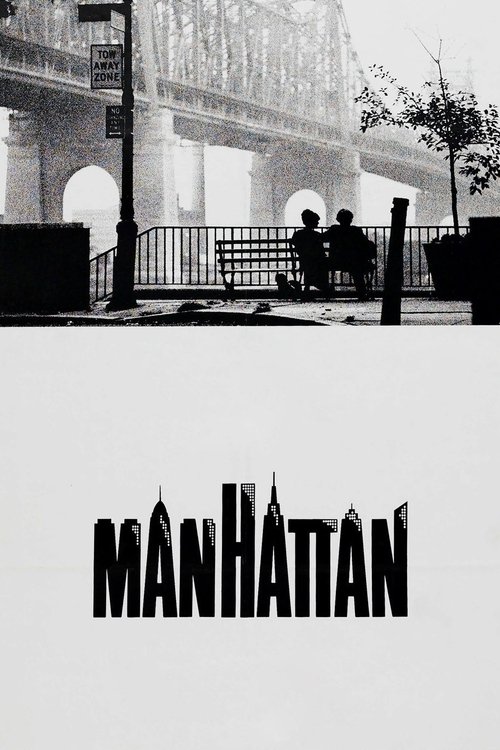
Manhattan
1979 · Woody Allen
For when you want smart, talky romance with a bitter aftertaste — a film to argue about afterward as much as enjoy. Comfort on the surface, discomfort underneath; it asks more of you than its charm suggests.
What it's about
Isaac, a forty-two-year-old TV writer who quits his job to write a novel, drifts through the romantic entanglements of Manhattan's chattering class: he's dating Tracy, a seventeen-year-old student, while falling for Mary, the sharp, insecure mistress of his married best friend. Everyone talks brilliantly and behaves badly, and the city gleams around them like a rebuke.
The experience
Witty, gorgeous, and quietly corrosive — the one-liners land fast while the film keeps score of every self-serving rationalization its characters make. It leaves you swooning at the images and squirming at the people, often in the same scene, and the central relationship is genuinely uncomfortable to sit with today.
Performances
Diane Keaton makes Mary's armor of opinions both funny and sad, and Mariel Hemingway, playing the youngest person on screen, quietly gives the film its most honest and grounded presence.
The craft
Gordon Willis's black-and-white widescreen photography is the reason this film endures — luminous skyline compositions that made monochrome feel like the only honest way to shoot New York — all set to wall-to-wall Gershwin. It's one of the great-looking films of its era and rewards the biggest screen you can find.
Why it matters
Instantly canonized as the definitive screen portrait of romantic New York, its imagery echoed through decades of city films — even as its central premise has made it one of cinema's most re-argued classics.
Snapshot
Manhattan is Woody Allen's monochrome love letter to New York City and, simultaneously, a corrosive comedy about the moral evasions of its educated, self-dramatizing inhabitants. Made directly after the one-two punch of Annie Hall (1977) and the austere Bergman homage Interiors (1978), it fuses Allen's gift for nervous verbal comedy with a newly serious visual ambition. Isaac Davis, a forty-two-year-old television writer who has quit his job to write a novel, is dating Tracy, a seventeen-year-old high-school student, while drifting toward Mary Wilkie, the brittle, over-cultured mistress of his married best friend Yale. Shot in luminous black-and-white widescreen by Gordon Willis and scored entirely to George Gershwin, the film presents a romantic, idealized city while dissecting the bad faith of the people who live in it. It is one of Allen's most enduring works and, partly because of Isaac's relationship with Tracy, one of his most contested.
Industry & production
Manhattan was produced for United Artists, the studio that had given Allen the rare creative autonomy — final cut, modest budgets, freedom of subject — under which his most celebrated 1970s films were made. It arrived at a moment when Allen's commercial and critical standing was at its height following the Best Picture win for Annie Hall, which bought him latitude to take risks: first the Bergmanesque chamber drama Interiors, then a black-and-white widescreen comedy-drama, both commercially counterintuitive choices.
Production was based entirely in New York, the city functioning as subject as much as setting; the film's geography is specific and lived-in, ranging from the Upper East Side and the Hayden Planetarium to Elaine's restaurant and the Queensboro Bridge. A widely circulated account holds that Allen was so dissatisfied with the finished film that he asked United Artists not to release it and offered to make another picture for free; the studio released it as planned. The anecdote is well attested in interviews and Allen lore, though it should be read as part of his characteristic self-deprecation rather than a documented contractual episode.
The film was a substantial commercial and critical success — among the stronger performers of Allen's career to that point — and earned Academy Award nominations for Best Supporting Actress (Mariel Hemingway) and Best Original Screenplay (Allen and Marshall Brickman). It is frequently cited as a BAFTA Best Film winner for its year; readers should treat specific awards tallies as checkable rather than taking my summary as final.
Technology
Manhattan was photographed on 35mm black-and-white stock in anamorphic Panavision, yielding the wide 2.35:1 scope ratio. The combination is deliberately unfashionable: by 1979 black-and-white was a rarity reserved for special cases, and the scope frame was associated with epics and spectacle rather than intimate urban comedy. Allen and Willis used both against type — monochrome to render the city as memory and myth, the wide frame to organize human-scaled drama within vast architectural and tonal space.
No exotic apparatus drives the film; its "technology" is the disciplined exploitation of mature tools — high-contrast black-and-white emulsion, anamorphic optics, available and supplemented light — by a cinematographer who understood their expressive limits. The Gershwin score was performed by orchestras (associated principally with the New York Philharmonic, with arrangements conducted for the production) rather than synthesized or library-sourced, giving the music a concert-hall fullness; the precise performing and conducting credits are worth verifying against the titles.
Technique
Cinematography
The cinematography by Gordon Willis is the film's signal achievement and one of the landmark camera jobs of American cinema. Willis — nicknamed "the Prince of Darkness" for his underexposed, top-lit work on the Godfather films — built Manhattan around extreme contrast, deep blacks, and a willingness to let faces fall into silhouette. The celebrated planetarium sequence, in which Isaac and Mary wander among the cosmos exhibits, plays much of its dialogue in near-total darkness, the actors reduced to rims of light. The equally famous dawn shot of the two seated on a bench beneath the Queensboro Bridge — the bridge strung with lights against a pale sky — is a composition of pure romantic iconography; the production reportedly had to contend with the bridge's lights going out, and the surviving frame became the film's emblem and poster image.
Willis exploits the scope frame to isolate figures at the edges of wide compositions, leaving expanses of negative space — a doorway, a gallery wall, a darkened apartment — that externalize loneliness and emotional distance. Characters frequently move out of frame while continuing to speak, or are blocked by furniture and architecture, so that the city's grandeur and the characters' smallness are held in a single image.
Editing
The film was cut by Susan E. Morse, who around this period became Allen's principal editor and would remain so for roughly two decades. Her work here serves the director's preference for sustained takes and unhurried two-shots over aggressive cutting; scenes are allowed to breathe at the pace of conversation, and comic and dramatic beats are timed to performance rhythm rather than imposed by montage. The editorial restraint is part of the film's adult tonal register — it trusts the actors and the widescreen staging to carry scenes that a more conventional comedy would fragment.
Mise-en-scène / staging
Manhattan's staging is inseparable from its photography: Allen and Willis stage long dialogue scenes in single setups that use the full width of the frame, choreographing entrances, exits, and reframings within the shot. Interiors are dressed as the habitats of a specific cultural class — book-lined apartments, art galleries, gourmet shops, the murmuring tables of literary restaurants. The city itself is staged as a character through montage and exterior tableaux, but the dramatic scenes are intimate and architectural, repeatedly placing characters against the geometry of rooms and bridges that dwarf them.
Sound
The soundtrack is dominated by the music of George Gershwin, opening with Rhapsody in Blue under the celebrated montage of city images that culminates in fireworks over the skyline. Gershwin's symphonic jazz supplies the film's emotional vocabulary — at once nostalgic, urbane, and grand — and ties the modern city to an idealized, mid-century American romanticism. Dialogue recording favors Allen's overlapping, naturalistic talk; the film's signature sound is the cadence of intelligent, anxious people talking themselves into and out of trouble.
Performance
The performances balance comic timing against genuine pathos. Allen plays Isaac as a familiar version of his neurotic persona, but darkened by self-righteousness and evasion. Diane Keaton's Mary Wilkie is a brilliant, defended, name-dropping intellectual whose bravado masks real fragility — a sharp departure from Annie Hall. Mariel Hemingway, a teenager at the time of filming, gives Tracy a clarity and unforced sincerity that quietly indicts the adults around her; her performance earned an Oscar nomination. Michael Murphy's Yale embodies smooth academic self-justification, and Meryl Streep, in an early role, is glancingly memorable as Jill, Isaac's ex-wife who has left him for a woman and is writing a candid memoir of their marriage.
Narrative & dramatic mode
The film operates as a comedy of manners braided with moral drama. Its structure is episodic and conversational rather than tightly plotted, advancing through romantic permutations among a small set of characters whose relationships keep reshuffling. The dominant mode is irony: Isaac diagnoses everyone's hypocrisy with great wit while remaining blind to his own, and the screenplay's comedy repeatedly curdles into discomfort. A first-person framing device — Isaac dictating the opening lines of his novel in voiceover, revising his own romantic self-image in real time — establishes the film's reflexive interest in how people narrate and flatter themselves. The ending, in which Isaac belatedly runs across the city to reach Tracy only to learn she is leaving for London, withholds easy resolution; her parting line about needing "a little faith in people" lands as both hope and rebuke.
Genre & cycle
Manhattan sits within the cycle of late-1970s American films that brought European art-cinema seriousness to home-grown subjects, and within Allen's own evolution from "early, funny" gag comedies toward the bittersweet comedy-drama he would refine across the following decade. Generically it hybridizes the romantic comedy, the relationship drama, and the city film. It belongs to a distinctly New York strain of filmmaking — urbane, talky, neurotic — that Allen did much to define and that Manhattan crystallized into a recognizable template.
Authorship & method
The film is a signature Allen work, co-written with Marshall Brickman, his collaborator on Annie Hall and Sleeper; the partnership combined Allen's voice with Brickman's structural and comic discipline, and the screenplay's blend of one-liners and moral seriousness reflects that two-man authorship. The decisive creative collaboration, however, is with cinematographer Gordon Willis, whose black-and-white scope photography is as much an authorial signature on this film as Allen's writing; their partnership across several films reshaped Allen's visual sophistication. Editor Susan E. Morse established here the unobtrusive, performance-led cutting that would characterize Allen's mature style. The "composer" is effectively George Gershwin, posthumously: rather than commissioning a score, Allen built the soundtrack from Gershwin's catalog, an authorial gesture that fuses his personal nostalgia with the film's idealized city. Allen's method — New York locations, repertory casting, long takes, jazz and standards on the soundtrack, autobiographically inflected protagonists — is fully present and, in some respects, definitively stated in Manhattan.
Movement / national cinema
Manhattan is a thoroughly American film deeply indebted to European art cinema. Allen's admiration for Ingmar Bergman and Federico Fellini shapes its seriousness of theme and its confidence that a comedy can also be a moral inquiry; Interiors had been his most direct Bergman homage, and Manhattan folds that ambition back into a comic register. It is also a key text of the New Hollywood's twilight, when director-driven, personal filmmaking still found studio backing. Above all it is a New York film, advancing a metropolitan, Jewish-inflected, intellectual sensibility that constitutes a recognizable regional cinema within American film.
Era / period
The film is precisely of its late-1970s moment: a portrait of an affluent Manhattan cultural class preoccupied with therapy, books, galleries, gourmet food, and the management of their own romantic lives. It captures a particular pre-gentrification, post-1960s New York — financially strained yet culturally confident — and a milieu of secular intellectuals for whom relationships and self-fulfillment have become the central moral arena. Its concerns with adultery, divorce, blended romantic histories, and the ethics of self-interest are very much those of the "Me Decade."
Themes
At its center is the conflict between integrity and self-deception. Isaac prides himself on moral seriousness — he quits a lucrative but vulgar job, lectures friends on courage and honesty — yet his own conduct, above all his relationship with a seventeen-year-old, exposes the gap between his rhetoric and his appetites. The film anatomizes intellectual pretension: characters wield cultural references as weapons and shields, and Mary's name-dropping "Academy of the Overrated" is both funny and a symptom. Nostalgia is a structuring theme — the black-and-white city and the Gershwin score render New York as a lost ideal — and the film is quietly aware that this idealization is itself a form of evasion. The May–December relationship between Isaac and Tracy, which the film treats with a tenderness that later viewers have found deeply troubling, foregrounds questions of power, exploitation, and self-justification that the surrounding comedy cannot fully contain. The closing emphasis on faith, sincerity, and the difficulty of simple goodness — embodied by Tracy against a chorus of clever, compromised adults — gives the film its moral throughline.
Reception, canon & influence
Manhattan was widely acclaimed on release and quickly entered the canon as one of Allen's finest achievements and a landmark of American cinematography; Willis's work in particular is routinely taught and cited. Looking backward, the film draws on Bergman and Fellini for its tonal seriousness, on the classical Hollywood romance and the iconography of the city symphony for its imagery, and on the Gershwin–Tin Pan Alley songbook for its emotional and musical idiom; Allen's own Annie Hall and Interiors are its immediate creative antecedents.
Looking forward, Manhattan helped fix a durable template for the literate, neurotic New York romantic comedy-drama, influencing a long line of filmmakers concerned with talky, morally ambivalent relationships in the city; its visual romanticism shaped how subsequent films have photographed New York. Its opening montage and bridge image have become among the most recognizable in American film.
The film's reputation has also become inseparable from later reassessment. The sympathetic framing of a middle-aged man's sexual relationship with a teenage girl, untroubling to many 1979 viewers, has become the focus of sustained critical re-examination, intensified by allegations and controversies surrounding Allen's personal life in subsequent decades. Much contemporary writing on Manhattan now holds its formal brilliance and its moral discomfort in deliberate tension — a film admired as a peak of craft and simultaneously interrogated for what its craft is asked to make beautiful. That double vision is now central to the film's place in the canon.
A Deleuzian reading
Chapter One.
The full Deleuzian reading of Manhattan →
Reception
Hailed on release as Woody Allen's masterpiece — B&W, Gershwin, rapturous reviews, Oscar nominations — it's now the single most re-litigated film in his catalog, with the 42-year-old-dating-a-17-year-old premise reading very differently after the allegations against Allen resurfaced.
How Manhattan was received, from release to now →
Influences: the films it descends from and the films it influenced
- The Godfather (1972) — Gordon Willis's underexposed, top-lit 'prince of darkness' photography established the restrained chiaroscuro and willingness to let faces fall into shadow that he carried directly into Manhattan's high-contrast black-and-white.
- Annie Hall (1977) — Allen and Brickman's first-person voiceover framing and episodic comedy-of-manners structure — neurotic narrator addressing the audience about love in New York — is the immediate template Manhattan refines into a more controlled register.
- Interiors (1978) — Allen's Bergman-inflected experiment in tonal gravity and Willis's muted, composed framing gave Allen the confidence to fuse moral seriousness with visual rigor that Manhattan then balances against comedy.
- 8½ (1963) — Fellini's episodic, autobiographically inflected portrait of a creative man juggling women and self-deception models the loosely strung, confessional artist-protagonist structure Allen adopts.
- Wild Strawberries (1957) — Bergman's austere reckoning with a protagonist's evasions and moral failures supplies the interrogative, conscience-driven seriousness Allen grafts onto a comic frame.
- Citizen Kane (1941) — Gregg Toland's deep-focus, high-contrast monochrome and sculpted pools of light are the classical-Hollywood precedent for Willis's expressive black-and-white compositions.
- Berlin: Symphony of a Great City (1927) — The city-symphony tradition of montage portraiture set to music is the direct model for Manhattan's opening sequence of New York vignettes cut to Rhapsody in Blue.
- An American in Paris (1951) — The film's wholesale use of Gershwin as emotional and orchestral idiom — symphonic standards carrying romance — anticipates Allen's decision to score the city with the Gershwin catalog rather than an original composition.
- The Last Picture Show (1971) — Inherits the validation of black-and-white as a living artistic choice in the color era, using Gordon Willis's monochrome for nostalgic, romantic effect rather than economy.
- Paper Moon (1973) — Gordon Willis's prestige black-and-white in the color era leans on the precedent Paper Moon and The Last Picture Show set for monochrome as a deliberate artistic, not nostalgic, choice.
- Stardust Memories (1980) — Allen's most overt 8½ homage continues the Willis black-and-white partnership, pushing the high-contrast, deep-shadow monochrome and autobiographical artist-protagonist further immediately after Manhattan.
- Hannah and Her Sisters (1986) — Extends Manhattan's episodic comedy-of-manners about interlocking literate New Yorkers, with performance-led cutting and standards-on-the-soundtrack, into an ensemble register.
- Crimes and Misdemeanors (1989) — Carries forward Manhattan's signature move of suspending one-liner comedy inside a Bergman-weighted moral examination of a man rationalizing his own betrayals.
- When Harry Met Sally... (1989) — Codifies the literate, talky New York romantic comedy-drama template — neurotic articulate couples debating love against a romanticized Manhattan — that Allen fixed.
- The Squid and the Whale (2005) — Inherits Allen's mode of autobiographically inflected, verbally dense New York intellectuals whose articulate self-justification masks moral evasion.
- Frances Ha (2012) — Explicitly revives Manhattan's romantic black-and-white photography of New York and its episodic portrait of a restless young creative drifting through the city's milieu.
- Dreams (2024) — Uses confessional literary voiceover by a writer narrating his own romantic entanglements, foregrounding the ethics of turning lovers into material.
- The Forty-Year-Old Version (2020) — Gordon Willis's black-and-white 35mm 'love letter' framing of the city — treating skyline and street as a lyrical collaborator — is the widescreen monochrome idiom Blank's cinematographer Eric Branco directly quotes.
- C'mon C'mon (2021) — Gordon Willis's precedent for photographing a contemporary American metropolis as luminous, architectural black-and-white space rather than as period pastiche.
- Sidewalls (2011) — Its opening city-symphony montage treats architecture itself as the romantic subject, the model for Medianeras' essayistic passages that render Buenos Aires's buildings as emotional characters.
- A Real Pain (2024) — Scores an entire film with a single dead national composer (Gershwin) instead of a hired one — the exact authorial gambit Eisenberg repeats by making Chopin his 'composer' to fuse setting, theme, and nationality.
- Metropolitan (1990) — Established the American dialogue-forward mix — talk recorded and balanced as the primary sonic event, scored with chamber/standards rather than orchestral underlining — and the convention of hyper-articulate New Yorkers walking and talking through named real locations, which Stillman adopts formally while relocating the milieu from the West Side intelligentsia to the debutante season.
- Broadway Danny Rose (1984) — Another Willis-shot black-and-white New York film that extends the same anamorphic-monochrome treatment of the city's iconography and showbiz milieu.
- Roma (2018) — Shares the project of using high-contrast, large-format black-and-white as an expressive, memorializing lens on a personally beloved city rather than a stylistic affectation.
- Lolita (1962) — Treats an older man's affair with a teenage girl through sophisticated black-and-white irony, inheriting Lolita's strategy of rendering taboo as urbane comedy of self-justification.
Similar films
- Annie Hall (1977) — influence & lineage
- Crimes and Misdemeanors (1989) — influence & lineage
- Interiors (1978) — influence & lineage
- Wild Strawberries (1957) — influence & lineage · often watched together
- The Graduate (1967) — often watched together
- Play It Again, Sam (1972) — shared sensibility
- If Beale Street Could Talk (2018) — shared sensibility
- Chinatown (1974) — shared sensibility
All the films related to Manhattan →