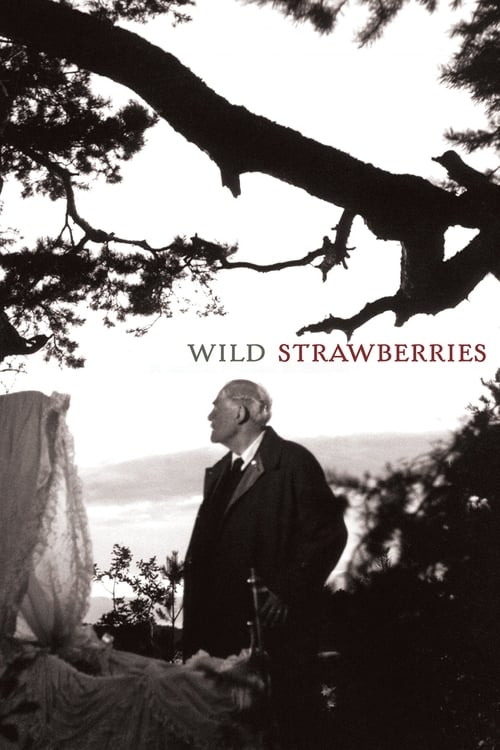
Wild Strawberries
1957 · Ingmar Bergman
For a reflective evening when you want a film about memory, regret, and second chances — the kind that leaves you wanting to call your parents. Gentle enough to be comforting, honest enough to sting.
What it's about
Isak Borg, a celebrated but coldly distant old doctor, drives from Stockholm to Lund to collect an honorary degree, with his unhappy, pregnant daughter-in-law Marianne along for the ride. The day keeps folding open: hitchhikers who echo people from his past, stops at childhood places, and dreams — one of them a genuinely frightening vision of death — that force him to tally what his detachment has cost everyone who loved him.
The experience
Tender, wistful, and quietly devastating, with flashes of real nightmare. It moves like a summer drive — warm, unhurried — while steadily cracking its hero open, and it earns its emotion without a drop of sentimentality.
Performances
Victor Sjöström, the great silent-era director acting in his final role, gives one of cinema's most moving performances as Isak — every flicker of pride, shame, and late-blooming warmth legible on his face. Bibi Andersson is radiant in a double role as the Sara of past and present.
The craft
Bergman weaves dreams, memories, and the present-day road trip into one seamless flow, decades before that structure became common. The opening nightmare — empty streets, a clock with no hands — is one of the most famous sequences in film, and the summery flashbacks glow in beautiful black and white.
Why it matters
A cornerstone of the art-film canon that shaped how movies portray memory and old age, and the template for generations of road movies where the real journey is inward.
Snapshot
Seventy-eight-year-old Professor Isak Borg, a celebrated but emotionally glacial physician, makes a daylong car journey from Stockholm to Lund to receive an honorary degree from the university where he once studied and taught. Accompanied by his daughter-in-law Marianne, he traverses not only Swedish roads but also the layered terrain of his own memory: dreamlike visions of an idyllic lost summer, a spectral nightmare of death and judgment, and charged encounters with living reminders of roads not taken. By the time the ceremony ends, something in Isak has shifted — not resolved into easy redemption, but cracked open. Wild Strawberries is at once a road film, a moral reckoning, a meditation on time, and one of cinema's most penetrating studies of a man confronting the emotional costs of his own detachment. It is widely regarded as among the finest films ever made.
Industry & production
Bergman wrote and directed Wild Strawberries for Svensk Filmindustri (SF), the Stockholm-based studio with which he had an ongoing production relationship throughout the 1950s. The project followed in rapid succession after The Seventh Seal (also 1957), with both films shot and released in the same year — a pace that reflects both Bergman's extraordinary creative momentum during this period and SF's willingness to green-light his increasingly ambitious work. The script originated, by Bergman's own account, in an impulse to revisit the landscape of his own childhood: a long drive through the Swedish countryside awakened memories of summer houses and early losses, and the screenplay took shape around those autobiographical sediments.
The casting of Victor Sjöström as Isak Borg was a coup of institutional and cultural memory. Sjöström, born in 1879, had been the towering figure of Swedish silent cinema — the director of The Phantom Carriage (1921) and The Wind (1928) — and was nearly eighty at the time of filming. His very presence activated a living connection to an earlier national tradition, so that watching the film carries an implicit meta-text: this is Swedish cinema's past being guided toward its own examination. Bergman has written movingly about what he observed in Sjöström during the shoot — the elderly actor's physical frailty and the uncanny emotional depths it unlocked — though the precise nature of their collaboration on set, beyond Bergman's general recollections, is not documented in granular detail. The supporting cast includes Bibi Andersson in a double role as both the young Sara of Isak's memory and the hitchhiker Sara of the present, and Ingrid Thulin as Marianne; Gunnar Björnstrand, a recurring Bergman collaborator, plays Isak's son Evald.
Technology
Wild Strawberries was shot in 35mm black-and-white, in the Academy aperture (approximately 1.37:1). The choice of black-and-white in 1957, when color processes were available and widely adopted in commercial cinema, was aesthetically deliberate: it allowed the cinematography to move fluidly between the photographic textures of naturalistic memory and the starker contrasts of nightmare without the expressive complications color would introduce. No unusual camera systems or proprietary processes are documented for this production; the technical apparatus was conventional SF studio-and-location work, which makes the film's achievements a matter of craft and vision rather than technological novelty.
Technique
Cinematography
Gunnar Fischer, Bergman's regular director of photography through the 1950s (before Sven Nykvist became his primary collaborator from The Virgin Spring onward), shot Wild Strawberries with a supple tonal range that quietly differentiates the film's temporal strata. The present-day sequences — the car journey, the service station, the degree ceremony — are rendered in a soft, naturalistic light appropriate to a Swedish summer: diffuse, unhurried, faintly melancholic. The nightmare that opens the film operates in a different register entirely. The deserted street without clocks' hands, the horseless hearse overturning, Isak's own coffin and the corpse within that turns to grasp him — these are shot with hard, raking shadows and the kind of high-contrast abstraction associated with Germanic Expressionism, translated into the Swedish idiom. The memory sequences at the family summer house occupy a middle zone: sunlit and tender, but also slightly too bright, too idealized, suggesting the unreliability of nostalgic vision. Fischer's control of this tonal vocabulary, achieved through conventional studio lighting and location photography rather than optical effects, is a central technical accomplishment of the film.
Editing
Oscar Rosander, who edited numerous Bergman films during this period, faced the structural challenge of a narrative whose present-tense scenes are regularly interrupted by visions that belong to different registers — memory, dream, nightmare — without a reliable system of transitional cues to guide the viewer. The solution is not seamlessness but a kind of calibrated abruptness: cuts into and out of the dream sequences are often clean rather than dissolved, trusting the viewer to track the shifts from context. The overall temporal architecture is more complex than its surface fluency suggests: five or six distinct time registers (the present journey; Isak's childhood memories; his early adult memories; the nightmare; a semi-conscious reverie; the closing interior vision) are woven through a journey that covers a single day. The editing keeps this machinery from becoming laborious, in part by subordinating temporal complexity to emotional legibility — the viewer may be uncertain exactly what order events occurred, but the emotional stakes remain clear.
Mise-en-scène / staging
Bergman's staging often exploits the geometry of confinement. The car — occupied throughout most of the film by Isak, Marianne, and eventually the hitchhiking young trio — becomes a crucible in which silence communicates as much as dialogue. Bergman stages confrontations and reconciliations in this cramped space with particular attention to eyeline and proximity: when Marianne tells Isak what she really thinks of him, she looks straight ahead at the road, while he is in profile, making her frankness more devastating precisely because it is delivered without face-to-face appeal. The family summer house of the memory sequences is staged as a kind of sunlit theater of the past — characters from multiple decades coexist in the same garden, visible to an Isak who observes rather than participates, a ghost in his own history. This staging of spectatorship — Isak as audience to his past self — carries the film's central dramatic conceit in spatial terms.
Sound
Erik Nordgren composed the score. His approach throughout this period of Bergman collaborations tends toward restraint: chamber textures, folk-inflected melodic lines, and an avoidance of the symphonic swells that Hollywood scoring of the era deployed to direct emotional response. In Wild Strawberries, the music often withdraws entirely during the most charged dramatic scenes, allowing silence and ambient sound to carry the weight. The degree ceremony, which might in another film be scored for ironic pomp or emotional uplift, is largely a sonic void. Conversely, the memory sequences at the summer house are accompanied by music that is nostalgic without being saccharine — the warmth is real, but it carries an undertone of irreversibility.
Performance
Sjöström's performance as Isak Borg stands among the great achievements of screen acting. Working from the inside out, he makes the character's emotional withholding feel like a physical condition — a stiffness of the self — rather than mere coldness. The performance is physically subtle in ways that only become apparent on repeated viewing: small relaxations of the jaw, a change in the distribution of weight, tiny modulations in how much he permits his eyes to engage with the person before him. The film's closing shot, in which Isak falls asleep with something like peace on his face as he glimpses a final vision of his parents on the distant shore, depends entirely on Sjöström's capacity to let decades of defended feeling partially dissolve without melodrama. Bibi Andersson's double casting — playing both Saras with distinct but resonant energy — is a technical and imaginative feat that has not always received the critical attention it warrants.
Narrative & dramatic mode
The film's primary narrative mode is retrospective — an old man's journey into and through his own past — embedded within a forward-moving journey narrative. This double structure, the road film and the memory film superimposed, is one of the reasons Wild Strawberries feels both formally controlled and emotionally loose. The dream sequences function not as Freudian problem-solving but as a form of moral theater: in one extended sequence, Isak is subjected to a kind of tribunal in which his professional and personal failures are exposed. The mode here is closer to Strindberg's dream-plays — in which conventional theatrical space dissolves and guilt externalizes as spectacle — than to Freudian symptom-logic. The film is not structured toward revelation or change in the conventional sense; Isak does not confess, repair his relationships, or undergo a transformative epiphany. The emotional movement is more modest: a man arrives at something like self-knowledge and is perhaps, at the last, capable of love he was not capable of before.
Genre & cycle
Wild Strawberries belongs most clearly to the art cinema tradition of the late 1950s and early 1960s — a body of work characterized by psychological interiority, literary ambition, and skepticism toward classical narrative resolution. Within that broader cycle, it participates in the specifically Scandinavian meditation on guilt, aging, and spiritual desiccation that runs through Bergman's work of this decade, alongside The Seventh Seal and the later "Silence of God" trilogy. It is also, improbably, a road film — one of the earliest examples of the road film used not for picaresque energy or American existentialist freedom, but for structured introspection, a mode that will later surface in films such as Wim Wenders's Kings of the Road (1976) and Agnès Varda's Vagabond (1985). The film's engagement with an aging protagonist conducting a life review also aligns it with a tradition of cinematic elegy for which there was, in 1957, relatively little established precedent.
Authorship & method
The auteurist reading of Wild Strawberries centers on Bergman's sustained preoccupation with emotional incapacity and its consequences — a theme that runs through his work with remarkable consistency and that he has acknowledged draws substantially on his own psychology and family history. The initials of Isak Borg (I.B.) match Bergman's own; the stern, emotionally unavailable father in Isak's memories echoes the clergyman father Bergman described in his autobiography The Magic Lantern (1987). Bergman frequently spoke of the film as among the most personally charged he made, though the degree to which specific autobiographical details map onto the narrative is not entirely recoverable.
Gunnar Fischer's role should not be understated: the visual decisions that make the nightmare and memory sequences feel phenomenologically distinct are collaborative achievements. Erik Nordgren's scoring sensibility — restraint as a form of respect for the image — and Oscar Rosander's structural editing were long-standing collaborative relationships Bergman relied upon during this fertile middle period.
Movement / national cinema
Wild Strawberries is a central work in the Swedish cinema's mid-century international flowering. Swedish film had achieved international recognition in the silent era through Sjöström and Mauritz Stiller, then receded from global consciousness during the sound transition. Bergman's work of the 1950s — subsidized by SF and supported by the cultural infrastructure of Swedish social democracy, which took cinema seriously as an art form — re-established Swedish film as a major world cinema, and Wild Strawberries was one of the films that carried that reputation internationally. The Swedish Film Institute, founded in 1963, would later institutionalize state support for quality filmmaking; the conditions that produced Wild Strawberries anticipate that model.
Era / period
The film is a product of late-1950s postwar European art cinema, a moment when the commercial and critical infrastructure for serious filmmaking outside Hollywood was consolidating — international film festivals, art-house distribution networks, critical institutions such as Cahiers du Cinéma — and when filmmakers across Europe were testing what cinema could do with philosophical and psychological content hitherto confined to literature and theater. It sits at the threshold of the New Waves: made just before the French New Wave, the Italian economic miracle cinema, and the new German cinema that would follow in its wake, but already pointing toward the formal freedoms those movements would embrace.
Themes
The film's governing concern is the emotional cost of self-sufficiency — the way a man can construct his life so efficiently around work and intellect that he forecloses the possibility of genuine intimacy, and the reckoning that attends this discovery late in life. Related to this is the film's meditation on the relationship between memory and identity: the past is not simply recoverable nostalgia but a living pressure that shapes the present, and Isak's inability to intervene in his own memories — to change what happened between him and Sara, to repair his relationship with his son before it was too late — is the film's central anguish. The strawberry patch of the title, associated with the lost summer of youth and first love, functions as a Proustian charged object: the specific sensory detail that carries an entire emotional history. Mortality figures not as horror but as clarifying fact — the nightmare is partly about death as judgment for a life insufficiently loved.
Reception, canon & influence
Backward influences. Strindberg's dream-play structures — particularly A Dream Play (1901) and The Ghost Sonata (1907) — are the most legible literary antecedents for the film's dissolution of realistic time and space. Bergman was steeped in the Swedish theatrical tradition, and Strindberg's technique of moral exposure through dream-logic is closely echoed in the tribunal sequence. Victor Sjöström's own The Phantom Carriage (1921), which also uses nested flashback and a protagonist's confrontation with his moral failures, constitutes an earlier Swedish cinematic precedent. Italian Neorealism — particularly its humanist interest in ordinary journeys and the dignity of aging faces — may have contributed to the film's tonal register, though the connection is one of broad influence rather than specific debt.
Critical reception. Wild Strawberries won the Golden Bear at the Berlin International Film Festival in 1958 and received an Academy Award nomination for Best Original Screenplay. It was received as a masterwork almost immediately by the international critical press, and its reputation has not significantly diminished. It features regularly in polls of the greatest films ever made — in the 2022 Sight & Sound poll it ranked in the upper tier of the all-time list — and has been the subject of sustained academic attention from scholars including Robin Wood, Paisley Livingston, and Maaret Koskinen, whose monograph on the film is among the most detailed studies available. Susan Sontag's influential essays on Bergman in the 1960s helped canonize his work for Anglophone intellectual culture, and Wild Strawberries was central to that reception.
Forward influence. The film's most direct legacy is in the art cinema of memory and retrospection: Alain Resnais's near-simultaneous Hiroshima mon amour (1959) and Last Year at Marienbad (1961) share the film's interest in the phenomenology of memory, though Resnais pushes toward formal abstraction where Bergman retains narrative legibility. Federico Fellini's 8½ (1963), with its introspective director-surrogate moving through layers of memory, fantasy, and present-tense crisis, is the film most often cited as a descendant of Wild Strawberries, though Fellini's approach is considerably more carnivalesque. The motif of a journey that is simultaneously an interior excavation — the road trip as structured self-examination — recurs across subsequent decades in work as varied as Wenders's road films, Kiarostami's car-bound dialogues, and Paolo Sorrentino's The Great Beauty (2013). Woody Allen's more introspective work, particularly Stardust Memories (1980) and Deconstructing Harry (1997), shows the influence of Bergman broadly and of Wild Strawberries specifically in its use of an artistic alter ego confronting the emotional debris of his life. The film's formal solution to the problem of rendering interiority — the waking dream, the spectatorship of one's own past, the tribunal as theatrical externalization of guilt — has become part of the shared vocabulary of serious cinema.
A Deleuzian reading
A man stands on a deserted street in the white glare of a dream.
The full Deleuzian reading of Wild Strawberries →
Reception
No rescue arc needed — it won the Golden Bear at Berlin in 1958 and landed Bergman an Oscar nomination for the screenplay; the only shift since is that it's become the 'warm' Bergman, the one people recommend to friends scared off by his reputation for gloom.
How Wild Strawberries was received, from release to now →
Influences: the films it descends from and the films it influenced
- The Phantom Carriage (1921) — Sjöström's double-exposure technique for rendering a ghost's retrospective observation of his own living past is the direct formal model for Wild Strawberries' observer-ghost-spectatorship, in which Isak watches his younger self trapped in memory; Bergman's casting of Sjöström as Isak literalizes this cinematic inheritance as a living meta-text.
- The Wind (1928) — Sjöström's expressionist technique of landscape as externalized psychological state — the wind as the protagonist's inner terror made physically visible — prefigures Wild Strawberries' summer-house memories and nightmare street, where Swedish topography becomes the texture of Isak's interior life.
- Citizen Kane (1941) — Welles's multi-register temporal architecture — a present-tense frame inquiry triggering multiple distinct memory strata through abrupt cuts — provided the structural template for Wild Strawberries' interlacing of five discrete time registers within a single day's journey.
- Brief Encounter (1945) — Lean's first-person voiceover retrospection — a narrator mentally addressing an absent other as she cuts to irrecoverable memory — is the structural armature Bergman adapts for Isak's interior monologue, which drives Wild Strawberries' present/past intercutting.
- Letter from an Unknown Woman (1948) — Ophüls's technique of a frame-narrative document triggering clean cuts into remembered sequences — with chamber-scored restraint letting performance carry pathos rather than orchestral underscoring — is the direct formal model for Wild Strawberries' voiceover-activated temporal architecture and its acoustic economy.
- Voyage in Italy (1954) — Rossellini established the European introspective road film in which a car becomes the pressure vessel for a couple's emotional confrontation with their mutual failure; Bergman directly adopts this format and the specific device of vehicle-as-crucible for Isak and Marianne's shared journey.
- Ikiru (1952) — Bergman's retrospective life-review structure for a dying academic — the realization that institutional success has crowded out authentic experience — directly extends Ikiru's formal architecture, while Sjöström's restrained physical performance (stillness as the measure of emotional depth) descends explicitly from Shimura's economy of gesture.
- A Lesson in Love (1954) — Inherits A Lesson in Love's flashback-as-counter-evidence device — a journey interrupted by flashbacks that systematically indict the protagonist's self-image — but strips away comedy so the identical formal structure performs psychological reckoning rather than marital wit.
- Hiroshima mon amour (1959) — Resnais extended Wild Strawberries' technique of cutting cleanly into traumatic memory without optical transitional effects, then made the viewer's temporal disorientation an explicit formal subject rather than a navigable architecture — pushing Bergman's calibrated abruptness into structural vertigo.
- Last Year at Marienbad (1961) — Resnais pushed Wild Strawberries' Strindbergian dream-tribunal staging — protagonist confronted by witnesses to an unverifiable past in a formally austere space — to its logical extreme, collapsing the distinction between remembered and present-tense action entirely.
- Cléo de 5 à 7 (1962) — Varda applied Bergman's road-film-as-elegy format — a protagonist's journey through space as real-time interior reckoning with mortality — to urban, feminist, and strictly real-time terms, retaining the introspective journey's structure while transforming its social and temporal coordinates.
- 8½ (1963) — Fellini absorbed Bergman's technique of intercutting dream and memory with present-tense action via clean cuts, and adapted the device of the artist-protagonist as simultaneous subject and observer of a moral tribunal staged within a reverie sequence.
- Persona (1966) — Bergman extended Wild Strawberries' confinement-as-crucible staging — two figures in a bounded space forcing mutual psychological exposure — and the observer-ghost structure, while destabilizing the film's own material substrate in ways Wild Strawberries' naturalistic surface held in reserve.
- Amarcord (1973) — Fellini extended Wild Strawberries' structural logic of reconstructing a formative landscape through memory-tableaux whose idealized brightness signals nostalgic distortion; Fischer's overexposed summer-house sequences become Nino Rota's warm-but-ironic tonal palette in Amarcord.
- The Mirror (1975) — Tarkovsky extended Wild Strawberries' multi-register temporal architecture — clean cuts between childhood memory, adult present, and documentary footage — into Soviet poetic cinema's associative mode, with the protagonist as an absent observer of his own formative past rather than a present narrator.
- Songs from the Second Floor (2000) — Andersson directly continued Wild Strawberries' Swedish expressionist staging tradition — tableau-composition shots in which ghostly observers are inserted into absurdist social spaces — extending the observer-ghost-spectatorship mode into a deadpan national allegory.
- Certified Copy (2010) — Kiarostami extended Wild Strawberries' car-as-crucible format — physical travel as the pressure vessel for a couple's ambiguous interior investigation — into a film where the couple's shared past is itself uncertain, reactivating the Rossellini–Bergman road-film-as-psychological-excavation template.
- Nebraska (2013) — Payne directly invokes Wild Strawberries' visual grammar — Academy-ratio black-and-white cinematography for an elderly protagonist's road journey as moral self-assessment — as an explicit citation of Bergman's fusion of road film format with elegiac retrospection on a life's emotional failures.
- 45 Years (2015) — Haigh deployed Wild Strawberries' confinement-as-crucible staging in domestic space and its chamber-scoring restraint — minimal underscore forcing emotional weight entirely onto performance — to render a past secret's slow disclosure as accumulating marital pressure.
- The Blue Trail (2025) — Frames an elderly protagonist's road journey as a reckoning with mortality and dignity, the aging-and-dignity throughline rendered through episodic roadside encounters.
- The Seventh Seal (1957) — Shot the same year by the same Bergman–Fischer cinematographic partnership and scored by Erik Nordgren, The Seventh Seal shares the expressionist-nightmare lighting grammar — hard raking shadows, high-contrast abstraction — and the chamber-scored acoustic restraint that both films deploy to render metaphysical confrontation without orchestral inflation.
- Smiles of a Summer Night (1955) — Made immediately after Smiles with the same repertory ensemble, Wild Strawberries redirects the displacement-and-return structure toward existential retrospection, using the journey away from social context as the mechanism for desire's resolution.
- The Magician (1958) — Made simultaneously with The Magician, shares the double-register mode — a protagonist who inhabits present tense and a dream-vision of self-examination simultaneously — and functions as a covert Bergman self-portrait, but in a realist-melancholic key where The Magician deploys Gothic theatrical artifice for the same interior project.
- The Father (2020) — Ancestor of dementia-as-staging: an aging man's past physically intrudes into present rooms, memory dramatized as walk-in space rather than voiceover.
- Testament of Orpheus (1960) — An old artist walks through dreamed memories of his own life toward death — the self-elegy structure Testament formalizes as the poet arraigned and judging himself.
- Ballad of a Soldier (1959) — Structures a journey by road as a chain of episodic memory-flashbacks and reflective reckoning, the same elegiac road-plus-recollection frame Ballad uses to bracket its trip home.
Similar films
- The Phantom Carriage (1921) — influence & lineage · often watched together
- The Seventh Seal (1957) — influence & lineage
- Brief Encounter (1945) — influence & lineage · same viewing thread
- A Lesson in Love (1954) — same viewing thread
- Two for the Road (1967) — same viewing thread
- Dancer in the Dark (2000) — often watched together
- The Virgin Spring (1960) — often watched together
- Cries and Whispers (1972) — often watched together
All the films related to Wild Strawberries →
Watch it with: curated runs of related films
- Love, Memory, and the Long Journey — A run of love films where a journey — by car, by rail, or through memory — quietly lays bare what two people are, or were, to each other.