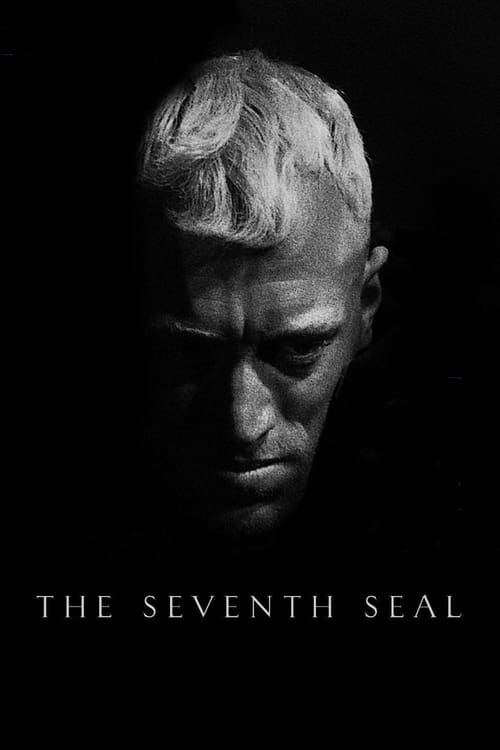
The Seventh Seal
1957 · Ingmar Bergman
For when the big questions are keeping you up at night and you want a film that takes them seriously without being a slog. A rite-of-passage watch that turns out to be genuinely gripping.
What it's about
A knight returns from the Crusades to find Sweden ravaged by the Black Death — and Death himself waiting for him on the beach. He proposes a chess match for his life, buying time to find one meaningful act, one shred of proof that God exists, before the game ends. Along the road he falls in with a gentle troupe of traveling players, and the film becomes a journey through a medieval world of plague processions, witch burnings, and stubborn everyday joy.
The experience
Far more alive than its reputation suggests — yes, it's a stark meditation on death and doubt, but it's also earthy, funny, and tender, with strawberries and songs between the reckonings. It leaves you sobered and strangely consoled.
Performances
Max von Sydow's gaunt, searching knight became one of cinema's defining faces, and Bengt Ekerot's Death — pale, courteous, faintly amused — is simply one of the most indelible characters ever put on screen.
The craft
Shot in about five weeks on a tiny budget, it produces image after image that entered the permanent memory of movies: the chess game on the stony beach, the silhouetted procession against the sky. Bergman's script balances medieval allegory with warm, human comedy, and the stark black-and-white photography is stunning on a big screen.
Why it matters
This is the film that made Ingmar Bergman an international name and made 'art cinema' a global phenomenon — endlessly referenced and parodied, its imagery is recognized even by people who've never seen it.
Snapshot
A disillusioned crusader knight named Antonius Block returns to a plague-ravaged Sweden and challenges the personification of Death to a chess match, buying himself time to commit one act of meaning before he dies. Shot in roughly five weeks on a shoestring budget by Svensk Filmindustri, The Seventh Seal became one of the most recognizable films in the history of the medium — its hooded Death, its final silhouette procession, and its vision of God's silence lodging themselves permanently in the iconographic memory of world cinema. The film catapulted Ingmar Bergman from a respected but regional art-cinema director into an international figure, and it established the template for a certain strain of European philosophical filmmaking that would define the 1960s.
Industry & production
Bergman developed the project from a one-act stage play he had written in 1954 titled Trämålning ("Wood Painting" or "Mural"), staged at the Malmö City Theatre where he was then resident director. The theatrical origin is visible in the film's structure: many scenes read as discrete set pieces, almost tableaux, with a rhetorical explicitness more common to stage than screen. Svensk Filmindustri, the Swedish studio that had produced Bergman's work throughout the early 1950s, greenlighted the film with a modest budget; production records indicate a shooting schedule of approximately 35 days in the summer of 1956, though the precise cost has not been widely documented in accessible sources.
The bulk of the interiors were shot at Råsunda Studios outside Stockholm. The exteriors — most memorably the coastal scenes with Jof, Mia, and the bowl of wild strawberries — were filmed at Hovs Hallar on the rocky Kullaberg peninsula on Sweden's southwest coast. The famous final "dance of death" silhouette against a storm sky was improvised when the regular cast was not available; Bergman used technicians and crew members to form the procession, shooting against a naturally dramatic cloudbank. This origin of one of the most celebrated shots in world cinema — as an improvised afterthought with non-actors — has been reported consistently in interviews and in biographical accounts by Birgitta Steene and others.
Technology
The film was shot in 35mm black-and-white on standard Svensk Filmindustri equipment of the period, without technical distinction at the level of format or camera hardware. What distinguishes the technological record here is less innovation than deliberate constraint: the low budget precluded elaborate optical effects, so the film achieved its visual metaphysics through composition, lighting, and staging rather than technical apparatus. The chess game with Death, which might easily have become a special-effects showcase, is rendered entirely through conventional framing and performance.
Nordgren's score was recorded with a chamber ensemble rather than a full orchestra, a budgetary reality that aligned with the film's austere tonal ambitions. The sound design broadly follows the conventions of 1950s European studio production — direct recording supplemented by post-production work — without notable innovation.
Technique
Cinematography
Gunnar Fischer, Bergman's principal cinematographer from the late 1940s through the late 1950s, shoots The Seventh Seal with a severity that matches the theological bleakness of the script. His images favor high contrast, placing faces or figures against overexposed skies or deep shadow, and the frequent use of low or wide-angle framings gives the medieval landscape an oppressive immensity. The opening shot — Block kneeling on a rocky shore while waves break behind him, the sky churning above — establishes an elemental world in which human figures are small and exposed.
Fischer and Bergman use close-ups sparingly but to calculated effect: the extreme close-up of Death's eyes as he looks up from the chess board, or Block's face in the confessional when he realizes he has inadvertently revealed his chess strategy to Death himself. The confessional sequence is staged and shot with particular cunning — Block and Death separated by a screen, Death's face partially lit from one side — and its spatial logic depends on precisely calibrated depth and shadow. Deep focus is used selectively; many two-shots flatten the planes enough to press characters into an almost heraldic confrontation with each other.
Editing
Lennart Wallén edited the film with a rhythm that honors the theatrical pacing of Bergman's stage-derived script. Cuts tend to be clean and functional rather than rhythmically assertive; the editing does not call attention to itself. Transitions between the metaphysical register (the chess scenes, Death's appearances) and the earthy comedy of Jof and Mia's troupe are handled with a matter-of-factness that is itself a philosophical gesture — the mundane and the transcendent inhabit the same editing tempo, the same world.
Mise-en-scène / staging
The film's staging is its most theatrically legible dimension. Bergman blocks figures in compositions that recall medieval frescoes and altarpieces: the wagon on the ridge, the procession of flagellants moving laterally across the frame, the final dance of death stretching across the hill's crest. These images are not documentary; they are designed as pictures first, drawing deliberately on a visual tradition that Bergman had absorbed both through Swedish ecclesiastical art and through his own extensive work in theater.
The casting of Bengt Ekerot as Death — tall, white-faced, robed — follows the iconographic tradition of Scandinavian church painting, particularly the danse macabre murals that Bergman had seen in Swedish medieval churches. Bergman has acknowledged this debt explicitly in interviews, identifying the church paintings of Albertus Pictor as formative images. The staging throughout maintains a quality of conscious pictorial composition: figures placed with heraldic deliberateness, the frame always organized around clear symbolic geometries.
Sound
The sound design is largely conventional for its era, though Erik Nordgren's score deserves specific attention. Nordgren uses motifs of medieval character — modal harmonies, austere melodic lines — without pastiche, creating a sonic atmosphere of religious solemnity edged with dread. The score does not underline emotional moments so much as sustain a pervasive tonal climate. There are also extended passages of near-silence, particularly during the chess scenes, where ambient sound (wind, the sea) carries the weight that music might in a more conventionally scored film.
Performance
Max von Sydow, at twenty-seven making only his third or fourth significant screen appearance, carries the film on the spiritual authority of Block's exhausted face. His performance is controlled to the point of stillness — a stillness that reads not as absence but as a man so emptied by doubt that ordinary affect has been burned away. Gunnar Björnstrand as the squire Jöns provides the secular counterweight: worldly, sardonic, compassionate in practice if atheistic in principle, and Björnstrand plays him with an ease that makes the philosophical sparring feel like lived experience rather than debate.
Nils Poppe's Jof and Bibi Andersson's Mia form the film's affirmative center — the innocent, visionary fool and the grounded, life-giving woman — and both are played with a warmth that keeps the film from collapsing entirely into its own metaphysical severity. Bengt Ekerot's Death is a masterclass in stillness and presence: he does nothing theatrical, simply inhabits the figure with calm authority, letting the visual design carry the abstraction.
Narrative & dramatic mode
The Seventh Seal is structured as an episodic journey — a road narrative through plague-ravaged medieval Sweden — in which Block accumulates companions and encounters as he moves toward his inevitable end. The chess game with Death provides narrative spine but does not function as conventional plot; there is no suspense about the outcome. What drives the film is rather the question Block poses explicitly: is there a God, does He hear us, and can a life lived in doubt and moral failure be redeemed by a single act?
The narrative mode blends allegorical morality play (inherited from medieval theater, which Bergman studied), existentialist drama, and Swedish folk comedy. The shifting register — from the earnest theological agony of Block's confessional to the slapstick of Skat the actor's seduction — is not tonal incoherence but structural argument: the two registers, the metaphysical and the comic-earthy, coexist in the same world and must be held together.
Genre & cycle
The film sits at the intersection of several generic traditions without belonging entirely to any. It draws on the European allegorical film (Dreyer's work provides a precursor), the costume historical drama, and the philosophical art film that was emerging as a distinct festival category in the mid-1950s. Bergman's willingness to stage supernatural encounters — Death walking among the living, Jof's visionary capacity — places the film in dialogue with fantasy and horror conventions, though its mode is never generically horrific.
Within Bergman's own career, The Seventh Seal belongs to a cycle of films from the late 1950s — including Wild Strawberries (also 1957), The Magician (1958), and The Virgin Spring (1960) — in which he worked through questions of faith, mortality, and the possibility of grace in an apparently indifferent universe. This cycle is sometimes called his "faith trilogy," though the grouping is informal and the films are not conceived as a formal series.
Authorship & method
Bergman adapted The Seventh Seal from his own stage play, which he had developed from improvisations with student actors in Malmö. His control over the material was therefore total from the outset: he arrived on set with a script he had lived with for two years, knowing its arguments and images intimately. His method at this period was essentially theatrical — intensive rehearsal, a clear vision of the scene's emotional and intellectual stakes, then relatively economical shooting. He worked with a compact, trusted crew and tended toward a fast pace on set that the limited budget necessitated.
Gunnar Fischer's collaboration with Bergman spanned roughly a decade (from the late 1940s to The Face in 1958, after which Sven Nykvist became Bergman's principal collaborator). Fischer's contribution to the visual grammar of The Seventh Seal is inseparable from Bergman's conception; the two had developed a shared visual language through numerous earlier films. Erik Nordgren composed scores for Bergman across much of the 1950s, and his restrained, modal approach to The Seventh Seal reflects a shared aesthetic of austerity. Lennart Wallén worked with Bergman as editor on a number of films in this period; his contribution here is largely enabling rather than distinctive.
Movement / national cinema
The Seventh Seal is a product of the Swedish film industry's most internationally visible period, but its relationship to Swedish national cinema is somewhat paradoxical. Sweden had a distinguished film tradition, particularly in the silent era — Victor Sjöström and Mauritz Stiller had made internationally influential work in the 1910s and 1920s — but Swedish sound cinema of the 1940s and 1950s was largely domestic in audience and ambition. Bergman's ascent changed this: his films from the mid-1950s onward were aggressively exported to art-cinema markets in Europe and North America, and The Seventh Seal was the breakthrough title.
The film draws on specifically Swedish cultural materials — the church murals, the plague mythology, the folk tradition — but transmutes them into a universalist philosophical register legible to international audiences who knew nothing of Albertus Pictor. In this sense the film performs a characteristic move of the European art cinema: it is rooted in national specificity while addressing the broadest questions of the human condition.
Era / period
The Seventh Seal appeared at the height of the Cold War, in the same year as Sputnik and amid global anxieties about nuclear annihilation that made its images of plague-ravaged civilization and divine silence resonant far beyond their medieval setting. The film belongs to a broader mid-1950s emergence of European art cinema as an international phenomenon: the Italian neorealist wave was consolidating its legacy, the French New Wave was about to crest, and international festival culture (Cannes, Venice, Berlin) was establishing the infrastructure through which films like The Seventh Seal could reach global audiences.
The mid-1950s also saw an expansion of art-house cinema circuits in the United States, Britain, and Western Europe, creating a market for foreign-language films of serious ambition that had not existed on the same scale before. The Seventh Seal benefited directly from this infrastructure; its American release through Janus Films in 1958 made it foundational to the American art-cinema audience.
Themes
The film's central preoccupation is the crisis of religious faith in the face of death, suffering, and God's apparent silence. Block's anguished question — addressed repeatedly to Death, to a mute sky, to anyone who might answer — is whether faith is possible when God does not communicate, whether prayer reaches anything, whether the void is real. This is Kierkegaardian terrain: the leap of faith against the abyss, the torment of the soul that cannot believe and cannot stop wanting to.
Against Block's agonized search, the film sets Jof and Mia's unconscious grace: they live without theological crisis, their faith simple and unreflective, and they survive. The film's theological argument, if it makes one, is that the visionary innocence Jof embodies — he alone can see the Madonna and Child walking in the meadow — is insulated from the intellectual disease that destroys Block. Whether this represents a resolution or an irony (innocence preserved by its own blindness to danger) is left genuinely open.
Mortality and the meaning of a single life in the face of extinction are threaded through every episode. The recurring motif of the strawberries and milk — Jof and Mia's simple meal, shared with Block in a moment of transient grace — becomes the film's emblem of life's fragile sufficiency. Block describes the moment as the one thing he will remember: not revelation, but a moment of ordinary presence.
The film also addresses social cruelty: the flagellants, the burning of the young woman accused of consorting with the devil, the soldier's casual brutality — these episodes map the ideological violence that organized religion inflicts in the name of what it cannot prove.
Reception, canon & influence
Backward: influences on the film. The most direct visual source is the tradition of danse macabre imagery in Scandinavian medieval church painting, particularly the work attributed to Albertus Pictor in the church murals Bergman knew from Swedish countryside churches. Medieval mystery and morality plays — in which Death, God, and allegorical figures walked among living characters — provide the dramatic template. Dreyer's Scandinavian religious films, particularly The Passion of Joan of Arc (1928) and Day of Wrath (1943), are legitimate precursors in their treatment of faith, institutional cruelty, and female martyrdom, though direct influence is difficult to document. The existentialist philosophical tradition — Kierkegaard above all, whose Danish Protestant preoccupations map closely onto Bergman's Swedish Lutheran formation — shapes the intellectual content profoundly.
Contemporary reception. The Seventh Seal won the Special Jury Prize at Cannes in 1957. Critical reception in Sweden was initially mixed — some reviewers found it pretentious, others recognized it immediately as a major work — but international critical response was overwhelmingly enthusiastic. The film confirmed Bergman's status as one of the significant filmmakers of the postwar period and opened the American and British art-cinema markets to his subsequent work.
Canon. The film is canonically positioned today as one of the foundational works of world cinema, appearing on most significant critical lists and constituting required viewing in film studies curricula internationally. Its iconographic power — the chess game with Death, the final silhouette procession — is such that images from the film circulate far beyond any audience that has actually seen it.
Forward: legacy and influence. The film's most immediate legacy was the international legitimization of European art cinema as a serious critical and commercial category. Its American distribution established Janus Films as a major art-cinema importer and helped create the audience that would receive Fellini, Antonioni, Godard, and Kurosawa in the years that followed.
More specifically, the film established Death as a figure available for philosophical comedy as much as terror: Woody Allen's Love and Death (1975) directly parodies the chess-with-Death conceit, as does the "Grim Reaper" sequence in Monty Python's The Meaning of Life (1983). The figure also resurfaces, played straight, in Bill & Ted's Bogus Journey (1991). These parodies are measures of canonical status: the film had to be universally known for its images to function as shared cultural reference points.
At the level of style and ambition, The Seventh Seal helped define what philosophical art cinema could look like: the severe black-and-white image, the willingness to stage abstractions as literal events, the combination of formal rigor with metaphysical urgency. Its influence on subsequent European filmmakers — on those who worked through questions of faith, mortality, and meaning in the art-cinema mode — is diffuse but real, traceable less in direct homage than in the legitimacy it granted to the project itself.
A Deleuzian reading
The board sits on a gray beach, the sea breaking behind it, and a knight plays chess with a white-faced man in a black cloak.
The full Deleuzian reading of The Seventh Seal →
Reception
It won the Special Jury Prize at Cannes in 1957 and turned Bergman into the face of the international art-house boom almost overnight. Today it's so canonical — and so endlessly parodied — that it's become shorthand for 'serious foreign film,' and modern viewers are often surprised by how playful and brisk it actually is.
How The Seventh Seal was received, from release to now →
Influences: the films it descends from and the films it influenced
- The Phantom Carriage (1921) — Sjöström established the Swedish morality tradition of Death as a physically embodied figure collecting souls in a frame narrative of moral reckoning; Bergman consciously inherited this iconographic template — including Bengt Ekerot's white-faced design — for the chess-playing Death who approaches Block on the shore.
- Faust (1926) — Murnau's Expressionist shadow-pool lighting — deep blacks, overexposed highlights, supernatural figures erupting from darkness — is the direct technical precedent for Fischer's high-contrast cinematography in Death's appearances, and the mortal-bargaining-with-supernatural-figure structural engine is shared.
- The Passion of Joan of Arc (1928) — Dreyer's extreme close-up grammar — faces isolated against near-white backgrounds — for externalizing theological ordeal is the direct precedent for Fischer's close-up of Death's eyes and Block's face in the confessional, where isolating contrast does the spiritual work rather than dialogue.
- Les Visiteurs du soir (1942) — Carné stages the Devil as a physical presence in a medieval world through theatrical, heraldic blocking; the conceit of a supernatural figure inhabiting a historical setting and engaging mortals in extended allegorical dialogue — treated as pictorial spectacle rather than horror — is the structural model Bergman directly develops.
- Day of Wrath (1943) — Dreyer's 17th-century witch-trial film uses Rembrandt-influenced chiaroscuro and lateral tableau compositions referencing Dutch ecclesiastical painting; Bergman inherits this grammar of morally charged shadow and devotional-painting-derived staging for his medieval world's fresco-blocked figures.
- Orphée (1950) — Cocteau's Death (Maria Casares) is an elegantly physical figure who can be directly engaged and communicated with; the specific device of a mortal protagonist in self-aware, extended dialogue with personified Death — including reversal of the power relation — is the immediate predecessor of Bergman's chess-match conceit.
- Ordet (1955) — Dreyer's rigorous long-take staging treats motionlessness as a spiritually weighted state; his actors hold stillness as theological posture — the most direct technical precedent for Bergman's direction of von Sydow and Björnstrand as figures whose spiritual condition is encoded in arrested movement and suppressed gesture.
- Häxan (1922) — Stages medieval allegory—Death, the flagellant procession, the witch-burning—as iconographically precise tableaux descended directly from Häxan's reconstruction of medieval visual sources.
- The Gospel According to St. Matthew (1964) — Pasolini stages the Gospels using Italian medieval and early Renaissance fresco painting (Giotto, Masaccio) as a live compositional grammar, blocking non-professional actors in tableau arrangements quoting specific devotional images — extending Bergman's technique of treating church painting as a direct staging template rather than period atmosphere.
- Andrei Rublev (1966) — Tarkovsky uses Russian Orthodox icon painting as a compositional reference for staging figures in a medieval landscape, precisely as Bergman uses Swedish church frescoes (Albertus Pictor); both films treat the devotional visual tradition of their respective cultures as a live mise-en-scène grammar structuring blocking and frame composition.
- The Mystery of Kaspar Hauser (1974) — Herzog stages Kaspar's inexplicable abandonment as a theological problem of divine silence, using severe wide-angle compositions that isolate the protagonist against open elemental landscapes in a manner directly inheriting Fischer's low-wide-angle framings of Block dwarfed against the bleak Swedish coast and churning sky.
- The Travelling Players (1975) — Angelopoulos extends Bergman's fresco-like lateral tableau compositions into extreme form — very long lateral tracking shots holding large groups in painting-derived configurations — developing the method of staging historical figures in the compositional register of their culture's devotional visual art.
- Love and Death (1975) — Allen directly cites the chess-with-Death conceit and the final silhouette procession, repurposing Seventh Seal's theatrical morality-play structure and tableau compositions as reflexive comedy — the most overt formal citation of Bergman's specific allegorical staging grammar across the descendant tradition.
- Breaking the Waves (1996) — Von Trier explicitly names Seventh Seal as a primary reference; the Kierkegaardian structure — a believer's ordeal testing an absent God's silence — is the direct narrative and theological inheritance, with the severity of Watson's performance stillness in crisis moments echoing Bergman's stillness-as-spiritual-register direction.
- Werckmeister Harmonies (2000) — Tarr extends Bergman's stillness-as-spiritual-register technique into extreme long-take form; his opening single-shot choreography of drunken men enacting the cosmos treats minimal body movement as a metaphysical register, continuing the Bergman-Dreyer tradition of staging spiritual states through monumental, deliberate stillness.
- Nosferatu the Vampyre (1979) — Bergman's staging of medieval plague as eschatological allegory — the Bosch-derived Death figure, the flagellant procession, the mass-death silhouette on the ridge — established the visual grammar of mythic-tragic European horror that Herzog deploys wholesale in Wismar, including the plague-as-collapse-of-rational-order thematic structure.
- The Virgin Spring (1960) — Bergman establishes the medieval Swedish landscape as a space for theodicy and iconographic blocking immediately before Virgin Spring, with von Sydow's physical economy and the film's ballad-episodic structure providing the direct template.
- McCabe & Mrs. Miller (1971) — Bergman's device of isolating a solitary figure moving toward certain death across a wide, indifferent landscape provides the formal template for McCabe's final pursuit through snow — a dying man unremarked by any witness, the world continuing its commerce around him.
- The Green Knight (2021) — The template for the death-haunted medieval quest as metaphysical allegory — a doomed knight literally bargaining with a personified Death — which Lowery rebuilds as Gawain's beheading-game contract with mortality.
- All That Jazz (1979) — Personifies Death as a conversational figure the protagonist negotiates with throughout — the device behind Jessica Lange's Angelique as Gideon's serene, interviewing angel of death.
- Journal d'un curé de campagne (1951) — Bresson's country priest undergoes an ordeal of God's silence through minimal performance and systematic stripping of expressivity — a parallel development to Bergman's stillness-as-spiritual-register technique, both filmmakers arriving independently at performance-emptiness as a method of encoding theological states.
- La Strada (1954) — Fellini structures an episodic morality play in which a holy fool perceives grace invisible to brutal others, using a traveling troupe format and allegorical pilgrimage structure that directly parallels Jof and Mia's troupe as carriers of transcendence through a ravaged landscape.
- Wild Strawberries (1957) — Shot the same year by the same Bergman–Fischer cinematographic partnership and scored by Erik Nordgren, The Seventh Seal shares the expressionist-nightmare lighting grammar — hard raking shadows, high-contrast abstraction — and the chamber-scored acoustic restraint that both films deploy to render metaphysical confrontation without orchestral inflation.
- The Magician (1958) — Shares cinematographer Gunnar Fischer, several cast members, and the Socratic duel as structural motor — the chess game with Death is the prototype for the Vogler-Vergerus confrontation — while the traveling company as social microcosm subject to existential scrutiny is the shared narrative architecture from which both films derive their form.
- The Devil's Eye (1960) — Fischer's high-contrast lighting grammar deployed for metaphysical allegory and direct theatrical staging, including a Death figure who operates as a kind of theatrical interlocutor — the shared visual vocabulary and allegorical-comedy mode that The Devil's Eye transposes into the Don Juan framework.
- Macbeth (1948) — Stages fate-and-prophecy as stark medieval allegory in high-contrast monochrome and abstracted landscape, the same Expressionist-theatrical fusion applied to a knight's death-game.
- Macario (1960) — A contemporaneous allegory personifying Death as a negotiating interlocutor in a plague-medieval world, sharing Macario's moral-fable form and death-as-equalizer theme.
Similar films
- Andrei Rublev (1966) — influence & lineage · often watched together
- Ordet (1955) — influence & lineage
- Faust (1926) — influence & lineage
- Day of Wrath (1943) — influence & lineage
- The Phantom Carriage (1921) — influence & lineage
- The Passion of Joan of Arc (1928) — influence & lineage
- The Magician (1958) — shared sensibility
- The Sacrifice (1986) — shared sensibility
All the films related to The Seventh Seal →