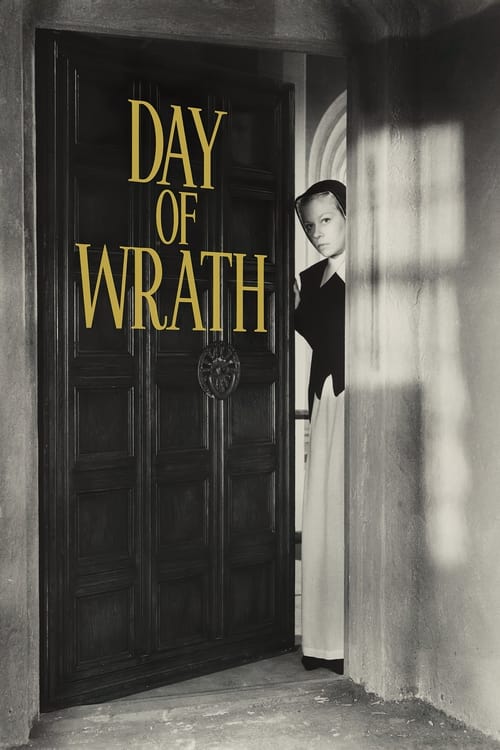
Day of Wrath
1943 · Carl Theodor Dreyer
For when you want a film to sit with and chew on — hushed, heavy, and hypnotic, best watched alone with the lights off and your phone in another room. A demanding watch that pays back every minute of patience.
What it's about
In a Danish village in the 1620s, a young woman named Anne is married to a much older pastor — a man whose intervention once spared her own mother from a witchcraft charge. When an old woman is accused and the parish closes ranks, and the pastor's grown son returns home and awakens something in Anne, the machinery of suspicion begins to turn toward her own house.
The experience
Slow, austere, and quietly suffocating — candlelit faces, long silences, and a dread that accumulates like weather. It doesn't shock you; it presses on you, and the pressure lingers for days.
Performances
Lisbeth Movin is extraordinary as Anne, letting desire, guilt, and defiance surface through a face the film studies like a portrait.
The craft
Dreyer composes every shot like a Danish old-master painting — deep blacks, slow gliding camera moves, faces lit by candle and hearth — and uses silence and hymn-singing as instruments of dread. It's filmmaking of total control, where a single camera movement carries more weight than most films' entire scores.
Why it matters
Made in occupied Denmark under German control, it was widely read as an allegory of persecution and conformity, and it restored Dreyer's career after a decade of silence — a landmark of stern, spiritual European cinema.
Snapshot
Day of Wrath (Danish: Vredens Dag) is Carl Theodor Dreyer's first sound feature in over a decade and the film that resurrected his directing career after the commercial failure of Vampyr (1932) and a long, painful drought. Adapted from Hans Wiers-Jenssen's Norwegian play Anne Pedersdotter (1908), itself founded on a documented sixteenth-century Bergen witch trial, the film transposes the action to a Danish parish in 1623 and follows Anne, the young second wife of the aging pastor Absalon, whose own mother was spared as a witch and who now watches an old woman, Herlofs Marte, burned for the same accusation. When Absalon's grown son Martin returns and Anne falls in love with him, the buried logic of persecution closes around her. Made and released in occupied Denmark under German control, the film is at once a chamber drama of guilt, desire, and conscience and an austere, slow-burning meditation on collective fear — a study of how a community manufactures and consumes its scapegoats. Its measured tempo, painterly chiaroscuro, and atmosphere of dread have made it a touchstone of art cinema and one of the defining works of Dreyer's late, contemplative style.
Industry & production
The production took place in Denmark in 1943, during the German occupation, and was produced by Palladium, a long-established Danish studio. After more than a decade in which Dreyer subsisted largely on journalism and could not secure backing for features — he had directed only short documentary work in the intervening years — Day of Wrath marked his return to fiction filmmaking. The circumstances were materially constrained: wartime occupation limited resources, and Dreyer's notoriously exacting, slow methods sat uneasily with commercial production schedules. The film was shot in studio interiors with a small, theatrically scaled cast, an economy of means that suited both the budget and the claustrophobic intimacy Dreyer sought.
The most frequently repeated element of the film's history concerns its political reception: with its narrative of innocent people denounced, interrogated, and executed by an authoritarian moral order, Day of Wrath was widely read as an allegory of the occupation and of life under surveillance and informers. Dreyer himself, in later remarks, tended to downplay any deliberate political intent, framing the work as a human and spiritual drama rather than a coded protest. What is documented is that not long after the film's premiere — which occurred in 1943 — Dreyer left for neutral Sweden, where he remained for a period during the war. The precise motives and chronology of that departure are sometimes blurred in popular accounts, and the strongest claim the record supports is that the film's atmosphere of persecution resonated unmistakably with audiences living under occupation, whatever the director's stated aims.
Commercially, the film was not a popular success on release, consistent with the difficult reception of much of Dreyer's work; its reputation was built slowly through later critical reappraisal.
Technology
Day of Wrath was produced on 35mm black-and-white film with synchronized optical sound, the standard professional apparatus of the period. Dreyer made no use of technological novelty for its own sake; his innovations were aesthetic rather than mechanical. The film relies on conventional studio lighting and camera equipment of the early 1940s, deployed with unusual patience. What distinguishes its technical realization is not new hardware but the disciplined manipulation of available tools — long takes that demanded precise coordination of camera movement, actor blocking, and lighting changes within a single shot. The deliberate, gliding camera movements for which the film is known required carefully laid tracks and dollies operated at a controlled, almost imperceptibly slow pace, a technically demanding feat of crew discipline rather than equipment. The high-contrast monochrome imagery depended on careful film stock exposure and the controlled placement of light sources to model faces and surfaces in the manner of Northern Renaissance painting.
Technique
Cinematography
The cinematography, by Karl Andersson, is the film's most celebrated formal achievement. Working in stark black and white, the film evokes the chiaroscuro of seventeenth-century Dutch and Flemish painting — faces emerging from darkness, white linen and pale skin set against deep shadow, compositions that recall Rembrandt and Vermeer in their distribution of light. Dreyer favors a grave, slow-moving camera: the frame drifts laterally across a scene, following or anticipating a figure's movement with a smoothness that lends even domestic interiors a processional solemnity. The pacing of these movements is famously unhurried, encouraging the eye to dwell. Faces are filmed in sustained close-up, often held longer than dramatic convention would dictate, so that the smallest shift of expression registers as event. The visual texture is austere and tactile: rough wood, woven cloth, the gnarled hands of the old, the smooth face of Anne. The overall effect is of stillness charged with tension, an image-world in which beauty and dread are inseparable.
Editing
The editing privileges duration over fragmentation. Where conventional drama would cut to accelerate, Dreyer holds. Scenes unfold in long, slow takes, and cuts tend to arrive only when a beat is fully consumed, giving the film its characteristic gravity and its reputation for "slowness." This is editing as restraint — a refusal of the reaction-shot rhythms of mainstream cinema in favor of a tempo that mirrors the weight of conscience and the inexorability of fate. The cumulative effect is hypnotic and oppressive, the formal equivalent of a tightening net.
Mise-en-scène / staging
Dreyer's staging is sculptural and frieze-like. Figures are arranged within shadowed interiors with a painter's attention to balance and negative space; the pastor's household, with its dark paneling, heavy furniture, and shafts of light, becomes a moral as well as physical enclosure. Costume and decor evoke the period with sober precision rather than spectacle — the black of clerical and matronly dress against the lighter tones of youth, the recurring iconography of crucifix, candle, and parchment. Bodies are blocked to express relations of power and suspicion: the looming presence of Absalon's mother Merete, the isolation of the accused, the charged proximity of Anne and Martin. The torture and burning of Herlofs Marte are staged with a restraint that makes their cruelty more, not less, harrowing.
Sound
Sound is used sparingly and pointedly. Dialogue is delivered slowly, in hushed, deliberate cadences that match the visual tempo. Silence is a structural element — the absence of sound deepens the sense of dread and concentration. The score, by Poul Schierbeck, draws on liturgical and choral textures; the Dies Irae — the medieval hymn of the Day of Judgment that gives the film its title — provides a thematic and sonic backbone, sounding the note of wrath and reckoning that hangs over the action. Ambient sound is subdued, keeping attention on voice, music, and the meaningful quiet between them.
Performance
Performance is pitched to a register of contained intensity. Lisbeth Movin as Anne carries the film's emotional arc from submissive stillness to awakened desire and finally to something like acceptance of her ascribed witch's identity, much of it conveyed through the face alone. Thorkild Roose plays Absalon as a man weighed down by guilt and tenderness, and Sigrid Neiiendam makes Merete, the domineering mother, a figure of rigid, judging authority. Anna Svierkier's Herlofs Marte gives the persecuted old woman a raw, terrified humanity in her interrogation scenes. Dreyer drew from his cast the slow, interiorized acting his style required — performances stripped of theatrical flourish, built on stillness, gaze, and the gradual surfacing of feeling.
Narrative & dramatic mode
The film operates in the mode of tragic, slow-burning melodrama elevated to the register of moral fable. Its structure is one of inexorability: a fate prepared in the opening — Anne's witch-mother, the precedent of the burning, the buried wish — works itself out with the logic of doom. The drama is built less on external incident than on the slow tightening of guilt and suspicion, with each act narrowing Anne's possibilities. Dreyer foregrounds ambiguity: the question of whether Anne in fact possesses uncanny power — whether her wish for Absalon's death is mere coincidence or something realized — is left deliberately unresolved, so that the film hovers between psychological realism and the suggestion of the supernatural. This refusal to adjudicate is central to its meaning: the community's belief in witchcraft becomes a self-fulfilling machinery, and the viewer is implicated in the very act of suspicion the film dramatizes. The dramatic mode is austere, ironic, and finally pitiless.
Genre & cycle
Day of Wrath belongs to several overlapping traditions: the historical costume drama, the literary stage adaptation, and the witch-persecution narrative. Within Dreyer's own work it forms part of an enduring preoccupation with faith, persecution, and female martyrdom that runs from The Passion of Joan of Arc (1928) through Vampyr and on to Ordet (1955). As a witch film it stands apart from the lurid or fantastical treatments common to the subject, treating witchcraft as a social and psychological phenomenon rather than horror spectacle, and in this it anticipates a later art-cinema lineage of sober historical reckonings with persecution. It is also a key entry in the broader cycle of mid-century European chamber dramas of conscience, and its example would feed into the slow, spiritually weighted cinema associated with Bergman and others.
Authorship & method
Day of Wrath is a quintessential auteur work, bearing Dreyer's signature in every formal choice. Dreyer (1889–1968) was by this point a director of fierce singularity, famous for his perfectionism, his refusal to compromise, and his long gaps between films. He co-wrote the screenplay, adapting Wiers-Jenssen's play with collaborators (the adaptation is credited to Dreyer with Poul Knudsen and Mogens Skot-Hansen), reshaping the stage material toward his own concerns with light, duration, and the suffering face. His method was meticulous and slow, devoted to controlling every element of the image.
His key collaborators served that vision. Cinematographer Karl Andersson realized the film's Rembrandtesque lighting and its grave, gliding camera. Composer Poul Schierbeck, a significant Danish composer, supplied the choral and liturgical score anchored in the Dies Irae. The performances of Lisbeth Movin, Thorkild Roose, Sigrid Neiiendam, and Anna Svierkier embodied Dreyer's demand for stillness and interiority. The result is a film of total stylistic integration, in which photography, sound, performance, and pacing converge on a single somber tone.
Movement / national cinema
The film is a landmark of Danish national cinema and, more broadly, of European art cinema. Denmark's film industry, which had flourished in the silent era through Nordisk Film, had a strong dramatic and literary tradition on which Dreyer drew. Yet Dreyer was always a somewhat solitary figure, not the product of a school or movement so much as a national institution unto himself, working at the margins of an industry that struggled to accommodate him. Produced during the occupation, Day of Wrath belongs to a wartime Danish cinema operating under constraint, and its international stature did much to consolidate Dreyer's place — alongside the silent masters — as one of the supreme figures of Scandinavian and world cinema. It stands as a bridge between the painterly Nordic visual tradition and the postwar European modernism it helped inspire.
Era / period
Made in 1943, the film is doubly historical: a work of the 1940s that looks back to the early seventeenth century. Its 1623 setting places it amid the great European witch-hunts, a period of intense religious anxiety in Protestant Northern Europe in which ecclesiastical authority, theology, and law combined to prosecute alleged witches. The film takes this history seriously, grounding its drama in the documents and rituals of accusation — the reading of charges, the application of torture to extract confession, the theological certainty of the judges. At the same time it is unmistakably a product of its own moment, its vision of denunciation and execution inseparable from the experience of occupied Europe. The two eras illuminate each other: the seventeenth-century apparatus of persecution becomes a mirror for the twentieth.
Themes
The film's central theme is persecution and the social production of the scapegoat — the way a community's fear, guilt, and desire are projected onto the vulnerable and then destroyed. Closely bound to this is the theme of guilt and conscience: Absalon's remorse over having once spared Anne's mother to win Anne, Anne's awakening to desire and her half-wished, possibly realized, will toward her husband's death. The film probes the ambiguous boundary between psychological causation and the supernatural, leaving open whether witchcraft is real or wholly a construction of belief — and showing how belief itself becomes lethal. Repression and awakening desire run through Anne's arc, as does the conflict between youth and age, life and a death-bound moral order. Religion appears as both consolation and instrument of cruelty, the Dies Irae sounding judgment over all. Underlying everything is fate: the sense that Anne is condemned in advance by her lineage and her community's need to believe in her guilt.
Reception, canon & influence
On its 1943 release the film was not a commercial success, and contemporary reception in occupied Denmark was complicated by wartime conditions and by the film's demanding austerity. Its reputation grew substantially in the postwar decades as Dreyer's stature was reassessed internationally, and Day of Wrath came to be regarded as one of his masterpieces and a canonical work of art cinema, regularly cited among the greatest films and preserved as a classic of the form.
Looking backward, the influences on the film are clear. Its literary source is Wiers-Jenssen's play, rooted in real Scandinavian witch-trial history. Its visual language draws openly on Northern European painting — the chiaroscuro of Rembrandt and the domestic luminosity of the Dutch masters. It extends concerns visible across Dreyer's own earlier work, above all The Passion of Joan of Arc, with its martyred woman and its devotion to the face, and the dread-soaked atmospherics of Vampyr.
Looking forward, the film's influence has been profound, particularly on the tradition of slow, spiritually serious European cinema. It is frequently linked to Ingmar Bergman, whose chamber dramas of faith, guilt, and persecution — and whose own witch-and-plague historical works — share much of Dreyer's gravity. More broadly, Dreyer's example of duration, restraint, and the close study of the human face fed into the "transcendental" or contemplative strain of art cinema that later critics traced through directors who prize stillness and spiritual weight over incident. As a treatment of witch-hunting that locates horror in social psychology rather than spectacle, it stands as an ancestor of later, soberer historical films about persecution and collective fear. Within Dreyer's career it secured the path to Ordet and Gertrud, completing the portrait of one of cinema's most uncompromising artists.
A Deleuzian reading
Watch how long Dreyer holds Anne's face.
The full Deleuzian reading of Day of Wrath →
Reception
Released in occupied Denmark in 1943 to a cool, baffled reception — too slow, too grim — it was rediscovered after the war abroad and steadily climbed to its current status as one of Dreyer's unassailable masterpieces.
How Day of Wrath was received, from release to now →
Influences: the films it descends from and the films it influenced
- The Passion of Joan of Arc (1928) — Dreyer's own template of the sustained, near-abstract close-up of a martyred woman's face as the primary dramatic event, carried directly into Anne's interrogation and Herlofs Marte's trial.
- Vampyr (1932) — The slow gliding camera and diffused, dread-soaked gray light Dreyer developed here become Day of Wrath's grave, drifting tracking shots through shadowed interiors.
- Häxan (1922) — The Danish dramatization of witch-trial torture, confession-under-duress and the accused old woman — the national witch-persecution iconography Dreyer strips of spectacle and re-grounds in social psychology.
- The Phantom Carriage (1921) — Pioneered the slow-paced Scandinavian drama of conscience and moral reckoning rendered in painterly chiaroscuro, the Nordic gravity Dreyer inherits.
- Faust (1926) — Modeled faces and bodies emerging from darkness in Northern-painting chiaroscuro, the expressionist light source behind the film's Rembrandt lighting.
- Sunrise (1927) — The 'unchained' camera gliding continuously through deep space — the moving-camera grammar Karl Andersson translates into Day of Wrath's slow lateral tracks.
- Ordet (1955) — Extends the frieze-like blocking, extended takes and slow lateral tracking into another austere drama of faith and miracle within the bare farmhouse interior.
- Gertrud (1964) — Pushes interiorized acting, averted gazes and static frieze-like two-shots held in very long takes to their furthest extreme.
- Diary of a Country Priest (1951) — Codifies the transcendental restraint Dreyer modeled — flattened affect, withheld performance and spiritual weight built through duration rather than incident.
- The Trial of Joan of Arc (1962) — A pared-down interrogation drama of a condemned woman built from the face and the spoken word, distilling the Joan/Anne tribunal scene to its essence.
- The Seventh Seal (1957) — Renders medieval persecution and a witch-burning as social and spiritual dread rather than horror spectacle, isolating the suffering face against blank ground in Dreyer's manner.
- The Virgin Spring (1960) — An austere historical moral drama using frieze-like staging and diegetic silence to locate guilt and divine reckoning in stillness.
- Andrei Rublev (1966) — Carries the contemplative duration and spiritual gravity of Dreyer's example into a medieval-religious slow cinema where time and the burdened face do the dramatic work.
- The Witch (2015) — Locates witch-hunt horror in Puritan social psychology and inherited guilt, using natural Northern-painting light and period austerity exactly as Dreyer refused supernatural spectacle.
- Witchfinder General (1968) — Grounds its witch-persecution drama in human cruelty, scapegoating and collective fear rather than the occult, the soberer historical horror Day of Wrath anticipates.
- Werckmeister Harmonies (2000) — Extends Dreyer's duration and gliding camera into hypnotic long takes that render collective hysteria and dread through stillness and chiaroscuro.
- Through a Glass Darkly (1961) — Dreyer's controlled interior window light in Nordic spaces and his slow-cut rhythm that refuses to resolve a performance before it has exhausted itself models the Bergman-Nykvist approach to naturalistic chiaroscuro and the editorial restraint of Through a Glass Darkly.
- The Magician (1958) — Dreyer's staging of the inquisition as slow theatrical performance — where institutional power operates as formal ritual and both accuser and accused perform scripted roles — directly informs the Socratic structure of Vergerus's examination of Vogler: the interrogation as theater in which neither party fully controls the stakes.
- Winter Light (1963) — A chamber drama of faith, guilt and God's silence shot in long quiet takes and gray diffused light, extending Dreyer's study of conscience and the close-studied face.
- Dogville (2003) — Dreyer's austere Scandinavian moral-trial cinema — a persecuted woman tested to destruction by a closed pious community — is the national-ancestral mode von Trier inherits and abstracts.
- Caravaggio (1986) — Dreyer lights interiors after Dutch/Flemish painting, modeling faces in pools of darkness — the cinematographic tenebrism Gabriel Beristain realizes for Jarman.
- Antichrist (2009) — Dreyer's slow, oppressive Lutheran study of witch persecution and the demonization of female desire is the historical 'gynocide' that She researches and internalizes in the cabin's attic.
Similar films
- Ordet (1955) — influence & lineage
- The Passion of Joan of Arc (1928) — influence & lineage
- Gertrud (1964) — influence & lineage
- Winter Light (1963) — influence & lineage
- Vampyr (1932) — influence & lineage
- The Virgin Spring (1960) — influence & lineage
- The Seventh Seal (1957) — influence & lineage
- Häxan (1922) — influence & lineage
All the films related to Day of Wrath →